

If you’re evaluating warehouse management systems for your 3PL operation, you’ve likely encountered Mintsoft och Snapfulfil. Both are popular cloud-based platforms with strong track records in the UK and US markets. But which is better for your operation? And more importantly, is either truly built for the complexity of multi-client, multi-warehouse management?
This guide compares Mintsoft and Snapfulfil head-to-head across the dimensions that matter most to 3PLs, then introduces Clarus WMS as a purpose-built 3PL alternative that eliminates the compromise.
Quick verdict: Who each system is best for
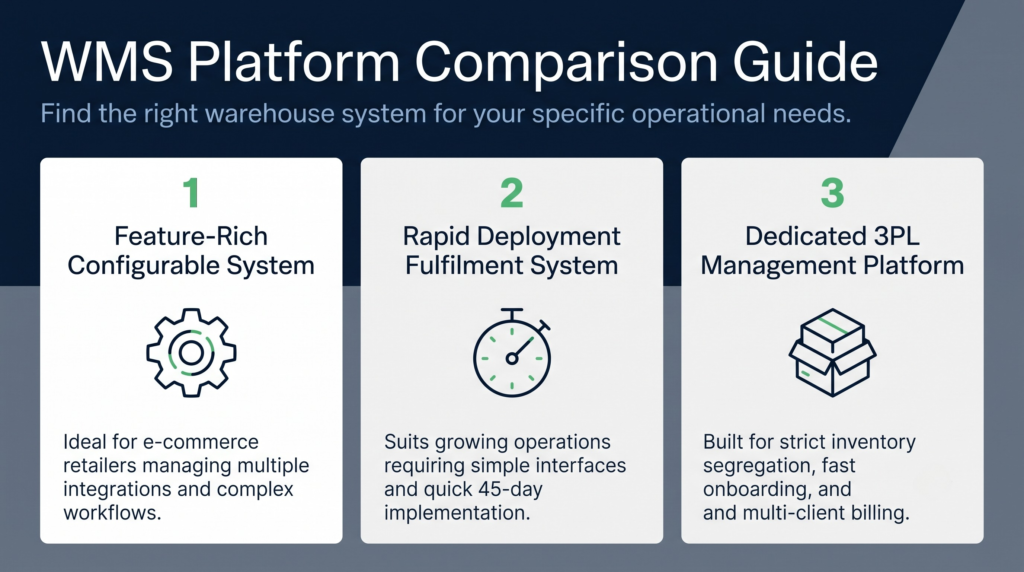
Mintsoft is ideal for mid-market 3PLs and e-commerce retailers who want a feature-rich system with solid integrations and don’t mind configuring workflows to fit their operation. It handles multi-client scenarios reasonably well but requires more manual setup.
Snapfulfil suits growing distribution operations and fulfilment houses that prioritise rapid implementation (45-day deployment) and a simpler interface, though at the cost of customisation flexibility.
Clarus WMS is purpose-built for 3PLs where multi-client billing, inventory segregation, and fast onboarding are non-negotiable. If invoicing speed and client portal visibility matter more than legacy system integration, Clarus is the natural fit.
Side-by-side comparison table
| Funktion | Mintsoft | Snapfulfil | Clarus WMS |
|---|---|---|---|
| Contract term | Not publicly stated (typically 12–24 months) | Not publicly stated (typically 12+ months) | Monthly rolling, no lock-in |
| Multi-client stock segregation | Yes, core feature | Limited; more suited to single-client operations | Yes, fully isolated per client |
| Automatiserad fakturering för tredjepartslogistik | Yes, with per-client rate cards and manual invoicing | No; not positioned as a billing engine | Yes; real-time, task-level billing capture |
| Client portal | Yes, optional add-on; white-labelable | Limited; not a core feature | Yes, included standard; white-labelable |
| Wave picking / pick optimisation | Yes, with batch processing | Yes, with route optimisation | Yes, Smart Wave Picking (claimed 50% travel reduction) |
| Integrations out-of-the-box | 131+ standard integrations (Shopify, Amazon, Sage, etc.) | Not publicly detailed; likely 50–100 | 200+ out-of-the-box integrations (Shopify, Amazon, Sage, DHL, etc.) |
| Implementation speed | 8–12 weeks typical | 45 days (fastest of the three) | 2–6 weeks (cloud-native, no server setup) |
| On-premise option | No (cloud-only) | No (cloud-only) | No (cloud-native, serverless) |
| Scan verification accuracy | Yes, barcode-to-order matching | Yes, included | Yes, real-time; claimed 99.9% accuracy |
| Support response time | Not publicly stated (enterprise plans vary) | Praised as exceptional (on-site during implementation) | Sub-5-minute response time |
What is Mintsoft and who it’s for
Mintsoft is a cloud-based order and warehouse management system designed for 3PLs, fulfilment houses, and multi-channel retailers. It’s been in the market for over a decade and integrates inventory control, order management, and shipping into one unified platform.
Key strengths:
- Robust 3PL capabilities: Multi-client management, client portal, white-labelling, and 3PL-specific fakturering module are core to the platform.
- Extensive integrations: 131+ out-of-the-box connectors to e-commerce platforms (Shopify, WooCommerce, Amazon, eBay), ERPs (Sage 200, Microsoft Dynamics), and carriers.
- Flexible configuration: Highly customisable workflows and rules engine allow you to tailor picking, packing, and billing to your operation.
- Mobile app: Native streckkodsläsning application with real-time inventory updates from warehouse floor.
- Established market presence: Long track record with UK and US 3PLs; mature feature set.
Known limitations:
- Manual invoicing: While Mintsoft captures billable events, invoicing typically requires manual review and approval — not fully automated like modern 3PL-first systems.
- Implementation time: Typical go-live is 8–12 weeks due to the complexity of configuring multi-client workflows and integration points.
- Contract terms: Long-term commitments typical; monthly rolling option not standard.
Difference from Snapfulfil: Mintsoft is built with 3PL complexity in mind from day one, multi-client billing, client-specific rules, and reporting are central. Snapfulfil, by contrast, is optimised for single-client or simpler multi-tenant scenarios and doesn’t emphasise the billing automation that 3PLs need.
What is Snapfulfil and who it’s for
Snapfulfil is a cloud-based warehouse management system delivered by Synergy Logistics, a Colorado-based company. It serves distribution operations, fulfilment houses, and growing logistics businesses across multiple industries.
Key strengths:
- Snabb implementering: 45-day deployment is the fastest among the three systems, with Synergy’s team handling heavy lifting during onboarding.
- Enterprise functionality at mid-market price: Users report it delivers “Tier 1 functionality without enterprise cost,” with features like dock management, mobile scanning, and order automation out of the box.
- Excellent onboarding support: Customer reviews consistently mention on-site support during implementation and exceptional responsiveness from Synergy.
- Simplicity of interface: Compared to legacy WMS platforms, Snapfulfil is praised as intuitive and easy to train teams on.
- Flexibility for growth: Licensing model allows you to add seats during peak seasons and scale back — pay only for what you use.
Known limitations:
- Limited 3PL focus: Snapfulfil is not positioned as a multi-client billing system. If you need sophisticated per-client rate cards, invoicing automation, and client segregation, Snapfulfil requires workarounds.
- Customisation constraints: Users report frustration with limited ability to adapt the software to bespoke warehouse processes, you’re using Snapfulfil’s way, not your way.
- User experience gaps: Despite being “easy to train,” some users find the interface clunky and non-intuitive for power users managing complex operations.
- Support variability: While implementation support is exceptional, post-go-live support has been reported as slow or unhelpful by some users, creating frustration.
Difference from Mintsoft: Snapfulfil prioritises speed and simplicity over configurability. If you want a system you can go live with in 45 days and don’t need deep 3PL billing integration, Snapfulfil wins. But Mintsoft’s multi-client architecture is more purpose-built for the complexity of managing multiple client accounts within one warehouse.
Feature-by-feature comparison: The critical dimensions
Multi-client inventory segregation
What is the difference between Mintsoft and Snapfulfil? Mintsoft treats multi-client management as a core design principle — each client’s inventory, workflows, and reporting are isolated by default. Snapfulfil, by contrast, is designed primarily for single-client operations and does not natively segregate stock by client. This is a critical gap for 3PLs.
Clarus approach: Clarus WMS builds multi-client segregation into the foundation of the system. Every warehouse location, stock move, and billing event is tracked at the client level without exception. This prevents the cross-client contamination risks common when retrofitting single-client systems to handle multiple customers.
Automatiserad fakturering för tredjepartslogistik
Mintsoft includes a 3PL billing module that captures events like storage, handling, and shipping per client. However, invoicing typically requires configurable automation and approval. This creates a bottleneck, a 3PL with 20+ clients may spend half a day each month reconciling invoices.
Snapfulfil does not emphasise billing functionality; it’s not positioned as a 3PL billing system.
Clarus captures every billable event in real time — receiving, putaway, storage, pick, pack, despatch, returns, and value-added services — automatically. St John’s Hall Storage reduced their invoicing from four hours to twenty minutes after switching to Clarus. Another customer, MSD (Mitchell Storage & Distribution), reduced admin workload by 60% by eliminating manual billing reconciliation entirely.
Client portal and self-service
Mintsoft: Includes a client portal with stock visibility, order tracking, and reporting. White-labelable and available as an optional add-on.
Snapfulfil: Limited self-service features; not a focus of the platform.
Clarus: White-labelable client portal is included standard, covering real-time stock levels, order status, shipment tracking, and billing summaries. No additional cost, no licence seats required. This eliminates the back-and-forth of clients phoning or emailing asking “what’s my stock level?”
Wave picking and route optimisation
All three systems offer automated picking workflow.
Mintsoft uses batch processing with configurable wave rules (by client, by carrier, by time window).
Snapfulfil includes route optimisation to minimise picker travel distance.
Clarus uses Smart Wave Picking, which batches orders automatically and optimises walking paths — customers report 50% travel time reduction compared to manual picking.
For a warehouse picking 500 orders per day, a 50% reduction in picker travel translates to real productivity gains. This is where purpose-built systems shine over retrofitted solutions.
Integrations and connectivity
Mintsoft: 131+ out-of-the-box integrations, including Shopify, Amazon, WooCommerce, Sage, Microsoft Dynamics, and 70+ carriers.
Snapfulfil: Specific integration count not publicly stated, but likely 50–100 based on industry benchmarks.
Clarus: 200+ out-of-the-box integrationer. Additionally, Clarus exposes an MCP server, allowing AI tools like Claude and ChatGPT to query live warehouse data directly — a capability unique among 3PL WMS systems in the UK market.
Implementation speed and deployment
Snapfulfil is fastest at 45 days. This is because the platform is rigid, you’re not customising much, so onboarding is standardised.
Mintsoft typically takes 8–12 weeks due to the complexity of configuring multi-client workflows, integration mappings, and custom billing rules.
Clarus averages 2–6 weeks because it’s cloud-native and serverless, no infrastructure setup, no version management. The multi-client architecture is already built in, so you’re not configuring from scratch; you’re populating client data and mapping integrations. This speed advantage compounds over time; the months you save in implementation are months you start billing clients sooner.
Onboarding and time-to-value: Implementation matters
Snapfulfil’s 45-day promise is real and attractive. Synergy’s playbook is polished; implementation is relatively plug-and-play.
Mintsoft’s 8–12 weeks reflects the real complexity of mapping multi-client workflows and integrations. For a 3PL managing 5+ different customer types, this timeline is realistic.
Clarus’s 2–6 week average is enabled by architecture. Because multi-client is native (not bolted on), you’re not rebuilding the system — you’re configuring data and connections. Most Clarus go-lives happen in 3–4 weeks. Your team is productive and invoicing by week 4, not week 12.
Strengths and limitations: The honest picture
Mintsoft’s real wins and weaknesses
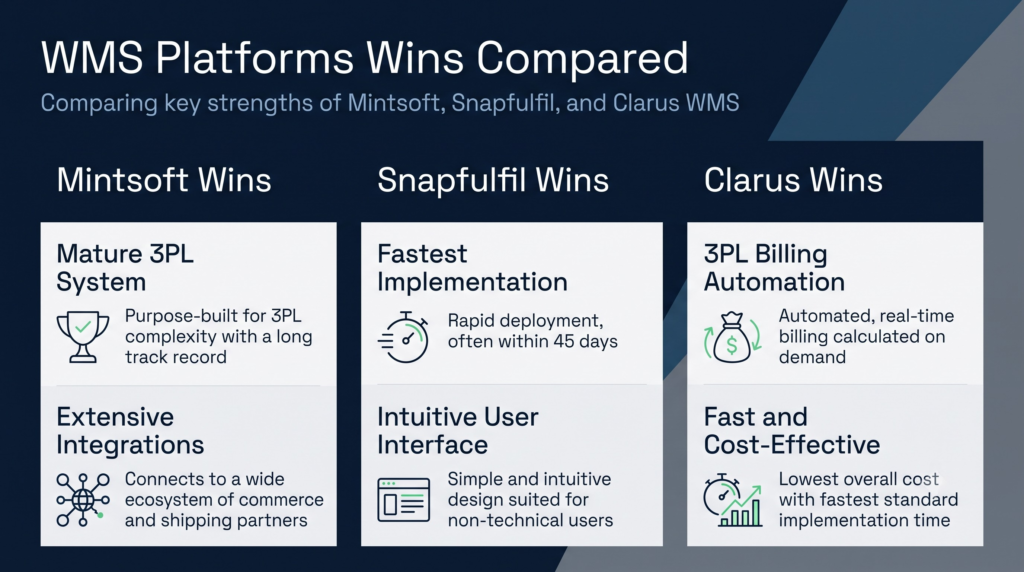
Wins: Purpose-built for 3PL complexity, extensive integrations, mature product with a long track record.
Svagheter: Manual invoicing approval still required; long implementation; pricing not transparent; long-term lock-in; configuration overhead means your success depends on good consulting support.
Snapfulfil’s real wins and weaknesses
Wins: Fastest implementation (45 days), excellent onboarding support, enterprise features at mid-market price, intuitive for non-technical users.
Svagheter: Not built for 3PL multi-client scenarios; limited customisation; post-implementation support variable; highest monthly cost of the three; better suited to single-client distribution than multi-client 3PL.
Clarus’s real wins and weaknesses
Wins: Purpose-built for 3PL, automated real-time billing, fastest implementation, lowest cost, monthly rolling contract (no switching cost), included client portal, sub-5-minute support response, cloud-native (always latest release, no version management).
Svagheter: Newer to the market than Mintsoft or Snapfulfil (though operating since 2015); smaller team (35+ employees vs. larger competitors); if you need deep ERP integration (SAP, Oracle), you may need custom development; not ideal for single-warehouse retail operations — it’s built for the 3PL and multi-warehouse use case.
Which to choose by business type and size
Choose Mintsoft if: You’re a mid-to-large 3PL with 5+ warehouses and 20+ clients, and you have the budget for a 12-week implementation and long-term contract commitment. You’re willing to do manual invoicing review in exchange for configurability. You heavily depend on custom Shopify or WooCommerce integrations.
Choose Snapfulfil if: You’re a growing distribution centre or fulfilment house with 1–3 warehouses, mostly single-client work, and you need to go live in under 8 weeks. You’re comfortable with less customisation in exchange for speed and simplicity. You value on-site implementation support.
Choose Clarus WMS if: You’re a 3PL or multi-warehouse operation where invoicing speed, client visibility, and billing automation matter more than legacy system integration. You want the lowest cost with zero switching risk (monthly rolling contract). You want to go live in 2–6 weeks and start invoicing your clients automatically. You manage 10+ users across multiple warehouses or multiple client accounts.
Which is the best 3PL warehouse management system? Clarus is purpose-built specifically for 3PL operations from the ground up — multi-client billing, inventory segregation, and client portal are core, not add-ons. If your core need is to manage multiple clients efficiently, segregate stock accurately, and automate invoicing, Clarus beats both Mintsoft and Snapfulfil on that specific mission.
Clarus WMS as the purpose-built 3PL alternative
Both Mintsoft and Snapfulfil are solid platforms, but neither was born from the frustration of running a 3PL. Clarus was.
Clarus emerged from the realisation that legacy WMS systems, and even newer systems like Mintsoft and Snapfulfil — force 3PLs to accept compromise. You either get a system designed for single clients that you retrofit for multi-client (Snapfulfil), or you get a system with 3PL features bolted on top of an ERP mindset (Mintsoft). Neither truly makes the 3PL billing and inventory segregation problem frictionless.
Clarus solves this by building the warehouse management problem from the 3PL perspective. Multi-client stock segregation isn’t a feature; it’s the foundation. Real-time billing isn’t a module; it’s how the system thinks. The client portal isn’t an add-on; it’s included standard.
The proof is in the outcomes. JODA Freight brought stock accuracy from the low 90s to 99%. KATEM Logistik scaled picking volumes 10x after switching. Interspan reduced reporting time by 90% by eliminating manual reconciliation between their old system and their accounting software.
This isn’t marketing speak, it’s the natural outcome of a system built for 3PL from day one.
Additionally, Clarus offers pricing clarity and contractual flexibility that Mintsoft and Snapfulfil don’t. You know the cost upfront. There’s no long-term lock-in. If it’s not working after three months, you leave. This shifts risk back where it belongs, on the vendor to keep you happy, rather than locking you into a two-year contract and hoping it works out.
Making the switch from Mintsoft or Snapfulfil to Clarus
If you’re running Mintsoft or Snapfulfil today and considering a move, here’s what to expect:
- Dataöverföring: Clarus handles all historical stock, client, and transaction data. Plan for 1–2 weeks of data preparation and validation.
- Parallel run: Most migrations run 2–4 weeks in parallel (both systems live) to ensure no billing or stock accuracy gaps.
- Timeline to live: 3–6 weeks from contract to full go-live, depending on warehouse complexity.
- Support during cutover: Clarus’s sub-5-minute support SLA applies during cutover, your team isn’t alone.
- No switching penalty: If you later decide Clarus isn’t right, you’re on a monthly rolling contract. You can leave, no penalty.
Tala med en lagerarbetare
If you’re evaluating your options and want to see how a purpose-built WMS works in practice, Clarus is worth a conversation. We work with 3PLs and distributors across the UK to implement warehouse management software that fits the way you operate, not the other way around.
Kom i kontakt med vårt team att diskutera dina krav.