

Warehouse management systems have become the backbone of modern logistics. Whether you run a three-person fulfilment operation or a sprawling 3PL with dosens of client accounts, the right WMS software can transform how you move inventory, charge your customers, and scale without adding headcount. But finding the best WMS for UK operations means understanding what actually matters in your sector. Not picking whatever ranks highest online.
This guide walks you through the landscape of warehouse management systems available to UK businesses in 2026, cuts through the noise, and shows you how to make a decision that fits your operation.
What makes a WMS “best” for UK warehouses?
There’s no single best WMS. What works for a food distributor with strict traceability demands won’t work for an e-commerce fulfilment house, and neither will work well for a traditional 3PL juggling a hundred client billing rules.
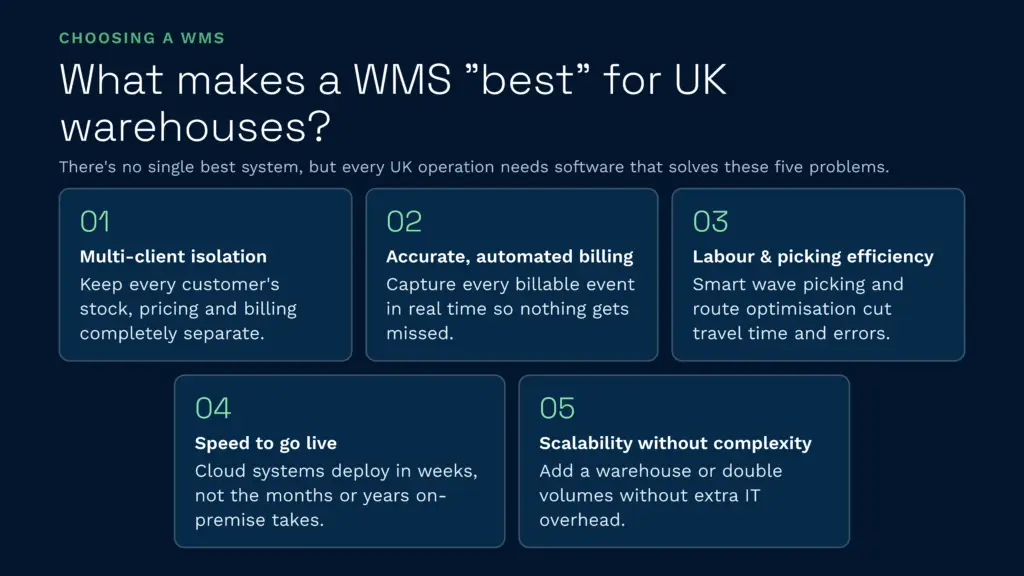
A best-fit WMS for UK operations must solve these core problems:
- Multi-client isolation: If you hold stock for multiple customers, your software must keep their inventory absolutely separate.different pricing rules, different visibility, different billing.
- Accurate, automated billing: 3PLs lose money to billing leakage. You need real-time capture of every billable event.receiving, storage, plockning, packning, leverans, returns.so you can invoice with confidence.
- Labour and picking efficiency: Pickers are your biggest operational cost. Smart wave picking, route optimisation, and scan verification cut travel time and errors.
- Speed to go live: Cloud systems deploy in weeks; on-premise takes months or years. Speed-to-value matters when you’re competing.
- Scalability without complexity: You need to add a new warehouse or double picking volumes without rearchitecting the system or hiring extra IT staff.
The UK WMS market: what’s available in 2026
The UK warehouse management market has split into clear tiers. At the top are enterprise platforms like Manhattan Active WMS, which dominate large-scale operations but carry enterprise pricing and timelines to match. In the mid-market, you’ll find purpose-built solutions designed specifically for 3PLs, food & beverage, and distribution.firms like Mintsoft, Snapfulfil, and Clarus.
Below that are SME tools and order-management-system-turned-WMS platforms that work for simple, single-client operations but struggle under complexity. The distinction matters: a system that handles one warehouse and one client brilliantly becomes a nightmare when you add a second client or a second location.
Cloud deployment is now the market default. According to recent analysis, cloud-based WMS platforms hold the largest revenue share in the market and grow at 22.6% annually.faster than the overall WMS market. Most UK operations launching a fresh WMS evaluation in 2026 default to cloud unless there are specific data sovereignty or legacy integration reasons otherwise.
Cloud vs on-premise WMS for UK businesses
The cloud-versus-on-premise decision shapes everything: your initial cost, implementation timeline, ongoing support burden, and ability to scale.
Cloud WMS.the modern default
Cloud systems run on the vendor’s servers, deploy in 4-12 weeks, and cost £1000 to £2,000 per month for mid-market UK operations. You get automatic updates, security patches, and support built in. When you need to add a new warehouse or scale picking volumes, you don’t need to buy new hardware or negotiate with your IT team.the system flexes within days.
The vendor manages availability, disaster recovery, and compliance. For 3PLs and distributors, this means zero downtime worries and faster time-to-revenue when you on-board a new client.
On-premise WMS.control at a cost
On-premise systems sit on your servers, carry upfront licence costs of £50,000 to £500,000+, and require your team to manage updates, backups, and security. Implementation timelines stretch to 6-18 months because you’re configuring bespoke workflows and migrating legacy data. Annual maintenance fees run 15-20% of the licence value.
You get local data control and deep customisation options. For most mid-market UK operations, the total cost of ownership over 3-5 years is 30-40% higher than cloud.and that’s before counting the internal IT burden.
Over a 3-5 year period, SaaS solutions are usually 30-40% more cost-effective than on-premise systems for small and mid-sized businesses.
Key WMS features UK warehouses actually need
Feature lists on vendor websites are long. The ones that matter depend on your operation. Here are the features that move the needle.
Multi-client inventory management
If you hold stock for more than one customer, this is non-negotiable. Your WMS must segregate inventory by client, provide each client with separate reporting and visibility, and prevent any mixing or cross-contamination. Each client should see only their own stock levels, locations, and movements.
Generic WMS platforms treat all clients the same. A purpose-built WMS for multi-client operations makes client segregation foundational.not bolted on.
Automated billing engine
3PLs live by accurate, timely invoicing. A robust WMS captures every billable event in real time.receiving, storage movements, picks, packs, despatch, returns, value-added services.without manual counting or month-end reconciliation. This alone can cut billing admin by 60% or more.
St John’s Hall Storage, a 3PL operator, saw their invoicing time drop from four hours to twenty minutes after switching to a WMS with a built-in billing engine. That’s not a rounding error for their team; it’s back-of-house labour freed up for other work.
Client self-service portal
If you manage dosens of clients, they’ll call asking for stock levels, order status, or shipping updates. A self-service portal with real-time data stops the phone from ringing and lets your team focus on operations. Look for white-labelable portals so clients see your branding, not the software vendor’s.
Smart wave picking and route optimisation
Picking is the largest labour cost in most warehouses. Smart wave picking batches orders intelligently and calculates optimal walking paths through the warehouse. The result: travel time can drop by 50% or more compared to manual pick lists. Paired with barcode scan verification at every step, accuracy climbs to 99.9%.
FIFO, LIFO, and FEFO rotation logic
Different industries need different stock rotation. Food & beverage needs FEFO (First Expiry First Out) to prevent dated stock from being despatch. Automotive and general distribution often need FIFO (First In First Out). Your WMS should let you configure rotation rules per client or per product, not force one rule across the board.
For food operations especially, the cost of a recall or non-compliance issue far exceeds the cost of a WMS. FEFO control and rapid recall capability matter.
Full audit trail and serialisation
You need to know who did what, when, and to which stock. This matters for compliance (BRC, HACCP, retailer codes of practice), for dispute resolution with clients, and for root-cause analysis when something goes wrong. Serial number tracking, batch/lot control, and expiry date management round out the picture for regulated industries.
API-first architecture and 3rd-party integrations
Your WMS won’t live in isolation. It needs to talk to your ecommerce platform (Shopify, WooCommerce, Amazon, eBay), your carrier (DHL, UPS, Parcelforce, DPD, Evri), your ERP, and your clients’ systems. Out-of-the-box integrations accelerate go-live; API-first design lets you build custom connections without vendor professional services.
WMS pricing in the UK: what to budget
WMS pricing varies wildly by vendor and deployment model. Understanding the total cost of ownership helps you make a fair comparison.
Cloud WMS subscription costs
Cloud platforms typically range from £100-£300 per month for small operations (basic packages handling low order volumes), £325-£629 per month for medium operations (up to 15,000 orders per month), and £1,500-£2,500+ per month for enterprise cloud deployments with dedicated support and customisation.
Clarus, a cloud WMS built for 3PLs and distributors, starts from £1,000 per month on monthly rolling contracts.no lock-in, no surprise annual fees. What’s included: unlimited users, cloud hosting, 99% uptime SLA, real-time billing automation, and client portals.
On-premise WMS licensing
On-premise systems cost £50,000 to £500,000+ in upfront licensing, plus 15-20% annual maintenance. A mid-market implementation adds another £10,000 to £60,000 for implementation services, data migration, and configuration.
Hidden costs in any WMS
Software cost is only part of the picture. Budget for:
- Hårdvara Handheld scanners, label printers, mobile devices. A small warehouse might spend £5,000-£15,000; a large operation £50,000+.
- Implementation and data migration: Moving your master data, product catalogue, and historical transactions to the new system is harder than it sounds. Budget £10,000-£60,000 depending on data complexity.
- Training and change management: Your team needs to learn the new system. Training can range from £1,000 to £10,000 depending on headcount and complexity.
- Integration and customisation: If you need bespoke workflows or custom integrations, that adds cost and timeline. Cloud systems with strong APIs and pre-built integrations keep this lower than on-premise.
Over a 3-5 year total cost of ownership, cloud WMS solutions are typically 30-40% cheaper than on-premise for small and mid-sized UK operations.
The best WMS for different UK sectors
Needs vary dramatically by industry. Here’s what matters in each.
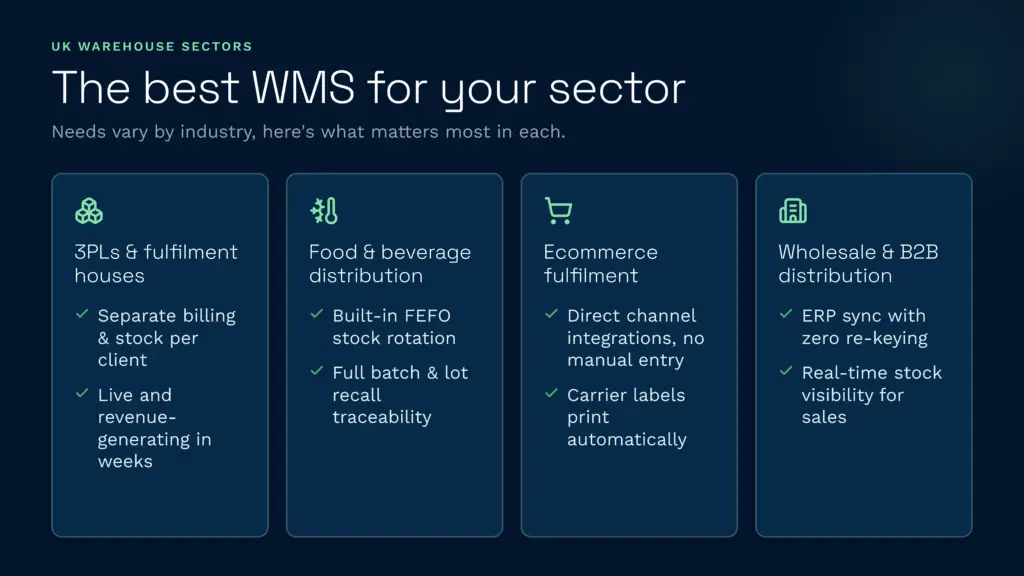
Best WMS for 3PLs and fulfilment houses
3PLs are the toughest sector to serve because they need everything: multi-client isolation, automated billing, carrier integrations, client visibility, and speed to scale. A purpose-built 3PL WMS is essential.retrofitting a single-client system onto multi-client operations is expensive and fragile.
Look for:
- Multi-client inventory and billing completely separate for each customer
- Automated event capture (receiving, storage, picking, packing, despatch) to feed billing
- Client portals so customers can see their stock and orders without calling
- Integrationer with Shopify, Amazon, eBay, and 70+ carriers
- Fast implementation.you need to be revenue-generating within weeks, not months
Clarus is built for this exact use case. JODA Frakt, a UK 3PL, took stock accuracy from the low 90s to 99% after switching. KATEM Logistik scaled picking volumes 10-fold without adding proportional headcount. Those aren’t isolated wins.they’re patterns that repeat across 3PL clients because the software was designed for 3PL complexity, not retrofitted to it.
Best WMS for food & beverage distribution
Food and beverage warehouses face compliance pressure that other sectors don’t. Retailers, food standards bodies, and the law demand rapid recall capability, full traceability, and proof of FEFO compliance.
Look for:
- FEFO (First Expiry First Out) as a built-in rotation rule, not a feature you have to request
- Expiry date, best-before, and sell-by tracking on every line
- Serial number and batch/lot control for full recall capability
- BRC-readiness (audit trail, documented procedures, traceability records)
- Temperature zone management if you hold ambient, chilled, and frozen stock
Familjen Campeys från Selby, a food distributor, achieved sub-5-minute product recalls and secured BRC Double-A accreditation after deploying a WMS with strong traceability and FEFO controls. The cost of a recall without that capability would have far exceeded the WMS licence.
Best WMS for ecommerce and order fulfilment
Ecommerce operations live by picking speed and accuracy. You need tight integration with your sales channels (Shopify, WooCommerce, Amazon, eBay), carrier APIs for real-time shipping label generation, and simple, repeatable workflows for pickers.
Look for:
- Native integrations with your ecommerce platform.no manual order entry
- Carrier API integrations so shipping labels print automatically
- Simple, scannable workflows that work for high-volume, low-complexity picking
- Wave picking and batch logic to optimise picking paths
- Returns management so you can restock and re-sell quickly
Best WMS for wholesale and B2B distribution
B2B distribution operations often sit between an ERP system (Sage, Microsoft Dynamics) and a customer base with EDI requirements or just phone/email orders. Your WMS needs to bridge that gap without creating duplicate data entry.
Look for:
- ERP integration so order data flows automatically (no re-keying)
- EDI capabilities if your customers require it (retailers, large accounts)
- Real-time inventory visibility so you can confirm stock availability to sales immediately
- Replenishment logic so your team knows when to reorder from suppliers
- Client-specific picking and packing rules (different labels, different carton sizes, etc.)
Interspan, a distribution operation, cut their reporting time by 90% and eliminated the spreadsheet-based inventory workarounds they’d relied on for years.
How to choose the right WMS: a practical framework
Vendor comparisons and feature lists only get you so far. Here’s a clearer way to decide.
Define your must-haves
Start with non-negotiables. If you run multiple client accounts, multi-client inventory management is non-negotiable. If you’re food & beverage, FEFO is non-negotiable. If you’re a startup, speed-to-go-live is non-negotiable. If you’re enterprise, integration depth is non-negotiable.
Separate must-haves from nice-to-haves. Features that would be nice but aren’t deal-breakers get evaluated later.
Test the system hands-on
Demo videos are one thing; actually picking an order in the software is another. Request a live or sandbox demo where you can walk through your core workflows.receiving a shipment, putting away inventory, picking an order, packing and despatch, generating an invoice. See if the system’s logic matches your operation or forces you to change how you work.
Check integration reality
Vendors say “we integrate with 200+ platforms,” but what matters is whether you can connect to your specific systems.your ecommerce channel, your carriers, your ERP.without custom development. Ask to see the integration docs and ask whether a data transfer test is possible before you commit.
Understand the implementation timeline
Cloud WMS platforms typically implement in 4-12 weeks. If a vendor is quoting 6-9 months for a cloud system, ask why. Implementation delay costs money and pushes your go-live back. With cloud systems, go-live should be measured in weeks, not quarters.
Talk to existing customers in your sector
Ask the vendor for references in your industry.a 3PL if you’re a 3PL, a food distributor if you’re mat och dryck. Call them and ask what surprised them about implementation, what they’d do differently, and whether they’d switch if they could. Real customer experience beats marketing claims.
Compare total cost of ownership over 3-5 years
Add up software costs, implementation, training, hardware, and estimated customisation. Cloud systems usually total lower over 3-5 years despite appearing more expensive month-to-month. On-premise systems carry hidden maintenance and IT burden.
Purpose-built WMS beats retrofit
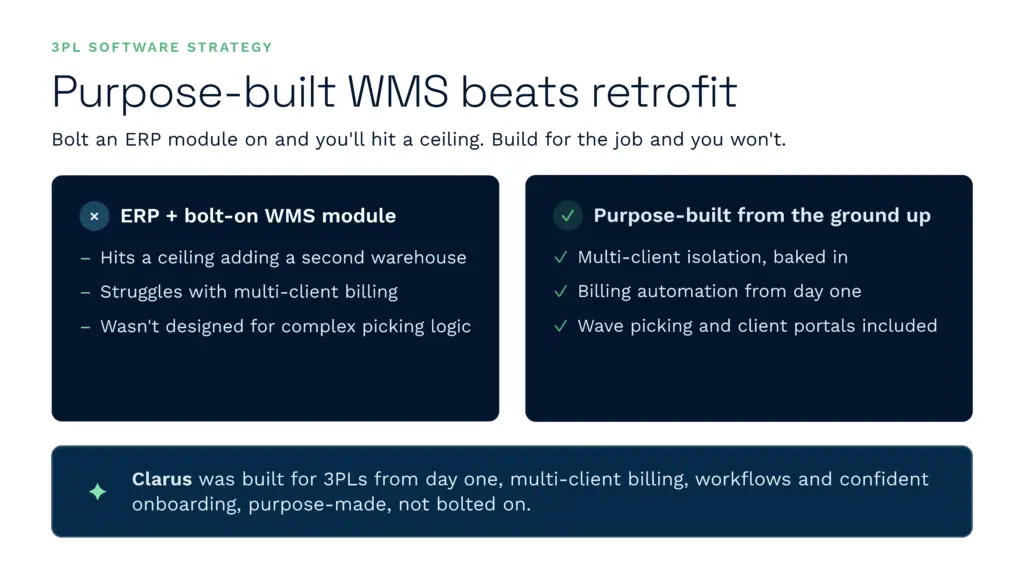
One of the clearest patterns in the market is the failure of retrofitted solutions. Many businesses start with an ERP system (Sage, Dynamics) that includes a basic WMS module, then hit a ceiling when they try to add a second warehouse, multi-client capability, or sophisticated picking logic. The ERP module wasn’t designed for that complexity.
A purpose-built WMS from the ground up handles complexity cleanly. Multi-client isolation, billing automation, wave picking, and client portals are baked in. You don’t hit the ceiling because the system was designed to scale from day one.
The same is true when comparing general WMS platforms to sector-specific ones. A general WMS will claim to serve 3PL, food, and ecommerce equally well. In practice, it serves all three poorly because it optimises for none. A 3PL WMS, built specifically for multi-client complexity, solves 3PL problems elegantly.and ecommerce-only platforms cut you loose when you try to add a second client.
Clarus started from the frustration of watching 3PLs struggle with retrofitted systems. The software was purpose-built for multi-client operations, automated billing, and the specific workflows 3PLs actually use. That design choice shows in the speed of implementation, the elegance of billing automation, and the confidence 3PLs feel when they on-board new clients.
The cloud WMS market will consolidate
Cloud WMS adoption is accelerating in the UK. Small regional WMS vendors are being acquired or pushed out. The market is shifting toward specialist platforms (3PL-focused, food-focused, ecommerce-focused) and mega-vendors (Körber, Manhattan, Infor) that sell into enterprise. The mid-market is where the real choice exists today.vendors like Mintsoft, Snapfulfil, Clarus, and others are competing hard to become the default choice for UK 3PLs and distributors.
If you’re evaluating in 2026, the choice landscape is healthy but narrowing. Picking a vendor with a clear niche and a proven track record in your sector matters more than picking the cheapest option.
Tala med en lagerarbetare
If you’re evaluating your options and want to see how a purpose-built WMS works in practice, Clarus is worth a conversation. We work with 3PLs and distributors across the UK to implement warehouse management software that fits the way you operate.not the other way around.
Kom i kontakt med vårt team att diskutera dina krav.