

Warehouse management software applications have become essential infrastructure for modern logistics operations. Whether you manage a single facility or multiple locations for third-party logistics clients, the right WMS platform can deliver real-time inventory visibility, automated order fulfilment, and seamless system integration, transforming warehouse operations from manual, error-prone processes into data-driven, scalable systems. This guide explains what warehouse management software is, its core features, deployment options, and how to select the right application for your business.
What is a warehouse management software application?
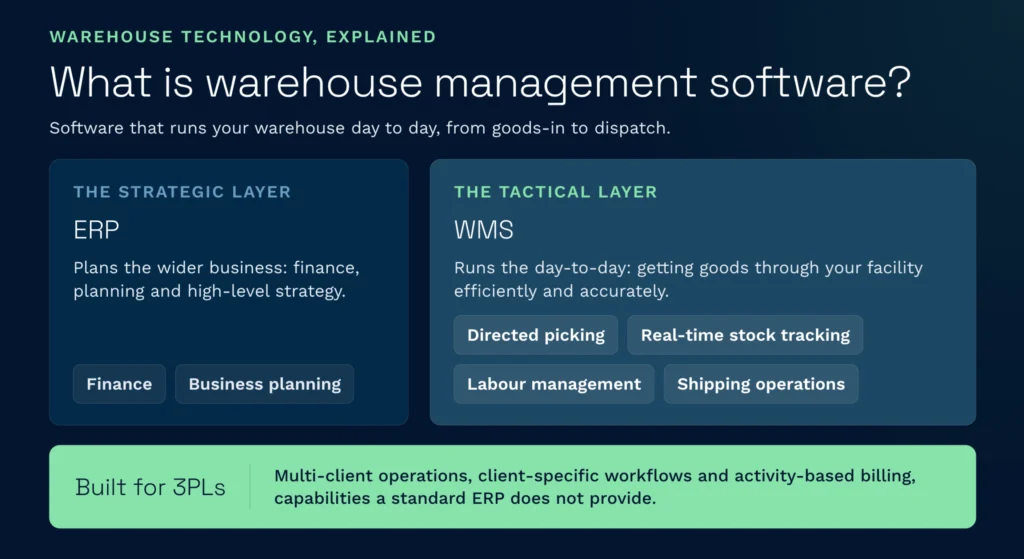
A warehouse management software application is a specialised platform designed to optimise and control daily warehouse operations from the moment goods enter a facility until they are shipped out. Unlike enterprise resource planning (ERP) systems that manage high-level business planning and finance, a WMS focuses on the tactical execution of tasks including directed picking, real-time stock tracking via barcodes or RFID, labour management, and shipping operations. The software provides centralised control over inventory movement, order fulfilment, and warehouse staff allocation, ensuring goods flow through your facility efficiently and accurately.
The distinction matters: whilst an ERP provides the strategic framework for your business, a warehouse management software application handles the day-to-day logistics. For 3PL operators specifically, a dedicated WMS must support multi-client operations, client-specific workflows, and activity-based billing, capabilities a standard ERP does not provide. This specialisation is why purpose-built 3PL warehouse management solutions have become standard across the logistics industry.
What are the key features of warehouse management software?
Modern warehouse management software applications deliver eight essential capabilities that drive operational excellence. These features work together to eliminate manual processes, reduce errors, and enable real-time decision-making across your warehouse network.
Seguimiento de inventario en tiempo real
Warehouse management software provides live visibility into stock levels, bin locations, and inventory movement. Using lectura de códigos de barras, RFID sensors, and IoT devices, the system tracks goods in real-time, preventing overstocking and stockouts whilst improving fulfillment accuracy. This real-time visibility enables proactive identification of issues before they impact operations, reducing losses and enhancing profitability.
Automated order fulfillment
The software automates picking, packing, and shipping workflows, directing warehouse staff to the optimal picking sequence and location to minimise travel time and errors. Automation can reduce picking errors by up to 99.9% and increase fulfilment speed by 300% in high-volume facilities, directly improving order accuracy and customer satisfaction.
Multi-client management (for 3PLs)
3PL-specific warehouse management applications manage inventory and orders for multiple clients from a single interface, keeping each client’s data separate and secure. This capability enables logistics providers to operate diverse client accounts with different SKUs, workflows, and billing models without system conflicts.
Customisable billing and reporting
The software automatically generates client-specific invoices based on warehousing, transportation, and fulfillment services used, whilst delivering detailed KPI insights to both providers and clients. Advanced reporting and analytics enable data-driven decisions on labour optimisation, space utilisation, and cost reduction.
Seamless system integration
Warehouse management software connects with enterprise resource planning (ERP) systems, transportation management systems (TMS), e-commerce platforms, and automation equipment. This integration eliminates data silos and enables real-time synchronisation of orders, inventory, and fulfilment status across your entire supply chain.
Labour management and optimisation
The system tracks warehouse staff performance, assigns tasks efficiently, and provides real-time visibility into labour productivity and costs. This enables managers to optimise shift allocation, identify training needs, and reduce overtime costs.
Returns management and reverse logistics
Modern WMS platforms automate returns processing with real-time inventory updates and workflow tracking, reducing the time required to restock goods and minimising lost value in reverse logistics operations.
Scalability and flexibility
Purpose-built warehouse management applications scale without major system overhauls, supporting growth across locations, order volumes, and client accounts. The right platform grows with your business, whether you operate one facility or a national network.
How should you choose between cloud and on-premise warehouse management software?
Deployment method fundamentally affects your costs, flexibility, and technology roadmap. Cloud-based and on-premise warehouse management software each offer distinct advantages and trade-offs that depend on your operational scale, IT capability, and growth strategy.
Cloud-based warehouse management software
Cloud WMS platforms are hosted by the vendor and accessed via the internet, shifting costs from capital expenditure (CapEx) to operational expenditure (OpEx). You pay monthly subscription fees, eliminating large upfront hardware investments and the need for dedicated internal IT staff to manage servers and security infrastructure.
Cloud solutions excel in multi-location scenarios, enabling centralised management of distributed warehouse operations from any internet-connected device. Remote accessibility supports flexible work arrangements whilst automatic updates ensure you always have the latest features and security patches without operational disruption.
The cloud model is particularly suited to 3PLs and enterprises experiencing rapid growth. Cloud-based WMS grows seamlessly as you add locations or clients—there are no hardware constraints or lengthy upgrade cycles. Cloud-based solutions provide real-time inventory management and visibility into dock activity, order status, and workforce performance, enabling faster decision-making and improved customer service.
Cloud WMS is growing faster than the overall market: cloud-based warehousing software now holds the largest revenue share in the market, growing at a CAGR of 22.6%—faster than the 21.9% growth of the broader WMS sector.
On-premise warehouse management software
On-premise WMS is installed directly on servers within your warehouse facility or data centre, with your organisation responsible for hardware, maintenance, and security. This approach requires significant upfront investment—hardware, software licensing, and installation costs—plus ongoing IT resources for maintenance and upgrades.
On-premise systems offer complete control over configuration, data storage, and security protocols. If your warehouse operations require strict data sovereignty, ultra-low latency automation, or highly customised workflows, on-premise deployment may be justified. However, on-premise platforms now function primarily for these specialised needs rather than general warehouse operations.
Cost comparison and total cost of ownership
Cloud solutions offer lower initial investment but can be more expensive over time with monthly fees. On-premise systems require substantial upfront CapEx but may have lower long-term costs for very large operations. Both require maintenance; cloud typically includes this in monthly fees, whilst on-premise adds up to 25% annual support licensing costs.
For most organisations, cloud WMS delivers better ROI through faster implementation, lower risk, automatic updates, and the flexibility to scale without hardware constraints. For large, stable operations with specialised needs, on-premise solutions may offer control advantages.
How does warehouse management software integrate with your ERP system?
Modern supply chains require seamless integration between your warehouse management software and your ERP system. This integration synchronises inventory data, automates order fulfilment workflows, and ensures a single source of truth across operations.
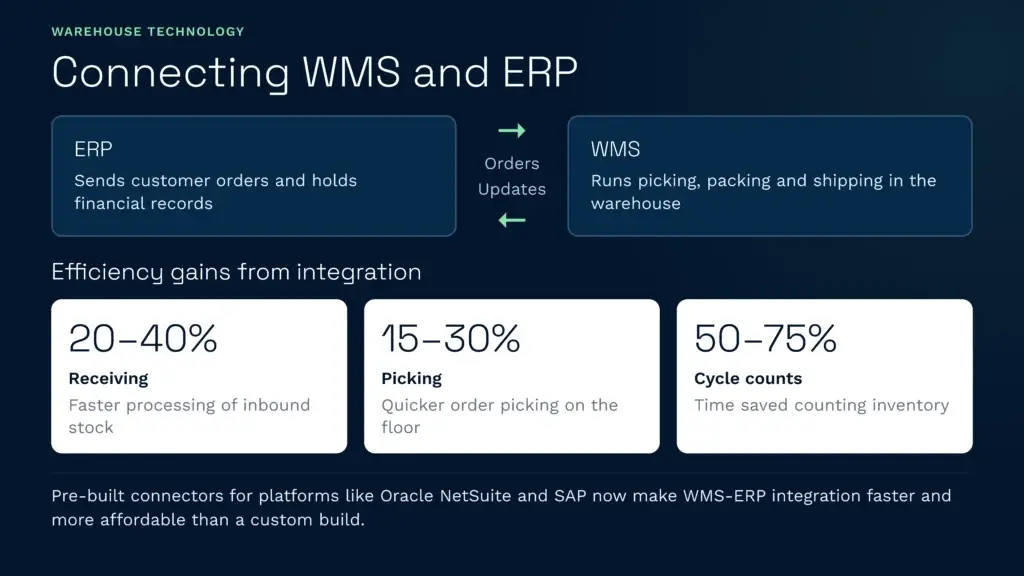
WMS-ERP integration eliminates manual data entry by automating the flow of order details from your ERP to warehouse execution. Your ERP transmits customer orders to the WMS, which then orchestrates picking, packing, and shipping. The WMS returns real-time inventory updates and fulfilment status to your ERP, enabling accurate financial reporting and order visibility across the organisation.
WMS ERP integration synchronises all data between the two systems, creating one reliable data source and eliminating manual entry errors whilst ensuring access to current information. This synchronisation delivers measurable efficiency gains: warehouse teams experience efficiency gains of 20-40% in receiving operations, 15-30% in picking functions, and 50-75% time savings during cycle counts.
The integration also enables comprehensive visibility into warehouse and financial performance. Combined reports reveal how warehouse execution impacts costs, profitability, and cash flow, enabling data-driven decisions on inventory levels, labour allocation, and space utilisation.
For organisations running Oracle NetSuite, SAP, or other major ERP platforms, dedicated WMS solutions now offer pre-built connectors that significantly reduce implementation costs compared to building custom integrations from scratch.
What are the benefits of warehouse management software for 3PL operators?
Third-party logistics providers operate under unique constraints: managing multiple clients’ SKUs, workflows, and billing models from shared facilities. Purpose-built 3PL warehouse management software delivers capabilities that standard systems cannot provide, directly improving profitability and client satisfaction.
Multi-client operations without complexity
A dedicated 3PL WMS manages inventory and orders for multiple clients simultaneously, keeping each client’s data fully separated and secure. This allows you to scale your client base without proportional increases in system complexity or IT overhead. Client-specific workflows ensure each operator’s unique processes are respected whilst maintaining centralised visibility.
Activity-based billing and transparency
3PL-specific warehouse management software automatically tracks and charges for warehousing, handling, transportation, and fulfilment services per client. This granular billing model ensures accurate cost recovery and transparent client invoicing, improving profitability and client relationships. Detailed reporting enables clients to understand exactly what they are paying for and the value delivered.
Operational scalability and flexibility
As your 3PL business grows, adding new client accounts, expanding to additional locations, or increasing order volumes, your warehouse management software scales seamlessly. Cloud-based 3PL solutions particularly excel here, adding capacity without hardware investment or lengthy system reconfiguration. This agility is critical during peak seasons or when acquiring new clients.
Enhanced client service and competitive advantage
Real-time order tracking and inventory visibility enable 3PLs to offer superior client service. Clients gain transparency into their inventory positions, order status, and logistics performance, building trust and competitive advantage in their own markets. Faster fulfilment cycles and reliable accuracy strengthen client retention.
Cost efficiency and labour optimisation
Warehouse management software reduces labour costs through automation, optimised picking routes, and efficient task allocation. UK warehouse labour shortages, driven by demographic changes and migration restrictions, have created significant wage pressures across the logistics sector. Automation and efficiency gains from warehouse management software help offset these rising costs.
How do you select the right warehouse management software application?
Selecting a warehouse management software application requires a structured evaluation of your business requirements, current system landscape, and growth strategy. A poorly-chosen system can cost more in lost productivity and failed implementation than a more expensive, better-fit solution.
Define your business requirements first
Start by mapping out your system requirements and which processes you want to run through your WMS. Move beyond feature checklists to focus on measurable business outcomes: reduce lead times by 10%, achieve 99.9% inventory accuracy, decrease labour costs by 15%, or scale to support 50% more client accounts. Well-defined goals keep your selection process focused on business impact rather than feature depth.
Assess core functionality and scalability
Evaluate whether the software delivers the features your business requires: inventory management, order fulfillment, receiving and putaway, labour management, shipping, and reporting. Equally important is scalability—the system must grow with your business without major re-implementation. For 3PLs, verify the software supports multi-client operations, customisable billing, and client-specific workflows.
Verify system integration capability
Seamless integration with your existing ERP, TMS, and e-commerce platforms is essential. Evaluate vendor integration roadmaps, ask about pre-built connectors (particularly for your ERP platform), and understand the costs and timeline for custom integrations. A system that cannot integrate is a system that will ultimately fail.
Evaluate user-friendliness and adoption
A WMS is only effective if warehouse staff use it correctly. Test the user interface with your team—the system should be intuitive enough that new employees can learn it quickly. Poor user experience drives workarounds, data quality issues, and ultimately, system failure.
Calcular el costo total de propiedad
Look beyond software licensing to understand the full cost: upfront implementation and training, monthly or annual fees, hardware costs (if applicable), ongoing support and maintenance, and customisation expenses. Compare the total cost of ownership across vendors over three to five years, not just the initial quote.
Check vendor references and implementation track record
Request a list of current customers and call them directly. Ask about implementation timelines and budget adherence, whether the project delivered expected business outcomes, the quality of vendor support during and after go-live, and how the vendor has handled updates and changes over time. Site visits are valuable for observing real implementations.
Assess support and training offerings
Technical support is crucial for any technology investment. Verify the vendor provides the level of support your business requires—24/7 availability, response time commitments, and support channels (phone, email, chat). Ask about training programmes: does the vendor provide comprehensive onboarding, ongoing user training, and access to knowledge resources?
What warehouse management software trends should you watch in 2026?
The warehouse management software market is evolving rapidly, driven by labour shortages, e-commerce growth, and technological advancement. Understanding emerging trends helps you select a platform with long-term relevance.
Labour shortage and automation acceleration
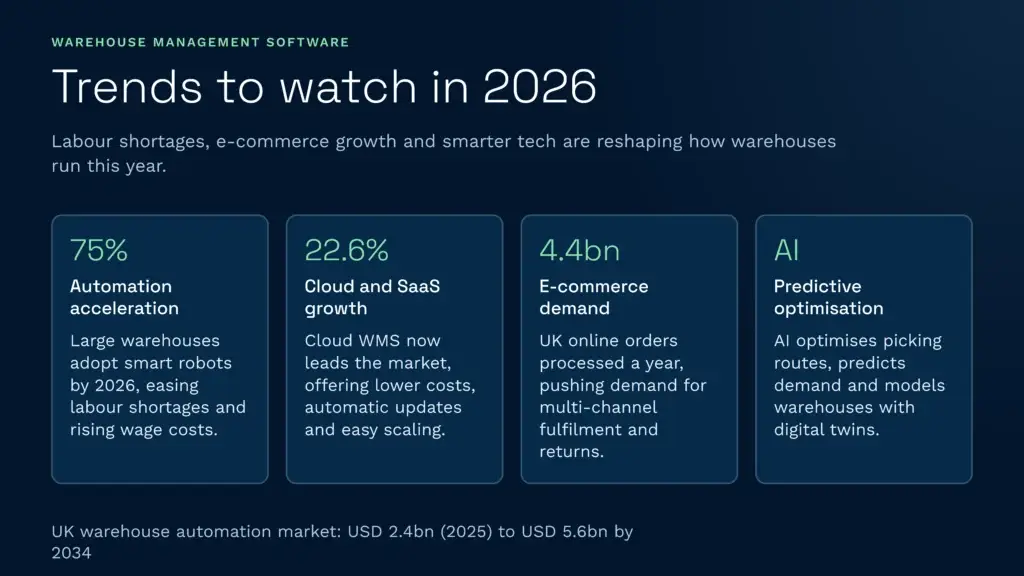
The UK warehouse automation market was valued at USD 2.4 billion in 2025 and is projected to reach USD 5.6 billion by 2034, growing at 9.49% annually. 75% of large warehouse enterprises are adopting intralogistics smart robots by 2026, addressing labour shortages and rising wage costs. Warehouse management software must integrate seamlessly with automated picking systems, conveyor networks, and robotic arms to coordinate human and machine work.
Cloud adoption and SaaS models
Cloud-based warehousing software now holds the largest revenue share in the market, growing at a CAGR of 22.6%. This shift reflects organisations’ preference for lower upfront costs, automatic updates, and flexibility to scale. If you are evaluating WMS options in 2026, cloud solutions should be your starting point.
E-commerce demand growth
In 2026, the UK logistics sector processes more than 4.4 billion online orders annually, with UK online retail sales reaching £128.6 billion in 2025—29% of total retail sales. This growth continues to drive demand for warehouse management software that handles rapid order volume fluctuations, multi-channel fulfilment, and returns management.
AI-driven optimisation and predictive analytics
Next-generation warehouse management software increasingly incorporates artificial intelligence and machine learning to optimise picking routes, predict demand, and allocate labour dynamically. Vendors are integrating digital twin technology, allowing you to model and simulate warehouse scenarios before implementing changes.
How can Clarus WMS help you optimise warehouse operations?
Clarus WMS is a purpose-built warehouse management software application designed specifically for 3PL operators and enterprise logistics providers. The platform delivers all the core features outlined in this guide, real-time inventory tracking, automated order fulfilment, multi-client operations, customisable billing, and seamless ERP integration—with particular strength in supporting the complex, multi-client environments that third-party logistics providers operate.
As a cloud-native solution, Clarus WMS eliminates upfront CapEx, scales automatically as you grow, and includes automatic updates to keep you current with the latest features and security patches. The platform supports integration with major ERP systems including Oracle NetSuite, SAP, and Sage, ensuring your warehouse and financial systems remain synchronised.
For organisations evaluating warehouse management software in 2026, Clarus WMS offers the flexibility, scalability, and 3PL-specific capabilities required to compete in a rapidly evolving logistics market. Explore how the best warehouse management software can optimise your operations, or learn more about what a warehouse management system is and how it differs from ERP and other business systems.