

The best lagerhanteringssystem for ecommerce is one that matches your business model, not the other way around. Whether you’re a direct-to-consumer (D2C) brand fulfilling Shopify orders, a 3PL managing multiple clients across different marketplaces, or a small online business working from a single warehouse, your WMS needs to sit at the intersection of three demands: real-time multi-channel order synchronisation, billing accuracy at scale, and the flexibility to grow without rebuilding your infrastructure.
Choosing a purpose-built ecommerce WMS, rather than bolting features onto an ERP or a generic on-premise system, is increasingly the difference between a fulfilment operation that runs your business and one that holds it back. This guide walks through what matters, how to evaluate your options, and why the right system unlocks growth that’s otherwise trapped behind manual processes and integration headaches.
Why Ecommerce Needs a Different Kind of WMS
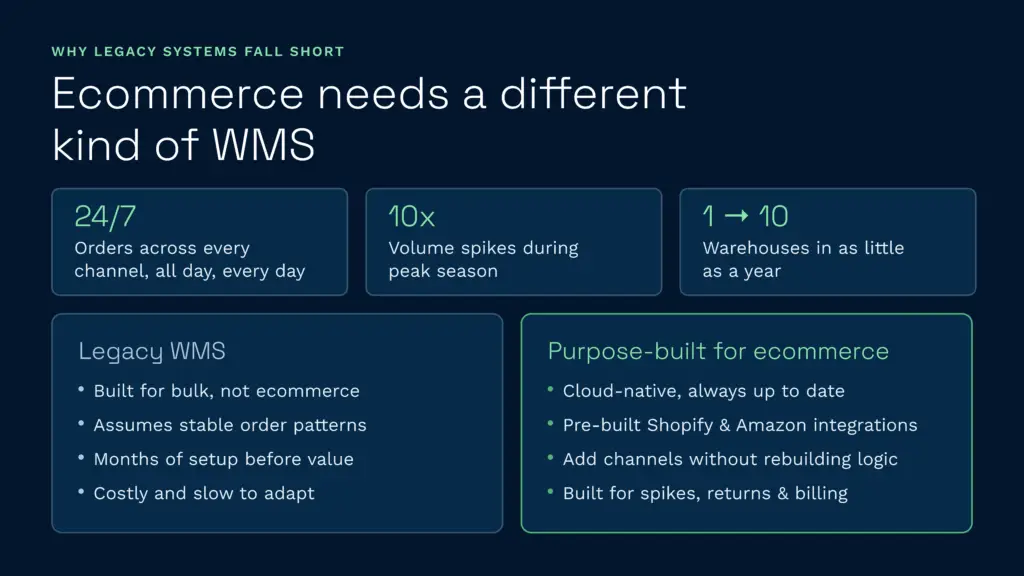
Ecommerce order fulfilment is fundamentally different from traditional warehouse operations. Your customers expect next-day or same-day delivery. Orders come in 24/7 from multiple channels—Shopify, Amazon, eBay, WooCommerce, your own website, all at once. Inventory levels change in real time. Returns flow back into the warehouse constantly. Your business might operate from a single site today and scale to ten warehouses by next year.
Legacy warehouse management systems, many built for bulk distribution or manufacturing, assume stable workflows, predictable order patterns, and long implementation timescales. They’re expensive, slow to adapt, and require months of data migration and configuration before you see value. For ecommerce, every week of delay costs cash flow and customer satisfaction.
A purpose-built ecommerce WMS is designed around these realities. It prioritises cloud-native architecture (no servers to maintain, always on the latest features), pre-built integrations with the platforms your customers use, and the ability to add new sales channels without rebuilding your warehouse logic. These systems are also engineered from day one to handle the specific pains of ecommerce: peak season spikes that can 10x your volume, returns processing that can’t wait, and fakturering that has to be accurate to the penny.
The Ecommerce WMS Requirement Checklist
Before evaluating specific solutions, ask yourself whether your WMS can do these things:
- Multi-channel order sync: Orders from Shopify, Amazon, eBay, WooCommerce, and your other channels arrive in the system in real time, with order status (pending, picked, shipped, delivered) syncing back to the source platform automatically.
- Realtidsöversikt över lager Your live stock level is visible to customers and your own teams across all sales channels. Overselling is prevented through system-level locks, not manual intervention or end-of-day reconciliation.
- Wave picking and batch logic: The system automatically groups orders into efficient waves based on shipping deadlines and destination zones, optimising travel time and reducing pick errors.
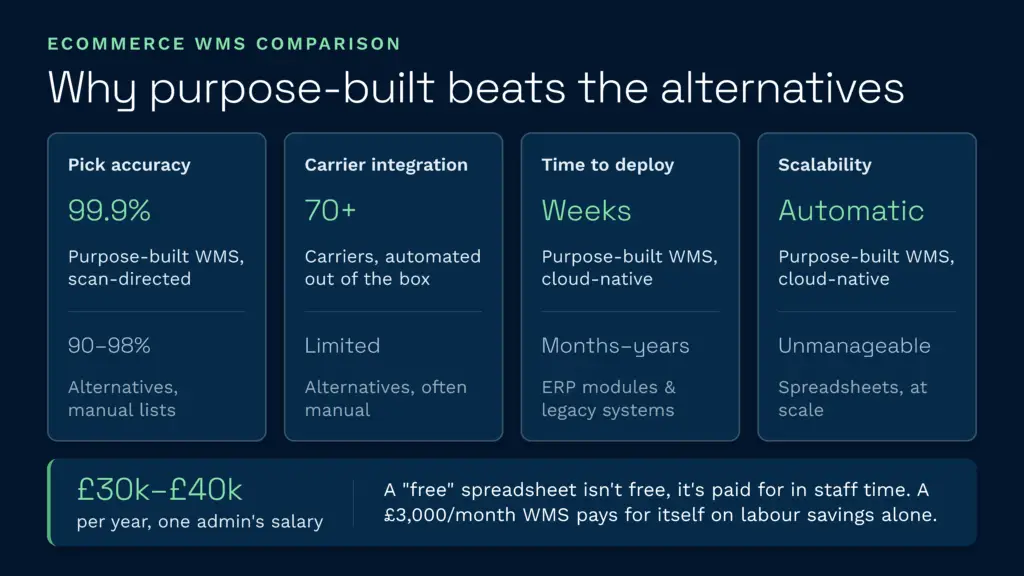
- Carrier integration: Orders route to 70+ carriers (DHL, UPS, FedEx, Postverket, DPD, Evri, and others) based on destination and service level, with label printing and tracking synchronisation automatic.
- Flexible fulfillment rules: Different clients or sales channels can have different rules. One might require FIFO rotation, another FEFO. One wants next-day, another is happy with five-day economy. The system adapts per-order without manual override.
- Returns processing: Customer returns flow back into the warehouse with clear status visibility, automatic stock reconciliation, and the ability to route items to restock, liquidation, or QA workflows.
- Billing automation (for 3PLs): Every billable event, receiving, storage, pick, pack, despatch, returns, value-added services, is captured in real time and assigned to the correct client account without manual data entry or end-of-month reconciliation.
- Kundportalen: Clients (if you’re a 3PL) or your own teams see real-time stock levels, order status, shipment tracking, and billing summaries through a web interface. No more phone calls asking “where’s my inventory?”
- API-first architecture: The system exposes APIs so you can build custom integrations with your own systems, accounting platforms, or future tools you haven’t chosen yet.
- Scalability without infrastructure redesign: You can add warehouses, increase order volume, or integrate new sales channels without rebuilding the system from scratch.
A system that ticks all of these boxes is rare. Many ecommerce platforms claim to do everything but struggle with the depth of integration or the automation sophistication. This is where purpose-built systems separate from retrofitted alternatives.
Multi-Channel Order Management: The Core Challenge
The first critical feature is multi-channel order management. Unlike a traditional retail warehouse or a B2B distributor—where most orders come from one or two sources (EDI, email, phone), ecommerce fulfilment centres receive orders from dozens of sources simultaneously. Your Shopify store, Amazon, eBay, your own website, TikTok Shop, Etsy, BigCommerce, all of them can be generating orders at the same moment.
A purpose-built WMS syncs all of these in real time. When an order is placed on Amazon, it arrives in your WMS within seconds. When you scan an item into a picking batch, the order status updates on Amazon immediately. When the order ships, the tracking number is pushed back to Amazon, and the customer sees it in their account within minutes.
Without this synchronisation, you end up with a familiar failure pattern: orders arriving by email or API, needing manual entry or re-keying into the warehouse system, creating data islands where the ecommerce platform and your warehouse are hours or days out of sync. Customers see “pending” when the order is already packed. You ship items that have already been cancelled on the marketplace. Returns come back with no visibility into where they go.
A cloud-native WMS designed for ecommerce eliminates this friction. It acts as the central hub. Orders flow in, inventory visibility flows out, and you focus on moving goods, not chasing data.
Marketplace and Shopping-Cart Integrations: Non-Negotiable for Scaling
The second critical dimension is the breadth and depth of pre-built integrations with the platforms your customers use. You don’t want to hire developers to custom-code connections to Shopify, Amazon, or WooCommerce. You want those integrations to exist, to be maintained by the WMS vendor as these platforms evolve, and to work out of the box.
The best WMS for ecommerce supports Shopify, WooCommerce, Amazon, eBay, Etsy, BigCommerce, Magento, Wix, Squarespace, TikTok Shop, and OnBuy, among others. Some also support B2B marketplaces and wholesale platforms. Look for at least 150+ pre-built integrations; this tells you the system is designed to be a hub, not a point solution.
In practice, this means when a customer buys on Shopify, the order is automatically imported with all line items, shipping address, customer notes, and any special instructions. When you pick and pack that order in the warehouse, streckkodsläsning is optional (though recommended); the order is tracked as it moves through stations. When it ships, Shopify is notified in real time, and the customer receives a tracking email immediately.
The same logic applies to Amazon, eBay, or WooCommerce. Different platform, same workflow. A D2C brand selling across three channels doesn’t need three separate systems, one WMS handles all three, keeping inventory accurate across all channels simultaneously.
Carrier Integrations and Shipping Automation for Ecommerce
Carrier integration is where many legacy WMS systems stumble. They can pick and pack orders, but shipping is either manual (you print labels from DHL’s website, then type tracking numbers back into your system) or requires a third-party shipping tool that introduces another integration headache.
A modern ecommerce WMS integrates directly with 70+ carriers including DHL, UPS, FedEx, Royal Mail, Parcelforce, DPD, Evri, TNT, and the major pallet networks (Palletways, Pallex, The Pallet Network). When an order is ready to ship, the system can:
- Automatically select the best carrier based on parcel size, destination, and your negotiated rates.
- Assign a shipping service level from the carrier’s options (next day, standard, economy) based on the order’s SLA or customer selection.
- Generate the shipping label with all required information, including customs data for international orders.
- Send the tracking number back to the order source (Shopify, Amazon, etc.) so the customer sees it in their account.
- Update the label with proof of delivery when the parcel reaches the customer, automatically closing the order loop.
This automation cuts the time required to process a single order from minutes (manual steps, potential errors, manual data entry) to seconds (one scan or one button click). At scale, when you’re processing hundreds or thousands of orders a day, this is the difference between needing three people in dispatch and doing it with one.
Pick, Pack, and Despatch Accuracy: Why Purpose-Built Systems Win
The most important metric in warehouse operations is noggrannhet. A mispicked or mispacked order damages customer satisfaction, creates a return, and triggers a replacement shipment, multiplying your cost and eroding margin. The industry standard for manual picking (pickers with printed pick lists) is 97–98% accuracy. With scan-directed picking (where a barcode scan confirms the item matches the order), accuracy climbs to 99.9%.
Purpose-built ecommerce WMS systems use directed picking workflows. The system tells the picker where to go, what to pick, and how many. The picker scans the barcode on the item. If it matches the order, they place it in the tote. If it doesn’t match, the system stops them and asks them to correct it. No guesswork. No interpretation of illegible handwriting or ambiguous product codes.
Clarus’s scan-directed pick verification, for example, targets 99.9% accuracy, compared to 97–98% typical for manual pick lists. When you’re shipping 10,000 parcels a month, that difference between a 0.1% and 2% error rate is the gap between happy customers and a reputation crisis.
The same principle applies to packing and despatch. The system directs the packer to the correct tote, confirms the contents, and only then allows the parcel to be sealed and handed to the carrier. Nothing ships without verification.
Real-Time Inventory Across Channels: Preventing Overselling
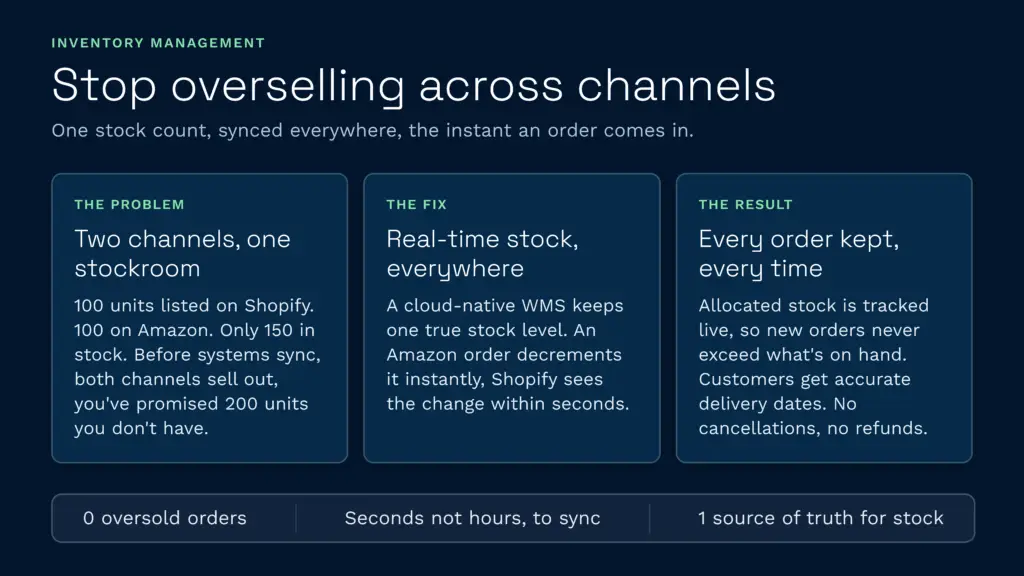
One of the costliest failure modes for ecommerce is overselling: you list 100 units on Shopify and 100 on Amazon, but you only have 150 in stock. A few hours pass before your systems sync, and by then both platforms have sold all 200 units. You’ve promised inventory you don’t have, and now you’re either cancelling orders, offering refunds, or scrambling to arrange emergency stock.
A modern cloud-native WMS syncs inventory in real time across all channels. Stock level is a single source of truth. When an order is placed on Amazon and received in the WMS, available inventory is immediately decremented. Shopify sees the updated level within seconds. No overselling. No broken promises.
This real-time visibility also allows you to use your inventory more efficiently. If you have 50 units in stock and 45 are already allocated to orders, the system knows that. It can accept new orders up to your stock level, but not beyond. Customers see accurate delivery dates. Your warehouse knows exactly what’s committed and what’s available for future orders.
Scalability for Peak Seasons and Growth
Ecommerce is seasonal. Black Friday, Christmas, and summer sales create order spikes that can be 10x your normal daily volume. Your WMS needs to handle this without crashing, without requiring you to buy new servers, and without manual workarounds.
Cloud-native systems scale automatically. When order volume spikes, the system’s infrastructure adapts. You don’t buy hardware; you don’t provision new servers. The vendor’s infrastructure handles it. This is one of the hidden costs of legacy on-premise WMS: when volume doubles, you hit infrastructure limits, performance degrades, and you’re forced to invest in new servers and new licenses.
Scalability also means adding new clients (if you’re a 3PL), new warehouses, or new sales channels without rebuilding the core system. A WMS that took a 3PL operator two years to implement the first time shouldn’t take six months to add a second warehouse. Purpose-built systems are designed for this growth; legacy systems are not.
Sector Fit: D2C, 3PL, Small Business, and Beyond
Not all ecommerce businesses are the same. A D2C brand selling through one Shopify store has different needs from a 3PL managing inventory for fifty different clients. A small online business working from a garage has different constraints from an enterprise fulfilment centre. The best WMS for you depends on your business model.
D2C Brands and Small Online Businesses
If you’re a D2C brand or a small online business, you need a WMS that gets you operational fast and scales as you grow. Your priority is avoiding manual workarounds and gaining visibility into your warehouse from day one. You probably work from one warehouse today, but you might need two or three in a few years. You sell through your own website, maybe Shopify, and possibly Amazon. You don’t want to manage complex billing or multi-client workflows.
Look for systems that offer rapid deployment (days or weeks, not months), pre-built integrations with Shopify and Amazon, and transparent pricing (no enterprise licensing, no surprise seat fees). A system that costs £1,000–£3,000 a month and is live within two weeks is worth far more than a £20,000 enterprise system that takes eighteen months to implement.
3PL Providers
If you’re a 3PL, your needs are more complex. You’re managing inventory for multiple clients, each with different SLA requirements, billing rules, and sales channels. One client wants FEFO rotation for food products. Another wants FIFO for books. A third wants items sorted by customer before packing. Your system needs to handle all of these simultaneously within the same warehouse.
You also need automated billing. Manual invoicing at the end of the month is error-prone and labour-intensive. Clients dispute charges. Revenue leaks out through missed billable events. A purpose-built 3PL WMS captures every billable activity in real time: receiving, storage, picking, packing, despatch, returns, and value-added services. It assigns each activity to the correct client. By month-end, your invoice is already built. No reconciliation. No disputes.
St John’s Hall Storage, a UK 3PL, illustrates this point. Before switching to a purpose-built WMS, they spent four hours every month invoicing clients manually. Two people reconciled data, chased down missing records, and fought billing disputes. After implementation, invoicing dropped to twenty minutes. Manual reconciliation was eliminated entirely. That’s one full FTE freed up to focus on growing the business.
Wholesale Distributors and Omnichannel Retailers
If you distribute wholesale to retailers (via EDI, order forms, and phone calls) and also sell direct to consumers through ecommerce channels, you need a system that handles both B2B and B2C workflows from the same inventory. This is where retrofitted ERP modules fall short. They’re built for one or the other, not both.
A purpose-built omnichannel WMS seamlessly handles wholesale orders (often with longer lead times and specific packing requirements) alongside high-volume B2C parcel orders arriving from Amazon and Shopify. Inventory is shared; picking workflows adapt to order type automatically.
Why Purpose-Built Beats Retrofitted ERP
Many businesses start with an ERP system, Sage 200, Microsoft Dynamics, SAP, that includes a basic warehouse module. It works until it doesn’t. The limitations become apparent when you try to:
- Integrate with ecommerce platforms: Sage’s WMS module isn’t designed for real-time Shopify synchronisation. You build custom code, which breaks when Shopify updates their API, which creates months of technical debt.
- Add new sales channels: Adding a third marketplace to your operation means reconfiguring picking workflows, adding new carrier integrationer, and potentially new data migrations. A purpose-built system adds a channel in days.
- Implement multi-client billing: If you acquire a 3PL customer or want to offer white-label fulfilment, the ERP’s fakturering engine isn’t flexible enough. You’re back to spreadsheets or custom development.
- Scale to peak volume: The ERP’s infrastructure wasn’t designed for 10x daily volume spikes. You hit database limits, performance degrades, and the system becomes a bottleneck instead of a tool.
- Upgrade or maintain the system: ERP upgrades are infrequent, expensive, and risky. A purpose-built cloud-native WMS updates continuously, and you always have the latest features without paying for an upgrade project.
The real cost of a retrofitted ERP isn’t the license fee. It’s the custom code, the integration maintenance, the staff time spent working around limitations, and the missed opportunities to automate because “the system doesn’t support that.”
A purpose-built WMS is engineered from day one for ecommerce. It assumes you’ll have multiple sales channels, that you’ll integrate with carriers and 3PLs, that you’ll need real-time accuracy, and that you’ll grow faster than you can predict. It’s built for this world, not retrofitted into it.
Key Features to Compare When Evaluating WMS Options
When shortlisting WMS vendors, compare these dimensions:
- Integrationer: How many pre-built integrations with ecommerce platforms, ERPs, and carriers? Can you integrate custom systems via API?
- Deployment time: Can you go live in weeks or does it require months? Are migrations assisted or manual?
- Accuracy and automation: Does the system use scan-directed picking or manual pick lists? What accuracy rates are claimed and can they be verified with references?
- Prissättningsmodell: Is it transparent and aligned with your growth? Watch for systems that lock you into long-term contracts or charge per-user seat fees that become prohibitive at scale.
- Support SLA: How fast do they respond to issues? For ecommerce, sub-2-minute response times are increasingly standard; if a vendor quotes days, that’s a red flag.
- Multi-client capabilities (if relevant): Can the system segregate inventory and billing for multiple clients in one warehouse?
- Customisation: Can you adjust workflows to match your warehouse layout or add custom fields without hiring developers?
- References and proof points: Ask for case studies from businesses similar to yours. Don’t trust marketing claims; verify results with references.
Read our guide on the What is a warehouse management system to understand the fundamentals before evaluating solutions.
Returns Management and Product Lifecycle
Ecommerce returns are inevitable. Customers change their minds, items arrive damaged, or they don’t match expectations. A purpose-built WMS includes a complete returns workflow: items are received, inspected, re-stocked (if condition is good), or routed to liquidation or scrap (if not).
Without a dedicated returns process, you end up with returns sitting in a corner of the warehouse with no clear status, getting mixed up with forward stock, or being lost entirely. A structured returns process in your WMS ensures every returned item has a journey: received? inspected? decision (restock, liquidation, scrap)? executed. You can track refunds, manage warranty claims, and measure return rates by product or customer.
This data also feeds into your inventory accuracy. If you’re missing inventory every month, returns processing is often the culprit. A clear returns workflow surfaces the issue and lets you fix it.
Real-World Proof: How Ecommerce Operators Improve with a Purpose-Built WMS
JODA Frakt, a UK 3PL, was managing inventory with a mix of spreadsheets and a legacy WMS that didn’t speak to their ecommerce clients’ platforms. Stock counts varied wildly between what the system said and what was on the floor. Invoicing took days because billing events were manually logged. When they switched to a purpose-built system, stock accuracy climbed from the low 90s to 99%. Their team could run monthly stocktakes in days instead of weeks. Invoicing became a daily automated process.
KATEM Logistik, another UK 3PL, faced a different challenge: growth. They were picking and packing so many orders manually that warehouse staff were working unsustainable hours. When they deployed a system with directed picking workflows and wave optimisation, picking volumes scaled 10x. They didn’t need to hire ten new people; smarter routing and batch logic meant the same team could handle far more volume.
These aren’t exceptional results. They’re what happens when a business moves from manual workflows to system-guided ones. The system knows the optimal picking path. It groups orders into efficient batches. It directs pickers to the exact location. Accuracy improves. Speed improves. Staff have time to focus on exception handling instead of routine labour.
Explore the Warehouse order picking guide to understand how modern systems optimise this critical process.
Integration with Your Existing Stack
You probably already use tools for accounting, CRM, shipping, and inventory. A new WMS needs to fit into that stack, not replace it wholesale. Look for systems that integrate with your existing tools:
- Accounting: QuickBooks, Xero, Sage 200, Microsoft Dynamics, SAP
- ERP and inventory: Brightpearl, Zoho Inventory, Unleashed Software
- Shipping and TMS: Qargo, Maxoptra, and integration with 70+ carrier APIs
- CRM and customer data: HubSpot, Salesforce, Pipedrive
A system with an API-first architecture and Clarus WMS integrations library of 200+ pre-built connectors means you’re not writing custom code; you’re plugging existing systems together. This is also important when you want to add a new tool in the future; a well-integrated WMS plays nicely with new additions without forcing you to rebuild integrations.
Warehouse Mapping and Physical Layout
The physical layout of your warehouse affects everything: picking time, packing efficiency, and error rates. A modern WMS includes Warehouse mapping feature that lets you define zones, aisles, shelves, and bin locations. The system can then optimise picking paths based on your layout, suggesting more efficient routes that reduce travel time and fatigue.
This is especially valuable if you’re moving to a new warehouse or expanding into a second location. You can map the layout once and the system adapts all its workflows automatically. Without warehouse mapping, you’re back to pickers learning routes by memory or following printed maps that become outdated.
The Comparison Table: Purpose-Built Ecommerce WMS vs Alternatives
To summarise the key trade-offs, here’s how purpose-built ecommerce WMS systems compare to alternatives:
| Funktion | Purpose-Built Ecommerce WMS | ERP Module (Sage, Dynamics) | Legacy On-Premise WMS | Spreadsheet + Manual |
|---|---|---|---|---|
| Shopify / Amazon integration | Pre-built, real-time | Custom code required | Custom code or third-party tool | Manual entry |
| Plocknoggrannhet | 99.9% (scan-directed) | 97–98% (manual lists) | 97–98% (manual lists) | 90–95% (depends on staff) |
| Integration av transportörer | 70+ carriers, automated | Limited, often manual | Limited, often manual | Manual label printing |
| Fakturering av flera kunder | Real-time, automated | Inflexible, manual workarounds | Manual or limited | Spreadsheet-based |
| Driftsättning | Weeks | Months to years | Months | Immediate (but limited) |
| Skalbarhet | Cloud-native, automatic | Kräver investeringar i infrastruktur | Requires new servers | Becomes unmanageable |
| Monthly cost | £1,000–£5,000+ | Included in ERP (if licensed) | £500–£5,000+ + infrastructure | £0 (but high labour cost) |
The row on cost deserves emphasis: a spreadsheet-based operation looks “free” until you account for the staff time spent on manual data entry, error correction, and firefighting. One FTE spent 80% on warehouse admin work is typically £30,000–£40,000 in annual salary. A £3,000/month WMS is paid for by the labour productivity gain alone, and that doesn’t count the accuracy improvements, faster processing, or reduced shipping costs from optimised routing.
Tala med en lagerarbetare
Om du utvärderar dina alternativ och vill se hur ett specialutvecklat WMS fungerar i praktiken är Clarus värt att ta en titt på. Vi samarbetar med 3PL-företag och distributörer över hela Storbritannien för att implementera lagerhanteringsprogramvara som anpassas efter ert arbetssätt – inte tvärtom.
Kom i kontakt med vårt team att diskutera dina krav.