

El mejor software de gestión de almacenes (WMS) combina la profundidad operativa con la facilidad de implementación, integrando el control de inventario, la gestión de pedidos y la gestión de personal en una única plataforma. El mercado mundial de WMS se valorará en 3.38 mil millones de dólares en 2025 y crecerá a una tasa compuesta anual (CAGR) del 21,91 % (Grand View Research), la oferta de plataformas disponibles nunca ha sido tan amplia. Esta guía desglosa las mejores opciones por tipo de actividad —grandes empresas, 3PL y pymes— para que puedas centrar tu evaluación en las plataformas que se adapten a tu tamaño.
¿Cuál es el mejor software de gestión de almacenes en 2026?
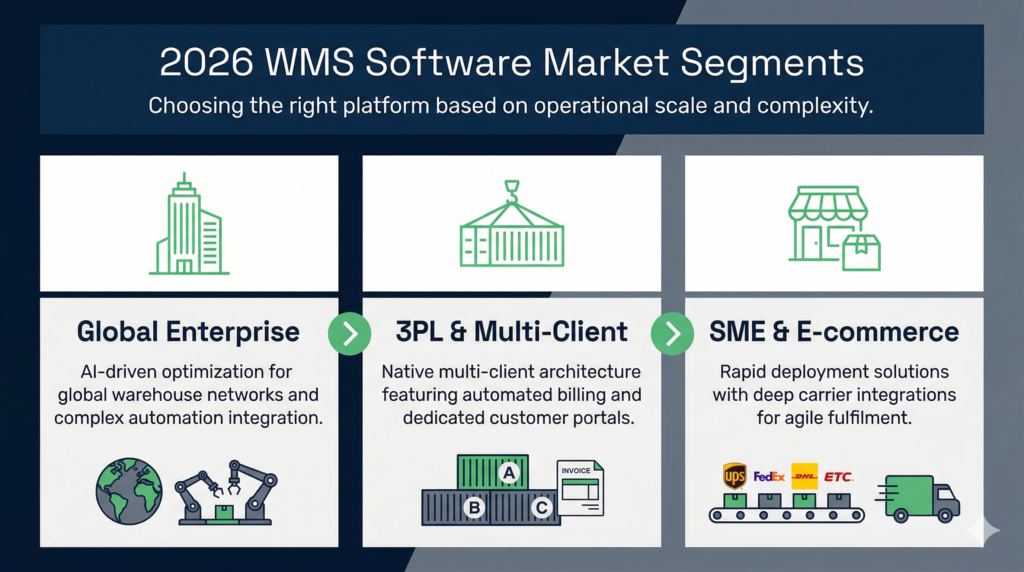
El mejor sistema de gestión de almacenes (WMS) depende del tipo de operación que tengas. Manhattan Active WMS es líder para grandes empresas, Clarus WMS y Extensiv destacan en operaciones de logística de terceros (3PL), y plataformas como Mintsoft y Zoho Inventory dan un buen servicio a los almacenes de las pymes. No hay una única plataforma que domine todas las categorías.
¿Cómo se comparan las principales plataformas de WMS según el tipo de operación?
| Plataforma | Tipo de operación | Despliegue | Diferenciador clave | Precios orientativos |
|---|---|---|---|---|
| Manhattan Active WMS | Gran empresa | Nativo de la nube | Líder en el Cuadrante Mágico de Gartner en 17 ocasiones, optimización basada en IA | Personalizado (precios para empresas) |
| SAP Extended Warehouse Management | Empresa (ecosistema SAP) | Nube / local | Integración profunda con el ERP, cadenas de suministro complejas | Personalizado (precios para empresas) |
| Oracle NetSuite WMS | Desde el segmento medio hasta las grandes empresas | Nube | ERP + WMS unificados, con las mejores valoraciones en cuanto a facilidad de uso | Desde 1.500 £ al mes |
| Clarus WMS | Empresa de logística 3PL con múltiples clientes | Nube | Facturación 3PL especialmente diseñada, despliegue rápido | Póngase en contacto con nosotros para conocer los precios |
| Extensiv: gestor de almacenes 3PL | Proveedores de servicios logísticos 3PL | Nube | Gestión de múltiples clientes, integraciones con operadores | Desde 500 £ al mes |
| Deposco | Proveedor de servicios logísticos (3PL) para el segmento medio del mercado, comercio electrónico | Nube | Incorporación de clientes en tan solo dos horas | Precios personalizados |
| Mintsoft (Access Group) | Pymes, gestión de pedidos de comercio electrónico | Nube | Fabricado en el Reino Unido, con sólidas integraciones con operadores y a un precio asequible | Desde 200 £ al mes |
| Zoho Inventory | Pequeñas empresas | Nube | Integración de ventas multicanal a bajo coste | Desde 50 £ al mes |
Para consultar opiniones de usuarios verificadas y comparativas de características, puedes recurrir a directorios como Gartner Peer Insights, Capterra Reino Unido, y Consejos de software ofrecen valoraciones detalladas realizadas por profesionales de almacenes con experiencia real.
¿Qué características debería incluir el mejor sistema de gestión de almacenes (WMS)?
Un sistema de gestión de almacenes obtiene la calificación de “el mejor” cuando lleva a cabo las operaciones básicas del almacén de forma fiable y, al mismo tiempo, ofrece la flexibilidad necesaria para gestionar tus flujos de trabajo específicos. Las listas de características importan menos que la capacidad del sistema para adaptarse a tu día a día.
Características esenciales en todas las categorías de sistemas de gestión de almacenes (WMS)
- Recepción y almacenamiento — Tramitación de la entrada de mercancías mediante códigos de barras, con normas de almacenamiento configurables en función del tipo de producto, la rotación o los requisitos del cliente
- Gestión de existencias — visibilidad de las existencias en tiempo real en todas las sedes, seguimiento de lotes y partidas, gestión de fechas de caducidad y recuento cíclico
- Preparación de pedidos — Compatibilidad con la preparación de pedidos por oleadas, por lotes, por zonas y por grupos, con rutas de recogida optimizadas para reducir el tiempo de desplazamiento
- Embalaje y envío — selección automática del transportista, generación de etiquetas y documentación de envío con confirmación de la prueba de envío
- Tramitación de devoluciones — flujos de trabajo estructurados para la recepción de devoluciones, el control de calidad y las decisiones sobre la reposición o la eliminación de productos
- Informes y análisis — paneles de control en tiempo real que recogen los pedidos recogidos por hora, el tiempo desde la descarga hasta la entrada en stock, la precisión de los pedidos y la utilización de la mano de obra
¿En qué se diferencian los sistemas de gestión de almacenes (WMS) para grandes empresas de las plataformas para el mercado medio?
| Capacidad | WMS Empresarial | SGA para el mercado medio |
|---|---|---|
| Gestión multisitio | Red mundial de almacenes con control centralizado | Normalmente 1 a 5 sitios |
| Integración de automatización | Integración nativa de AMR, AS/RS y cintas transportadoras | Basado en API o limitado |
| Gestión Laboral | Estándares de ingeniería, seguimiento de incentivos | Informes básicos de productividad |
| Profundidad de configuración | Flujos de trabajo altamente personalizables para cada sitio web | Basado en plantillas, con algunas personalizaciones |
| Tiempo de implementación | 6–18 meses | 4–12 semanas |
¿Qué sistema de gestión de almacenes (WMS) es el más adecuado para las operaciones de almacén de un proveedor de servicios logísticos (3PL)?
Los proveedores de logística externos necesitan plataformas WMS que gestionen de forma nativa la complejidad de la gestión multicliente, y no como una solución añadida a posteriori a un sistema diseñado para un único cliente. El segmento de los 3PL acaparó la mayor cuota de mercado de WMS en 2024 (Grand View Research), lo que refleja la gran dependencia del sector respecto al software especializado.
Las capacidades clave que distinguen a un sistema de gestión de almacenes (WMS) de nivel 3PL del software de almacén general son las siguientes:
- Segregación de inventario multi-cliente — Las existencias de cada cliente se gestionan de forma independiente dentro de un espacio de almacén compartido, con catálogos de referencias y normas de ubicación distintos
- Facturación automática a los clientes — motores de facturación configurables que calculan los gastos de almacenamiento, las tasas de gestión y los servicios de valor añadido por cliente, y generan facturas de forma automática
- Portales de autoservicio para clientes — paneles de control seguros en los que tus clientes puedan consultar sus niveles de existencias, realizar un seguimiento de los pedidos y generar informes sin necesidad de ponerse en contacto con tu equipo
- Gestión flexible de los SLA — diferentes niveles de servicio, plazos límite y normas de prioridad para cada cliente
Clarus WMS se diseñó desde cero para operaciones de 3PL. Nuestra arquitectura multicliente garantiza que todas las funciones —desde la facturación hasta la generación de informes, pasando por la configuración de flujos de trabajo— funcionen a nivel de cliente sin necesidad de soluciones provisionales. Un proveedor de servicios de logística que gestiona ocho marcas de comercio electrónico desde un único almacén implantó Clarus WMS y logró una reducción de 401 TP3T en el tiempo de tramitación de los pedidos durante el primer trimestre, principalmente gracias a la planificación automatizada por oleadas, que agrupa los pedidos por cliente, transportista y nivel de servicio de forma simultánea.
¿Cómo se evalúa un software de gestión de almacenes (WMS) antes de comprarlo?
El proceso de evaluación debe poner a prueba el sistema en el contexto de sus operaciones reales, no en escenarios teóricos. Son demasiadas las implementaciones de sistemas de gestión de almacenes (WMS) que fracasan porque la selección se basó en listas de características en lugar de en la adecuación operativa.
Un marco práctico para la evaluación de sistemas de gestión de almacenes (WMS)
- Define tus condiciones imprescindibles — Enumera entre 5 y 7 funcionalidades sin las que no podrías trabajar en absoluto (por ejemplo, facturación para varios clientes, integración con la API del operador, seguimiento de lotes).
- Solicitar demostraciones basadas en escenarios — Pide a los proveedores que te muestren tus flujos de trabajo específicos, no su guion de demostración estándar.
- Comprobar las capacidades de integración — Comprueba cómo se integra el WMS con tu ERP, tus canales de comercio electrónico y los sistemas de los transportistas antes de tomar una decisión definitiva.
- Consultar clientes de referencia — Habla con clientes actuales de tu sector y de tamaño similar.
- Evaluar el coste total de propiedad — incluyen los costes de implementación, formación, integración y asistencia continua, además de las cuotas de licencia
- Evaluar la hoja de ruta del proveedor — Averiguar con qué frecuencia se actualiza la plataforma y si las actualizaciones requieren un periodo de inactividad
Opiniones sobre Gartner Peer Insights resultan especialmente valiosas durante la evaluación, ya que incluyen comentarios detallados sobre la implementación, además de valoraciones de las funciones, lo que te ofrece una visión realista de lo que puedes esperar durante la puesta en marcha.
¿En qué consiste normalmente la implantación de un sistema de gestión de almacenes (WMS)?
Los plazos de implementación y la complejidad varían considerablemente entre las plataformas nativas de la nube y las locales. Las soluciones WMS en la nube de proveedores como Deposco Se puede dar de alta a clientes individuales en tan solo dos horas, mientras que las implementaciones completas para empresas pueden tardar entre 12 y 18 meses.
Una implementación típica de un sistema de gestión de almacenes (WMS) en la nube sigue esta secuencia:
- Análisis inicial y definición del alcance (1-2 semanas) — análisis de los flujos de trabajo actuales, los requisitos de integración y las necesidades de migración de datos
- Configuración del sistema (2-4 semanas) — configuración de almacenes, ubicaciones, productos, usuarios y reglas de flujo de trabajo
- Compilación de integración (2-6 semanas) — conexión del WMS con tu ERP, tus plataformas de comercio electrónico y los sistemas de los transportistas a través de API
- Pruebas de aceptación por parte de los usuarios (1-2 semanas) — Tu equipo comprueba el funcionamiento del sistema en situaciones reales
- Puesta en marcha y asistencia técnica (1 semana) — puesta en marcha supervisada con asistencia del proveedor, ya sea in situ o a distancia
El mercado británico de sistemas de gestión de almacenes (WMS) se decanta cada vez más por las plataformas en la nube de implementación rápida. Mintsoft, desarrollada por una empresa con sede en el Reino Unido, El Grupo Access, presta servicio a más de 160 000 pequeñas y medianas empresas y destaca la rapidez en la incorporación como uno de sus principales argumentos de venta.
¿Estás listo para encontrar el mejor sistema de gestión de almacenes (WMS) para tu almacén?
El mejor sistema de gestión de almacenes es aquel que se adapta a tu actividad actual y que se adapta a tu crecimiento. Si gestionas un 3PL o atiendes a varios clientes desde un espacio de almacén compartido, una plataforma diseñada específicamente para este fin siempre ofrecerá mejores resultados que un sistema genérico adaptado para su uso con múltiples clientes.
Clarus WMS ofrece a los proveedores de servicios logísticos (3PL) y a los almacenes empresariales una capacidad multicliente, facturación automatizada y una rápida implementación que las plataformas genéricas no pueden igualar. Reservar una demostración para ver cómo gestiona Clarus WMS tus flujos de trabajo específicos… utilizamos tus datos, no un entorno de demostración genérico.
Referencias
- Informe sobre el tamaño del mercado de sistemas de gestión de almacenes, 2033 — Grand View Research. Enlace
- Mejores Sistemas de Gestión de Almacenes Reseñas 2026 — Gartner Peer Insights. Enlace
- Sistema de Gestión de Almacenes — Capterra Reino Unido. Enlace
- Comparación de Sistemas de Gestión de Almacenes — Software Advice. Enlace
- Los mejores sistemas de gestión de almacenes 3PL de 2026 — Deposco. Enlace
- Los 5 mejores sistemas de gestión de almacenes para proveedores de servicios logísticos externos (3PL) en 2026 — Noticias sobre robótica y automatización. Enlace
- Los 7 mejores programas de gestión de almacenes en 2026 — Digit Software. Enlace