

Running an online store across multiple platforms is exhilarating and exhausting in equal measure. You’re managing inventory on Shopify, Amazon, eBay, and your own website simultaneously, and every minute you spend manually updating stock levels is a minute lost to growth. That’s where inventory management software for ecommerce steps in. The right platform syncs your stock in real-time, prevents costly overselling, and integrates seamlessly with your sales channels. In this guide, we’ll explore what modern ecommerce inventory software does, how it works, and how to pick the solution that fits your business.
What is Inventory Management Software for Ecommerce?
Inventory management software for ecommerce is a digital system that tracks, organises, and synchronises your stock across all selling channels from a single dashboard. Instead of managing inventory in separate spreadsheets or platform dashboards, ecommerce inventory management software connects your warehouse, your online store, and your fulfilment operations into one cohesive network.
This isn’t just a stock counter. Modern ecommerce inventory management software handles real-time stock updates, automated reordering, multi-channel synchronisation, and integration with your payment processors and shipping providers. When a customer buys a product on Amazon, the system instantly updates your Shopify inventory, your warehouse count, and your purchase orders all at once.
The scale of this problem has grown dramatically. According to recent ecommerce data, small to mid-sized retailers lose between 5% and 10% of sales annually due to inventory mismanagement alone. That means overselling, stockouts, and manual errors that erode customer trust and revenue. A proper lagerhanteringssystem that handles ecommerce eliminates most of these leaks.
Why Real-Time Inventory Matters for Ecommerce
Real-time inventory is the difference between a smooth customer experience and angry refund requests. Real-time inventory means your stock levels update instantly across all channels every time someone clicks “Buy Now”.
Without real-time inventory synchronisation, you face two nasty scenarios:
- Overselling: A customer buys your last pair of shoes on Shopify. Ninety seconds later, another customer buys the same item on Amazon. You’ve promised both customers a product you don’t have. Now you’re issuing refunds, losing revenue, and damaging your reputation.
- Phantom stock: Your system says you have 50 units in stock, but your warehouse counter shows 30. Your team burns time investigating discrepancies instead of fulfilling orders.
Real-time inventory solves both problems by creating a single source of truth. Every channel pulls live stock data from the same database. Clarus WMS, for example, updates inventory the moment an order is placed anywhere in your sales network, so no channel ever shows false availability.
How Multichannel Inventory Management Works
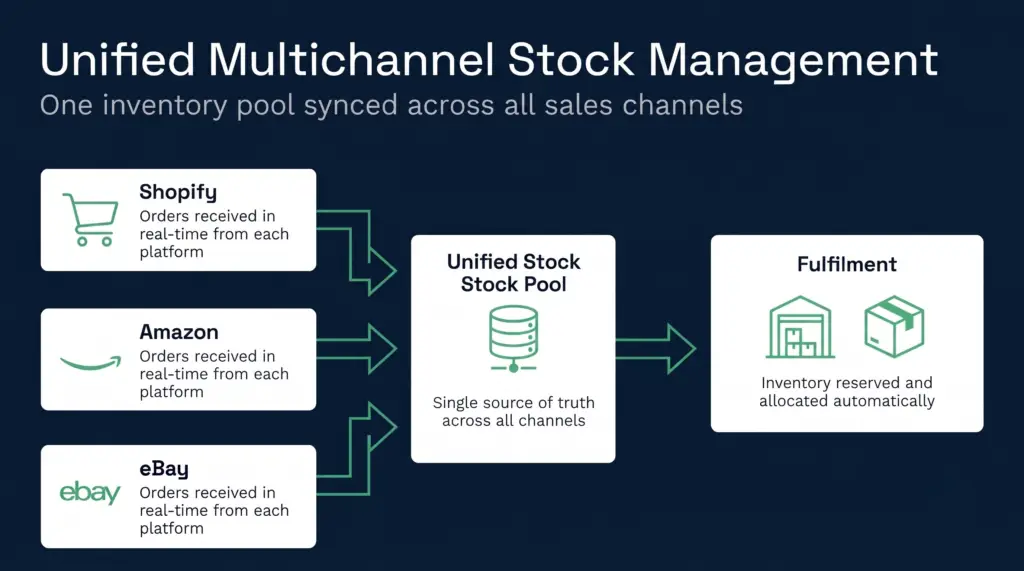
Multichannel inventory management software is built to handle the chaos of selling on Shopify, Amazon, eBay, and elsewhere simultaneously. Here’s how it works in practice:
Unified Stock Pool
Instead of keeping separate inventory for each channel, you maintain one master stock pool. The software allocates units from this pool to whichever channel sells first. A customer buys on Amazon, units are deducted from the shared pool. Ten minutes later, a Shopify customer buys the same product and gets the next available unit from the same pool. No double-counting, no orphaned stock.
Instant Channel Synchronisation
When inventory changes, the system pushes that update to every connected channel within seconds. Shopify updates, Amazon updates, eBay updates. All channels always reflect the true stock level.
Rule-Based Allocation
You can set rules to prioritise channels if needed. Maybe you want to reserve 20% of stock for direct sales on your website. Your software handles that automatically, allocating remaining units to Shopify and Amazon in real-time.
The ecommerce inventory management guide from Crunch explains these mechanics in detail, and modern platforms automate them entirely so you’re not managing allocation rules by hand.
How Inventory Software Integrates with Ecommerce Platforms
Integration is where ecommerce inventory management software earns its value. Here’s what proper integration looks like:
API-Driven Connections
Leading platforms use APIs to connect directly with Shopify, Amazon Seller Central, eBay, WooCommerce, and other storefronts. When a customer places an order, the order data flows into your inventory system automatically. The system picks the item from the warehouse, updates stock levels, and sends fulfilment instructions to your team.
Two-Way Data Flow
Integration isn’t one-directional. Your ecommerce inventory management software sends updated stock levels back to each platform, and it also receives new order data in real-time. This creates a closed loop where no manual intervention is needed.
Accounting and Reporting Integration
Proper software integrates with accounting packages like Xero eller QuickBooks. Your inventory costs, purchases, and sales flow into your books automatically. You’re not manually keying in stock adjustments or reconciling discrepancies at month-end.
For a detailed look at integrations, the best inventory management software for ecommerce comparison from Clarity Ventures breaks down which platforms connect with which ecommerce tools.
Avoiding Stockouts and Overselling Across Multiple Sales Channels
Stockouts and overselling are the twin nightmares of ecommerce. A stockout loses you a sale. Overselling costs you money in refunds, expedited shipping, or expensive replacements. Multichannel inventory management software prevents both through automation and visibility.
Automated Low-Stock Alerts
Set a reorder point (for example, “alert me when I drop below 10 units”). The system watches stock levels across all channels and sends you a notification when you’re approaching that threshold. You can then place a purchase order with your supplier before you hit zero.
Inventory Forecasting
Smarter platforms analyse your sales velocity and forecast demand. If you normally sell 50 units of Product X per week, the system flags when your current stock will run out. You can adjust prices, run promotions, or order more stock proactively instead of scrambling after stockouts happen.
Reserved Stock Management
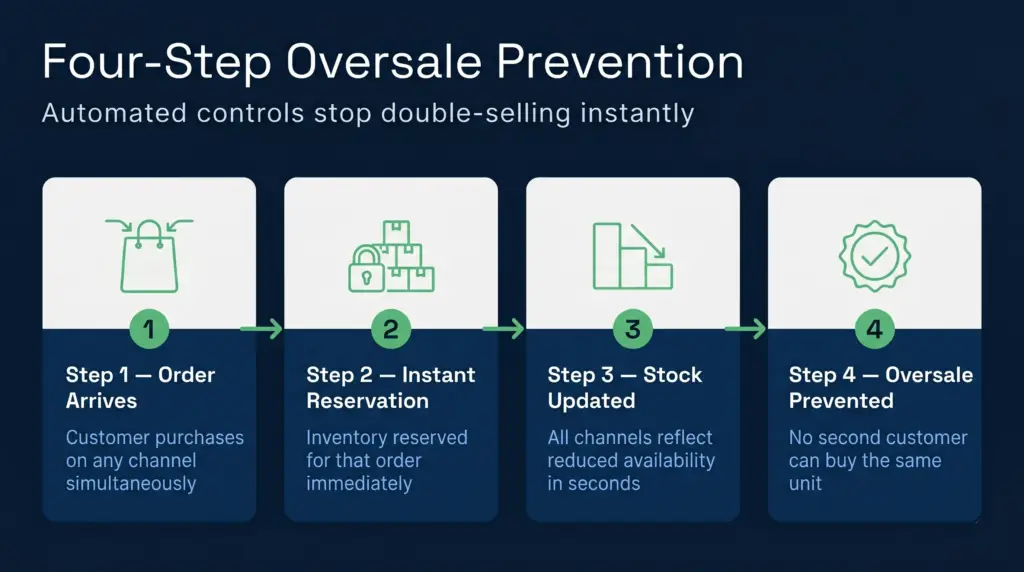
When an order is placed, the system instantly reserves inventory for that order across all channels. This prevents other customers from buying the same unit elsewhere. Your warehouse picking team then fulfils orders in the order they were placed, and stock remains accurate.
Overselling Prevention Logic
The system enforces business rules that prevent overselling entirely. If you have 5 units left and receive 2 simultaneous orders on different channels, the first order to arrive in the system takes all 5 units. The second order is either rejected (if your settings don’t allow backorders) or queued until you restock. There’s no way to accidentally promise more stock than you have.
According to the best ecommerce inventory management software solutions guide for 2025, demand forecasting and low-stock automation are now table stakes for any platform targeting serious ecommerce operators.
Key Features to Look for in Ecommerce Inventory Software
Not all inventory platforms are built the same. When evaluating options, prioritise these features:
Real-Time Synchronisation Across All Channels
This is non-negotiable. If stock updates aren’t instantaneous, you’ll eventually oversell. Test this during a trial by placing simultaneous test orders on different channels and checking how fast the system updates across the board.
Automated Purchase Order Generation
The system should automatically generate purchase orders to your suppliers based on reorder points, sales velocity, and forecast demand. This saves hours of manual work and reduces stockouts caused by forgotten orders.
Integration with Your Channels and Accounting Software
Your inventory software won’t work in isolation. It must connect seamlessly with Shopify, Amazon, eBay, WooCommerce, and your accounting platform. Check the integration roadmap before signing up.
Barcode Scanning and Warehouse Automation
If you handle fulfilment in-house, your software should support barcode scanning to speed up picking and reduce errors. Better platforms integrate with warehouse hardware like automated conveyor systems or pick-to-light displays.
Reporting and Analytics
You need visibility into stock turnover, goods inwards accuracy, and sales by channel. A dashboard that shows which products are moving fast and which are stagnant helps you make smarter restocking decisions.
Multi-Location Support
If you operate multiple warehouses or hold stock at third-party logistics (3PL) providers, the system must track inventory across all locations and allocate orders to the nearest or most efficient warehouse automatically.
The Business Case: ROI and Efficiency Gains
Implementing ecommerce inventory management software requires an investment. What’s the payoff?
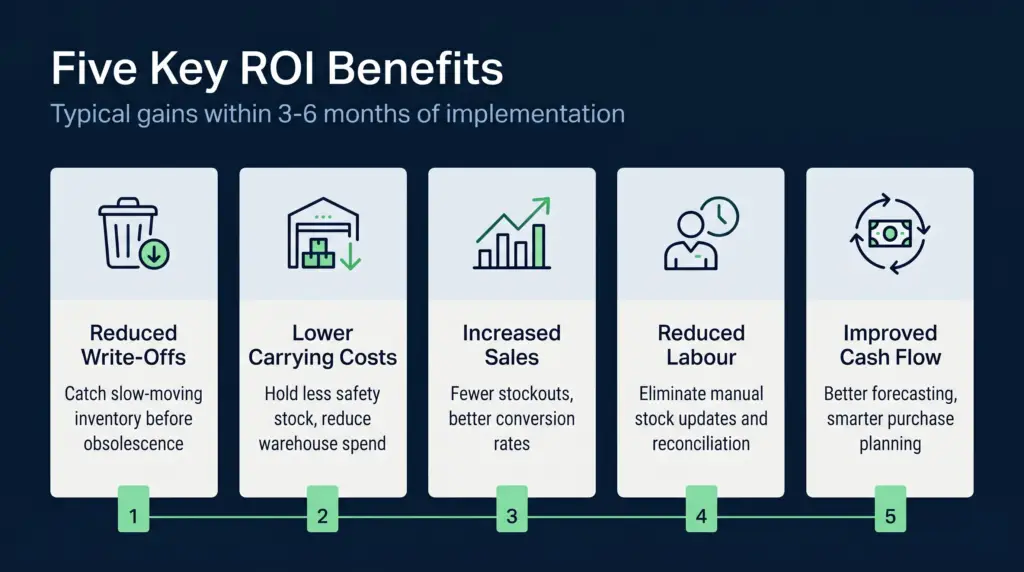
Most retailers see tangible benefits within three to six months:
- Reduced stock write-offs: Better visibility into slow-moving inventory means you catch problems before items become obsolete. This alone often pays back the software cost.
- Lower carrying costs: Accurate forecasting means you hold less safety stock. You’re not tying up cash in inventory you’ll never sell. Combined with the warehouse cost savings from faster picks and fewer errors, this impact is significant.
- Increased sales: When you stop overselling and stockouts become rare, customer satisfaction improves and repeat purchases increase. You’re also able to say “in stock” with confidence, which lifts conversion rates.
- Reduced labour costs: Your team spends hours every week manually updating inventory, reconciling discrepancies, and investigating oversold orders. Automation eliminates that busywork, freeing them to focus on strategy and customer service.
- Improved cash flow: Accurate inventory means better forecasting, which means better purchase planning. You’re not over-ordering to cover phantom stock, and you’re not under-ordering and missing sales. Your cash cycles improve.
A purpose-built solution for 3PL and ecommerce operations like Clarus WMS handles all these dimensions because it was designed from the ground up for multi-client, multichannel operations. Generic inventory software treats ecommerce as an afterthought. Purpose-built platforms live and breathe it.
Tala med en lagerarbetare
If you’re evaluating your options and want to see how a purpose-built WMS works in practice, Clarus is worth a conversation. We work with 3PLs and distributors across the UK to implement warehouse management software that fits the way you operate, not the other way around.
Kom i kontakt med vårt team att diskutera dina krav.