
Food and Beverage Logistics is fast, unforgiving, and leaves no room for system hiccups. Fresh stock comes in, moves quickly, and spoils if anything slows down. Clarus keeps everything moving with stable cloud performance, smart zoning, and workflows built for short shelf-life operations.
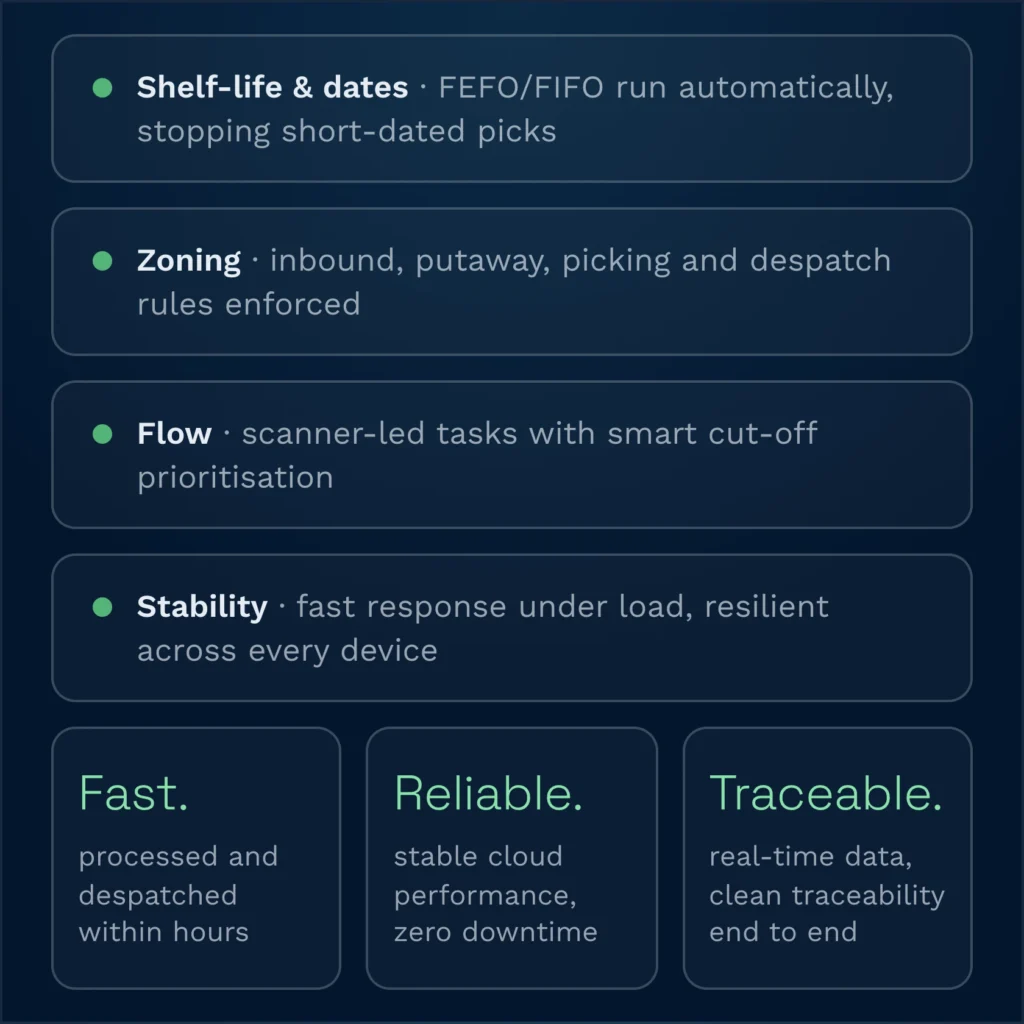
Food and Beverage Logistics is all about precision. Orders land early, stock moves fast, and everything needs processing, zoning, and despatch within hours. There’s no room for rework.
You also need rock-solid stability. When retailers depend on your timings, downtime becomes a real risk. Clarus removes hardware failures and keeps teams connected with real-time data and clean traceability end to end. Fewer issues, fewer errors, and complete confidence across the chain.
Elke kaart bevat een link naar het volledige artikel, met de bewijsstukken en configuratiegegevens die een operationeel manager nodig heeft voordat hij een shortlist opstelt.
Automatically manage expiry, best-before, use-by, and rotation. FEFO and FIFO run in the background, stopping short-dated picks and showing teams exactly what needs to move first. It cuts waste and keeps retailers stocked without any compromise.
Food Logistics needs strict zoning. Clarus enforces rules across inbound, putaway, picking, and despatch so nothing ends up in the wrong place. Staff can’t mis-store product, stock stays in the right zone, and workflows stay safe and compliant (essential for sites handling fresh, ambient, and sensitive lines).
Food distribution has to move fast. Inbound lands early, gets processed straight away, and outbound leaves within tight windows. Clarus keeps the flow clean with real-time updates, scanner-led tasks, and smart cut-off prioritisation… reducing bottlenecks and cutting last-minute scrambles.
Short shelf-life goods can’t wait for systems to recover. Uptime is a hard requirement. Clarus delivers stable cloud performance, fast response under load, and resilience across every device. Teams stay productive, stock keeps moving, and no one is stuck firefighting IT while goods are going off.
De Clarus AI-assistent werkt binnen uw bedrijfsvoering: hij spoort gemiste kosten op, zet voorraad in quarantaine, groepeert bestellingen en versnelt de facturering. En dankzij de ingebouwde MCP-server kunnen uw eigen AI-tools rechtstreeks verbinding maken met het magazijn.
Kosten terugvorderen
Voorraad beschermen
Beheer automatiseren
Randtransport needed tighter control for its food customers. BRCGS demands clean batch tracking, best-before control, and full traceability, but the old setup relied on manual checks, messy pallet histories, and no reliable way to prove what happened across inbound, storage, moves, or despatch.
Clarus fixed it. Best-before and batch dates now drive the flow, the shortest-dated goods are picked first, and part pallets clear before full ones. The warehouse is cleaner, accuracy is higher, and waste is down. Traceability is no longer a scramble: Edge can pull full pallet histories, movement logs, PODs, receipts, and audit evidence in minutes.
A Food & Beverage WMS must handle shelf-life control, traceability, rapid turnaround, and zoning without adding complexity. The sector moves at speed, so the system must support FEFO/FIFO, batch tracking, allergen controls, and accurate picking. It also has to be stable — downtime is a direct risk to product quality. A suitable WMS protects product integrity, supports compliance, and moves goods fast enough to meet retailer expectations.
The system should record batch IDs, production dates, expiry dates, and handling rules automatically. Zoning is enforced through logic: operators can’t store or pick items from the wrong area, and the system prevents cross-contamination through enforced workflows. Regulations such as BRCGS or HACCP often apply, but specific compliance depends on the site. Clarus supports accurate, timestamped records and clean process control, but details should always be validated against the operator’s exact standards.
Modern systems calculate FEFO automatically, flag short-dated stock, and prevent teams from selecting the wrong pallets or cases. This is critical in bakery, chilled, or delicate foods. The WMS uses expiry attributes captured at goods-in, then routes tasks based on what must move first. It reduces waste, protects service levels, and simplifies reporting. For rapid-turnover operations, these rules run silently in the background, keeping everything flowing.
Most food logistics implementations run from several weeks to a few months, depending on the number of zones, integrations, temperature areas, and SKU complexity. High-velocity operations often require staged go-lives to minimise disruption. Training is usually quick because workloads are task-driven and handheld-based. These timelines are estimates; actual scope and readiness determine the pace.
Yes, though specifics vary by site. Many connections are handled through APIs, middleware, or standard file exchange. Retailer feeds (EDI or API), weigh-scale links, and production systems often require configuration but are common in food logistics. Any assumptions on integration should be checked against your actual systems. Clarus handles multi-device setups and real-time updates, ideal for busy food operations across ambient or temperature-controlled zones.
Food waste comes from delays, errors, and poor stock rotation. A strong WMS cuts all three by enforcing shelf-life rules, surfacing short-dated stock, and driving clean picking paths. KPIs typically include DIFOT, waste reduction, traceability accuracy, labour efficiency, and SLA performance. By preventing downtime and streamlining high-velocity flows, the WMS helps maintain service levels even on the tightest turnaround windows.