

Choosing warehouse management software requires cutting through marketing claims to understand how each platform performs in real operations. The global WMS market reached USD 3.38 billion in 2025 and is projected to grow at a CAGR of 21.9% through 2033 (Grand View Research), which means the number of options available to warehouse operators is growing rapidly. This guide reviews the leading platforms across enterprise, mid-market, and SME categories, with a focus on what matters most to UK warehouse professionals.
Wat zijn de beste softwareplatforms voor magazijnbeheer in 2026?
Welk WMS-platform het beste is, hangt af van de omvang van uw bedrijf, de branche waarin u actief bent en uw integratiebehoeften. Grote ondernemingen geven doorgaans de voorkeur aan SAP EWM, Manhattan Active WMS of Oracle NetSuite, terwijl middelgrote bedrijven en 3PL-bedrijven beter af zijn met cloud-native platforms die zijn ontworpen met het oog op flexibiliteit en het beheer van meerdere klanten.
How do the leading WMS platforms compare?
| Platform | Beste voor | Implementatie | Key strength |
|---|---|---|---|
| Manhattan Active WMS | Grote onderneming, multichannel | Wolk | Quarterly updates without disruptive upgrades |
| SAP Extended Warehouse Management | SAP ecosysteembedrijven | Cloud / on-premise | Diepe ERP-integratie, complexe fulfilment |
| Oracle NetSuite WMS | Growing businesses needing ERP + WMS | Wolk | Hoogst gewaardeerd voor gebruiksvriendelijkheid onder zakelijke tools |
| Infor WMS | Manufacturing, multi-site operations | Cloud / on-premise | Industry-specific configurations |
| Indigo WMS (Aptean) | UK-based 3PLs, food & drink, fashion | Cloud / on-premise | UK-focused with strong 3PL capabilities |
| Clarus WMS | 3PLs, enterprise multi-client operations | Cloud-native | Purpose-built for 3PL billing, multi-client, rapid deployment |
For a broader view of available options, review directories such as Capterra VK, Software Advies, en Gartner Peer Insights provide verified user reviews from warehouse professionals.
Waar moet je op letten bij het beoordelen van magazijnsoftware?
De belangrijkste beoordelingscriteria reiken verder dan een opsomming van functies. Een WMS dat er in een demo indrukwekkend uitziet, kan in de praktijk moeite hebben met uw specifieke werkprocessen, gegevensvolumes of integratie-eisen. Richt uw beoordeling vooral op de operationele geschiktheid in plaats van op het aantal functies.
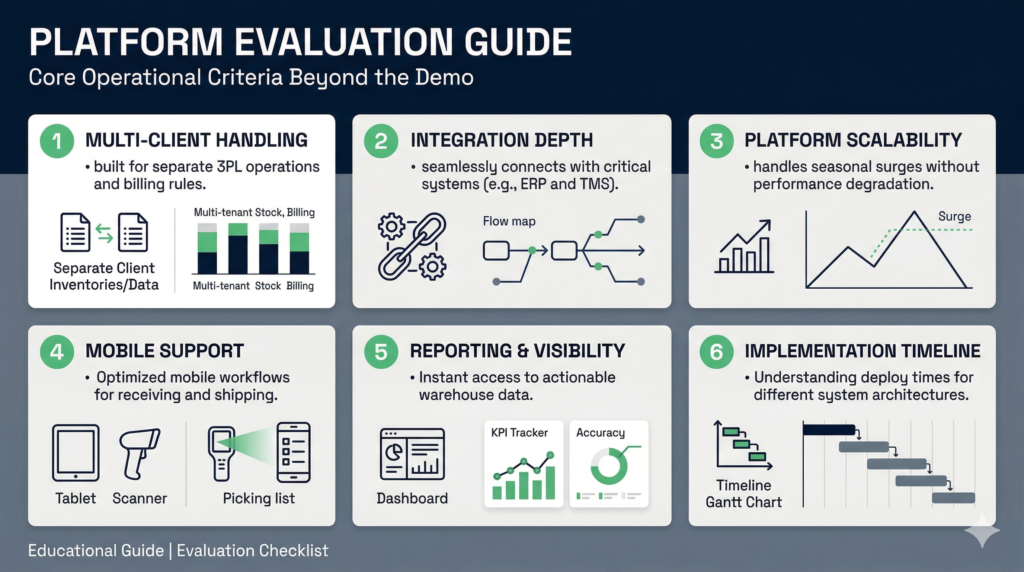
Core evaluation criteria
- Multi-client capability — if you operate a 3PL, the WMS must handle separate client inventories, billing rules, and reporting without workarounds
- Integratiediepte — how the WMS connects with your ERP, transport management system, carrier APIs, and e-commerce channels
- Schaalbaarheid — whether the platform handles peak volumes (Black Friday, seasonal surges) without performance degradation
- Mobile and scanning support — barcode and RFID scanning on handheld devices for picking, packing, and receiving workflows
- Reporting and visibility — real-time dashboards, KPI tracking, and the ability to build custom reports without vendor involvement
- Implementation timeline — cloud-native platforms often deploy in weeks, while enterprise on-premise systems can take 6–12 months
What questions should you ask during a WMS demo?
- Can I see the system handling multi-client inventory with different billing rates?
- How does the platform handle exceptions — short shipments, damaged goods, returns?
- What does the integration process look like for our existing ERP?
- How are software updates deployed, and do they require downtime?
- What is the typical go-live timeline for an operation of our size?
Hoeveel kost software voor magazijnbeheer?
De prijzen voor WMS-systemen lopen sterk uiteen, afhankelijk van het implementatiemodel, de omvang van de bedrijfsactiviteiten en de leverancier. Bij cloudgebaseerde platforms worden doorgaans kosten per gebruiker of per magazijn per maand in rekening gebracht, variërend van £ 200 tot £ 2.000+ per maand. Bij on-premise oplossingen voor grote ondernemingen zijn er licentiekosten vooraf van £ 50.000 tot £ 500.000+ plus doorlopende onderhoudskosten.
Welke prijsmodellen gebruiken WMS-leveranciers?
| Prijsmodel | Typisch bereik | Beste voor |
|---|---|---|
| Per user / per month (SaaS) | £50-£200 per gebruiker/maand | SMEs, growing operations |
| Per magazijn / per maand | £500–£2.000/maand | Multi-site operations |
| Transactiegebaseerd | Variabele per orderregel | High-volume e-commerce |
| Perpetuele licentie + onderhoud | £50.000–£500.000+ aanbetaling | Large enterprises with specific compliance needs |
Cloud SaaS solutions now dominate the market, holding the largest revenue share and growing at a CAGR of 22.6% through 2033 (Grand View Research). The shift to cloud is driven by lower upfront costs, faster deployment, and automatic updates.
Welke magazijnsoftware is het meest geschikt voor 3PL-activiteiten?
Third-party logistics providers need WMS platforms purpose-built for multi-client environments, not enterprise ERPs adapted for warehousing. The 3PL segment held the largest WMS market share in 2024, reflecting how critical specialised software is to this sector (Grand View Research).
Key requirements for 3PL warehouse software include:
- Scheiding van voorraden voor meerdere klanten — maintaining separate stock, locations, and rules for each client within a single warehouse
- Client-specific billing — automated invoicing based on storage, handling, pick-and-pack, and value-added services per client
- Client portal access — giving your customers real-time visibility into their inventory and orders without exposing other clients’ data
- Flexible workflow configuration — each client may have different picking methods, packing requirements, and carrier preferences
At Clarus WMS, we built our platform specifically for 3PL complexity. Multi-client billing, client-specific workflows, and real-time client portals are native capabilities rather than add-ons. One of our 3PL clients managing seven different brand accounts from a single warehouse reduced their billing preparation time by 60% after switching from a generic ERP-based WMS to Clarus… the automated client-specific billing eliminated hours of manual spreadsheet reconciliation each week.
Wat zeggen echte gebruikers over toonaangevende WMS-platforms?
User reviews across platforms like Gartner Peer Insights en Capterra consistently highlight the same themes regardless of the specific WMS being reviewed.
Common praise in WMS reviews
- Inventory accuracy improvements — most users report significant gains in stock accuracy after implementing a WMS, often moving from 85–90% to 99%+ accuracy
- Picking efficiency — directed picking workflows reduce training time for new staff and increase picks per hour
- Realtime inzicht — the ability to see stock levels, order status, and warehouse performance in real time is consistently rated as the highest-value feature
Common criticisms in WMS reviews
- Implementation complexity — enterprise WMS platforms frequently receive criticism for lengthy, expensive implementations that overrun timelines
- Customisation costs — users report that adapting the software to specific workflows often requires expensive professional services
- Integration challenges — connecting the WMS to existing systems (ERP, TMS, e-commerce) is frequently cited as the most difficult aspect of adoption
- User interface — older platforms often receive lower ratings for dated interfaces that require extensive training
Hoe maak je een keuze tussen een cloud- en een on-premise WMS?
Cloud-WMS-platforms zijn tegenwoordig de meest gangbare keuze bij nieuwe implementaties, omdat ze lagere initiële kosten, een snellere implementatie en automatische updates bieden. On-premise-oplossingen blijven relevant voor organisaties met strenge eisen op het gebied van gegevenssoevereiniteit of sterk op maat gemaakte integraties met legacy-systemen.
| Factor | Cloud WMS | On-premise WMS |
|---|---|---|
| Upfront cost | Low (subscription) | High (licence + infrastructure) |
| Implementatietijd | Weeks to months | 6–12+ months |
| Updates | Automatic, vendor-managed | Manual, scheduled downtime |
| Schaalbaarheid | Elastic, pay as you grow | Requires infrastructure investment |
| Data control | Vendor-hosted | Full on-site control |
| IT overhead | Minimal | Significant (servers, backups, security) |
The transportation and logistics application segment is growing at a CAGR of 23.2% (Grand View Research), with cloud deployment driving the majority of new adoptions. For most UK warehouse operations, cloud WMS now offers the strongest combination of capability, cost, and speed to value.
Ready to see how Clarus WMS compares?
Reviewing warehouse software is time well spent… the right WMS transforms your operation, while the wrong one creates years of workarounds and frustration. If you run a 3PL or multi-client warehouse operation, Clarus WMS was built specifically for your challenges.
Our team offers personalised demos using your actual workflows, so you can evaluate the platform against your real requirements rather than generic scenarios. Boek een demo and see how Clarus WMS handles the complexity that generic platforms struggle with.
Referenties
- Warehouse Management System Marktomvang Rapport, 2033 — Grand View Research. Schakel
- De beste beoordelingen van magazijnbeheersystemen 2026 — Gartner Peer Insights. Schakel
- Magazijnbeheersysteem — Capterra UK. Schakel
- Warehouse Management Systeem Vergelijking — Software Advice. Schakel
- 5 Best Warehouse Management Systems 2026 — Mintsoft. Schakel
- Best WMS Software Companies in 2026 — Warego. Schakel
- Top 10 Warehouse Management Systems Tools in 2026 — DevOps School. Schakel