

Pick and pack is the physical core of warehouse fulfilment. When a customer places an order, warehouse teams must locate items, verify them, and package them for shipment, often within hours. For 3PL operators and warehouse managers, every second of this process matters. Rising online sales, labour shortages, and margin pressures mean that how you approach pick and pack directly impacts your bottom line and your customers’ satisfaction. This guide explores what pick and pack is, the main operating methods, common challenges, and how modern technology transforms this labour-intensive work.
What is pick and pack in a warehouse?
Pick and pack fulfilment is the process of locating items from warehouse inventory, removing them from storage, and packaging them for shipment to customers. When an order arrives at your warehouse management system, a digital packing slip is generated with full order details. A warehouse picker then retrieves that item (or items) from the shelf or storage location and transports it to a packing station, where it is packed into the correct box, envelope, or bag, labelled with the shipping address, and prepared for handoff to a carrier. Pick and pack fulfilment is the heartbeat of e-commerce operations: online sales now account for 27.1% of retail transactions in the UK, and the logistics sector processes over 4.4 billion online orders annually.
For 3PL warehouses, pick and pack efficiency directly determines how many customer orders can be fulfilled per day, how accurate those shipments are, and how much labour cost is absorbed per transaction. A purpose-built 3PL management system is essential because it orchestrates picking routes, prioritises orders, and reduces picker travel time.
Why pick and pack matters
Order picking accounts for more than 55% of total warehouse operating costs. This means that even small improvements in picking speed or accuracy can have significant cost and customer satisfaction benefits. A single mis-pick can trigger a return, a complaint, or a chargeback, all of which cost far more than the item itself. Conversely, fast, accurate picking improves customer delivery times, reduces complaints, and strengthens your competitive position.
What are the main steps in the pick and pack process?
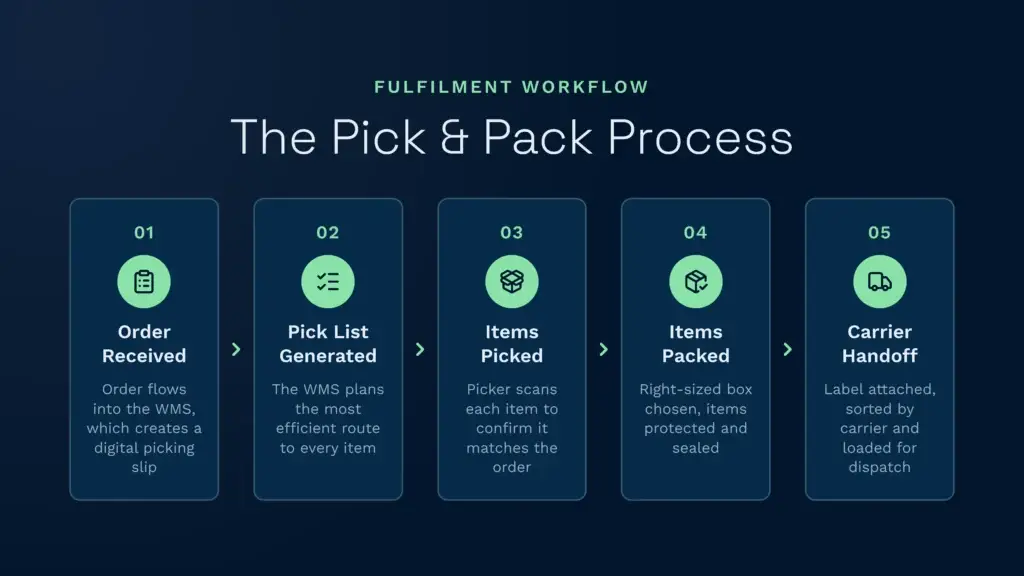
The pick and pack process follows a clear sequence: order receipt, picking, packing, labelling, and shipment. Each step is interconnected. Delays in picking slow packing; errors in picking force repacking; poor labelling creates carrier and customer confusion. Understanding each step helps you identify bottlenecks and optimise your operation.
Step 1: Order receipt and system notification
When a customer places an order online or via a sales channel, the order data flows into your order management system (OMS) or warehouse management system (WMS). The WMS instantly generates a digital picking slip with the customer’s order details, item SKUs, quantities, and delivery address. This slip is sent to a warehouse picker’s handheld device, tablet, or printed on paper, depending on your technology setup.
Step 2: Picking
The picker receives the order and navigates to the storage location (bin, shelf, or aisle) where the item is stored. Modern WMS systems assign the most efficient picking route to reduce walking distance and overlap. The picker retrieves the item, scans or verbally confirms the barcode to verify it matches the order, and places it on a trolley or into a tote. If the order has multiple items, the picker continues to the next location until all items are collected.
Step 3: Quality check and staging
Picked items are often brought to a staging area where a quality check may occur. A checker scans the picked items against the packing slip to ensure the right item, quantity, and condition. This step is optional but highly recommended, catching errors before packing prevents costly returns and customer complaints.
Step 4: Packing
Items move to the packing station. The packer selects the appropriate box, bag, or envelope based on item size and weight to minimise shipping cost and reduce damage risk. Fragile items are wrapped; heavy items are placed at the base. The packing slip is placed in the box or attached to the outside. The box is sealed and is ready for labelling.
Step 5: Labelling and dispatch
A shipping label is printed with the customer’s address, código de barras, and tracking number. The label is affixed to the package. The package then moves to a dispatch area where it is sorted by carrier and loaded onto outbound vehicles. The carrier picks up and the order is on its way to the customer.
What picking methods do 3PLs use?
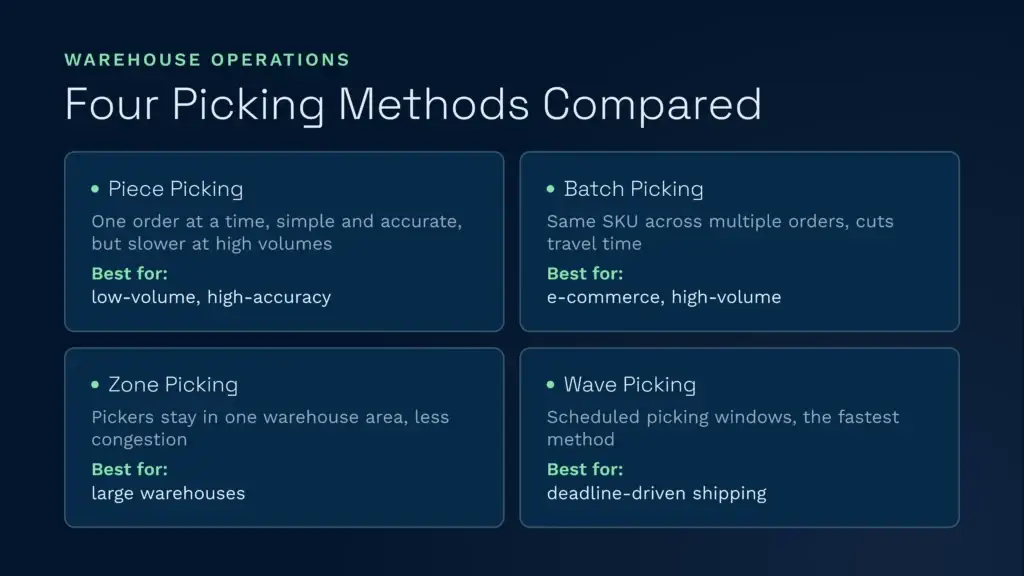
Not all picking strategies are equal. Warehouses use four main picking methods—piece, batch, zone, and wave—each suited to different order volumes, warehouse layouts, and product ranges. Understanding the pros and cons of each helps you choose the right approach for your operation.
Piece picking (single-order picking)
Piece picking, also called single-order picking, is the simplest and slowest method. A picker receives one customer order, picks all items for that order, and delivers them to the packing station before moving to the next order. While this approach minimises errors and works well for small e-commerce businesses or warehouses managing limited daily volumes, it results in a lot of wasted picker travel time and is inefficient for high-volume operations.
Picking por lotes
Batch picking groups multiple similar orders together. A picker collects items for, say, five customer orders in one trip, then sorts and routes the items to the correct packing station. This reduces travel time and picker fatigue compared to piece picking. Picking por lotes is effective for operations with moderate order volumes and works well when items are clustered in the same warehouse zones.
Recogida por zonas
In zone picking, the warehouse is divided into zones (e.g., A–D), and a picker is assigned to one zone. When an order arrives, each zone’s picker retrieves the items for that order from their zone, then passes the partially picked order to the next zone. Zone picking reduces picker congestion and suits large warehouses with distinct product categories. However, coordination between zones is critical to avoid bottlenecks.
Picking por olas
Wave picking combines batch and zone picking. Orders are grouped into “waves” based on priority, order similarity, carrier pickup windows, or delivery destination. All pickers work simultaneously on items in the current wave, optimising their routes and reducing travel overlap. Wave picking is the most efficient method for high-volume 3PLs and e-commerce fulfilment centres because it maximises throughput and minimises idle time. A detailed warehouse order picking guide explores these methods and their execution in depth.
Comparison table: Picking methods
| Method | Speed | Accuracy | Complexity | Best For |
|---|---|---|---|---|
| Piece picking | Slow | Very high | Low | Small e-commerce, low volume |
| Picking por lotes | Moderate | High | Moderate | Moderate volume, similar orders |
| Recogida por zonas | Moderate to fast | High | Moderate to high | Large warehouses, diverse inventory |
| Picking por olas | Very fast | High | High | High-volume 3PLs, e-commerce |
How can warehouses improve picking accuracy and speed?
Modern pick and pack operations achieve picking accuracy targets of 99.5% and speeds exceeding 120 items per hour through a combination of system optimisation, layout design, and staff practices. Speed without accuracy is costly, a single mis-pick triggers a return, restocking, and a potential customer complaint. Accuracy without speed loses you margin and customer satisfaction. Both matter equally.
Reduce travel distance with dynamic slotting
Dynamic slotting involves strategically placing fast-moving items closer to the packing area and slower-moving items further back. High-demand products occupy prime, easy-to-reach locations. This single change can reduce picker travel time by up to 30%, directly increasing picking speed and reducing fatigue. A warehouse design and layout checklist provides a framework for optimising your physical space.
Implement barcode scanning and verification
Escaneo de códigos de barras removes ambiguity. When a picker scans the item barcode and it does not match the order, the system alerts them immediately. This prevents mis-picks before they reach the packing station. Modern WMS systems prompt pickers to scan both the location barcode and the item barcode, creating a double-check that catches errors on the spot. Random order verification checks after picking also reinforce accuracy.
Use structured order batching
Group orders by location, carrier, or delivery window before releasing them to pickers. This minimises re-picking and backtracking. Smaller, focused batch sizes also reduce mental load on pickers and improve concentration, leading to fewer errors.
Invest in staff training and incentives
Picker training should cover warehouse layout, picking methods, quality standards, and safety. Performance metrics should be visible to pickers, speed and accuracy targets with positive feedback and incentives drive engagement and results. Regular training sessions, refreshers, and open communication about performance keep teams aligned.
Monitor and measure KPIs
Track picking rate (picks per hour), picking accuracy (error-free orders as a percentage), order cycle time, and cost per order. Use these metrics to identify underperforming areas and staff, and to measure the impact of changes. Weekly or daily reporting helps teams stay focused on continuous improvement.
What technology powers modern pick and pack operations?
Technology is no longer optional in pick and pack fulfilment. Manual, paper-based picking is slow, error-prone, and labour-intensive. Modern technology reduces human error, increases speed, and helps warehouses operate with leaner teams. The main technologies are warehouse management systems, barcode scanning, voice picking, and robotic automation.
Warehouse management systems (WMS)
A WMS is the central nervous system of your pick and pack operation. It receives customer orders, assigns picking routes, tracks inventory in real time, and manages labour allocation. A good WMS reduces picking errors by more than 30% and can improve accuracy to 99.9%. Solutions for warehouse management should integrate with your order channels and accounting systems to eliminate manual data entry and create a seamless flow from order to shipment.
Barcode and scanning technology
Barcode scanners (handheld, fixed-mount, or mobile devices) eliminate guesswork. Pickers scan the location, scan the item, and the WMS confirms the match. If there is a discrepancy, the system alerts the picker immediately. Barcode technology is inexpensive, proven, and integrates with all modern WMS solutions. It is the foundation of accurate picking.
Voice-directed picking
Voice picking systems guide warehouse workers through tasks using verbal instructions via a headset connected to the WMS. The picker hears spoken directions: “Go to aisle C, bin 15, pick two units of SKU 1234.” The picker confirms by speaking the item number back to the system, and it directs them to the next location. Voice picking is completely hands-free and eyes-free, allowing pickers to move freely and maintain situational awareness. A UK manufacturer reported a 50% picking efficiency increase after implementing voice picking; most deployments achieve 15–20% improvements within 12 months. Voice picking also reduces scanning errors because the picker verbalises the SKU, adding a layer of verification.
Mobile devices and handheld terminals
Modern handheld terminals or tablets replace paper picking lists and fixed barcode scanners. Pickers carry a mobile device that displays the next item location, quantity, and SKU. They scan the barcode and the device confirms the pick. Mobile devices enable real-time communication with the WMS, instant error alerts, and dynamic route updates. They also improve data capture and traceability.
Robotic and automated picking systems
Goods-to-person (GTP) robots bring storage bins or shelves to a stationary picker, eliminating travel time altogether. Autonomous mobile robots (AMRs) transport picked items from picker to packer. Automated picking systems can increase picking productivity by up to 300% compared to manual operations. Warehouse receiving processes also benefit from automation, which sets the stage for smooth picking operations downstream. The UK warehouse automation market was valued at USD 2.4 billion in 2025 and is projected to reach USD 5.6 billion by 2034, reflecting strong adoption momentum. However, automation requires significant capital investment and is most cost-effective for high-volume, continuous operations.
How Clarus WMS supports pick and pack fulfilment
Clarus WMS is a purpose-built warehouse management system for 3PLs and enterprise logistics operations. It orchestrates pick and pack from order intake through shipment, with features specifically designed for multi-carrier, multi-channel e-commerce fulfilment. Clarus integrates barcode scanning, voice-directed picking, and dynamic routing to maximise picking speed and accuracy. Its real-time inventory visibility prevents stockouts and ensures pickers always work with current data. Clarus also tracks picking KPIs, staff performance, and cost per order, enabling continuous improvement and transparent reporting to customers.