

Finding the right 3PL software is a pivotal decision. The stakes are clear: pick the wrong system, and you’re locked into outdated workflows, billing leakage, manual invoicing, and unhappy clients. Pick the right one, and you unlock the ability to scale, onboard new clients confidently, and automate the operational nightmares that eat up your team’s time.
The market for 3PL software has shifted dramatically. Legacy systems designed for single-client warehouses are now dinosaurs when it comes to multi-client complexity. Modern systèmes de gestion d'entrepôt built for 3PLs handle real challenges: isolated stock for each client, client-specific billing rules, real-time client portals, and integration with the tools your customers already use.
This guide walks through what 3PL software actually does, the core features that separate purpose-built systems from retrofitted ones, pricing models across different scales, and a breakdown of use-case-specific solutions so you can identify which systems fit your operation.
What is 3PL Software and How Does It Differ from WMS?
The confusion starts here: many people use “3PL software” and “warehouse management system” interchangeably. They’re not the same thing, and the distinction matters.
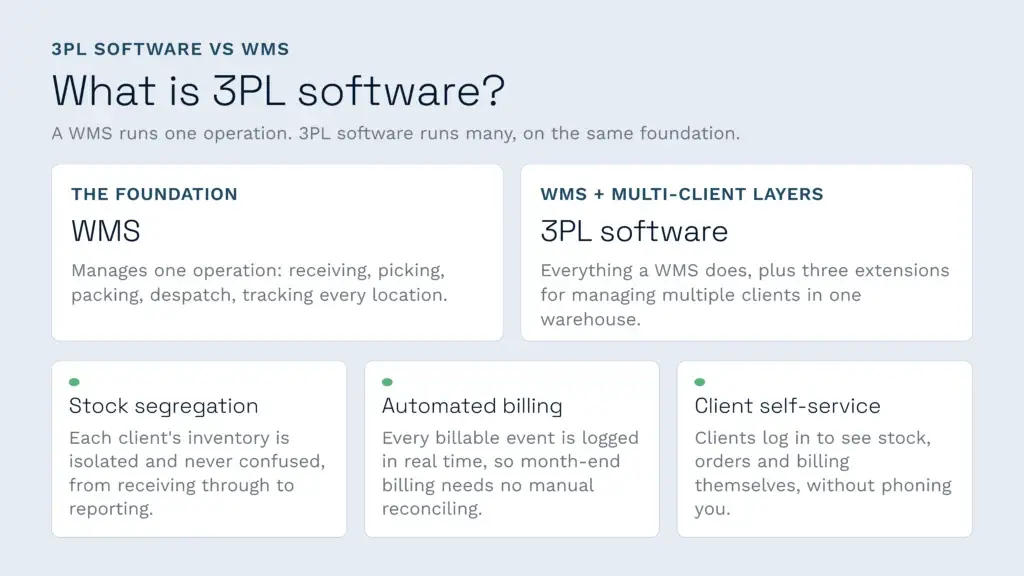
Système de gestion d'entrepôt (WMS) is the foundational technology that manages a single operation: receiving, putaway, replenishment, préparation des commandes, emballage, expédition. It tells you where inventory is, optimises picking routes, prevents mis-picks through scan verification, and maintains stock accuracy. A WMS is concerned with efficiency within your four walls.
3PL Software starts with WMS capabilities but adds the layers that make multi-client warehousing possible. Think of it as WMS plus three critical extensions:
- Stock segregation: Each client’s inventory is isolated within the same warehouse. Client A’s 10,000 units of Product X cannot be confused with Client B’s stock of the same product. The system enforces that isolation at every step, receiving, picking, rapports.
- Facturation automatisée : Every billable event is captured in real time. A pick happens, the system logs it. A unit moves into storage , the system records it. A return is processed, the system notes it. At month-end, facturation is calculated automatically, not reconciled manually from spreadsheets.
- Client self-service: Your customers can log into a portal, see their real-time stock levels, track orders, view billing summaries, and monitor SLA compliance, without phoning you.
That distinction is crucial. A generic WMS retrofit to handle multiple clients creates operational pain: billing becomes a nightmare of manual counting, clients badger you for stock visibility because there’s no portal, and onboarding new clients feels like a project rather than a workflow.
Meilleur logiciel de gestion d'entrepôt pour 2026 explores the broader WMS landscape, but if you’re running a 3PL, you need software purpose-built for the multi-client model. That’s what this guide focuses on.
Core Features Every 3PL Should Look for in WMS Software
The operational realities of a 3PL create specific software demands. Here are the non-negotiables.
Multi-Client Stock Isolation and Management
This is the technical foundation. When Client A’s SKU arrives, the system must tag it with the client identifier. When Client B orders that same SKU, the pick logic must pull from Client B’s stock, not Client A’s. This seems obvious until you realise many WMS platforms treat “client” as a reporting dimension, not a stock segregation rule. They’ll move the wrong inventory and you’ll discover the problem at reconciliation.
Purpose-built 3PL software enforces isolation at the database level. Client A’s stock is physically and logically isolated. Reporting is siloed. Cross-contamination is technically impossible, not just procedurally discouraged.
Automated Billing Engine
Manual facturation is the top operational pain in 3PL. A two-person invoicing team spends three to four days a month pulling data, cross-referencing stock moves, and building invoices. That work is error-prone and it leaves revenue on the table, activity gets missed, charges aren’t applied, disputes drag on.
An automated billing engine captures every transaction: receiving fees, storage charges, pick labour, packing, shipping label generation, returns processing, value-added services. As the event happens, it’s logged and priced according to the client’s contract. Entrepôt de St John’s Hall saw invoicing time collapse from four hours to twenty minutes after switching to a system with real-time billing. That’s not a marketing claim, that’s the operational reality of eliminating manual counting.
Real-Time Client Portal
Today’s clients expect visibility. They want to see their stock levels now, not when you get around to emailing a spreadsheet. A self-service client portal reduces support burden and strengthens client relationships. It should show:
- Real-time stock by SKU, location, and status (available, in-transit, on-hold).
- Order history and current order status.
- Shipment tracking (linked to carrier tracking).
- Billing summaries and invoice history (white-labelable to your brand).
- SLA performance reporting (on-time receipt rate, picking accuracy, etc.).
The portal should be white-labelable so it feels like your clients are using your platform, not your WMS vendor’s. This small detail matters more than it seems, it strengthens your brand and makes switching costs higher for your customers.
Flexible Billing Rules and Multi-Tier Pricing
Every client’s contract is different. Client A pays per unit stored plus a flat receiving fee. Client B pays by pallet, with value-added services billed separately. Client C has minimum monthly charges with overage rates.
Your WMS must support configurable billing logic without custom code. Rules should include:
- Tiered storage pricing (e.g. first 1,000 units at £0.50, next 5,000 at £0.35).
- Activity-based charges (pick labour, pack labour, returns processing).
- Minimum monthly fees and overages.
- Client-specific SKU-level pricing (e.g. hazmat SKUs cost more).
- Volume discounts tied to thresholds.
- Billing cycles (monthly, weekly, per-event).
Flexibility here is how you win contracts. Prospects often say “we can’t move because our current vendor can’t price our model.” If your WMS can adapt to any reasonable billing structure, you’ve just unlocked a new revenue stream.
Integration with Ecommerce Platforms, ERP, and Carriers
Your clients use Shopify, Amazon, WooCommerce, Magento. Your own system talks to Sage, Dynamics, or QuickBooks. You ship via 70+ carriers (DHL, UPS, La Poste Royale, DPD, Parcelforce, TNT, etc.). Your WMS can’t be a standalone island.
Modern 3PL software should offer:
- Out-of-the-box ecommerce integrations: Shopify, Amazon, eBay, Etsy, TikTok Shop, WooCommerce, BigCommerce, Magento, Wix, Squarespace, OnBuy.
- Architecture « API-first » : For custom integrations, EDI, XML, CSV via SFTP, or MCP server access so AI tools can query live warehouse data.
- Transporteur intégrations: 70+ shipping providers. Label printing, rate shopping, proof-of-delivery capture.
- ERP and inventory systems: Sage 200, Dynamics, SAP, QuickBooks, Brightpearl, Zoho, Unleashed Software.
- No-code integration tools: For clients or partners who want to wire up their own systems without engineering overhead.
Audit Trail and Compliance
Every action in a 3PL is potentially billable and potentially disputable. A client claims they never received a shipment. A regulator asks for a full trace of a batch of products. You need to prove what happened, when, and by whom.
Your WMS should log:
- Every stock movement (receipt, putaway, préparation des commandes, emballage, expédition, return).
- Who performed the action and when.
- Serial numbers, batch codes, expiry dates, and best-before information.
- Temperature and environmental conditions (for perishables or hazmat).
- Exception handling (e.g. rejected receipt, quality hold, damage).
This isn’t bureaucracy, it’s operational protection. A full audit trail resolves disputes instantly and keeps you compliant with food standards, pharmaceutical traceability, and retail audit requirements.
Common Benefits of Purpose-Built 3PL Software
When you implement 3PL software purpose-built for multi-client operations, the operational shifts happen fast. Here’s what clients typically report.
Elimination of Manual Invoicing and Revenue Leakage
Manual billing is one of the fastest sources of revenue loss. Activities slip through the cracks. Data entry errors create disputes. Invoices are late, clients challenge line items, and finance spends days reconciling instead of collecting. Automated billing means:
- Every event is captured: No missed picking charges, storage moves, or value-added services.
- Invoices are accurate by design: They’re calculated from real transactions, not estimates or manual counts.
- Invoices are on time: Generated automatically, they can be sent on day 1 of the next month, not day 25.
- Disputes are resolved fast: You can pull a transaction log and prove exactly what happened.
The financial impact is substantial. A typical 3PL with £50k monthly revenue might recover 3-5% through facturation automatisée alone, money that was previously left on the table through missed charges or underpricing.
Improved Stock Accuracy and Faster Reconciliation
Les inventaires manuels sont lents et imprécis. Grâce au suivi en temps réel du système de gestion des stocks (WMS), vous connaissez l'état de vos stocks à tout moment. L'inventaire tournant devient alors une tâche de maintenance, et non plus une urgence liée à la production. JODA Fret brought stock accuracy from the low 90s to 99% after implementing purpose-built WMS technology—that precision eliminates customer disputes and reduces write-offs.
Faster Client Onboarding
Onboarding a new client manually takes weeks: setting up receiving procedures, training pickers on new SKU layouts, building billing logic, configuring rapports. Purpose-built systems compress this to days because the infrastructure is already there. You configure client parameters (pricing rules, integration endpoints, portal settings) and you’re live. That speed is a competitive advantage, prospects know they can go live in a week, not a quarter.
Reduced Operational Headcount Requirements
Labour is your largest variable cost. Automation doesn’t eliminate roles, but it does eliminate toil. Smart picking (batch automation, wave picking, directed putaway) reduces pickers’ travel time and cognitive load. Automated billing removes the need for dedicated invoice reconciliation. Real-time portals reduce the support queue. The net result: you can handle 50% more volume with the same headcount, which directly improves margin.
Enhanced Client Relationships Through Transparency
A self-service portal changes the client relationship. Instead of chasing you for stock updates, they log in and see real-time data. Instead of questioning your invoices, they see the underlying transactions. Transparency builds trust and reduces churn. Clients who have visibility into their operations and clear, itemised billing are less likely to shop around.
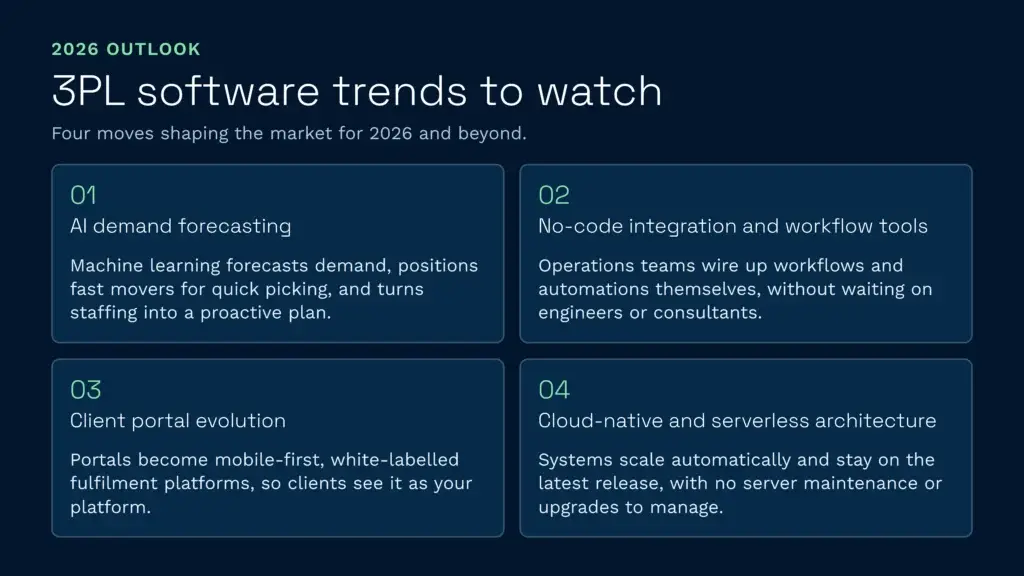
3PL Software Trends Shaping 2026 and Beyond
The 3PL software market is evolving. Here are the moves to watch.
AI-Driven Demand Forecasting and Labour Optimisation
AI is moving from buzzword to operational tool. Modern systems are using machine learning to forecast demand, optimise inventory allocation across clients, and predict labour requirements. This means:
- Demand signals from client orders feed into putaway logic: Fast-moving SKUs are positioned for quick access. Slow movers go deeper into the warehouse.
- Labour scheduling is proactive: The system predicts tomorrow’s volume and suggests staffing levels, not reactive guesswork.
- Stock rotation is automatic: FEFO (first-expiry-first-out) and FIFO rules are applied dynamically, not manually.
The vendors leading here are moving labour cost from a fixed burden to a dynamic, optimised variable—which directly impacts margin.
No-Code Integration and Workflow Tools
Not every integration needs a software engineer. Modern 3PL platforms ship with no-code builders that let you wire up custom workflows, map data between systems, and trigger automations without touching code. This is critical because it means your operations team can adapt the system as your business evolves, you’re not hostage to vendors or consultant timelines.
Client Portal Evolution: White-Label, Mobile-First, Real-Time Sync
Portals are moving from “view-only dashboards” to interactive fulfilment platforms. Clients expect to place orders, modify orders, and receive real-time updates directly in the portal. Mobile-first design is table stakes. White-labelling is standard. The winners are making the portal so smooth that clients see it as *your* platform, not a vendor add-on.
Cloud-Native and Serverless Architecture
Legacy on-premise WMS systems require server maintenance, version upgrades, and infrastructure management. Modern cloud-native systems are serverless, no servers to manage, automatic scaling, always on the latest release. This matters operationally: you’re not waiting for IT to patch systems or scale infrastructure when volume spikes.
Who Uses 3PL Software? Industry Breakdown and Use Cases
3PL software isn’t one-size-fits-all. Different industries have specific needs. Here’s a breakdown of who uses 3PL systems and why.
Ecommerce Fulfilment 3PLs
Ecommerce 3PLs store inventory for online retailers, handle order fulfilment, and often manage returns. Their requirements centre on:
- High pick volume with low error tolerance (every mis-pick is a customer complaint).
- Multi-warehouse distribution (clients want goods near their customers to reduce shipping time).
- Rapid onboarding (ecommerce sellers switch fulfilment providers frequently; speed matters).
- Intégration with major ecommerce platforms (Shopify, Amazon).
- Returns processing and restocking.
Ecommerce 3PLs live and die by accuracy and speed. A system that can reduce pick time by 30% and eliminate mis-picks is worth significant premium pricing.
Distribution and Logistics 3PLs
These operations manage inventory for wholesalers, distributors, and retailers. They handle:
- Larger SKU counts and higher average order values.
- Mixed ecommerce and B2B orders (Shopify next to EDI orders from retail partners).
- Complex picking (full-pallet orders, partial-pallet orders, mixed SKU orders).
- Labour-intensive packing and quality control.
- Integration with client ERP systems for order data and inventory visibility.
Distribution 3PLs often manage high-value inventory and complex workflows. Accuracy and audit trails are non-negotiable. Billing is intricate: tiered rates, volume discounts, value-added services.
Food and Beverage 3PLs (Temperature-Controlled)
Cold-chain logistics is a specialised domain. Food 3PLs manage:
- Multiple zones de température (ambient, chilled, frozen).
- Best-before and expiry date tracking (FEFO compliance is regulatory, not optional).
- BRC Global Standards certification and HACCP documentation.
- Rapid recall capability (regulators expect minutes, not hours, for product recalls).
- Traceability records from receipt to despatch.
A WMS designed for food must handle FEFO automatically, capture batch and lot data, and generate audit-ready recall documentation. Legacy systems force manual FEFO management, which fails under pressure. Les Campeys de Selby achieved sub-5-minute product recalls after implementing real-time WMS tracking, that’s the difference between a system designed for the vertical and a retrofitted one.
Pharmaceutical and Healthcare 3PLs
Pharma and healthcare have the most stringent compliance requirements:
- Track-and-trace for every unit (supply chain serialisation).
- Cold-chain integrity monitoring and documentation.
- Recall readiness (FDA, MHRA, EMA standards).
- Segregation of recalled stock and quarantine management.
- Full audit trail for every movement.
A WMS for pharma isn’t nice-to-have, it’s regulatory requirement. The system must log everything, generate compliance reports automatically, and prevent non-compliant operations (e.g. picking an expired unit).
Perishable Goods and Temperature-Sensitive Fulfilment
Beyond food, perishables include cosmetics, supplements, and chemicals. These require:
- Temperature monitoring during storage and transit.
- Shelf-life management (products near expiry are flagged or automatically rejected from orders).
- Batch segregation (some batches are quarantined pending test results).
- Environmental condition logging (humidity, temperature, light exposure).
The WMS must integrate with IoT sensors and reject picks or orders if conditions are out of spec. This is automation that prevents costly product loss and regulatory violations.
Automated Warehouse Environments
Robotic picking systems (goods-to-person, automated storage/retrieval, carousel systems) require tight WMS integration. The system must:
- Orchestrate robot movements and task assignment.
- Handle failures and exceptions (robot jams, SKU misplacement).
- Maintain real-time synchronisation between physical and system inventory.
- Adapt to changes in throughput (peak vs. off-peak scaling).
Automated operations are capital-intensive, so WMS optimisation directly impacts ROI. A system that improves robot utilisation by even 5% can add £100k+ to annual profit.
How to Choose 3PL Software: A Decision Framework
With so many options on the market, how do you evaluate and choose? Here’s a structured approach.
Step 1: Audit Your Current Pain Points
The best software solves your biggest problems. Before looking at features, list the operational headaches:
- Is manual invoicing eating time? (Billing automation is critical.)
- Are stocktakes slow and inaccurate? (Real-time tracking is critical.)
- Are clients constantly calling for stock visibility? (Self-serve portal is critical.)
- Are new client onboardings taking weeks? (Configuration speed is critical.)
- Are you losing revenue through missed billable events? (Audit trail and billing engine are critical.)
Prioritise your top three pain points. Software that solves those is worth premium pricing. Software that doesn’t won’t justify the migration cost.
Step 2: Define Your Non-Negotiables
Based on your vertical (ecommerce, food, pharma, distribution), list hard requirements:
- Prise en charge multi-clients : Can the system isolate stock and billing for multiple clients?
- Integration ecosystem: Does it integrate with the ecommerce platforms, carriers, and ERP systems you use?
- Compliance requirements: If you’re in food or pharma, does it meet BRC, HACCP, or FDA standards? If you’re automated, does it orchestrate your robots?
- Scalabilité : Does it grow with you? Can it handle 10x your current volume without architectural changes?
- Deployment model: Do you need cloud-native (no servers to manage) or are on-premise options acceptable?
- Contract terms: Monthly rolling or multi-year lock-in? This affects flexibility.
Non-negotiables are deal-breakers. A vendor that can’t do one of them is off the list, regardless of price or other features.
Step 3: Evaluate Implementation Speed and Support
The best software in the world is worthless if it takes nine months to go live. Evaluate:
- Go-live timelines: Can you go live in 6–8 weeks for a single-location implementation? 12 weeks for multi-warehouse?
- Migration des données : Do they have tools to import your existing inventory and client data, or is it manual?
- Training and onboarding: Do they provide structured onboarding, or are you left to figure it out?
- Support response times: What’s their SLA for critical issues? (Sub-2-minute is industry standard for critical issues.)
- Dedicated support: Do you get a named support contact, or are you in a queue?
Fast implementation is a competitive advantage. A vendor who can go live in 8 weeks instead of 16 weeks saves you months of dual-system running costs and staff overtime.
Step 4: Run a Proof-of-Concept or Trial
Before committing, ask for a trial on real or realistic data. This is where vendor claims meet reality. During the trial, focus on:
- Can you configure your billing rules without custom development?
- Do the key integrations (your top 3 ecommerce platforms, your ERP, your carrier) actually work or are they half-baked?
- How easy is the client portal to use? Would your clients be satisfied with it?
- When something breaks or doesn’t work as documented, how responsive is support?
A two-week trial is worth a month of sales conversations. It’s the difference between theoretical fit and proven fit.
3PL Software Pricing Guide: What to Expect by Scale
Pricing varies dramatically by vendor, scale, and features. Here’s what the market looks like in 2026.
Small 3PL Operations (1–5 Employees, £5–20M Annual Revenue)
Entry-level 3PL software typically starts at £250–£600 per month, with additional charges for integrations, users, or clients. Expect:
- Base platform cost: £300–£500/month for a cloud-hosted multi-client WMS with basic billing.
- Coûts d'intégration : £0–£200/month depending on whether you need third-party integrations or EDI.
- Support costs: Usually included in the base fee.
- Typical total: £300–£700/month.
At this scale, you’re often running a lean operation. You value simplicity and fast deployment over enterprise features. Clarus WMS pricing starts from £1,000/month on monthly rolling contracts, which includes core multi-client WMS, automated billing, and client portal—no hidden per-client charges or module upgrades.
Mid-Tier 3PL Operations (5–20 Employees, £20–100M Annual Revenue)
Mid-market 3PLs run multiple warehouses, manage dozens of clients, and need advanced automation. Pricing typically ranges from £600–£2,000/month, depending on complexity:
- Base platform cost: £600–£1,500/month for multi-warehouse WMS with advanced billing, client portal, and integrations.
- Per-client or per-user charges: Some vendors add £50–£200/month per additional client (this adds up fast).
- Implementation and migration: Expect £5,000–£20,000 in setup costs if you’re migrating from a legacy system.
- Typical total (ongoing): £1,000–£2,500/month depending on client count and integration complexity.
At this scale, you need flexibility. Your clients have diverse requirements (different billing models, different integration needs, different compliance requirements). The system must adapt without custom development. Mid-market vendors compete on feature depth and implementation speed.
Enterprise 3PLs (20+ Employees, £100M+ Annual Revenue)
Enterprise 3PLs operate across multiple locations, manage hundreds of clients, and run high-volume operations. Pricing is custom but typically ranges from £3,000–£10,000+/month, with major vendors requiring annual commitments. Expect:
- Base platform cost: £2,000–£5,000+/month for unlimited warehouses, unlimited clients, and advanced features (API access, custom workflows, demand planning).
- Mise en œuvre : £50,000–£200,000+ for multi-site rollout, data migration, and custom integrations.
- Ongoing support: Dedicated support team, SLA guarantees, custom development (if needed).
- Contract terms: Usually 2–3-year commitments with price escalation clauses.
- Total cost of ownership (first year): £100,000–£500,000+.
Enterprise software is sold on features, support, and vendor stability. At this scale, you’re evaluating long-term partnerships, not just software purchases. Switching costs are high, so the vendor must prove they can grow with you.
What to Watch: Hidden Costs and Per-Unit Pricing Traps
Many vendors quote a base price that looks attractive until you add features:
- Per-client charges: A vendor quotes £499/month, but each additional client is +£100/month. With 10 clients, you’re at £1,400/month.
- Per-user charges: The platform quote excludes per-user fees (£20–£50 per user per month). With 15 warehouse staff, that’s an extra £300–£750/month.
- Per-integration charges: Want Shopify integration? That’s an add-on. Want Amazon? Another add-on. Five integrations later, you’ve doubled the base cost.
- Frais de mise en œuvre : Quoted separately, often £10k–£50k depending on complexity.
- Annual contracts with price escalation: Year 1 is £10,000/year, but Year 2 includes a 10% increase. Locked in.
When comparing vendors, ask for a three-year total cost of ownership (TCO) including all fees, not just the headline monthly price. A vendor charging £1,500/month all-inclusive is often cheaper than one quoting £800/month with a dozen add-ons.
Cloud-Native Deployment, Scalability, and Integrations
Architecture matters because it determines how the software performs under load and how expensive it is to maintain.
Cloud-Native vs. On-Premise vs. Hybrid
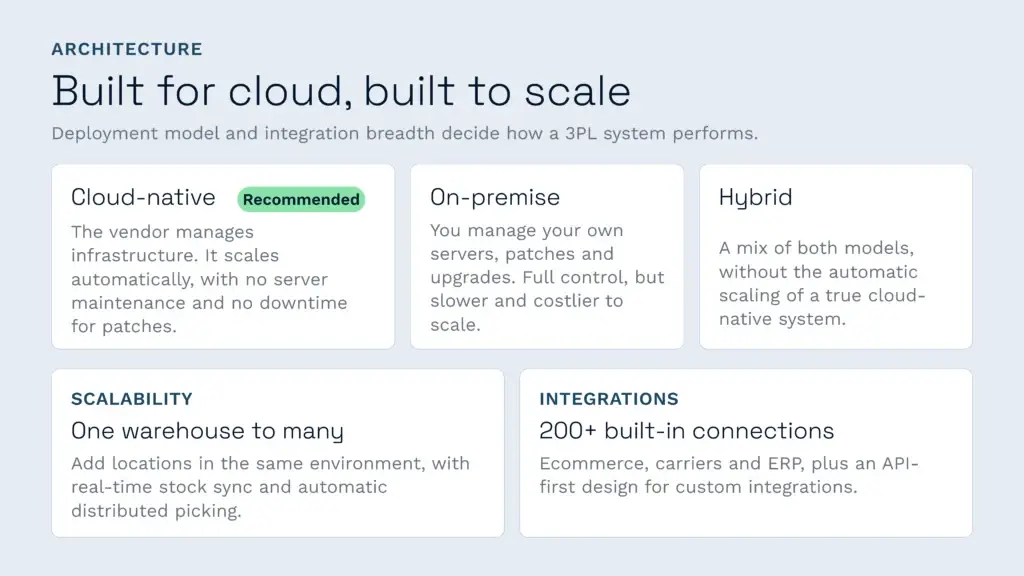
Cloud-native (serverless): The vendor manages all infrastructure. You provision the system, configure it, and it scales automatically. No server maintenance, no version upgrades, no downtime during patches. This is table stakes for modern 3PL software. Cost is predictable and fixed. Deployment is fast (days, not months).
On-premise: You install software on your own servers. You manage patches, upgrades, and scaling. This gives you full control but adds operational burden. Upgrades can take weeks or months to plan and execute. Costs are unpredictable (hardware, infrastructure, support). Most 3PLs are moving away from on-premise due to the overhead.
Hybrid: Some systems allow on-premise or cloud deployment. This is often the worst of both worlds—the vendor doesn’t optimise for cloud scalability, and you still have infrastructure burden.
For 3PL software, cloud-native is the right choice. It removes operational burden from your team and means the vendor is incentivised to keep the platform performant and secure.
Scalability: From Single Warehouse to Multi-Site Networks
A good 3PL system should scale without architectural changes. This means:
- Single to multiple warehouses: You start with one location. As you grow, you add locations in the same environment, not a separate system.
- Stock synchronisation across sites: Clients need visibility of inventory across all their warehouses. The system should consolidate that view in real time.
- Distributed picking: Orders can be routed to the nearest warehouse for fastest fulfilment. The system should optimise this automatically.
- Volume scaling: From 1,000 picks per day to 100,000. The system should handle throughput increases without performance degradation.
This is why cloud-native architecture matters. Legacy on-premise systems hit performance ceilings and require expensive upgrades. Cloud systems scale elastically.
Integration Breadth and Depth
A system is only as powerful as its integrations. Look for:
- Pre-built ecommerce integrations: Shopify, Amazon, eBay, Etsy, TikTok Shop, WooCommerce, BigCommerce, Magento (200+ standard integrations).
- Carrier integrations: All major UK and international carriers (DHL, UPS, Royal Mail, Parcelforce, DPD, Evri, TNT, FedEx).
- ERP and accounting integrations: Sage 200, Dynamics, SAP, QuickBooks, Brightpearl, Zoho.
- API-first design: For custom integrations, the system should expose a REST API, support EDI, and ideally an MCP server so AI tools can query live data.
- Sync frequency: Near real-time (minutes) or batch (hourly)? Real-time is better but not always necessary.
Broad integration support is a competitive moat. The vendor that integrates with your entire tech stack is hard to replace.
Multi-Client Handling, Billing Isolation, and Invoicing
The core value of 3PL software is enabling you to serve multiple clients from a single warehouse without operational or financial entanglement. Here’s how the best systems handle this.
Stock Isolation and Client Segregation
Each client’s inventory must be isolated at every step. This means:
- Receiving: Goods are tagged with the client identifier. The system prevents mixing stock from different clients in the same location.
- Sélection : Pickers see orders for one client at a time. They can’t accidentally pick from a different client’s stock.
- Rapports : Each client sees only their own stock, orders, and activity. They can’t see data from other clients.
- Billing: Every transaction is attributed to the correct client. No cross-billing.
Purpose-built systems enforce this at the database level. Retrofitted systems rely on procedure, which is fragile and error-prone.
Client-Specific Billing Rules
Your clients have different contracts. You need to support:
- Storage billing: Per unit, per pallet, per m³, tiered by duration.
- Activity billing: Per pick, per pack, per despatch, per return.
- Value-added services: Kitting, labelling, customisation, returns processing (charged separately).
- Minimum charges and overages: Client A has a minimum 500 units per month; beyond that, they’re charged per unit.
- Volume discounts: After 10,000 picks, price drops from £0.50 to £0.40 per pick.
- Client-specific SKU pricing: Client A pays £0.50 per unit to store hazmat; Client B pays normal rate.
The best systems allow you to define these rules in a UI without custom code. Flexibility here is how you win contracts prospects can’t move from competitors.
Automated Invoicing and Billing Accuracy
Manual invoicing is the biggest operational drag in 3PL. Automated invoicing means:
- Event capture: Every transaction is logged as it happens (not estimated or counted at month-end).
- Automatic calculation: Billing is calculated from the transaction log, applying client-specific rules. No manual spreadsheet.
- On-time generation: Invoices are ready on day 1 of the next cycle, not day 25.
- Journal d'audit : Each invoice is backed by detailed transactions. Disputes are resolved by showing the client the underlying data.
- Multi-currency and multi-language: If you serve international clients, invoices should support their currency and language.
The shift from 4-hour invoicing to 20 minutes isn’t just time savings—it’s a shift from reactive (fixing invoicing errors) to proactive (eliminating errors).
Best 3PL Software by Use Case: Distribution, Ecommerce, Food, Pharma, and Automated
There’s no single “best” 3PL software. The right choice depends on your specific domain and operational needs. Here’s a breakdown.
Distribution-Based 3PLs
Distribution 3PLs typically manage higher SKU counts, larger orders, and mixed ecommerce and B2B volume. Look for systems with:
- Advanced picking algorithms: Wave picking, batch picking, and route optimisation to reduce picking time.
- Quality control workflows: Multi-station packing with checkpoints to catch errors before despatch.
- EDI and ERP integration: Orders come from multiple channels (ecommerce, EDI, portal); the system must consolidate them.
- Complex billing: Per-pallet, per-SKU, volume-based, minimum charges—all in one contract.
For distribution 3PLs, accuracy and speed determine profitability. A system that reduces picking time by 30% and eliminates errors directly impacts margin.
Ecommerce 3PLs and Fulfilment Centers
Ecommerce 3PLs prioritise speed, accuracy, and integration with ecommerce platforms. Look for:
- Ecommerce integration depth: Shopify, Amazon, WooCommerce, eBay. Orders sync in real time. Inventory is visible to clients in their sales channels.
- High-speed picking: Batch picking, préparation des commandes par zone, and wave picking optimised for high throughput.
- Traitement des retours : Automated return label generation, inspection, and restocking workflows.
- Multi-warehouse distribution: Orders are routed to the nearest warehouse for fastest delivery.
- Low setup costs and fast onboarding: Ecommerce sellers switch fulfilment providers frequently; speed and low switching costs matter.
Ecommerce 3PLs live on volume and customer satisfaction. A system that onboards a new seller in a week instead of a month directly impacts revenue.
Food and Beverage 3PLs (Temperature-Controlled)
Food 3PLs operate under strict regulatory and operational constraints. Look for systems with:
- FEFO (first-expiry-first-out) automation: Best-before and expiry dates are tracked automatically. Pickers can’t accidentally pick near-expiry stock.
- BRC Global Standards compliance: The system generates audit-ready documentation for BRC audits. Traceability is built in, not bolt-on.
- État de préparation aux rappels : Full batch and lot tracking. A product recall can be executed in minutes, not hours.
- Gestion des zones de température : Ambient, chilled, and frozen zones are physically separated and the system enforces segregation.
- Hazmat and allergen tracking: Cross-contamination is prevented at the system level.
For food 3PLs, compliance isn’t optional, it’s existential. A system that ensures compliance automatically and generates audit trails reduces regulatory risk and speeds audits.
Pharmaceutical and Healthcare 3PLs
Pharma 3PLs operate under the most stringent regulations. Look for systems with:
- Serialisation and track-and-trace: Every unit is tracked by serial number from receipt to despatch.
- Cold-chain integrity: Temperature logging and documentation for every step. Deviations trigger alerts.
- Quarantine and segregation: Suspect units are automatically held. Release requires approval.
- FDA/MHRA/EMA audit readiness: Full transaction history, batch traceability, exception handling—all documented.
- Expiry and recall management: Expired stock is automatically flagged and removed from circulation.
For pharma, the WMS is a regulatory tool, not just an efficiency tool. The system must prevent non-compliant operations at the software level.
Perishable Goods and Specialized Fulfilment
Perishables (cosmetics, supplements, specialty foods) require shelf-life management without the full regulatory burden of pharma. Look for:
- Shelf-life tracking: Products nearing expiry are flagged and segregated.
- Environmental condition logging: Temperature, humidity, and light exposure are tracked and logged.
- Batch segregation: Products awaiting test results or in quarantine are separated from available stock.
- Quality hold workflows: Products can be placed on hold pending inspection or approval.
The goal is to prevent stock loss through expiry or condition degradation. Automated shelf-life management directly improves profitability.
Automated Warehouse Operations
If you run robotic systems (goods-to-person, ASRS, carousels), your WMS must orchestrate them seamlessly. Look for:
- Robot integration: The WMS controls robot task assignment and movement.
- Exception handling: If a robot fails, the system reassigns tasks and logs the exception.
- Real-time synchronisation: System inventory matches physical robot positions in real time.
- Throughput optimisation: The system sequences picks to minimise robot idle time and travel distance.
Automated environments are capital-intensive. WMS optimisation directly impacts ROI. A 5% improvement in robot utilisation can add £100k+ to annual profit.
Key 3PL Software Features: Smart Stock Rotation, Labour Management, and Client Portals
Beyond the basics, here are the operational features that separate good systems from great ones.
Smart Stock Rotation and FEFO/FIFO Logic
Inventory rotation, which unit gets picked first, determines profitability in perishable industries and risk in manufacturing. Smart systems:
- Enforce FEFO automatically: Pickers pick the unit with the earliest expiry date without checking dates manually.
- Support multiple rotation rules: FEFO for food, FIFO for manufacturing, LIFO for commodities. Configurable by client or by SKU.
- Flag exceptions: If FEFO can’t be enforced (e.g. no stock of the next expiry unit), the system alerts and holds the order.
- Prevent waste: Near-expiry stock is highlighted for priority picking or clearance.
Labour Management and Productivity Tracking
Labour is the largest variable cost. A good WMS tracks and optimises labour:
- Attribution des tâches : Pickers are assigned tasks based on their location and efficiency. Travel distance is minimised.
- Productivity metrics: Picks per hour, packs per hour, despatch time per order. Real-time dashboards show team performance.
- Bottleneck identification: If packing is slow, the system shows why. Is it order complexity? Are there quality hold-ups?
- Shift scheduling recommendations: Based on historical volume patterns, the system recommends staffing levels for tomorrow or next week.
Client Portal: Real-Time Visibility and Self-Service
A self-service client portal is a game-changer. It should offer:
- Visibilité des stocks en temps réel : Clients log in and see their stock by location, status, and age (oldest stock highlighted).
- Order status tracking: From submission to despatch. Clients can see if an order is picking, packing, or ready for shipment.
- Shipment tracking: Integrated with carrier tracking so clients see real-time delivery status.
- Billing summaries: Month-to-date activity, pending charges, and invoice history. No surprises at invoicing.
- SLA reporting: On-time receipt rate, picking accuracy, average processing time. Transparency builds trust.
- White-labelling: Portal looks like your brand, not the vendor’s.
- Conception axée sur le mobile : Clients access it from their phone, not just a desktop dashboard.
A portal that works reduces support burden and improves client satisfaction. Clients who have visibility into their operations are less likely to churn.
Discutez avec un expert en entreposage
Si vous êtes en train d'évaluer vos options et que vous souhaitez découvrir comment fonctionne concrètement un progiciel de gestion d'entrepôt (WMS) spécialement conçu à cet effet, n'hésitez pas à contacter Clarus. Nous collaborons avec des prestataires logistiques tiers (3PL) et des distributeurs à travers tout le Royaume-Uni pour mettre en place un progiciel de gestion d'entrepôt qui s'adapte à votre mode de fonctionnement, et non l'inverse.
Contactez notre équipe pour discuter de vos besoins.