

If you’re using Unleashed Software for inventory management, you’ve probably discovered its strengths, real-time stock tracking, barcode scanning, multi-warehouse support, but also its limitations. Unleashed is built as an inventory management system (IMS), not a warehouse management system (WMS). While Unleashed offers a basic WMS add-on for multi-bin tracking, it lacks the advanced routing, wave picking, and automated 3PL billing features of a purpose-built WMS.
This article walks through the best Unleashed Software alternatives for UK warehousing and 3PL operations, including Clarus WMS, which is purpose-built for the operational complexity that Unleashed wasn’t designed for.
Quick comparison: Unleashed vs alternatives at a glance
This table shows how Unleashed stacks against the leading alternatives for UK warehouse and 3PL operations:
| Solution | Best for | Multi-client / 3PL | Automated billing | Pick optimisation | Cloud-native |
|---|---|---|---|---|---|
| Clarus WMS | Purpose-built 3PL, multi-client billing, complex operations | Yes, full client isolation + white-label portal | Yes, real-time capture of all billable events | Yes, smart wave picking with 50% travel time reduction | Yes, server-less, no upgrades |
| Unleashed Software | Inventory tracking, small-to-mid eCommerce, simple warehouse | No, single-client focus | Manual, requires reconciliation | No — basic picking only | Yes, cloud-based |
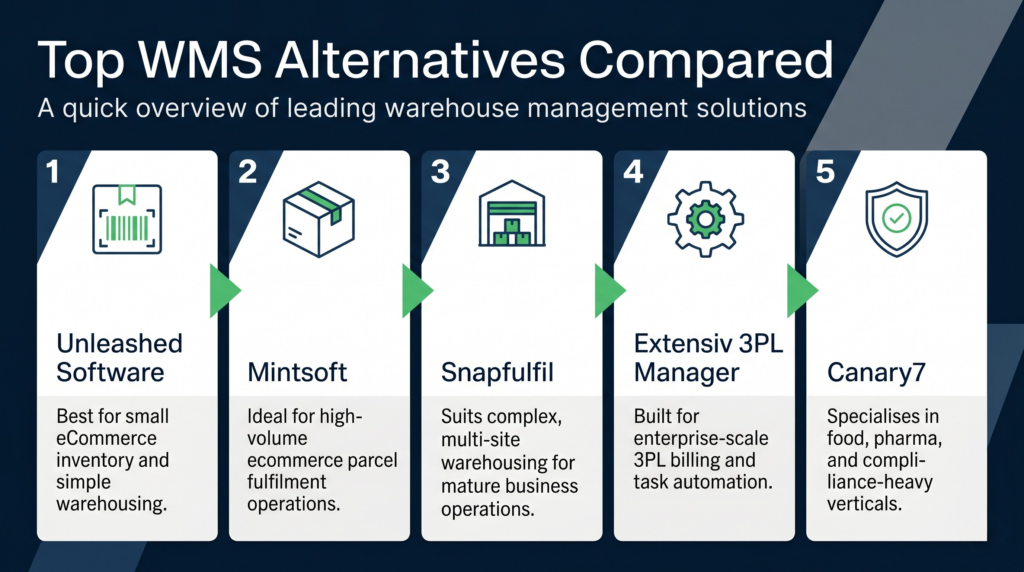
| Mintsoft | Ecommerce fulfilment, high-volume parcel operations | Limited, basic multi-warehouse, not true 3PL | Automated billing | Yes, picking and packing optimisation | Yes, cloud SaaS |
| Snapfulfil | Complex warehousing, multi-site operations, mature businesses | Limited, requires custom configuration | No, not automated | Yes, advanced pick routing | Yes, cloud |
| Extensiv 3PL Manager | 3PL operations, billing automation, enterprise scale | Yes, built for multi-client 3PL | Yes, integrated with TMS | Yes, advanced routing | Yes, cloud-based |
| Canary7 | Food, pharma, and compliance-heavy verticals | Yes, multi-client capable | Limited, requires integration | Yes, compliance-first picking | Hybrid, on-premise or cloud |
What is Unleashed Software and why look for an alternative?
Unleashed is a cloud-based inventory management system designed for small-to-mid-sized businesses. It tracks stock levels, manages purchase orders, handles multi-warehouse operations, and integrates with ecommerce platforms like Shopify and Amazon. For basic inventory visibility, knowing what you have, where it is, and when to reorder, Unleashed works well.
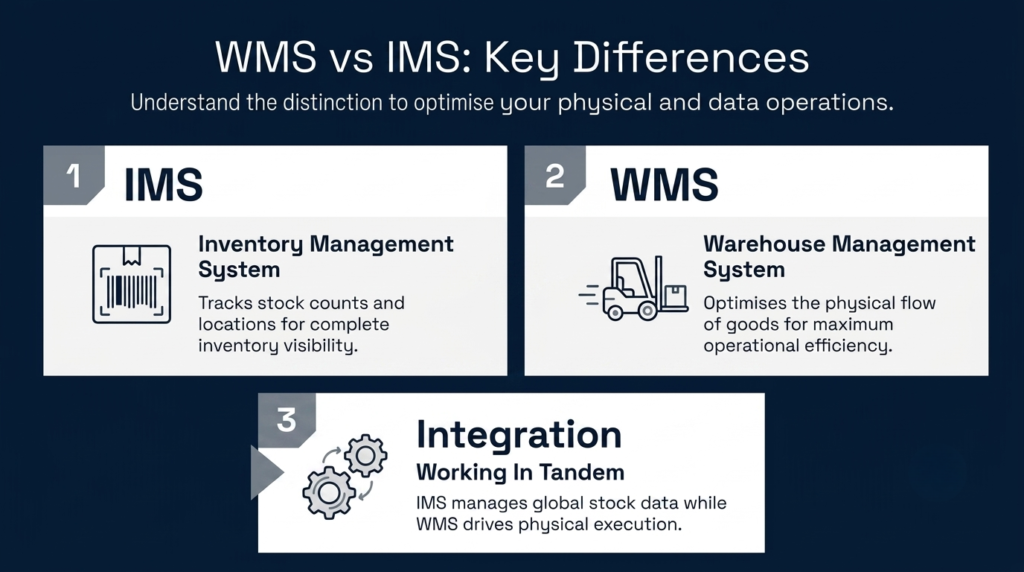
However, Unleashed is fundamentally an inventory management system (IMS), not a warehouse management system (WMS). The distinction matters in practice:
- Inventory management systems (IMS): Track what you have and the total quantity in each location. Unleashed tells you “we have 500 units of product X in Warehouse A” and integrates with sales channels to avoid overselling.
- Warehouse management systems (WMS): Optimise how goods move through the warehouse: receiving, putaway, replenishment, picking, packing, and despatch. A WMS tells you “the next 50 units of product X are in bin C-15-4, and the optimal picking path for today’s orders visits that bin in this sequence.”
For single-client operations, ecommerce shops, small distributors, basic wholesale, Unleashed’s inventory management is sufficient. For 3PL operations, multi-client warehouses, and complex picking scenarios, the gaps become painful. Here’s what you’ll struggle with on Unleashed:
- No multi-client billing: Unleashed tracks stock per location, not per client. A 3PL using Unleashed cannot automatically invoice clients for storage, handling, or labour. Invoicing becomes a manual reconciliation nightmare, counting picks, storage fees, and value-added services by hand at month-end.
- Picking is manual and inefficient: Unleashed generates pick lists, but it doesn’t optimise them or route pickers. In a warehouse with hundreds of SKUs across multiple locations, pickers waste hours backtracking and interpreting handwritten notes. Accuracy suffers.
- No real-time client visibility: Clients can’t see live stock levels or order status. They call or email with queries you have to answer manually because Unleashed has no client-facing portal.
- Barcode scanning is basic: Unleashed supports scanning, but doesn’t enforce it at the point of contact (no scan verification). A picker can set a package down without confirming the order matches the barcode.
- Limited integration with carrier and TMS systems: Unleashed connects to major ecommerce platforms (Shopify, Amazon), but integrates poorly with shipping carriers and transport management systems — critical for 3PLs.
Clarus WMS: Purpose-built for 3PL and multi-client operations
Clarus is a cloud-native WMS designed specifically for the operational realities of UK 3PLs, multi-client warehouses, and complex distribution networks. It was built by people frustrated with legacy WMS platforms and their inflexibility — the idea is to replace spreadsheets and manual processes with a system that scales with your business without enterprise complexity.
What makes Clarus different
Multi-client stock segregation: Clarus isolates each client’s inventory, workflows, and reporting within a single warehouse. Goods from client A are barcode-tracked separately from client B’s stock. Clients cannot see each other’s data. This is foundational for 3PL operations, Unleashed cannot do this.
Automated billing engine: Clarus captures every billable event in real time: receipts, storage by day, picks, packs, despatch, returns, and custom value-added services. At month-end, invoicing is automatic — no manual counting, no reconciliation disputes. St John’s Hall Storage, a UK 3PL, cut their invoicing time from four hours to twenty minutes after switching to Clarus. One less person doing manual admin.
Smart wave picking: Clarus batches orders intelligently and optimises walking paths. The system groups picks based on location, order size, and time sensitivity, meaning pickers walk shorter routes and handle more orders per hour. Claimed: 50% travel time reduction compared to manual pick lists. Scan verification at every pick ensures the barcode matches the order; if it doesn’t, the system stops the packer and flags the discrepancy. This drives accuracy above 99.9%.
Client self-service portal: Clients log in to see live stock levels, order status, shipment tracking, and billing summaries. The portal is white-labelable with your branding, which deepens client relationships and cuts support overhead. No more calls asking “where’s my stock?”
Real-time automation and workflows: Set rules that trigger automatically. When stock drops below a threshold, replenishment picks generate. When a shipment is packed, it triggers a despatch note and a carrier booking. When a client receives goods, a storage fee accrues in real time. Everything is tracked, audited, and billable.
Cloud-native, server-less architecture: Clarus runs entirely in the cloud with no servers to maintain, no version upgrades to schedule, and no downtime for patches. You always run the latest release. It integrates with 200+ systems including Shopify, Amazon, ecommerce platforms, 70+ shipping carriers (DHL, UPS, Royal Mail, DPD, Evri, TNT), ERPs like Sage 200 and Dynamics, pallet networks (Palletways, Pallex), and TMS platforms like Qargo.
Where Clarus is not the right fit
Clarus is built for warehouses with 10+ users, multiple clients or complex operations, and £5M–£500M revenue. If you’re a very small single-client business (under 5 users, simple warehouse, low volume), Unleashed or a basic inventory system may be sufficient and cheaper. Clarus also assumes you want cloud deployment; if you require on-premise infrastructure for security or compliance reasons, you’d need to evaluate Canary7 or Snapfulfil instead.
Clarus pricing and implementation
Clarus pricing starts from £1,000 per month on a monthly rolling contract — no lock-in, no annual commitment. What’s included: the WMS software, all core features (multi-client, billing automation, picking optimisation), unlimited users, unlimited stock locations, and sub-2-minute support response time. There are no per-user add-ons, no per-order charges, no surprise modules. Implementation typically takes 4–8 weeks from sign-up to go-live, depending on the complexity of your warehouse layout and integrations.
Other Unleashed Software alternatives
Mintsoft: For high-volume ecommerce fulfilment
Mintsoft is a cloud-based WMS focused on ecommerce and parcel fulfilment. It excels at fast-moving, high-volume order operations: Shopify stores, Amazon sellers, and multi-channel ecommerce businesses. It offers picking and packing optimisation, carrier integration, and basic reporting.
Strengths: Designed for ecommerce speed and scale. Picking optimisation is strong. Integration with Shopify, WooCommerce, and shipping carriers is seamless.
Limitations: Multi-client capabilities are limited, Mintsoft is not built for 3PL scenarios. It’s more of a warehouse order-processing tool than a full 3PL solution.
Who it’s best for: High-volume ecommerce businesses, online retailers, and parcel fulfilment houses that ship their own goods (not 3PLs managing multiple clients).
Snapfulfil: For complex, mature warehouse operations
Snapfulfil is a long-established WMS used by larger, more complex operations — multi-site networks, large distributors, and mature businesses with significant operational budgets. It offers advanced picking routines, inventory control, and reporting.
Strengths: Highly configurable to complex warehouse layouts and processes. Advanced routing and putaway logic. Strong in mature, larger operations.
Limitations: Implementation is lengthy and expensive — often 6–12 months. Multi-client 3PL functionality requires custom configuration, not out-of-the-box. Licence costs are high. Updates require downtime and IT involvement.
Who it’s best for: Large distributors, enterprise-scale operations, and businesses with in-house IT teams and mature warehouse processes. Not suitable for small-to-mid 3PLs seeking quick time-to-value.
Extensiv 3PL Manager: For enterprise 3PL billing and TMS integration
Extensiv 3PL Manager (formerly known as Extensiv Warehouse Manager) is designed specifically for 3PL and multi-client operations. It integrates with Extensiv’s Transport Management System (TMS) and offers automated billing, carrier integration, and detailed reporting.
Strengths: Built for 3PL operations from the ground up. Integrated billing and transport management. Strong vendor relationships with major carriers and logistics platforms. Mature feature set.
Limitations: Pricing is higher (£800+/month). Implementation is complex and lengthy — expect 8–12 weeks. Cloud-based but with a heavier footprint and longer deployment cycles than Clarus. Less suitable for smaller 3PLs or those with tight budgets.
Who it’s best for: Larger 3PLs with enterprise budgets, multiple sites, and complex carrier management needs. Good fit if you need integrated TMS functionality.
Canary7: For food, pharma, and compliance-heavy operations
Canary7 is a WMS built for regulated industries: food, pharmaceutical, cosmetics, and any business requiring traceability, batch control, and compliance reporting. Multi-client capabilities exist but are not the primary focus.
Strengths: Exceptional for compliance-heavy verticals. Full batch and lot control, expiry date management, BRCGS and HACCP alignment, and recall workflows. Multi-warehouse support. Can run on-premise or in the cloud.
Limitations: Billing automation is limited and requires integration with separate systems. Not optimised for high-volume ecommerce picking. On-premise deployments require significant IT support. Pricing and implementation timelines are substantial.
Who it’s best for: Food distributors, pharmaceutical warehouses, and businesses in regulated verticals that prioritise compliance and traceability over speed. Not ideal for general 3PL operations or ecommerce-focused fulfilment.
Delta WMS: Low-cost alternative for smaller operations
Delta WMS is a UK-based, affordable WMS option aimed at smaller warehouses and distributors. It covers basic WMS functions: receiving, putaway, picking, packing, and despatch.
Strengths: Low entry cost. Simple to learn and implement. Good for small-to-mid warehouses with straightforward operations.
Limitations: Limited multi-client 3PL support. No billing automation. Picking optimisation is basic. Fewer integrations than larger competitors. Limited reporting and analytics.
Who it’s best for: Small to mid-sized single-client warehouses on tight budgets. Not suitable for 3PLs or businesses requiring sophisticated billing or multi-client management.
Unleashed Software: Strengths and limitations
What Unleashed does well
- Real-time inventory visibility: Unleashed excels at showing you what you have, where it is, and how much stock is available across multiple warehouse locations.
- Ecommerce integration: Native integration with Shopify, WooCommerce, Amazon, eBay, Etsy, and other sales channels means orders flow directly into Unleashed without manual entry.
- Multi-location support: You can manage stock across unlimited warehouse locations in a single system.
- Barcode scanning: Basic barcode scanning and serial number tracking for product traceability.
- Cloud-based and affordable to start: At £269/month, it’s an accessible entry point for small businesses. No servers to manage.
- B2B ecommerce portal: Unleashed includes a basic B2B ordering portal so customers can place orders and check stock.
Where Unleashed falls short
- No warehouse management: Unleashed is an inventory system, not a warehouse management system. It doesn’t optimise picking routes, dispatch replenishment, or enforce scan verification at the point of contact.
- No multi-client billing: If you operate a 3PL, Unleashed cannot automatically invoice clients for storage, labour, or services. Billing is manual and reconciliation is error-prone.
- No client portal: Clients cannot see live stock levels or order status. You become a bottleneck, answering stock queries manually.
- Picking is inefficient: Pick lists are generated, but not optimised. Pickers backtrack unnecessarily, accuracy drops, and labour costs climb.
- Limited carrier integration: Shipping carrier connections exist but are not as comprehensive as dedicated WMS platforms. TMS (transport management) is not integrated.
- Barcode scanning limitations: On Capterra, some users report limitations in barcode functionality and report generation.
WMS vs IMS: Why the distinction matters
Understanding the difference between inventory management systems and warehouse management systems is crucial when choosing software:
Inventory Management System (IMS) — what Unleashed is:
Tracks what you own, how much you have, and where it’s located. Inventory systems answer questions like “Do we have enough units to fulfil this order?” and “Which warehouse should this order ship from?” They’re designed for visibility and stock control, not for optimising the physical movement of goods.
Warehouse Management System (WMS) — what you need for 3PL:
Optimises the physical flow of goods through the warehouse: receiving, putaway, replenishment, picking, packing, and despatch. A WMS answers questions like “What’s the fastest route for today’s picks?” and “Which pallet should this shipment go on?” and “Has the barcode been verified?” It’s designed for operational efficiency and labour cost control.
In practice, many businesses use both in tandem: an ERP or inventory system (like SAP or Sage 200) tracks stock and financial data, and a WMS (like Clarus or Snapfulfil) optimises the warehouse operations. Unleashed tries to do both but does neither as well as dedicated solutions.
How Unleashed integrates with Clarus
If you want to keep Unleashed as your core inventory system but need the operational firepower of a true WMS, Clarus integrates directly with Unleashed. The native connection requires no third-party middleware and keeps both platforms perfectly aligned.
By running the two together, you retain Unleashed’s strong purchasing and financial tools while upgrading your warehouse floor with Clarus’s advanced picking routines, strict barcode verification, and 3PL billing automation.
How the workflow operates:
- Order pass-through: Sales orders flow seamlessly from Unleashed into Clarus so your warehouse and finance teams always see the exact same data.
- Warehouse control: Your teams allocate stock by exact quantity, run wave picks, pack, and print shipping labels entirely within the Clarus dashboard.
- Real-time sync: The moment an order is despatched, Clarus automatically posts the shipment confirmation, carrier tracking references, and inventory adjustments back to Unleashed.
Want to see exactly how the setup works and what data syncs between the platforms? Read the full guide on the Clarus and Unleashed integration here.
How to choose the right Unleashed alternative
Ask yourself these questions:
- Are you a 3PL managing multiple clients? If yes, you need multi-client billing and client segregation. Clarus or Extensiv 3PL Manager. Unleashed cannot do this.
- Do you need picking optimisation and labour cost control? If yes, you need a true WMS with route planning and wave picking. Clarus, Mintsoft, or Snapfulfil. Unleashed’s picking is manual.
- Are you in a regulated industry (food, pharma, cosmetics)? If yes, Canary7. If not, skip it.
- Is ecommerce your primary channel and do you ship your own goods? If yes and you’re not 3PL, Mintsoft is a strong choice. It’s optimised for speed and Shopify/Amazon integration.
- Do you have a very large, complex operation with legacy systems and significant IT resources? If yes, Snapfulfil can handle it — but expect long implementation and high cost.
- Do you want simplicity, cloud-first architecture, and a 3PL-focused feature set at a mid-market price? If yes, Clarus. It’s the fastest to deploy and most cost-effective for 3PLs under 100 users.
Speak to a warehouse expert
If you’re evaluating your options and want to see how a purpose-built WMS works in practice, Clarus is worth a conversation. We work with 3PLs and distributors across the UK to implement warehouse management software that fits the way you operate — not the other way around.
Get in touch with our team to talk through your requirements.
 English (UK)
  Nederlands (Formeel)
  Nederlands (België)
  Français de Belgique
  Deutsch
  Español
  Español de México
  English
  English (Australia)
  English (Canada)
  English (New Zealand)
  Svenska
  Norsk bokmål