

When you run a small warehouse, warehouse management is personal. You’re not just moving stock — you’re managing margins, keeping customers happy, and keeping your team productive without the luxury of a dedicated IT department. The question small business owners face isn’t “do we need a warehouse management system?” — it’s “can we afford one that doesn’t run us around in circles?”
For years, small business owners had three bad options: spreadsheets (which broke at scale), hand-me-down enterprise WMS systems (which cost six figures and took 12 months to implement), or paper-based picking lists that bled accuracy every time the warehouse grew. Cloud-native WMS software has changed that game. Today’s best warehouse management software for small business is cloud-based, affordable, and built to grow with you, not against you.
This guide walks you through what a small business actually needs from a WMS, how to spot the difference between genuine purpose-built solutions and scaled-down enterprise systems, and why cloud-native architecture matters more than feature count. We’ll also look at real-world results from small and growing businesses like yours to show you what’s possible.
What is the best WMS for a small business?
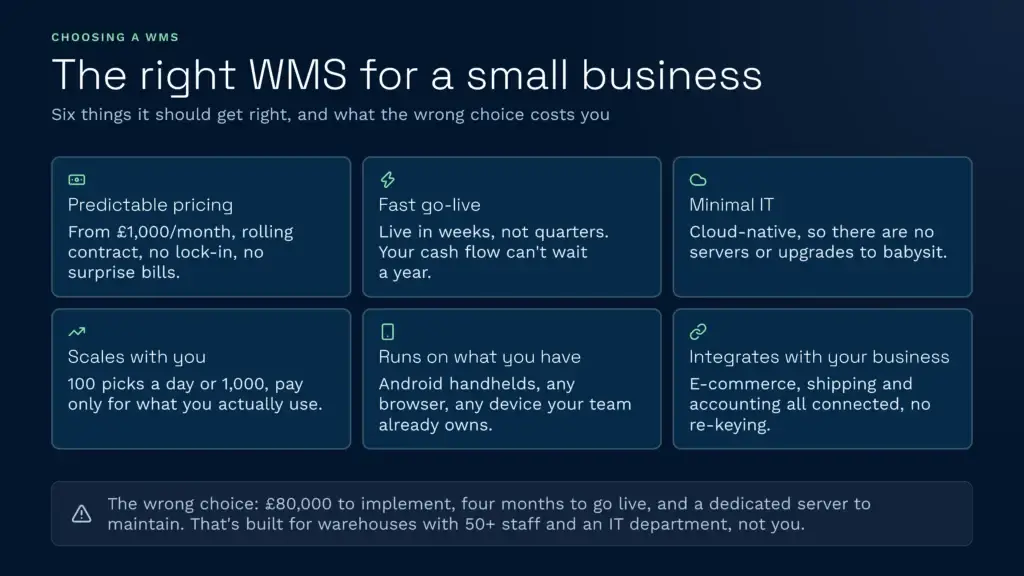
The best WMS for a small business is one that:
- Costs what it should. From £1,000/month upwards on monthly rolling contracts — no lock-in, no upfront servers, no surprise implementation bills.
- Goes live fast. Not in 12 months. A modern cloud WMS should go live in weeks, not quarters. Your cash flow can’t wait 18 months for ROI.
- Requires minimal IT infrastructure. Cloud-native means no servers to manage, no IT team babysitting upgrades, no “the system’s down” every time someone patches something.
- Scales with you. Whether you’re doing 100 picks a day or 1,000, you don’t pay for enterprise features you don’t use. You pay for what you need, when you need it.
- Runs on what you have. Android handhelds (Zebra, Honeywell) that your team already has or can buy cheaply, any browser, any device.
- Integrates with your business. Your e-commerce platform, your shipping carrier, your accounting software. No manual re-keying.
The wrong choice looks like this: an on-premise system that costs £80,000 to implement, requires a dedicated server and someone to look after it, takes four months to go live, and still requires custom development to connect to your Shopify store. Those systems are built for warehouses with 50+ staff and IT departments. If that’s not you, you’re buying the wrong product.
Small business warehouse challenges: where legacy systems break down
Before you pick a system, you need to understand where your current setup is actually costing you money.
Manual picking and accuracy problems. Pick lists on paper or printed from Excel create a specific failure pattern: pickers interpret handwriting differently, create their own shortcuts to save time, and errors cluster around peak periods when cognitive load is highest. The average small warehouse runs at 97–98% pick accuracy with manual lists. Scan verification moves that to 99.9%. The cost difference? One mis-pick resolved in a customer complaint can cost £50–£200. If you’re doing 200 picks a day and running at 97% accuracy, that’s six errors a day. Six errors times £100 in customer friction and rework is £600 a day, £3,000 a week, £156,000 a year you’re not seeing on a P&L line.
Inventory doesn’t match reality. Spreadsheets and legacy systems don’t capture real-time movement. Your system says you have 200 units; your floor count says 180. Stock audits take a week, disrupt operations, and always turn up discrepancies that are a nightmare to reconcile. You’re either holding buffer stock to cover the unknown (cash tied up), or you’re overselling because the system’s wrong (customer problems). A modern WMS with scan-verification and directed putaway keeps system and floor in sync. JODA Freight, a UK 3PL, brought stock accuracy from the low 90s to 99.8% after switching to Clarus.
Billing headaches — if you’re 3PL or multi-client. If you manage stock for other businesses, billing is a nightmare. You’re manually counting what you stored, what you picked, what you handled, and reconciling against what you charged. If something went uncaptured — a handling charge, an extra day of storage, a special pack — you don’t bill for it. MSD, a UK 3PL, brought invoicing from a four-hour manual reconciliation to 20 minutes of automated capture. They also eliminated a two-person reconciliation process entirely.
Recall time. If you handle food, pharmaceuticals, or any product where a recall is possible, your recall time is what matters. Can you pull every unit of a batch in five minutes? Or are you pulling records manually for hours? Campeys of Selby, a food wholesaler, went from hours to sub-five-minute product recalls after moving to a WMS with full traceability. That’s the difference between a contained issue and a disaster.
Growing out of what you have. You’re at the point where hiring a new warehouse person would cost £30,000 a year, but you don’t have capacity for the work to justify it. A modern WMS does the work of an extra person: automated putaway routing, wave picking, packing optimisation. KATEM Logistics scaled picking volumes 10x after switching to a purpose-built WMS without adding headcount.
Cloud WMS vs on-premise WMS: why cloud-native is the clear winner for small business
The biggest decision you’ll face is cloud versus on-premise. For small businesses, this isn’t even close.
On-premise WMS: You buy the licence (£40,000–£150,000), install it on a server you own or rent (£5,000–£15,000 setup), pay someone in IT time to manage it (£50,000–£100,000 per year), upgrade when the vendor forces it (weeks of downtime, retraining, risk), and lose access if the server goes down. Total cost of ownership over five years: £250,000–£400,000. And you own the risk — if the system breaks, your warehouse stops.
Cloud-native WMS: You pay monthly (£1,000–£3,000/month depending on size), everything is hosted and maintained by the vendor, updates happen automatically without disruption, you access it from any device with a browser, and uptime is their responsibility. Total cost of ownership over five years: £60,000–£180,000. Cloud WMS is 30–40% cheaper over five years, and you don’t carry the operational risk.
The second advantage of cloud is speed. On-premise systems take 12–18 weeks to implement because you’re installing software, configuring servers, training IT, running pilot periods, and managing cutover risk. Cloud systems go live in 2–4 weeks because there’s no infrastructure to build. Your time to value is measured in days, not quarters.
Is cloud WMS better for small businesses? Unambiguously yes. The only reason to run on-premise now is if you have no internet connection (which isn’t really applicable in the UK) or if you have extremely specific regulatory requirements that prevent cloud (almost never the case — even bonded warehouses run cloud WMS now). For everyone else, cloud is cheaper, faster, lower-risk, and easier to scale.
What features should a small business look for in a WMS?
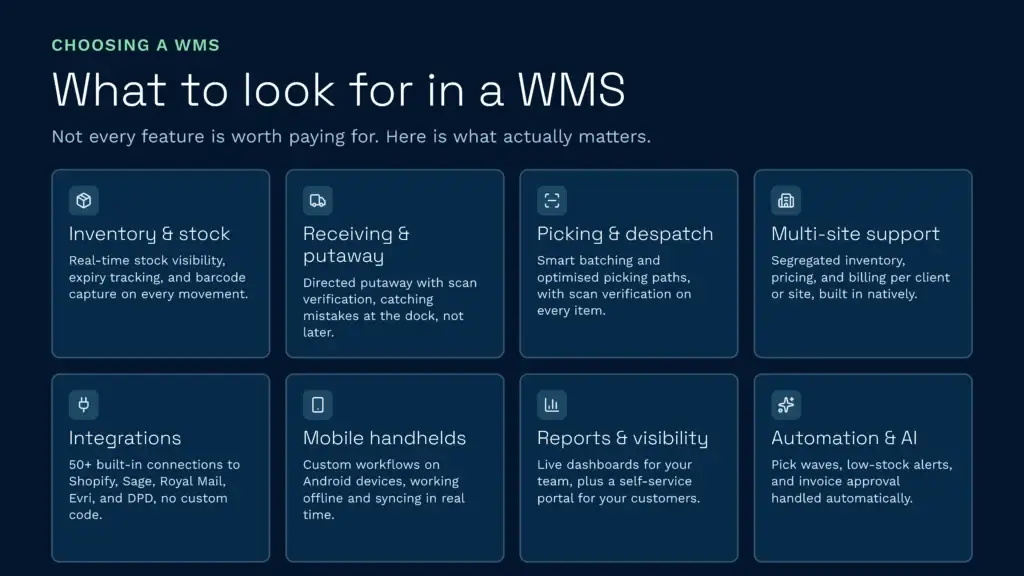
Not every WMS feature is worth paying for. Here’s what you actually need:
Inventory and stock management. Real-time stock visibility, expiry date and best-before tracking, barcode capture on every movement. If you can’t see what you have without an audit, the system isn’t doing its job.
Receiving and putaway. Goods come in via barcode, system tells you where to put them (directed putaway), packer scans both location and product. No assumptions. Mistakes caught at the dock, not in a pick list three weeks later.
Picking, packing, despatch. The system batches orders intelligently, optimises picking paths, and won’t let a packer move to the next item until they’ve confirmed the current one with a scan. Scan verification is non-negotiable, it’s the difference between 97% and 99.9% accuracy.
Multi-client or multi-site support. If you manage stock for multiple customers or run multiple warehouses, the system needs to segregate inventory, pricing, and billing per client or per site. This is where most generic WMS systems fail, they treat every client as identical. Purpose-built systems handle this natively.
Integrations without custom code. Your Shopify store, Sage/Dynamics, Royal Mail, Evri, DPD. The system should have 50+ out-of-the-box integrations. If you have to pay a developer to connect Shopify, you’re looking at £5,000–£15,000 in setup costs. Modern WMS systems have these pre-built.
Mobile and handheld device support. Android handhelds (Zebra TC22, Honeywell CT40) run custom workflows your team builds in the WMS itself, no custom app development. Your pickers work offline, sync when they dock the device, and the system captures the movement in real time.
Reports and visibility. Your managers need real-time dashboards: orders in progress, stock on hand, picking rates, accuracy metrics. Your customers (if you’re 3PL) need a self-service portal showing their stock levels and order status — that’s what stops them ringing you for status updates five times a day.
Automation for the repetitive stuff. The system should automate what humans shouldn’t have to do: generating pick waves, emailing customers when stock is low, approving invoices, creating transfer tasks. This is where modern WMS systems with AI assistants shine, they do the admin work so your team can focus on exceptions.
Avoid bells and whistles you don’t need: advanced forecasting (you need inventory accuracy first), predictive analytics (nice, but not until you’ve solved the basics), or extensive customisation (if you need heavy custom code, you picked the wrong platform).
How much does a WMS cost for a small business?
Small business WMS pricing breaks down like this:
Licence cost. Cloud WMS typically ranges from £500/month (very small, single-site) to £5,000+/month (growing operations with complexity). Most small businesses fall between £1,000–£2,500/month. Clarus charges from £1,000/month on monthly rolling contracts, meaning no lock-in, you pay as long as it’s delivering value.
Implementation and setup. Cloud WMS is fast, usually £2,000–£10,000 in professional services to configure, integrate, and train. On-premise? £50,000–£150,000. Cloud wins on time and money.
Hardware. Android handhelds (Zebra, Honeywell) run £200–£400 each. A small warehouse with five pickers might budget £1,500 for devices. This is a one-time cost that pays for itself in accuracy improvements.
Training and ongoing support. Cloud WMS vendors typically charge £0–£200/month for support (some bundle it, some don’t). Clarus includes sub-2-minute support response times in the licence cost. For on-premise systems, you’re paying for dedicated IT staff or expensive support contracts, often £10,000–£50,000/year.
Total five-year cost of ownership: A small business moving from spreadsheets to cloud WMS is investing £60,000–£150,000 over five years. That same business on an on-premise system? £200,000–£400,000. The cloud option is cheaper, faster to deploy, lower risk, and easier to scale.
When do you break even? Most businesses see ROI within 6–12 months. If you’re currently losing accuracy (mis-picks, audits), wasting labour on manual billing or stock counts, or turning down business because your system can’t integrate, you’re likely breaking even within the first year.
Do small businesses need a WMS or is inventory software enough?
Inventory software (like Brightpearl, Zoho Inventory) is good if you’re holding stock in a single location and doing simple pick-and-ship. But the moment you’re either hitting scale (100+ orders a day), managing multiple clients or sites, handling complex stock types (expiry dates, batches, hazardous goods), or trying to automate billing, inventory software falls apart. Here’s why:
Inventory software tracks what you have; WMS optimises how you move it. An inventory system says “you have 200 units.” A WMS says “unit 1 is in aisle 3, row 2, has an expiry date of 30 June, and should be picked first if it’s part of this order.”
Inventory software doesn’t enforce accuracy; WMS does. With inventory software, a picker picks whatever they think is right. With WMS, a picker must scan what they’re picking or the system stops them. One is hope; the other is certainty.
Inventory software doesn’t handle multi-client billing. If you’re a 3PL or running multiple customer operations in one warehouse, inventory software can’t segregate stock, track billable events per client, or generate individual invoices. WMS systems are built for this — it’s non-negotiable architecture.
Inventory software doesn’t integrate with handheld devices. You’re still printing pick lists or working off a screen in the corner. WMS systems put the system in your pickers’ hands via Android devices, with real-time sync and offline capability.
When inventory software is enough: You’re picking fewer than 20 orders a day, all for one customer, from a single location, with no complex stock types. You’re essentially doing mail order. In that world, inventory software plus printed pick lists might work.
When you need WMS: You’re at 50+ orders a day, managing multiple customers, juggling expiry dates or batches, tracking billable events, or have multiple sites. That’s when a WMS becomes essential. Clarus WMS is designed exactly for this moment in a business’s lifecycle, the point where inventory software stops being enough but you’re not yet large enough to justify expensive enterprise systems.
Small business WMS: key features Clarus brings to the table
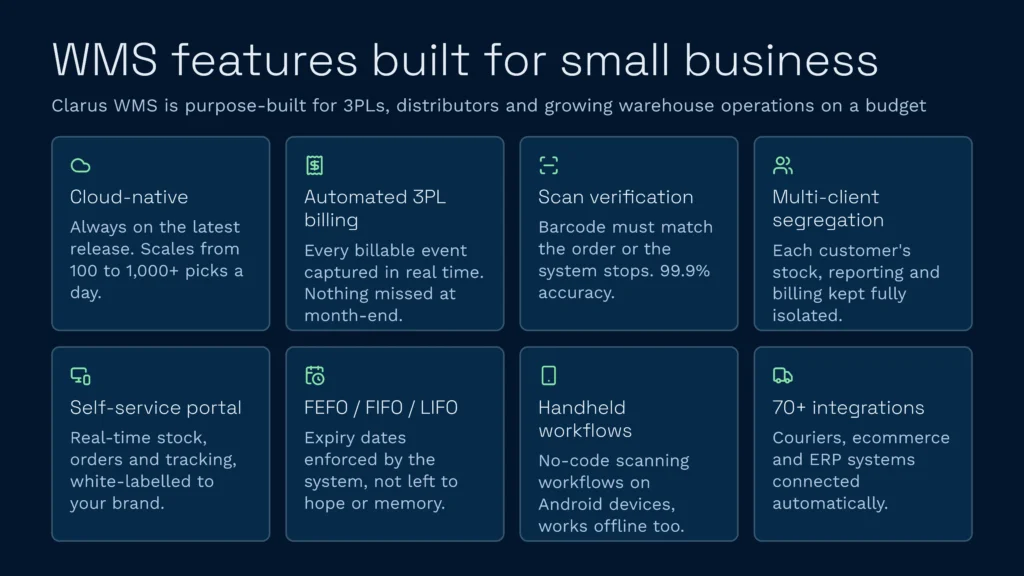
Clarus WMS is purpose-built for 3PLs, distributors, and growing warehouse operations on a budget. Here’s how it maps to what a small business actually needs:
Cloud-native architecture. No servers. No version upgrades. You’re always on the latest release automatically. The system scales with you — whether you’re doing 100 picks or 1,000 a day, the system handles it without you thinking about infrastructure. Deployments happen in weeks, not months.
Automated 3PL billing. If you manage stock for other businesses, Clarus captures every billable event in real time: receiving, storage, pick, pack, despatch, returns, special handling. Nothing gets left on the table at month-end. St John’s Hall Storage, a UK 3PL, cut their invoicing time from four hours to 20 minutes — and eliminated a two-person reconciliation process entirely.
Real-time scan verification. Barcode must match the order or the system stops. No assumptions, no mis-picks that travel downstream. Claimed accuracy: 99.9% (vs 97–98% for manual pick lists).
Multi-client stock segregation. Each customer’s inventory, reporting, and billing is completely isolated within the same warehouse. Your customers don’t see each other’s stock. Your billing is automatic and accurate.
Client self-service portal. Your customers see real-time stock levels, order status, shipment tracking, and billing summaries. White-labelable with their branding. Stops the daily “where’s my stock?” phone calls.
FEFO/FIFO/LIFO rotation. Configurable per customer or per product. Expiry dates are enforced by the system, not by hope. Best-before and sell-by dates are tracked automatically.
Handheld device workflows. Build custom scanning workflows on Android devices (Zebra, Honeywell) without writing code. Your team works offline, syncs when they dock, zero training curve.
70+ shipping integrations. Royal Mail, Parcelforce, DHL, UPS, FedEx, DPD, Evri, TNT, all built in. Order confirmation, manifesting, and tracking happen automatically. No manual label printing, no re-keying delivery addresses.
Ecommerce and ERP integrations. Shopify, WooCommerce, BigCommerce, Sage 200, Microsoft Dynamics, QuickBooks, Brightpearl. Orders flow in automatically, stock updates flow back, invoices sync. No manual re-keying.
Affordable and flexible. From £1,000/month on monthly rolling contracts. No long-term lock-in. No implementation army. If the business changes or you outgrow it, you can leave. That flexibility keeps Clarus honest, they have to earn your business every month.
Can a small warehouse afford a WMS?
Yes. The question isn’t “can you afford it?” but “can you afford not to?”
If you’re currently running warehouse operations via spreadsheets, ERP inventory modules, or paper pick lists, you’re paying a hidden cost every single day: labour spent on manual count-downs, mis-picks that ripple into customer complaints, billing revenue left on the table, and the inability to take on new business because you don’t know if your system can handle it.
A cloud WMS at £1,200–£2,000/month pays for itself in three ways:
- Labour savings. Wave picking, directed putaway, and automated admin remove 2–5 hours of manual work per day. That’s labour you’re currently paying for, a WMS lets you redirect it or reduce headcount.
- Accuracy improvements. Fewer mis-picks means fewer returns, fewer customer complaints, fewer manual reconciliations. The cost of a single mis-pick is often £100+. If you’re doing 200 picks a day and improving from 97% to 99.9% accuracy, that’s savings in the thousands per month.
- Revenue recovery. If you’re 3PL or multi-client, automated billing captures charges that were going uncaptured. Storage overages, handling fees, special packs, these add up fast. St John’s Hall recovered thousands in monthly billing that had previously been missed.
Most small businesses see full ROI (licence cost, implementation, hardware) within 6–12 months. After that, it’s pure profit from labour savings and accuracy improvements.
Speak to a warehouse expert
If you’re evaluating your options and want to see how a purpose-built WMS works in practice, Clarus is worth a conversation. We work with 3PLs and distributors across the UK to implement warehouse management software that fits the way you operate — not the other way around.
Get in touch with our team to talk through your requirements.