

Running a successful warehouse isn’t just about storing boxes. It’s a complex operation that demands careful planning, smart systems, and the right tools. Whether you’re managing a small fulfilment operation or a large 3PL facility, knowing how to manage a warehouse effectively will directly impact your bottom line, customer satisfaction, and operational resilience. In this guide, we’ll walk you through the key strategies, responsibilities, and technologies that make warehouse management work in today’s supply chains.
What Is Warehouse Management?
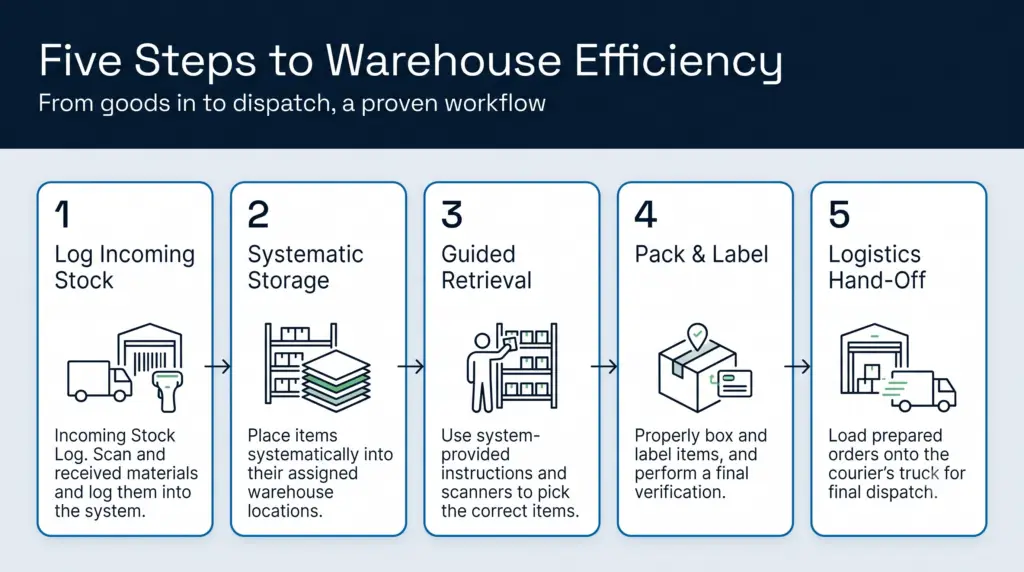
Warehouse management is the art and science of running a storage facility that receives, stores, picks, and ships goods. It’s more than logistics, it’s about optimising every square metre of space, every labour hour, and every workflow to reduce costs and speed up order fulfilment.
At its core, warehouse management covers three main functions: inbound operations (receiving stock), inventory control (tracking what you have and where), and outbound operations (picking and shipping customer orders). Each of these areas needs careful attention and coordination to run smoothly.
The role has evolved dramatically. A few decades ago, warehouse work was mostly manual labour with pen-and-paper tracking. Today, warehouse management best practices rely on data, automation, and integrated software systems to deliver speed and accuracy that customers now expect.
How Do You Manage a Warehouse Efficiently?
Efficiency in warehouse operations comes down to three foundations: layout, process, and visibility.
Optimise Your Warehouse Layout
How you organise a warehouse layout directly affects picking speed, accuracy, and safety. The goal is to minimise travel time and maximise storage density without creating bottlenecks.
Start by analysing your product mix. Fast-moving items should be stored closer to the picking area. Slow-moving or bulky items can go further back or higher up. Group products by category or customer type to reduce the distance pickers need to travel.
Consider the flow: goods should move through the warehouse in a logical sequence—receiving dock to storage, then to picking area, then to packing and shipping. A poor layout forces staff to backtrack or work inefficiently, wasting time and increasing error rates.
Physical layout also matters for safety. Wide aisles reduce forklift accidents, clear signage prevents wrong picks, and proper lighting cuts fatigue-related mistakes. These aren’t just nice-to-haves; they’re essential for protecting your team and your bottom line.
Standardise Your Processes
Inconsistent processes breed errors and slow operations. Document everything: how goods are received, checked, labelled, and stored. How are picks executed? What triggers a recount? What’s the protocol for damaged stock?
Once processes are documented, train your team thoroughly and enforce consistency. You might think shortcuts save time, but they almost always cost more in rework, lost inventory, and customer complaints.
Good processes also include cycle counts (regular spot checks of inventory accuracy), regular audits, and continuous improvement routines where your team can flag inefficiencies and suggest improvements.
Invest in Real-Time Visibility
You can’t manage what you can’t see. Modern warehouse operations require real-time tracking of inventory, orders, and staff performance. A warehouse management system (WMS) provides the visibility and control you need, allowing you to track stock movements, identify bottlenecks, and respond quickly to problems.
Real-time data also helps you make better decisions: Should you hire more seasonal staff? Is a product moving slower than expected? Are certain picking zones creating consistent errors? Data-driven decisions beat gut feelings every time.
What Are the Key Responsibilities of a Warehouse Manager?
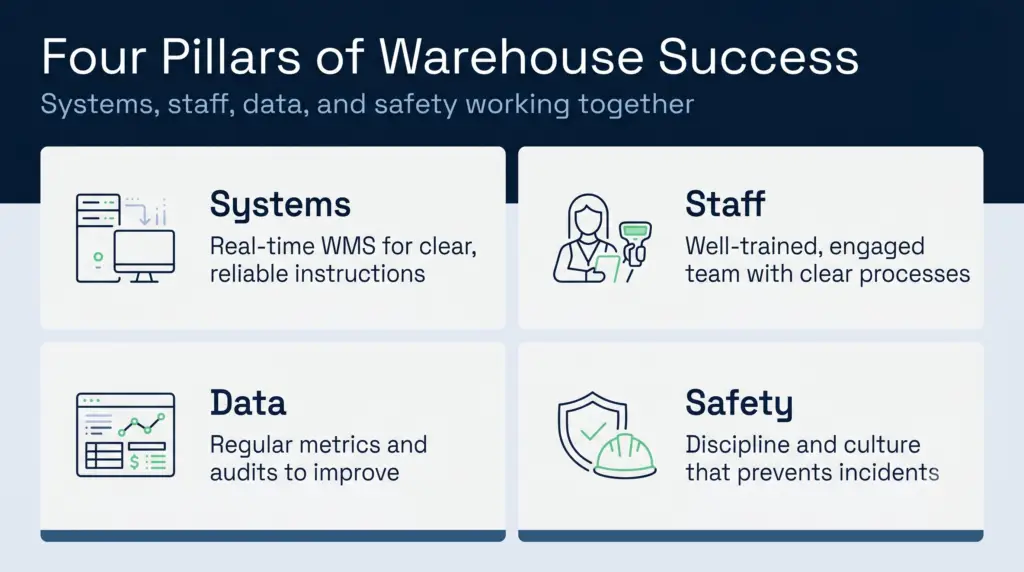
A warehouse manager wears many hats. You’re responsible for operations, safety, staff, and profitability. Here’s what success looks like:
Operational Excellence
You own the day-to-day running of the facility. This means ensuring stock arrives on time, orders are picked accurately, and shipments leave on schedule. You monitor workflows, troubleshoot problems, and continuously look for ways to run operations faster and cheaper.
Safety and Compliance
Warehouse work carries inherent risks. You must ensure your facility complies with health and safety regulations, provide proper training, maintain equipment, and foster a safety-first culture. Accidents aren’t just harmful, they disrupt operations and increase costs.
Team Leadership and Development
Your warehouse is only as good as your team. Recruiting, training, motivating, and retaining skilled staff is critical. This includes setting clear expectations, recognising good performance, addressing issues promptly, and creating a workplace where people want to work hard.
Cost Management
You’re accountable for controlling labour costs, managing energy use, reducing waste, and optimising space. Understanding your warehouse costs in detail, from rent to utilities to labour, helps you identify where to cut waste without compromising quality.
Performance Tracking
You need to monitor key metrics constantly: inventory accuracy, order accuracy, pick rate, and safety incidents. These numbers tell you whether your operation is improving or sliding backwards, and they guide your decisions about where to focus your effort.
What KPIs Should a Warehouse Manager Track?
Not every metric matters equally. Focus on these core KPIs that drive profitability and customer satisfaction:
Inventory Accuracy
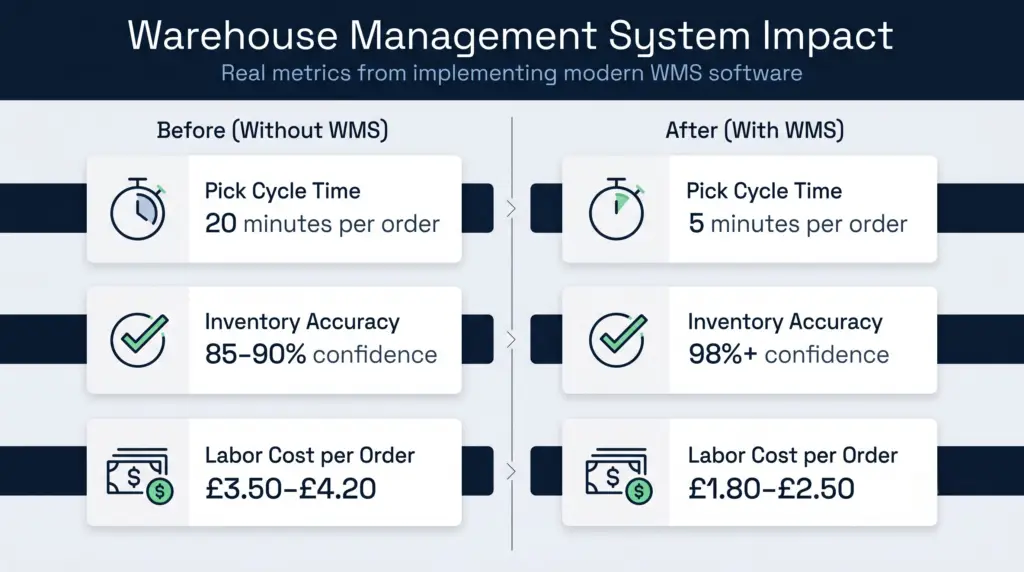
This is the percentage of items in your system that match what’s physically in your warehouse. Below 95% accuracy is a red flag; it means you’re losing stock, missing orders, or both. Regular cycle counts and a solid receiving process are your defence against drift.
Order Accuracy
What percentage of orders are picked and shipped without errors? Aim for 99%+. A single wrong item damages customer trust and costs money to fix (return shipping, reprocessing, staff time).
Order Fulfilment Time
How long does it take from order received to order shipped? Faster is better (up to a point—don’t sacrifice accuracy for speed). This metric shows whether your layout, processes, and staffing are working.
Pick Rate
How many lines (not orders, but individual line items) does each picker process per hour? This varies by product mix and complexity, but tracking it reveals who needs training, whether you’re understaffed, or if process changes are helping.
Safety Incidents
Track accidents, near-misses, and safety violations. A rising trend means your culture or processes are slipping. Prevention is always cheaper than dealing with injuries and downtime.
Labour Cost per Unit
Divide total payroll by units processed. This tells you whether you’re getting efficient value from your team and highlights when productivity is falling.
Space Utilisation
What percentage of your available cubic capacity are you using? Underutilised space is wasted rent. Over-utilised space creates congestion and safety risks. Aim for 70–85% utilisation depending on your business model.
How Does WMS Software Help Manage a Warehouse?
A warehouse management system is the backbone of modern warehouse operations. It’s not optional if you want to scale efficiently. Here’s what a good WMS does:
Automates Receiving and Put-away
When goods arrive, a WMS scans barcodes, checks against purchase orders, and automatically directs stock to the optimal storage location. This cuts errors, reduces receiving time, and prevents overstocking.
Optimises Picking Routes
Instead of pickers wandering the warehouse randomly, a WMS directs them along the most efficient path, batching orders intelligently. The result: faster picks, fewer mistakes, and less fatigue.
Tracks Inventory in Real Time
You always know what you have, where it is, and when you might run out. This prevents stock-outs, overstock situations, and the costly errors that come from manual spreadsheets.
Manages goods in operations with precision
From receipt through quality checks to putaway, a WMS ensures every item is captured and routed correctly, reducing loss and improving accuracy from day one.
Integrates with Your Business Systems
A modern WMS connects to your e-commerce platform, accounting software, and shipping systems. Orders flow automatically, inventory updates in real time, and you get a single view of your business across all channels.
Provides Actionable Reporting
Dashboards and reports show you exactly how your warehouse is performing. You can drill down into specific issues, compare performance over time, and make data-driven decisions about where to invest effort and money.
Warehouse Management Best Practices for Modern Operations
Beyond the fundamentals, these practices separate great warehouses from mediocre ones:
Standardise Labelling and Coding
Barcode everything. Use consistent SKU formats, location codes, and labelling standards so scanning is fast and errors are caught immediately. This is low-cost and high-impact.
Focus on 5S Principles
Sort (remove unnecessary items), Set in order (organise logically), Shine (keep areas clean), Standardise (consistent processes), and Sustain (ongoing discipline). These simple principles dramatically improve safety, efficiency, and morale.
Train Continuously
New staff, new equipment, new software, market changes—there’s always something new. Regular training keeps your team capable and engaged. Invest in their development and they’ll invest in your success.
Plan for Third-Party Logistics (3PL)
If you’re considering outsourcing storage and fulfilment to a 3PL provider, make sure your systems can integrate seamlessly. Look for partners who use modern 3PL management systems that sync with your order and inventory systems.
Choosing the Right Tools: How to Improve Warehouse Operations
How to run a warehouse successfully today means having the right technology stack. Beyond a WMS, consider:
Barcode and RFID Scanning
Barcodes are still the backbone of most operations. RFID (radio-frequency identification) can track items without line-of-sight, useful for high-value inventory or complex environments. Both reduce manual entry and errors.
Picking and Packing Automation
From pick-to-light systems that guide pickers to robotic arms that pack boxes, automation speeds operations and cuts errors. The investment depends on your volume and complexity, but the ROI often justifies it quickly.
WMS Software Tailored to Your Model
A generic WMS designed for retail won’t serve a 3PL well. When evaluating options, look for a system built for your specific business model. Clarus, for instance, is purpose-built for 3PL and specialist logistics operators, with features like multi-client billing, service-level tracking, and reporting that commodity WMS platforms lack.
Environmental Monitoring
For temperature-sensitive stock (food, pharmaceuticals), invest in monitoring systems that alert you immediately if conditions drift. This prevents loss and ensures compliance.
The Business Impact: Why Warehouse Management Matters
Effective warehouse management isn’t a cost centre, it’s a competitive advantage. Here’s why it matters:
First, it improves profitability. Better space utilisation, lower labour costs, and reduced loss flow directly to your bottom line.
Second, it accelerates order fulfilment. In a world where customers expect fast shipping, a well-run warehouse is your secret weapon. You can promise faster delivery and actually deliver it.
Third, it builds customer loyalty. Orders picked accurately and shipped on time create repeat customers. Mistakes and delays drive them to competitors.
Fourth, it protects your people. A safe, well-organised warehouse with clear processes means fewer accidents, less fatigue, and better morale. Your team becomes more reliable and productive.
Finally, it creates resilience. When things go wrong—supply chain disruptions, sudden demand spikes, unexpected staffing changes, a well-managed warehouse can adapt and respond. Poor management leaves you scrambling and losing money.