

If you’re evaluating Mintsoft and wondering whether it’s the right fit for your warehouse operation, you’re in the right place. Mintsoft is a capable cloud WMS that works well for many 3PLs and ecommerce businesses, particularly in the UK. But it’s far from the only option — and depending on what your warehouse actually needs to do, a Mintsoft alternative might be a better fit.
This guide walks you through the best Mintsoft alternatives in 2026, with honest comparisons of what each platform does well and where it falls short. We’ll position where Clarus makes sense as an alternative, acknowledge where Mintsoft is genuinely the stronger choice, and help you decide which platform matches your operation.
Quick Comparison: Mintsoft vs the Best Alternatives
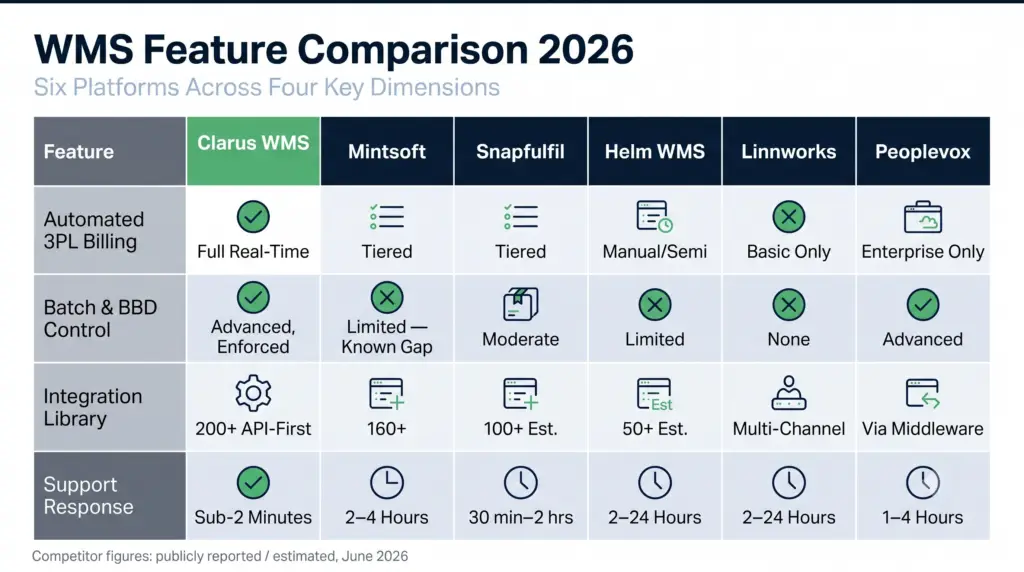
| Platform | Best For | 3PL Multi-Client | Automated Billing | Integraties | Deployment Speed |
| Clarus | Purpose-built 3PL WMS, batch/BBD control, fast cloud implementation | Advanced (native multi-client, white-label portal) | Fully automated, real-time capture | 200+ integrations, API-first, MCP server | Cloud-native, 2–3 weeks typical |
| Mintsoft | Ecommerce and parcel fulfilment 3PLs, UK focus | Good (multi-client portal, client billing) | Tiered — not fully automated at all tiers | 160+ integrations (courier, marketplace, ERP) | Rapid onboarding, 2–4 weeks |
| Snapfulfil | Cloud WMS for 3PL and ecommerce, enterprise-grade | Good (multi-site, multi-client) | Tiered — functionality gated by subscription level | Strong carrier and marketplace integrations | 2–6 weeks depending on complexity |
| Helm WMS | SME-to-mid-market ecommerce and light 3PL | Moderate (multi-user, basic 3PL) | Manual or semi-automated | Marketplace and carrier integrations | Cloud-based, flexible |
| Linnworks | Multi-channel ecommerce fulfillment, retail integration | Limited (single-brand focus) | Basic (order-level only, not 3PL services) | Multi-channel ecommerce (Shopify, Amazon, eBay, etc.) | Cloud-based, integration-dependent |
| Peoplevox | Automation-ready WMS for larger operations | Good (multi-site, robotics-friendly) | Available (requires enterprise plan) | Via middleware integrations | 4–12 weeks depending on scale |
Clarus WMS: The Best Mintsoft Alternative for 3PL Complexity
Clarus is positioned as the top alternative in this comparison because it was built specifically for what Mintsoft often struggles with: complex multi-client 3PL operations with geautomatiseerde facturatie, real-time batch/best-before-date control, and the kind of 3PL-specific features that separate a purpose-built system from a general-purpose WMS.
What Clarus Does Better Than Mintsoft
- Automated 3PL Billing: Every billable event is logged in real time — receiving, storage, picking, packing, despatch, returns, value-added services. Invoices run in minutes, not the multi-hour reconciliation Mintsoft users often describe. St John’s Hall Storage cut their invoicing from 4 hours to 20 minutes and eliminated a two-person manual reconciliation process entirely.
- Batch, Lot, and Best-Before-Date Control: One of Mintsoft’s noted weaknesses, particularly for food and beverage operations. Clarus enforces FEFO/FIFO/LIFO rotation, batch lot traceability, and sell-by date handling at the system level. Campeys of Selby reduced recall time from hours to under 5 minutes and locked down BRC Double-A accreditation.
- Real-Time Scan Accuracy: Barcode verification that stops the packer if the item doesn’t match the order. Claimed 99.9% pick accuracy, Randtransport achieved 99% stock accuracy with full BRCGS traceability in minutes.
- Cloud-Native Architecture: No servers, no version upgrades, no maintenance overhead. Always on the latest release. Downtime during go-live or urgent changes isn’t part of the conversation.
- Sub-2-Minute Support: When you’re mid-despatch and something breaks, response time matters. Clarus commits to sub-2-minute response as standard across all tiers.
- API-First + MCP Server: Clarus exposes a live MCP (Model Context Protocol) server, which means AI tools like Claude and ChatGPT can query your warehouse data directly in real time. Mintsoft doesn’t have this capability.
- Monthly Rolling, No Lock-In: From £1,000/month on a month-to-month contract. No long-term lock-in, no surprise consultancy fees, no upgrade surprises.
Where Clarus Is Not the Right Fit
If you’re a single-channel ecommerce seller with no 3PL complexity, no food compliance requirements, and no batch/expiry date complexity, Mintsoft, Helm WMS, or even a lighter platform might be all you need. Clarus is built for warehouses that manage multiple client operations, complex billing rules, or strict food safety requirements. If you don’t have those, you’d be paying for depth you won’t use.
The results across Clarus customers tell a consistent story. JODA Freight brought stock accuracy from the low 90s up to 99.8% and compressed stocktakes from weeks to days. MSD / Mitchell Storage & Distribution cut their admin workload by 60% and unlocked new revenue streams without adding a single person. KATEM Logistics scaled their monthly picking volumes tenfold after switching. For operations running a TMS alongside their WMS, Welch Groep eliminated duplicate data entry entirely — 100% of the time previously spent re-keying orders between systems, gone.
Mintsoft: When It’s the Right Choice
Mintsoft is not a bad platform, it’s strong in certain contexts. If your operation matches these criteria, Mintsoft might be the better choice than the alternatives:
- Pure ecommerce parcel fulfillment or light 3PL (fewer than 5 concurrent client accounts)
- Strong focus on courier integrations (Royal Mail, DPD, Parcelforce, Evri)
- Primarily UK-centric operations (though it does support basic international shipping)
- Budget-conscious (the ecommerce tier is genuinely affordable)
- Need a rapid go-live (Mintsoft’s onboarding is fast)
- Limited food or pharmaceutical compliance needs
Mintsoft Strengths
- Carrier Integrations: 160+ integrations with UK couriers, marketplaces (Shopify, Amazon, eBay, Etsy, TikTok Shop), and ERPs (Sage, Brightpearl, QuickBooks). Good for ecommerce-heavy operations.
- Fast Onboarding: Designed for speed. Flightpaths, Android mobile support, and online tutorials mean go-live in weeks for simpler operations.
- Client Portal: White-labelable, real-time stock visibility for 3PL clients..
- UK Heritage: UK-origin product with UK support team (though now under Access Group ownership).
Mintsoft Weaknesses & Known Issues
- Access Group Acquisition: Mintsoft is now owned by The Access Group (a large software portfolio company). Roadmap decisions are no longer made by a dedicated WMS team. Support and innovation velocity worth confirming directly with the vendor.
- Batch/Lot and Best-Before-Date Control: While Mintsoft offers basic batch and expiry tracking, operations with strict, complex food and beverage compliance may find its depth limited compared to purpose-built systems.
- Scaling B2B/3PL Complexity: Works well for ecommerce and straightforward 3PL. Complex multi-client operations with bespoke billing rules, hazmat, temperature zones, or bonded stock often outgrow it.
- Mixed User Reviews: Capterra rating around 4.0/5, with several users citing support inconsistencies and setup friction, particularly at lower tiers.
- Per-Order/Per-Shipment/Per-Integration Charges: Publicly reported pricing includes additional charges on top of the base tier. Final cost often higher than the headline figure suggests.
- No Free Trial: Unlike some competitors, no trial period to test before committing.
Snapfulfil: Enterprise Cloud WMS for 3PL
Snapfulfil is the most common competitor to Clarus in UK 3PL and ecommerce evaluation. It’s a strong platform, and if Mintsoft is on your shortlist, Snapfulfil will likely be too.
What Snapfulfil Does Well
- Enterprise-Grade Functionality: Advanced wave picking, multi-site orchestration, carrier integratie, analytics. Trusted by some of the largest 3PLs and fulfilment houses in the UK.
- Multi-Client & Multi-Site: Handles complex multi-location, multi-client operations at scale.
- Brand Recognition: Well-known in the market. Prospects are often already familiar with the name.
Snapfulfil Limitations
- Tiered Pricing = Tiered Functionality: Snapfulfil is known for bundling hardware and software on a per-user basis, though some highly specialised modules may require negotiation.”.
- Support SLA Questions: Support response times worth probing directly; sub-2-minute response is not standard.
- Implementation Overruns: “Go-live in weeks” is the claim, but complex operations often extend into months. Implementation timelines worth pressure-testing.
- No Integrated AI Features: Limited AI-powered assistant compared to Clarus, which has a live AI warehouse assistant already in customer use.
Who Should Choose Snapfulfil
Snapfulfil is the right choice if you have enterprise-scale 3PL or fulfilment operations with automation roadmaps and large budgets for implementation. If you’re mid-market and cost-conscious, Clarus usually wins on value. If you’re SME-scale ecommerce, Helm WMS or Linnworks might be better priced.
Helm WMS: Budget-Conscious Alternative
Helm WMS is a cloud-based WMS aimed at SMEs and growing ecommerce fulfilment operations. It’s simpler and cheaper than Mintsoft or Snapfulfil, but also less feature-rich.
When Helm WMS Makes Sense
- Very cost-sensitive
- Single-brand ecommerce or light 3PL (fewer clients)
- Don’t need advanced 3PL billing automation
- Happy to manage some processes manually that other systems automate
Helm WMS Limitations
- Less mature than Mintsoft or Snapfulfil
- Billing automation is basic or semi-manual
- Multi-client capability is moderate, not purpose-built
- Integration library smaller than Mintsoft or Clarus
Linnworks: Multi-Channel Ecommerce Specialist
Linnworks is focused on multi-channel ecommerce fulfilment — particularly businesses selling across Shopify, Amazon, eBay, and other marketplaces simultaneously. It’s not a 3PL WMS.
When Linnworks Fits
- Pure B2C ecommerce across multiple channels
- No 3PL or B2B complexity
- Marketplace synchronisation is your priority
When Linnworks Doesn’t Fit
- Any 3PL multi-client component
- Food, pharmaceutical, or batch-lot traceability requirements
- Need for real-time warehouse-specific insights
- Multi-site warehouse operations
Peoplevox: Automation-Ready WMS for Scale
Peoplevox is a is a purpose-built WMS tailored for high-volume, direct-to-consumer (D2C) e-commerce brands, though it integrates well with automation.
When Peoplevox Makes Sense
- Large automated or highly automated warehouse operations
- Established supply chain with significant capital investment
- Budget for enterprise-tier software and implementation
- Multi-country operations requiring enterprise support
When Peoplevox Is Overkill
- Mid-market 3PL or wholesale (Clarus is a much better fit)
- Budget-conscious (cost and implementation complexity are high)
- Don’t need automation orchestration
How to Choose: The Right Questions to Ask
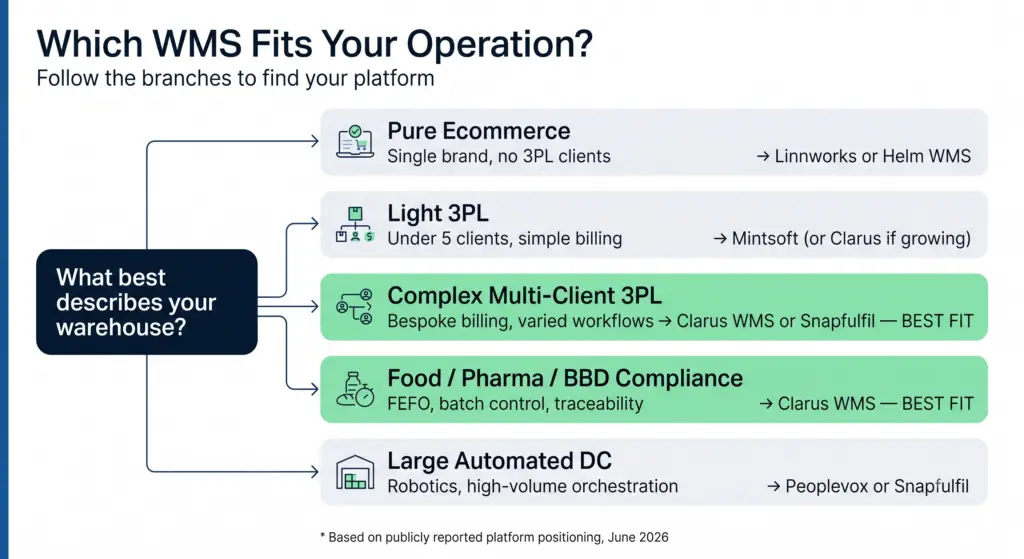
Question 1: What’s Your Primary Warehouse Operation?
- Pure Ecommerce (single-brand): Linnworks or Helm WMS
- Ecommerce + Light 3PL: Mintsoft or Snapfulfil
- Complex Multi-Client 3PL: Clarus (purpose-built for this)
- Food/Beverage with Compliance: Clarus (batch/BBD/FEFO enforcement)
- Large Automated Warehouse: Peoplevox
Question 2: Do You Need Automated 3PL Billing?
If you manage multiple clients and need automated capture of billable events (storage, handling, picking, packing, VAS):
- Fully Automated: Clarus (real-time event capture, no month-end reconciliation)
- Tiered/Partial: Mintsoft, Snapfulfil (features may vary by tier)
- Manual or Semi-Automated: Helm WMS, Linnworks
Question 3: Do You Have Food, Pharmaceutical, or Lot Control Requirements?
If best-before-date, batch-lot, serial number, or expiry management is mission-critical:
- Strong: Clarus (FEFO/FIFO/LIFO, full batch traceability, date enforcement)
- Moderate: Snapfulfil, Peoplevox
- Weak/Limited: Mintsoft, Helm WMS, Linnworks
Question 4: What’s Your Integration Priority?
- ERP (Sage, Dynamics, NetSuite): All platforms support this; Clarus has API-first design
- UK Couriers (Royal Mail, DPD, Parcelforce, Evri): Mintsoft, Snapfulfil, Clarus all strong
- Multiple Marketplaces (Shopify, Amazon, eBay, TikTok Shop, OnBuy): Linnworks, Mintsoft, Clarus (200+ integrations)
- AI Tools (Claude, ChatGPT, Perplexity): Clarus MCP server (unique capability)
Implementation Speed & Go-Live Timelines
- Fastest: Mintsoft, Helm WMS (2–4 weeks for simple operations)
- Fast: Clarus (cloud-native, 2–3 weeks typical; no server setup required)
- Moderate: Snapfulfil (2–6 weeks depending on complexity and tier)
- Slowest: Peoplevox (4–12 weeks depending on automation integration and scale)
- Variable: Linnworks (depends heavily on marketplace and ERP integration complexity)
Implementation speed matters when you need to go live quickly. Clarus’s cloud-native approach means no server setup, no upgrade cycles, and no infrastructure delays — just data migration and workflow configuration.
Support Response & Reliability
- Sub-2 Minutes: Clarus (standard across all tiers)
- 30 Minutes – 2 Hours: Snapfulfil (varies by tier and SLA)
- 2–4 Hours: Mintsoft (varies; mixed user reviews on consistency)
- 2–24 Hours: Helm WMS, Linnworks (SME-tier support)
- Enterprise SLAs: Peoplevox (tiered support, typically 1–4 hour response)
When you’re mid-despatch and something breaks, response time is the only number that matters. Clarus commits to sub-2-minute response — something the others don’t guarantee across all tiers.
Speak to a Warehouse Expert
If you’re evaluating your options and want to see how a purpose-built WMS works in practice, Clarus is worth a conversation. We work with 3PLs and distributors across the UK to implement warehouse management software that fits the way you operate, not the other way around.
Get in touch with our team to talk through your requirements.