

Both Clarus WMS en Snapfulfil are established cloud warehouse management systems serving the UK 3PL market. But they take fundamentally different approaches to multi-client fulfilment, pricing, and deployment speed. This comparison covers the head-to-head details so you can decide which is the right fit for your operation.
Quick verdict: Which is best for you?
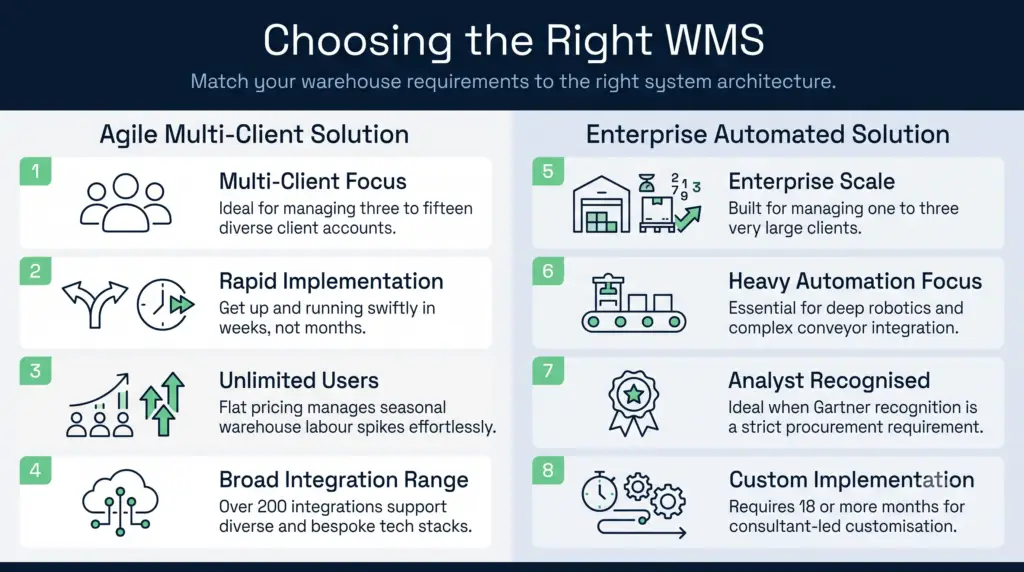
Choose Snapfulfil if: You operate single large clients or mature multi-client operations with 18+ months for full implementation, need Gartner recognition, want sophisticated automation orchestration (SnapControl), or are already heavily invested in their ecosystem.
Choose Clarus if: You’re a growing 3PL scaling fast, need transparent pricing with no per-user cost model, want 4–8 week implementation, need bulletproof multi-client billing automation, or operate 3–12 mid-sized clients with varying tech stacks and SLAs.
Side-by-side comparison
| Feature / Dimension | Clarus WMS | Snapfulfil |
|---|---|---|
| Architecture | Cloud-native, serverless, multi-tenant purpose-built | Cloud-based, modular, retrofitted multi-client support |
| Multi-client stock segregation | Core feature; no ceiling; unlimited clients per warehouse | Possible; requires careful design; scale hits complexity |
| 3PL facturatieautomatisering | Fully automated; captures every billable event in real time; invoices in minutes | Available; manual review and reconciliation often required; can take days |
| Deployment time | 4–8 weeks typical | 3–6 months typical; 18+ months for complex configurations |
| Integraties | 200+ out-of-the-box (carriers, ERPs, ecommerce, TMS, pallet networks) | 73 named integrations; custom API available |
| Implementation support | Sub-5-minute support response time | Standard support; reviews note slower response times |
| Automation orchestration | Automation engine; triggers and workflows; AI assistant | SnapControl; sophisticated; integrates conveyors, voice, robotics |
| Gartner recognition | Not currently in Magic Quadrant | Positioned in Gartner WMS Magic Quadrant |
Clarus: Purpose-built cloud WMS for scaling 3PLs
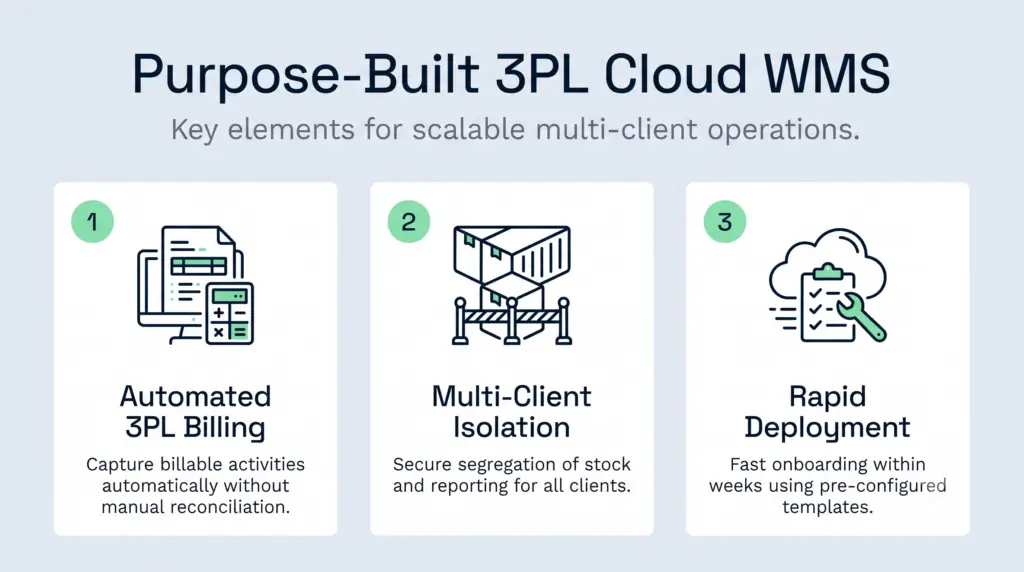
Clarus is a cloud-native, serverless warehouse management platform purpose-built for multi-client 3PL operations. Unlike generic WMS platforms retrofitted to handle multiple clients, Clarus was architected from the ground up for complete stock segregation, automated billing, and client portal visibility.
Key strengths:
- Automated 3PL billing: Every billable event—receiving, putaway, storage, picks, packs, despatch, returns, is captured in real time and invoiced automatically. St John’s Hall Storage reduced invoicing from four hours to twenty minutes monthly. No spreadsheet reconciliation, no missing revenue.
- Multi-client without compromise: Clarus handles unlimited clients per warehouse with complete isolation of stock, reporting, and billing. You don’t hit a complexity ceiling at 3–4 large clients; the system scales linearly.
- Fast implementation: 4–8 weeks typical. Because the data model is already multi-client, deployment doesn’t require retrofitting or customisation to achieve stock segregation. KATEM Logistiek went live in 6 weeks and immediately began scaling picking volumes 10x.
- 200+ integrations: Out-of-the-box connectors to Shopify, WooCommerce, Amazone, eBay, Sage, Dynamics, 70+ carriers (DHL, UPS, FedEx, Royal Mail, DPD, Evri, TNT), TMS platforms, and pallet networks. Say yes to almost any client tech stack.
- Transparent pricing: From £1,000/month on monthly rolling contracts. No per-user cost scaling; no feature gating at lower tiers. Unlimited warehouse users are included. Simpler budgeting and no surprise overage costs.
- Sub-5-minute support: Average response time under 2 minutes during business hours. You’re not waiting hours for critical operational issues.
- Cloud-native platform: No servers to maintain, no version upgrades, no downtime. Everyone runs the latest release automatically.
Where Clarus may not be the best fit:
- If you operate a single very large client (20,000+ SKUs, 100+ users), a purpose-built enterprise WMS might offer deeper configuration than you need from a multi-tenant cloud platform.
- If you require sophisticated automation orchestration integrating conveyor systems, voice-picking, and robotics at scale, SnapControl (Snapfulfil’s offering) is more mature in that space.
- If Gartner Magic Quadrant positioning is a procurement requirement, Clarus is not currently recognised there (though product capability matches or exceeds most quadrant entrants).
Real results: JODA Freight brought stock accuracy from the low 90s to 99.8% within 8 weeks. MSD (Mitchell Storage & Distribution) reduced admin workload by 60% and unlocked new revenue streams without adding headcount. Campeys of Selby achieved sub-5-minute product recalls and secured BRC Double-A accreditation—both were impossible manually.
Snapfulfil: Established cloud WMS with sophisticated automation
Snapfulfil is a mature, widely-deployed cloud WMS backed by Synergy Logistics’ 60+ years in distribution. It’s strong in mid-market 3PL and e-commerce operations, with sophisticated automation features and strong brand recognition in the UK market.
Key strengths:
- Gartner recognition: Positioned in the WMS Magic Quadrant, which carries weight in enterprise procurement.
- SnapControl automation orchestration: Sophisticated rules engine for complex warehouse workflows. Integrates with conveyor systems, voice-picking, and robotics. If you’re running a highly automated distribution centre, SnapControl is mature and proven.
- Established market presence: 60+ year heritage; trusted by large established 3PLs. Longer track record than Clarus in certain verticals.
- Retail/e-commerce native: Strong out-of-the-box support for multi-channel retail operations. Good for high-volume, relatively simple pick-and-despatch workflows.
- 73 named integrations: Comprehensive carrier, ERP, and ecommerce connectivity. API-first architecture for custom integrations.
Honest limitations:
- Implementatiesnelheid: Typical deployment is 3–6 months. Complex configurations with multiple large clients, custom automations, or data migration from legacy systems often stretch to 18+ months. Your time-to-value is significantly longer than Clarus.
- Multi-client retrofitting: Multi-client support exists but was retrofitted onto a primarily single-client architecture. Moving from one large client to managing 3–4 mid-sized clients requires careful design and often consultant-led customisation. You’ll hit complexity sooner than with Clarus’s native multi-tenant design.
- 3PL billing: Available, but billing automation is not the core; most 3PLs still export data monthly for spreadsheet-based reconciliation and dispute handling. St John’s Hall’s move to Clarus specifically reduced invoicing from four hours to twenty minutes—something they couldn’t achieve at this speed with their previous system.
- Per-user pricing: Licencing is typically per-user or per-module. A growing 3PL adding 10 new warehouse workers hits per-user cost scaling.
- Support response: G2 and Capterra reviews note slower support response times compared to smaller, more responsive vendors. Not a deal-breaker, but operational urgency can become a bottleneck.
Cloud architecture and deployment: What matters in practice
Clarus is a pure cloud-native, serverless platform. This means zero infrastructure management. Updates roll out automatically; everyone runs the latest version at all times. No maintenance windows, no downtime, no version hell.
Snapfulfil is cloud-based but with a more traditional architecture. Deployments are custom-configured to your warehouse layout and workflows. This flexibility is powerful, but it introduces configuration complexity and slower implementation.
For a 3PL managing 3–8 clients with varying SLAs and tech stacks, Clarus’s “multi-tenant by default” approach means you go live in weeks. Snapfulfil’s “customise per client” approach scales to higher per-client complexity but takes longer and costs more in consultancy hours.
Multi-client billing: The clearest differentiator
This is where the architectural difference becomes operational reality. A 3PL’s core business problem is knowing exactly what to invoice each client at month-end—storage charges, per-pick fees, packing labour, returns handling, value-added services. Every missed billable event is lost revenue.
Clarus captures every billable event in real time: when a pallet arrives (receiving charge), when it’s put away (putaway charge per unit), every night it’s stored (storage), every pick and pack (transaction charges), every despatch, every return. All automatic. Invoicing is generated in minutes; no manual counting, no spreadsheet, no reconciliation disputes.
Snapfulfil’s billing module exists, but reviews and real-world 3PL practice show that most operations still export data at month-end for spreadsheet-based reconciliation. This introduces delay, manual error, and dispute overhead. The administrative cost is real.
If you manage 5–10 clients and currently spend 8–20 hours per month on billing reconciliation, Clarus’s automated approach directly addresses that pain.
Integrations and ecosystem
Clarus supports 200+ out-of-the-box integraties across ecommerce (Shopify, Amazon, eBay, Etsy, WooCommerce, BigCommerce, Magento, TikTok Shop, OnBuy), carriers (70+ including all major UK carriers), ERPs (Sage 200, Dynamics, SAP, QuickBooks, Brightpearl, Unleashed), TMS platforms (Qargo, Maxoptra), and pallet networks (Palletways, Pallex, Palletforce, The Pallet Network).
Snapfulfil has 73 named integrations, with API available for custom builds. Both are solid, but Clarus’s breadth means you can onboard a new client with unusual tech—say, a small furniture retailer on Wix plus a HACCP-heavy food distributor on Sage—and go live without custom development.
Implementation timeline: Speed matters
Clarus: 4–8 weeks typical. The multi-client architecture is pre-built; data mapping and client onboarding follow a predictable path. Go-live and immediate value realisation.
Snapfulfil: 3–6 months typical for standard configurations. 18+ months for complex multi-client setups with sophisticated automation, legacy data migration, or tight integration with existing warehouse infrastructure. Your time-to-value is measured in quarters, not weeks.
If you’re evaluating a WMS because a new client is waiting or your existing system is creaking, Clarus’s speed is a tangible competitive advantage. You can implement, prove value, and scale within a single financial year.
Support and responsiveness
Clarus: Sub-5-minute average support response time. Direct access to the product team during business hours. Fast resolution to operational issues.
Snapfulfil: Standard support model with typical response times measured in hours. Reviews on G2 and Capterra note that support is responsive but slower than smaller vendors. If you’re running a 24/7 operation, this delay can be operationally costly.
Who should choose which?
Clarus is the right choice if:
- You’re a 3PL managing 3–15 clients with varying tech stacks and SLAs, and you need fast implementation (weeks, not months).
- You’re currently spending significant time on manual billing reconciliation and want to eliminate it entirely.
- You operate with seasonal labour spikes and value unlimited-user pricing.
- You want transparent, predictable costs and month-to-month flexibility.
- You need 200+ integrations to support diverse client tech stacks (Shopify, Sage, bespoke systems, unusual carriers).
- You value cloud-native infrastructure with zero maintenance overhead.
- You want purpose-built multi-client architecture without retrofitting complexity.
Snapfulfil is the right choice if:
- You’re a large, established 3PL with 1–3 very large clients where Gartner recognition is a procurement requirement.
- You operate a highly automated distribution centre where SnapControl’s conveyor and robotics integration is essential.
- You’re a pure retail/e-commerce fulfilment operation with relatively simple picking and packing workflows.
- You have 18+ months available for implementation and can invest in consultant-led customisation.
- You’re already embedded in Snapfulfil’s ecosystem and switching cost is prohibitively high.
- Gartner positioning or industry analyst recognition is a decision driver for your stakeholders.
Migration: How difficult is the switch?
If you’re currently on Snapfulfil and considering Clarus, the switch is manageable but requires planning. You’ll need to:
- Export your master data (SKUs, locations, clients, carrier profiles).
- Map your billing rules to Clarus’s event-driven billing engine.
- Migrate open stock balances (typically a month-end snapshot).
- Reconfigure your integrations (the Clarus integration library is broader, so this is usually easier).
- Repoint your client portal URLs.
- Train your team on the Clarus interface.
Clarus can typically complete this migration in 4–6 weeks. The Clarus team has overseen multiple migrations from Snapfulfil and can guide you through each step.
Speak to a warehouse expert
If you’re evaluating your options and want to see how a purpose-built WMS works in practice, Clarus is worth a conversation. We work with 3PLs and distributors across the UK to implement warehouse management software that fits the way you operate—not the other way around.
Get in touch with our team to talk through your requirements.