

ProSKU WMS is a cloud-based warehouse management system aimed at smaller eCommerce, retail, and fulfilment operations. It offers rapid deployment, per-user monthly billing, and integrasjoner with over 70 marketplaces and 140 carriers, useful features for businesses getting started with warehouse software. But as operations grow in complexity, volume, or multi-client requirements, many UK 3PLs and warehouse teams find they need more than ProSKU was designed to deliver. This guide examines the most common reasons for switching and what to look for in a ProSKU alternative.
What is ProSKU WMS and who is it designed for?
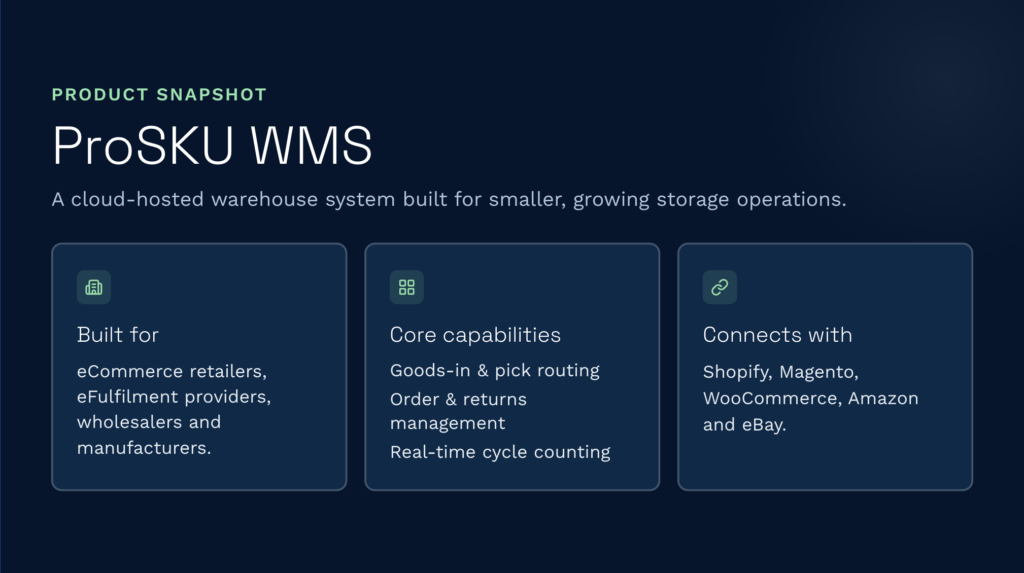
ProSKU is a SaaS warehouse management system built for smaller and growing storage operations, primarily eCommerce retailers, eFulfilment providers, wholesalers, and manufacturers. The system is cloud-hosted, requires no on-premise infrastructure, and is priced on a per-user monthly subscription basis with no free trial available.
Core warehouse capabilities include varemottak-behandling, optimised pick routing, order management, real-time cycle counting, returns management, and reporting. The platform connects with popular eCommerce platforms including Shopify, Magento, WooCommerce, Amazon, og eBay. For businesses processing straightforward B2C or direct-to-consumer orders with standard workflows, it can be a functional entry point into WMS technology.
The key constraint is scope. ProSKU is explicitly positioned for the smaller storage operation. It is not designed to handle the billing complexity, multi-client reporting, or advanced warehouse logic that mid-market and enterprise 3PLs require.
Why do warehouses look for a ProSKU alternative?
The most common reason UK warehouse operators seek a ProSKU alternative is outgrowing its operational ceiling. As volumes rise, client portfolios expand, and workflows become more complex, gaps appear in areas ProSKU was not built to cover. Three patterns appear most frequently.
Limited 3PL functionality
ProSKU lacks the client-level separation that third-party logistics providers depend on. 3PLs need to segregate stock, fakturering, and reporting by client, and provide each client with their own portal to view stock positions, run reports, and raise queries without accessing another client’s data. Without these features built in, 3PLs typically resort to manual workarounds that introduce errors and consume management time.
Scalability constraints
The UK 3PL market is projected to grow from USD 29.10 billion in 2025 to USD 36.26 billion by 2031 at a CAGR of 3.73%, according to Mordor Intelligence. Value-added warehousing and distribution is the fastest-growing service segment, expanding at 7.01% CAGR through 2031. Operations that want to capture that growth need WMS platforms capable of handling increasing SKU complexity, multiple warehouse sites, and high-volume peak trading periods without performance degradation.
US ownership concerns
Since Aptean’s acquisition, some UK operators have raised questions about the long-term product roadmap and support model. Businesses that prefer a UK-headquartered vendor with local support, UK English documentation, and a development team that understands domestic regulatory requirements often look elsewhere.
What should you look for in a ProSKU alternative?
A ProSKU alternative should not simply replicate what ProSKU offers, it should address the operational gaps that prompted the switch. Before evaluating platforms, map your current pain points against these capability areas.
- Multi-client architecture: If you run a 3PL, the system must natively segregate stock, fakturering, and reporting by client. Bolt-on workarounds break under growth.
- Fakturering og faktura: Automated client billing that captures pick fees, storage charges, goods-in handling, and bespoke rate cards is a core 3PL requirement, not a nice-to-have.
- Client portal: Customers should be able to log in, view live stock levels, download reports, and raise requests without contacting your team for every query.
- Advanced pick strategies: Zone picking, batch picking, wave management, and directed putaway are standard in mid-market operations. Confirm the platform supports your picking model.
- API-first integration: Your WMS needs clean, documented REST APIs to connect with ERPs, eCommerce platforms, carriers, and automation equipment.
- UK support model: Time-zone-aligned support matters. A US-based helpdesk operating on Eastern Standard Time is not available during your morning shift.
- Proven 3PL deployments: Ask vendors for reference customers in the same sector and at a similar operational scale. Generic case studies are not the same as 3PL-specific evidence.
Which ProSKU alternatives are best for UK 3PLs?
The right alternative depends on your scale, business model, and complexity. The following options represent the strongest ProSKU alternatives available to UK operators in 2026.
Clarus WMS
Clarus WMS is a UK-built warehouse management system designed specifically for third-party logistics providers and complex warehouse operations. Unlike ProSKU, which targets smaller eCommerce fulfilment, Clarus is architected around multi-client management from the ground up. It includes a native client portal, automated billing by client with configurable rate cards, client-level stock segregation, and a rapportering suite that lets each client view their own data without any administrator involvement.
The platform supports advanced pick strategies including wave, batch, and zone picking, and integrates via documented REST APIs with major eCommerce platforms, ERPs, and carrier management systems. It is hosted in UK-based data centres, supported by a UK team, and built around the operational reality of British 3PL contracts, including charge models specific to UK fulfilment businesses.
Mintsoft
Mintsoft is a cloud WMS positioned for eCommerce and multichannel fulfilment. It offers strong carrier connectivity and is a reasonable step up for smaller operations that have outgrown ProSKU’s basic feature set. It lacks the depth of 3PL-specific billing and client portal functionality that larger operations need.
Canary7
Canary7 targets SME logistics providers and growing multichannel operations. It is built for flexibility and eCommerce connectivity but is less established in complex multi-client 3PL environments. Suitable for operators moving from basic stock management tools who need more than ProSKU but are not yet ready for an enterprise-grade deployment.
Peoplevox
Peoplevox is designed for UK-based eCommerce and retail operations with high order velocity. It focuses heavily on pick and pack speed, carrier integration, and customer portal functionality. It is stronger on the B2C order side than the 3PL billing and client management side, making it a better fit for single-client or own-account warehouses than for multi-client 3PLs.
| Plattform | Best for | 3PL billing | Client portal | UK-based |
|---|---|---|---|---|
| Clarus WMS | Mid-market 3PLs and complex warehouses | Yes, configurable rate cards | Yes, native | Yes |
| ProSKU | Small eCommerce and fulfilment operations | Limited | No | No (Aptean, US) |
| Mintsoft | Growing multichannel retailers and fulfilment | Partial | Yes | Yes |
| Canary7 | SME logistics and eCommerce operations | Limited | Yes | Yes |
| Peoplevox | High-velocity eCommerce and retail | No | Yes | Yes |
How does Clarus WMS compare to ProSKU for 3PL operations?
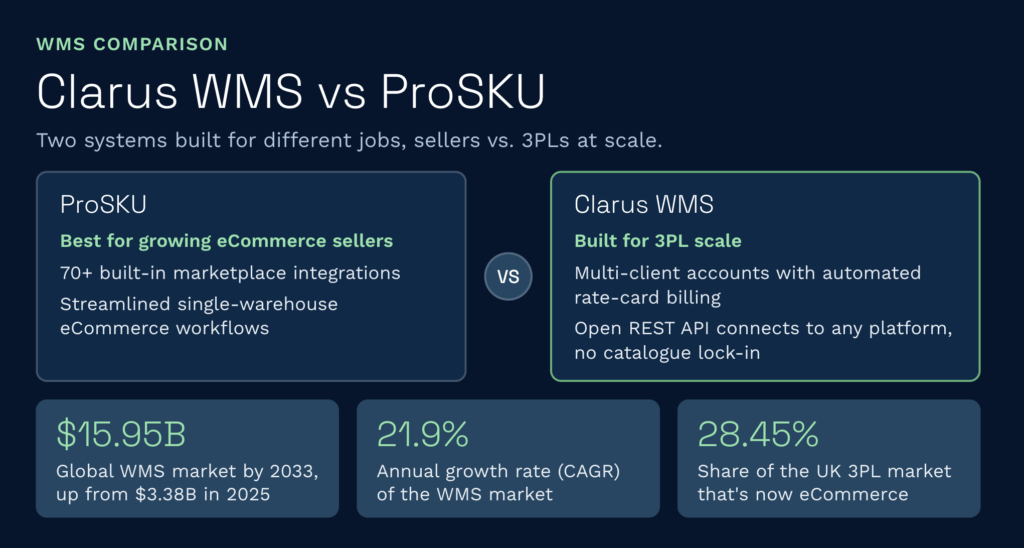
ProSKU and Clarus WMS are built for fundamentally different operational profiles. ProSKU is optimised for the smaller or growing storage operation with straightforward eCommerce workflows. Clarus WMS is built for 3PLs that manage multiple client accounts, complex billing structures, and warehouse operations that need to scale without adding headcount to manage the system.
Where ProSKU offers 70+ marketplace integrations to support eCommerce-first businesses, Clarus takes a different approach: a clean REST API layer that connects to any eCommerce platform, ERP, or carrier the business already uses, without locking operators into a pre-defined integration catalogue. This matters when clients use bespoke systems or when the 3PL takes on a new client using different technology.
One 3PL that transitioned to Clarus WMS reported a significant reduction in manual billing administration after switching from a system that required month-end reconciliation spreadsheets to generate client invoices. With Clarus, billing runs automatically against configurable rate cards for each client, capturing pick fees, storage charges, goods-in handling, and returns processing without manual intervention.
The global WMS market is growing rapidly, valued at USD 3.38 billion in 2025 and projected to reach USD 15.95 billion by 2033 at a CAGR of 21.9%, according to IMARC Group. That growth reflects increasing investment by 3PLs in systems that can handle rising e-commerce volumes: e-commerce already accounts for 28.45% of the UK 3PL market and is growing at 7.50% annually. Operators who stay on under-featured WMS platforms risk losing ground to competitors who can process more volume, onboard new clients faster, and provide better transparency, all areas where the right WMS makes a direct operational difference.
Ready to see what a purpose-built 3PL WMS looks like?
If your operation has grown beyond what ProSKU was designed to handle, Clarus WMS is worth a closer look. We work specifically with UK 3PLs and complex warehouse operations, not as a generic supply chain tool, but as a system built around how British 3PL contracts actually work, including client billing, portal access, and multi-site management.
Our implementation team can walk you through a working demonstration using your own operational scenarios, showing exactly how Clarus handles your billing model, your pick strategies, and your client rapportering requirements. There are no lengthy sales cycles or opaque pricing: we work with you to scope what your operation actually needs.
Ta kontakt med teamet vårt å snakke gjennom dine krav.