

If your 3PL operation is still building invoices from spreadsheets, manual timesheets, and end-of-month reconciliation, you’re leaving money on the table. The industry data is stark: 3PLs lose between 3 and 15% of annual revenue to billing leakage due to uncaptured charges that never make it onto a client invoice. For a mid-sized operation, that’s £30,000 to £80,000 a year gone. Yet automating 3PL billing isn’t just about stopping the leakage. It’s about moving from a world where invoicing is a firefighting exercise to one where every billable activity is captured in real time, clients can see exactly what they’re being charged for, and your finance team has their evenings back. This guide walks you through how to automate 3PL billing, why it matters, and what a purpose-built billing automation system looks like in practice.
What is 3PL billing, and why is it so complicated?
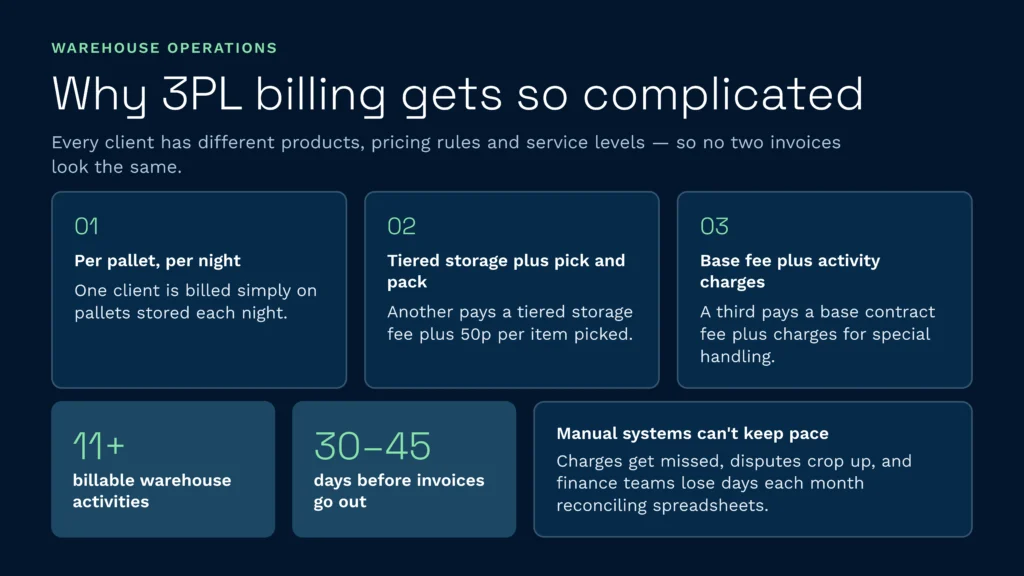
At its heart, 3PL billing is the process of invoicing clients for the space, services, and labour their goods consumed in your warehouse. But unlike a single-client operation, where the invoice is straightforward, 3PLs manage dozens of clients: each with different products, different pricing rules, different storage zones, and different service levels. One client might be charged per pallet per night. Another is billed on a tiered storage fee plus pick-and-pack at £0.50 per item. A third has a base contract fee plus activity charges for special handling. The complexity explodes from there.
Every activity in your warehouse is potentially billable: receiving, putaway, storage (nightly), replenishment picking, order picking, packing, despatch, returns inspection, kitting (assembly work), relabeling, temperature-controlled storage, and hazmat handling. Each one carries a different rate card, sometimes applied differently per client, and sometimes with volume discounts or monthly minimum fees thrown into the mix. Manual systems simply cannot keep pace. Charges get missed. Disputes crop up because there’s no audit trail. Finance teams spend days each month reconciling spreadsheets and chasing pickers for time sheets. In many cases, the billing process trails the operational activity by weeks; invoices are sent 30 to 45 days after the work was done, leaving no time to correct errors before clients dispute them.
The true cost of manual 3PL billing
Let’s quantify the damage. Industry research shows that over 80% of 3PL warehouses lose revenue due to uncaptured storage, shipping, and receiving charges. The most commonly cited billing challenges are uncaptured charges (56% of 3PLs), complex per-client pricing setup (47%), and lack of automation (40%). But the human cost is just as real. More than 50% of 3PL providers spend over 16 hours per month on billing tasks alone: calculating charges, fixing errors, handling client disputes, and reconciling spreadsheets. For a lean operation, that’s easily one person’s part-time job that produces zero operational value.
The problems cascade. First, tribal knowledge becomes a liability. If the person who understands the billing logic leaves, the system logic walks out with them. Second, disputes multiply because there’s no real-time visibility. Clients don’t see charges until they arrive 30 days late, making it impossible to verify them against what actually happened. Third, you can’t win new contracts easily. When a prospect asks “do you support our custom billing model?” the honest answer is often “we’ll need to build a spreadsheet just for you,” which doesn’t inspire confidence. Finally, you can’t scale without adding headcount to the invoicing team; every new client adds manual work, not just operational complexity.
How does a WMS calculate 3PL storage and handling charges?
A purpose-built lagerstyringssystem (WMS) with automated billing doesn’t calculate charges at month-end. It captures them continuously. Here’s the operational flow:
Receiving: When a goods-in barcode is scanned, the WMS records the event with timestamp, quantity, unit of measure, client ID, product, and location. If receiving charges apply (£ per pallet received, for example), that’s instantly billable.
Putaway and storage: As the product is directed to its storage location, the WMS knows the location, the client, and the date. Nightly, the system runs a batch process that counts every pallet in every storage zone and applies the per-client storage rate (which may vary by zone: ambient, chilled, or frozen, for instance). The daily storage charge accumulates automatically. By the end of the month, you have 30 days of continuous storage charges, not a guess based on “average inventory.”
Picking, packing, and despatch: When a picker scans a batch to start picking, the WMS knows it’s a client order. When items are scanned into the container, the system verifies them against the pick list. When the pack is weighed and scanned for despatch, the event is recorded. Pick-and-pack charges (often charged per line item or per order) flow into the invoice automatically. If carriers are integrated, despatch charges may be captured too.
Value-added services: If a product requires special handling (relabeling, kitting, returns inspection, temperature-controlled storage), those events are either triggered manually by the operator or triggered automatically by rules in the system (for example, “if a product code starts with HAZ-, flag it as hazmat handling”). The charge is applied in real time.
The key difference between a purpose-built system and retrofitted software is this: the billing engine draws from the same operational data stream as the warehouse. It doesn’t reconstruct what happened; it captures what’s happening. Centralised 3PL billing within a single integrated platform means every scan, every movement, every minute of occupancy flows into the invoice without a manual recount or spreadsheet handoff.
Activity-based billing: capturing every chargeable event
Activity-based billing is the operational model that makes automated invoicing work. Instead of guessing at charges based on sample counts or monthly snapshots, you bill for every discrete activity your team performs. This requires three things: real-time event capture, configurable rate cards, and audit trails.
Real-time event capture: The WMS must log every warehouse activity. Not just the obvious ones (pick, pack) but the small ones too: relabelling, returns inspection, special handling requests, expiry-date management, cross-docking, and kitting. Each event carries a timestamp, a client ID, a product code, and metadata (for example, zone, weight, special flag). If an activity isn’t captured by the system, it won’t be billed.
Configurable rate cards: Each client contract is different. The WMS must allow you to define per-client pricing for every activity type. Client A might pay £0.50 per pick, £0.25 per case put-away, and £5 per pallet of storage per night. Client B might have a flat monthly fee plus £0.30 per pick. Client C might have tiered volume discounts. The system should make it trivial to set these rules up without requiring a developer or spreadsheet workaround.
Revisjonsspor: When a client disputes a charge, you need to show them exactly what they’re paying for. “Here’s the pick that charged you £0.50. It was picked by operator XYZ at 14:23 on 15 June 2026. The order was customer reference 12345. The item was product code ABC-789.” That level of traceability eliminates disputes and builds trust. It also forces your team to be accurate. Everyone knows the system is watching.
In practice, activity-based billing means the invoice becomes a narrative of work performed, not a negotiation. Clients see the detail. Disputes shrink. And you capture every penny your team earns.
How do you bill clients for pick, pack, storage, and value-added services?
Once the WMS is capturing activities, you need a billing engine that can aggregate them into line items and apply business logic. Here’s what that looks like across the main service categories:
Storage charges: Nightly, the system counts pallets (or cases, or cubic metres, depending on your contract) in each storage zone for each client. It applies the per-unit nightly rate (which may differ by zone, season, or product type). After 30 days, you have 30 lines of charges. Some systems allow you to bill weekly or monthly; your choice. The key is that it’s automatic and based on actual occupancy, not estimates.
Pick and pack charges: When an order is marked as picked, the system applies the pick charge (often per line item or per order). When it’s marked as packed, it applies the packing charge. If a carton is held in a surge area waiting for collection, and surge storage charges apply, those are added too. By the time the shipment leaves, the charges are complete.
Despatch charges: If carriers are integrated (and most modern systems support 70+ carriers), despatch charges can be captured automatically. If not, the system can apply a per-shipment flat fee or per-kg fee.
Value-added services: Relabelling, kitting, special packaging, hazmat handling, temperature monitoring, and returns processing are typically operator-triggered or rule-triggered. An operator scans “relabel” in the HHD (handheld device) when they perform the work. The system logs it, applies the rate (which may be per item, per order, or per batch), and includes it in the invoice.
The commercial advantage is speed. Because the billing engine is inside the warehouse system, you can invoice within 2 to 3 days of work completion, giving clients and yourself the chance to catch errors while memory is fresh. 3PL software providers that keep billing separate from operations require manual export-and-import workflows and will always lag weeks behind reality.
What causes billing errors and revenue leakage in 3PLs?
Understanding where the leakage happens is the first step to plugging it. Here are the main culprits:
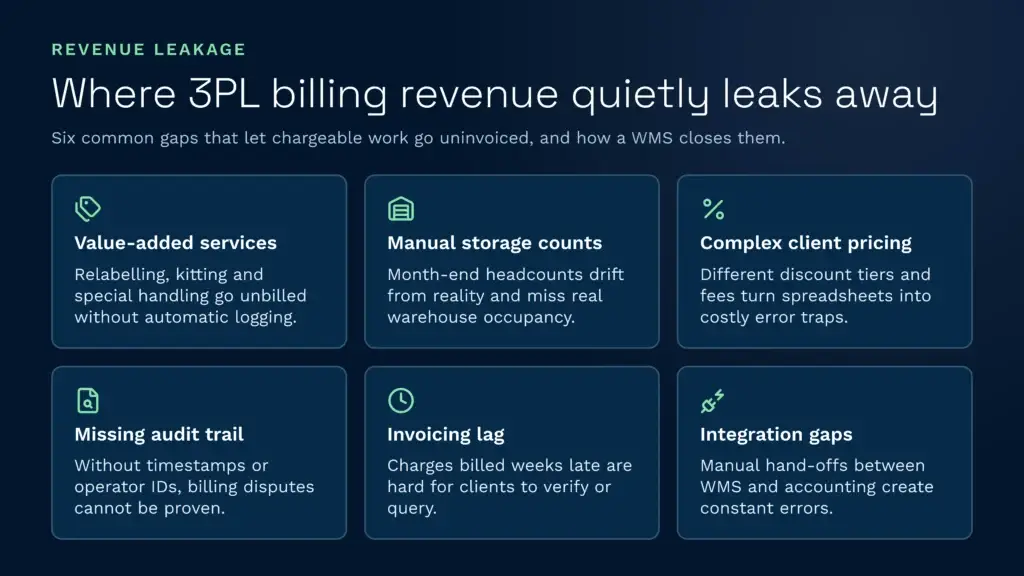
Uncaptured value-added services (biggest category): Pick, pack, and storage are obvious. But relabelling, kitting, special handling, and returns inspection are easy to forget. If the operator doesn’t remember to log the time sheet, or if logging it is cumbersome, the charge simply doesn’t happen. Automating this means the WMS triggers the charge when the activity happens. No memory. No logging. No leakage.
Manual storage calculations: Month-end headcounts are notoriously inaccurate. A pallet is forgotten in a corner. New stock arrives and goes missing in the system. Manual counts are often done once, during a quiet shift, and can drift from reality. A WMS tracks storage in real time. Every movement, every receipt, every despatch is logged. The storage invoice is built nightly from actual occupancy data.
Complex per-client pricing rules: When you manage multiple clients with different pricing models, spreadsheets breed errors. Client A’s tiered discount triggers at 5,000 units per month. Client B’s triggers at 3,000. Client C has a minimum monthly fee but Client D doesn’t. When rules are embedded in a spreadsheet, they’re checked manually, and mistakes are common. A WMS codifies the rules so they apply automatically and consistently.
No audit trail: When there’s no visibility into how a charge was calculated, disputes become arguments. A client says “we shouldn’t have been charged for that relabel” and you can’t prove they were because there’s no timestamp, no operator ID, no product code. A WMS records all this. You can show the client exactly what happened, when, and by whom. Disputes drop dramatically.
Invoicing lag: Manual systems often invoice 30 to 60 days after work is performed. By then, clients have moved on. They can’t verify charges. You can’t investigate discrepancies. Automated invoicing lets you bill within days, whilst everything is fresh and verifiable.
Integration gaps: Many 3PLs use a WMS for operations but a separate accounting system for billing. Data moves between them manually: spreadsheet exports, email attachments, re-keying. Every hand-off is an error opportunity. A unified system means data flows once, automatically, with no gaps.
How to set up automated recurring invoices for 3PL clients
Once your WMS is capturing activities, setting up recurring invoices is straightforward. Here’s the workflow:
Step 1: Define the billing cycle and rates. For each client, configure the billing cycle (weekly, bi-weekly, monthly, or custom). Define the rate card: how much you charge for each activity type. If rates vary by season, zone, or product, set those rules. Modern systems let you do this through a UI, not a spreadsheet.
Step 2: Configure integrations. Connect your WMS to your accounting system (Salvie, QuickBooks, Dynamics, etc.). This means invoice data flows automatically every month. No export-and-import. No re-keying. If your system doesn’t natively integrate, you can use webhooks or APIs to push the data programmatically.
Step 3: Run the billing engine. On your chosen billing date (for example, the last day of the month), the system aggregates all activities for each client, applies the rate cards, and generates an invoice. This typically takes seconds to minutes, even for thousands of transactions.
Step 4: Review and dispatch. Before sending invoices to clients, review them (a 5-minute sanity check: are the amounts in the expected range?). Then either dispatch them automatically via email or API, or route them to a team member for final approval first. Most systems allow you to white-label invoices with your branding.
Step 5: Client visibility. Deploy a client portal so clients can see their invoices in real time, search by date range, download PDFs, and see the line-item detail. This transparency reduces disputes and improves the client experience. Clients stop calling to ask “what were we charged for last month?” because they can log in and see it themselves.
The transformation is dramatic. A 3PL we work with moved from a two-person billing team spending three days a month on invoicing to a one-person role, once a month, reviewing and dispatching. The system does the hard work. The team does the thinking work.
Choosing a billing-integrated WMS to stop revenue leakage
Not all warehouse management systems are created equal when it comes to 3PL billing. Generic WMS platforms, often retrofitted from single-client roots, treat billing as an afterthought. Purpose-built 3PL systems integrate it from the ground up. Here’s what to look for:
Multi-client stock segregation: The system must isolate each client’s inventory, operations, reporting, and billing within a single warehouse. Mixing clients’ data is a recipe for billing errors and regulatory risk.
Real-time activity capture: Every warehouse event (receiving, putaway, picking, packing, despatch, returns, special handling) must be logged with a timestamp and client ID. If the system doesn’t capture it, it can’t bill it.
Configurable rate cards: You should be able to define per-client pricing for every activity type without requiring a developer. UI-driven configuration, not spreadsheets.
Automated billing engine: The system should run scheduled billing jobs (nightly, weekly, monthly) that aggregate activities, apply rates, and generate invoices without manual intervention.
Integration with accounting systems: Invoice data should flow automatically to your ERP or accounting software: Sage, Dynamics, QuickBooks, etc. No manual export-and-import.
Kundeportal: Clients should be able to see their stock levels, order status, and invoices in real time. This reduces support overhead and builds trust. Et lagerstyringssystem that keeps clients in the dark about their data is a relic.
Audit trail and reporting: Every charge must be traceable back to an operational event. Detailed reports should show activities by date, by client, by service type, and by operator. This powers dispute resolution and helps you identify where leakage is happening.
Cloud-native deployment: A cloud-based WMS means you don’t manage servers, you always have the latest features, and integration via APIs is standard. Legacy on-premise systems lock you into version cycles and make integrations expensive.
The choice between generic WMS platforms and purpose-built 3PL systems often hinges on this: can the system capture the operational reality of a multi-client warehouse accurately, and can it turn that reality into a bill automatically? If the answer is no, you’re back to spreadsheets and manual work.
Snakk med en lageransvarlig
If you’re evaluating your options and want to see how a purpose-built WMS works in practice, Clarus is worth a conversation. We work with 3PLs and distributors across the UK to implement warehouse management software that fits the way you operate, not the other way around. Clarus’s automated billing engine captures every billable event in real time, eliminating revenue leakage. Our customers have slashed invoicing time from hours to minutes and recovered 3 to 15% of lost revenue through activity-based billing that actually works. From £1,000/month on monthly rolling contracts with no long-term lock-in and no enterprise complexity.
Ta kontakt med teamet vårt å snakke gjennom dine krav.