

Choosing between a warehouse management system and a retail operations platform depends entirely on what you’re trying to solve. If you’re a 3PL managing multiple clients’ inventory within a single warehouse, or a distributor handling complex warehouse operations, you need a purpose-built WMS. If you’re a retail brand or wholesaler running omnichannel ecommerce operations, you need a retail operating system. Clarus and Brightpearl serve fundamentally different needs, and conflating them can lead to expensive implementation struggles.
Brightpearl is a retail operations platform built for omnichannel merchants: inventory and order management across Shopify, Amazon, eBay, and brick-and-mortar locations, with accounting integration and demand planning. Clarus is a cloud-native WMS purpose-built for 3PLs, wholesalers, and complex distribution operations, with multi-client stock segregation, automated billing engines, and real-time warehouse task management.
This guide compares them across the dimensions that matter: architecture, 3PL and multi-client capabilities, billing automation, integrasjoner, implementation speed, pricing, and support.
Quick Comparison Table
| Dimension | Clarus WMS | Brightpearl |
|---|---|---|
| Best for | 3PLs, wholesalers, distributors, food & beverage, complex warehousing | Retail brands, omnichannel ecommerce, multi-location retailers, wholesalers with retail operations |
| Architecture | Cloud-native, serverless, no server maintenance | Retail ERP platform, part of Sage ecosystem |
| Multi-client / 3PL | Built-in: stock segregation, per-client workflows, per-client reporting, white-label portal | Can integrate with 3PLs; not designed for multi-client billing within one warehouse |
| Automatisk fakturering | Captures storage, pick, pack, despatch, returns, value-added services in real time | No automated multi-client billing; suited for single-brand retail accounting |
| Warehouse optimisation | Smart wave picking, real-time scan verification, FEFO/FIFO, replenishment logic | Barcode scanning, automated pick/pack workflows; designed for retail fulfilment not complex warehouse ops |
| Integrasjoner | 200+ out-of-the-box (ERP, carriers, pallet networks, TMS, ecommerce) | Shopify, Amazon, eBay, BigCommerce, accounting (Sage Intacct, QuickBooks), 130+ 3PL/WMS partners |
| Implementeringstid | 4–8 weeks (cloud-native, pre-built workflows) | 8–16 weeks (requires channel setup, workflow design, accounting integration) |
| Støtte | Sub-2-minute response time, cloud support team | Tiered support via Sage team, variable response times |
Architecture and Deployment
Clarus: Cloud-native serverless
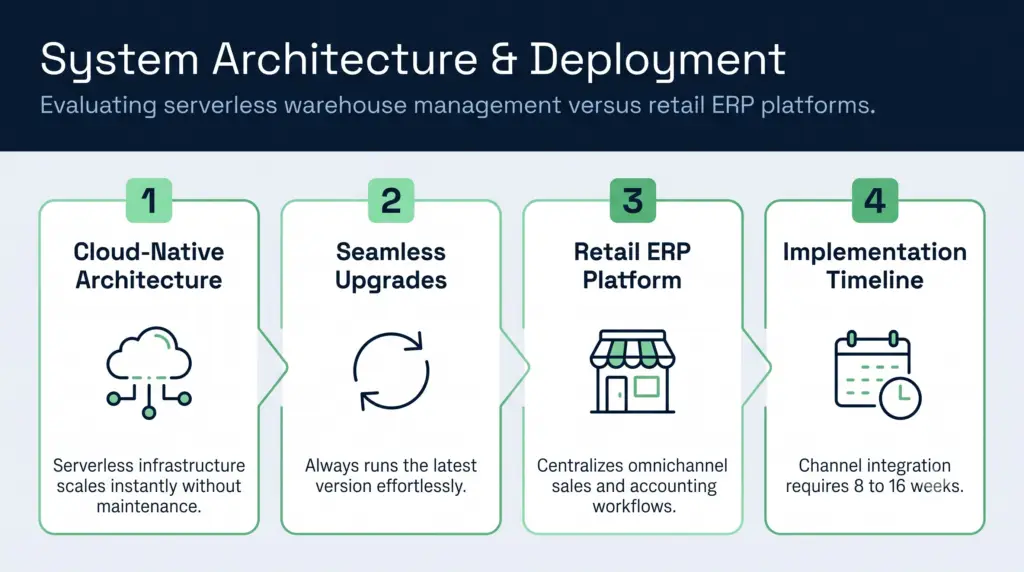
Clarus runs entirely in the cloud with no servers to maintain. Every user always runs the latest version, there are no upgrade cycles or version management overhead. The platform is designed to scale; your warehouse can add more users, more sites, or more complex workflows without infrastructure changes. This simplicity is especially valuable for 3PLs scaling to new contracts: you add a new client, define their workflows and billing rules, and go live without touching any servers.
Brightpearl: Retail ERP platform
Brightpearl is a retail operations platform acquired by Sage in 2021 and now part of the Sage ecosystem. It functions as an omnichannel retail back-office: orders, inventory, accounting, and reporting in one place. The architecture is designed around retail workflows — sales channels (Shopify, Amazon, eBay) and accounting integration (Sage Intacct, QuickBooks) are central. Implementation requires channel integration, workflow setup, and data migration, which explains the 8–16 week timeline.
Multi-Client and 3PL Capabilities
This is where the two platforms diverge most sharply.
Clarus: Purpose-built multi-client
Clarus is purpose-built for 3PLs and multi-client warehousing. Every client’s stock, workflows, reporting, and billing runs separately within a single warehouse environment. This means:
- Stock segregation: Client A’s inventory is completely isolated from Client B’s, even though both are stored in the same warehouse.
- Workflow isolation: Each client can have different pick routing, labelling, packaging, and labelling rules without affecting others.
- Per-client reporting: Each client sees only their own inventory levels, orders, and performance metrics in real time via a white-label client portal.
- Automated multi-client billing: Every billable event (inbound receipt, storage, pick, pack, despatch, returns, value-added services) is captured in real time and tied to the correct client, no month-end manual reconciliation.
Clarus customers like St John’s Hall Storage cut their invoicing workload from 4 hours to 20 minutes per month by eliminating manual reconciliation entirely. JODA Freight scaled their 3PL operation from 10–15 stock moves per day to hundreds without adding headcount.
Brightpearl: Single-brand retail ERP with 3PL connectors
Brightpearl is designed for a single brand or merchant managing inventory across multiple sales channels and locations (Shopify stores, Amazon, brick-and-mortar). It can integrate with 3PL partners (it lists support for 130+ 3PL and WMS systems), but it’s not designed to manage multiple clients’ inventory within a single warehouse. If you use Brightpearl and outsource fulfilment to a 3PL, Brightpearl remains your inventory source of truth and the 3PL’s system integrates as a carrier/fulfilment partner. You don’t get multi-client billing, per-client workflows, or client portals within Brightpearl itself.
Billing Automation
Clarus: Real-time event capture
Clarus’s billing engine is the biggest operational win for 3PLs. Every action in the warehouse — receiving a pallet, storing a SKU for 30 days, picking an order, packing a case, despatching via carrier, processing a return — is captured in real time and tagged to the correct client. At month-end, you generate invoices automatically; there’s no data entry, no reconciliation, no disputes. MSD / Mitchell Storage & Distribution reduced their admin workload by 60% after switching from manual spreadsheet billing.
Brightpearl: Retail accounting integration
Brightpearl’s billing engine is built around retail operations: order-to-invoice workflows for your own brand’s ecommerce operations, integrated with your accounting system (Sage Intacct, QuickBooks). If you’re a 3PL, you’d invoice clients outside Brightpearl using your own billing system or spreadsheets. Brightpearl doesn’t automate multi-client billing.
Warehouse Operations and Picking Optimisation
Clarus: Complex warehouse optimisation
Clarus is built to handle complex warehouse operations — the kind of work that happens in high-touch 3PL warehouses, food distribution, and wholesale. Core capabilities include:
- Smart wave picking: Orders are batched automatically and picking paths are optimised (claimed: 50% travel time reduction). Pickers follow a directed path through the warehouse, not a route they choose.
- Real-time scan verification: Every barcode must match the order at the moment of pick or pack. If there’s a mismatch, the system stops the operation and alerts the supervisor. Achieved accuracy: 99.9% (vs 97–98% typical for manual pick lists).
- FEFO/FIFO/LIFO rotation: Configurable per client or per product — best-before dates are enforced by the system, not managed on clipboards.
- Replenishment and directed putaway: Stock movement is optimised — the system tells warehouse staff where to put incoming items and when to replenish pick-zones, not the other way around.
- Serial and batch control: Full traceability for recalls, expiry date management, and regulatory compliance (critical for food and pharmaceuticals).
- Multi-zone support: Ambient, chilled, and frozen zones managed within a single environment with proper stock controls.
Brightpearl: Retail fulfilment automation
Brightpearl includes barcode scanning, automated pick-and-pack workflows, and integration with fulfilment logic. It’s optimised for e-commerce order fulfilment, taking orders from multiple sales channels and routing them to the right warehouse or 3PL. It doesn’t include wave picking, directed putaway, multi-zone management, or the batch/serial control required for complex distribution and food operations.
Integrasjoner
Clarus: 200+ warehouse-focused integrations
Clarus integrates with:
- E-commerce: Shopify, WooCommerce, Amazon, eBay, Etsy, TikTok Shop, BigCommerce, Magento
- Carriers: 70+ shipping providers including DHL, UPS, FedEx, Royal Mail, Parcelforce, DPD, Evri, TNT
- Pallet networks: Palletways, Pallex, The Pallet Network, Palletforce
- ERP and inventory: Sage 200, Microsoft Dynamics, SAP, QuickBooks, Brightpearl, Zoho Inventory, Unleashed Software
- TMS: Qargo, Maxoptra
- 200+ total out-of-the-box integrations across the library
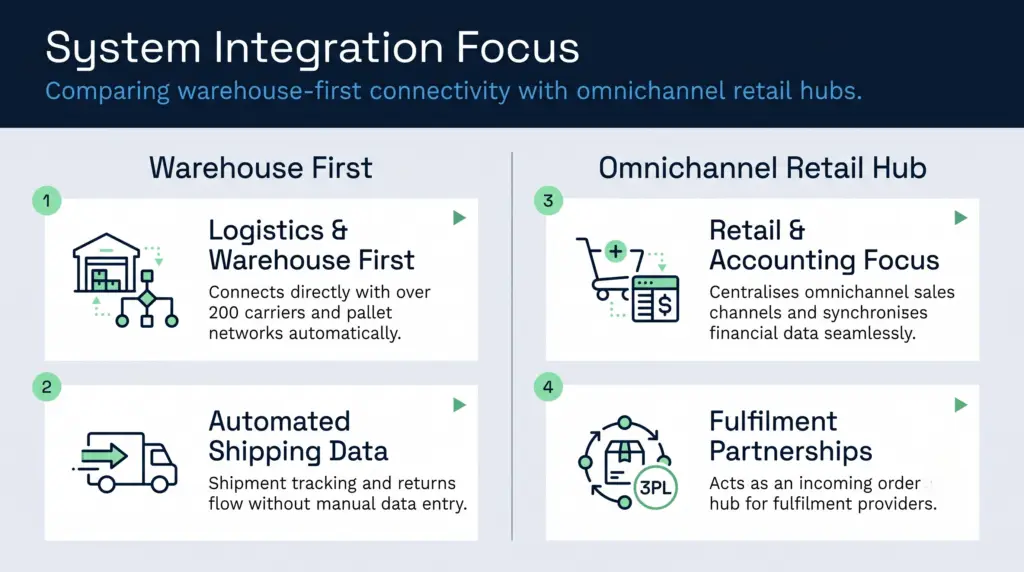
The integration philosophy is carrier-first: whatever logistics partner your 3PL uses, Clarus likely integrates directly. This means shipment data, tracking, and returns flow automatically — no manual carrier uploads or re-keying.
Brightpearl: E-commerce and accounting focused
Brightpearl integrates with:
- Sales channels: Shopify, Shopify Plus, BigCommerce, Magento, Amazon, eBay, Etsy
- Accounting and CRM: Sage Intacct, QuickBooks, Stripe, Square, Xero (via third-party), Salesforce
- Fulfilment: 130+ 3PL and WMS systems via integration partners
Brightpearl is an excellent hub for omnichannel retail, centralising orders and inventory from multiple sales channels and syncing accounting automatically. However, if you’re a 3PL using Brightpearl, you’ll connect as a fulfilment partner (incoming orders, outgoing shipments), not as your clients’ operational system.
Implementation Time and Complexity
Clarus: 4–8 weeks
Clarus implementations are fast because the platform’s workflows are pre-built around warehouse operations. Implementation covers: data migration from your legacy WMS or spreadsheets, config of picking rules and client workflows, carrier and ERP integrations, user training. Since it’s cloud-native, there’s no infrastructure setup. Most 3PLs go live in 4–8 weeks.
Brightpearl: 8–16 weeks
Brightpearl implementations are longer because the platform is more complex. You’re not just moving to a new WMS; you’re centralising orders, inventory, accounting, and reporting in one place. Implementation includes: channel setup (Shopify, Amazon, etc.), workflow design, accounting system configuration (Sage Intacct, QuickBooks), data migration, and staff training. Most retailers report 8–16 week timelines, with complex multi-location operations taking longer.
Pricing and Contract Terms
Clarus: Transparent, rolling contracts
Clarus pricing is straightforward:
- From £1,000/month for a basic setup (small warehouse, one to three clients)
- Monthly rolling contracts — no lock-in, no long-term commitment
- Tiered pricing based on user count and operation size
- All major features included — multi-client management, automated billing, integrations, cloud infrastructure
The total cost is predictable: you know the monthly fee upfront, no surprises at implementation or on invoice. Clarus pricing page has a calculator to estimate your costs based on warehouse volumes and client count.
Brightpearl: Custom pricing, enterprise terms
Brightpearl doesn’t publish pricing. Based on industry reports and user data:
- Estimated £1,000–£3,000+/month depending on transaction volume and feature set
- Implementation: £10,000–£50,000+ — this is where costs spike. Multi-location setups, complex channel integrations, and accounting workflows add weeks and headcount to implementation.
- Annual or multi-year contracts — no month-to-month option
- Unlimited user seats included
For a small retail brand with one Shopify store, a Brightpearl implementation could cost £30,000–£50,000 in the first year (software + implementation). Scaling to multiple sales channels pushes costs higher.
Support and Service
Clarus: Sub-2-minute response time
Clarus offers dedicated cloud support with a sub-2-minute average response time. Most issues are resolved via the support team rather than a ticketed queue. This matters for 3PLs: when a client’s inventory isn’t moving through the system, you need fast, hands-on help, not a wait for a callback.
Brightpearl: Sage support model
Support is tiered based on contract level. As a Sage product, Brightpearl’s support team handles incidents, but response times vary by tier. For enterprise customers, dedicated account management is standard; for smaller accounts, support is more self-service.
Where Clarus Wins
- 3PL and multi-client warehousing: Built for it from day one. Multi-client stock segregation, automated billing, and per-client workflows are native to Clarus; retrofitting Brightpearl for this use case is expensive and never feels quite right.
- Speed to value: 4–8 week implementation vs. 8–16 weeks. Cloud-native architecture means no servers, no downtime, no version upgrades.
- Warehouse optimisation: Wave picking, scan verification, FEFO rotation, and replenishment logic are built in. Brightpearl’s focus is orders and inventory; Clarus’s is warehouse operations.
- Transparent pricing: Clear monthly rolling contracts and predictable base costs, though standard upfront implementation fees apply.
- Fast support: Sub-2-minute response time vs. Sage’s tiered model.
- No vendor lock-in: Monthly contracts, not annual or multi-year terms. Leave if it doesn’t work.
Where Brightpearl Wins
- Omnichannel retail: Built for multi-channel e-commerce from the ground up. If you’re a retail brand selling on Shopify, Amazon, eBay, and your own website simultaneously, Brightpearl centralises orders and inventory across all channels in a way that’s more natural than bolting integrations onto a WMS.
- Accounting integration: Sage Intacct and QuickBooks integration is deep and native. If your team lives in accounting software and you need real-time order-to-invoice automation, Brightpearl’s strength is there.
- Demand planning: Brightpearl’s Inventory Planner uses demand forecasting and seasonality to recommend stock levels and transfers across locations. This is valuable for retail brands managing seasonal peaks. Clarus doesn’t offer demand planning.
- Enterprise scale: Brightpearl is part of the Sage ecosystem and has extensive enterprise customers. If you’re a £50M+ retail brand and want to integrate WMS and ERP tightly, Brightpearl is built for that.
Who Should Choose Clarus
- 3PLs — managing multiple clients’ inventory in shared warehouse space, billing each client separately, and needing real-time visibility of each client’s stock.
- Wholesalers and distributors — complex warehouse operations, pick optimisation, batch/serial control, multi-zone management (chilled, frozen, ambient).
- Food and beverage distributors — FEFO/FIFO enforcement, expiry date management, recall-readiness (sub-5-minute recalls required by retailers and food standards bodies).
- Fast-growth companies — need to go live quickly and scale without replacing their WMS as they grow.
- Budget-conscious operators — no implementation fees, transparent monthly pricing, no long-term lock-in. You can pilot with Clarus on a short-term contract.
Who Should Choose Brightpearl
- Retail brands with omnichannel operations — selling on multiple platforms (Shopify, Amazon, eBay, physical stores) and needing unified inventory and order management.
- Multi-location retailers — managing inventory across several stores or warehouses, moving stock between locations, and reporting on each location separately.
- B2B wholesalers with retail operations — selling to retail customers and also selling direct to consumers on ecommerce channels, needing both wholesale and retail workflows in one system.
- Retailers with tight accounting integration requirements — if your finance team requires order-to-invoice automation within Sage Intacct or QuickBooks, Brightpearl is native to that ecosystem.
- Enterprise retailers — £50M+ in revenue, complex multi-site operations, need hands-on Sage support and integration with their broader Sage ecosystem.
Integrating Clarus and Brightpearl
While Clarus and Brightpearl serve different primary functions, they don’t have to be mutually exclusive. For businesses that require Brightpearl’s omnichannel retail management alongside Clarus’s advanced warehouse controls, the two platforms integrate natively, requiring no third-party middleware or custom coding.
When connected, Brightpearl acts as the central retail ERP while Clarus manages the physical execution on the warehouse floor. Here is how the workflow operates:
- Order Pass-Through: Sales orders flow automatically from Brightpearl into Clarus, complete with customer details, delivery requirements, and line-item quantities.
- Warehouse Execution: Your team allocates stock by quantity, then picks, packs, and prints shipping labels directly within Clarus.
- Real-Time Writebacks: Once an order is despatched, Clarus instantly pushes shipment confirmations and tracking data back to Brightpearl.
- Inventory Synchronisation: Stock availability is kept continuously in sync, ensuring that Brightpearl, and all connected downstream sales channels, reflect accurate, real-time inventory levels.
This native integration is ideal for growing retail brands and wholesalers who have outgrown standard ecommerce fulfillment and need to apply complex, purpose-built warehouse management to their Brightpearl operations.
Snakk med en lageransvarlig
Hvis du vurderer alternativene dine og ønsker å se hvordan et spesialbygd WMS fungerer i praksis, er Clarus verdt en samtale. Vi jobber med tredjepartslogistikkleverandører og distributører over hele Storbritannia for å implementere lagerstyringsprogramvare som passer måten du opererer på – ikke omvendt.
Ta kontakt med teamet vårt å snakke gjennom dine krav.