

If you’re comparing warehouse management systems for your 3PL or fulfilment operation, Klar og Mintsoft will likely appear on your shortlist. Both are cloud-based platforms built to handle multi-channel order processing and warehouse logistics. But they’re built for different operational models. Clarus is purpose-built for true 3PL multi-client operations with automated billing; Mintsoft excels at ecommerce and parcel fulfilment with deep integrasjoner to Shopify and Amazon. Understanding where each tool fits is crucia, choosing the wrong one wastes months in implementation and creates ongoing operational friction.
Quick Verdict
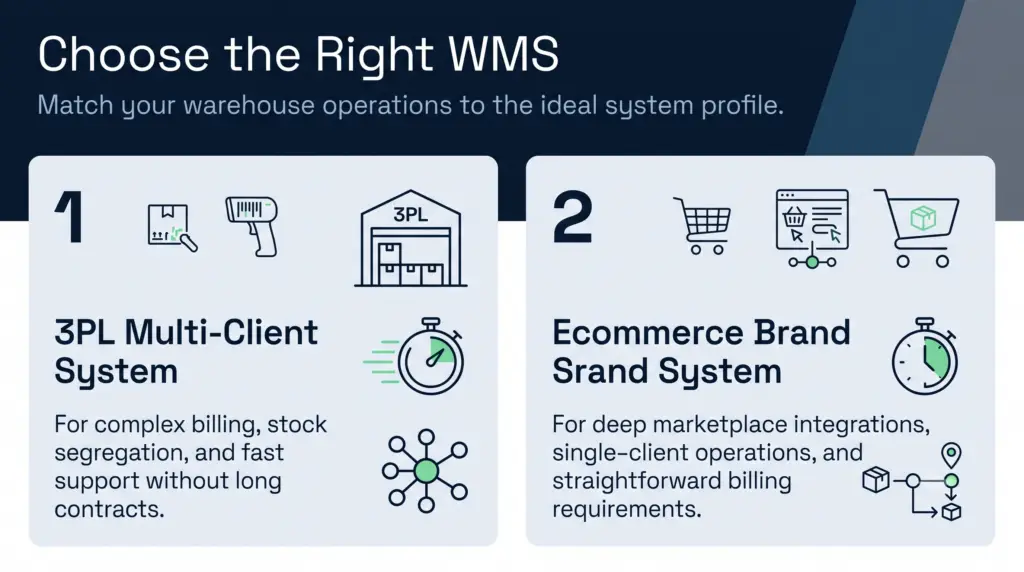
Choose Clarus if: You operate a 3PL warehouse managing multiple clients with complex billing needs, require stock segregation by client, need sub-5-minute support response, or want to avoid long-term contracts (monthly rolling pricing).
Choose Mintsoft if: You’re primarily handling ecommerce brand fulfilment, require deep Shopify/Amazon integration, are willing to commit to longer implementation timelines, or operate a single-client or small multi-client warehouse with straightforward billing.
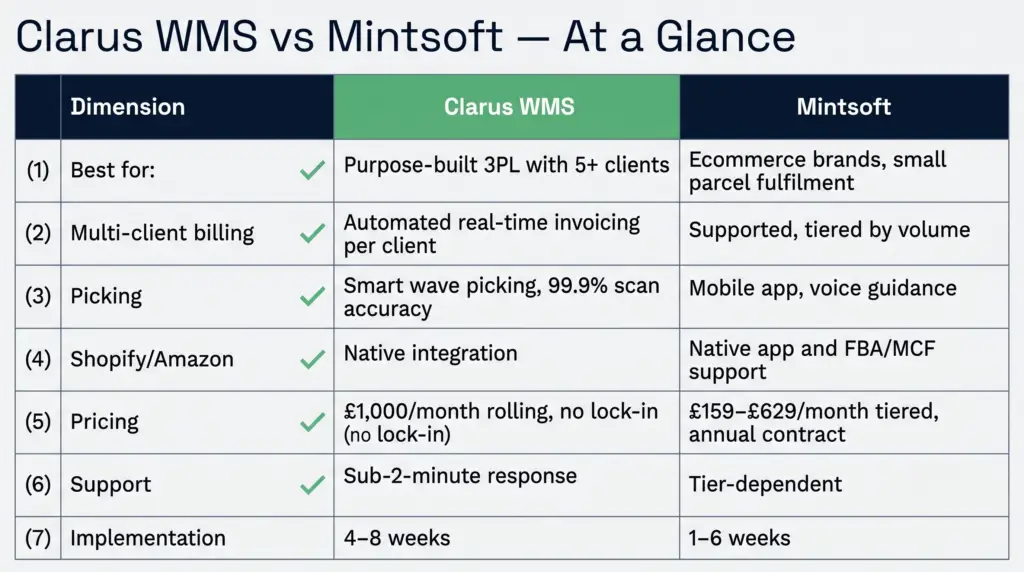
Feature Comparison Table
| Funksjon | Clarus WMS | Mintsoft |
|---|---|---|
| Architecture | Cloud-native, serverless, no updates required | Cloud-based SaaS |
| Multi-client stock segregation | Purpose-built; each client isolated | Supported but not the core design |
| Client self-service portal | White-labelable, real-time visibility | Client dashboards available |
| Smart wave picking | Automated batching and route optimisation | Mobile picking app with voice guidance |
| Integrations (major platforms) | 200+ out-of-the-box (Shopify, Amazon, ERP, carriers) | 150+ integrations (strong Shopify/Amazon focus) |
| Shopify integration | Native; import orders, sync stock in real time | Native Shopify app; multi-channel inventory sync |
| Amazon integration | Supported; order and inventory sync | Native FBA and MCF support; multi-channel listings |
| Carrier integrations | 70+ shipping providers (DHL, UPS, Royal Mail, Parcelforce, DPD, Evri, TNT) | Multiple couriers supported |
| ERP/accounting sync | Sage 200, Dynamics, SAP, QuickBooks, Brightpearl, Unleashed | Accounting software integrations |
| Mobile/HHD workflows | Customisable Android HHD workflow builder (Zebra, Honeywell) | Mobile scanning app with voice-guided picking |
| Priser | From £1,000/month on monthly rolling contracts | From £159/month (ecommerce), £375/month (3PL); tiered by volume |
| Contract term | Monthly rolling; no lock-in | Annual contracts (typical enterprise standard) |
| Support response time | Sub-5 minutes | Depends on plan tier |
| Implementation speed | Typically 4–8 weeks for cloud-native setup | 1–6 weeks depending on complexity |
Multi-Client Stock Segregation and 3PL Billing
The biggest operational difference between these two systems is how they handle the core 3PL challenge: keeping each client’s inventory, billing, and reporting completely separate within a single warehouse.
Clarus was built from the ground up for this. Every client’s stock, orders, and transactions are isolated within the system. When a picker moves inventory from receiving to a location, the system logs which client owns that stock. When they pick an order for Client A, Clarus captures that event in real time. Its automated billing engine then invoices Client A for every billable activity, receiving, storage, pick, pack, despatch, returns, and value-added services (kitting, labelling, repacking), without manual counting or spreadsheet reconciliation. St John’s Hall Storage, a 3PL operator, cut their invoicing time from four hours to twenty minutes after moving to Clarus, and eliminated the two-person manual reconciliation process entirely.
Mintsoft supports multi-client operations, and their feature set includes a client portal and billing management. However, it’s not the foundational design philosophy, Mintsoft was primarily built for ecommerce brand fulfilment and parcel logistics. True multi-client 3PL billing (per-client rate tables, mid-month rate changes, activity-based invoicing, billing dispute trails) is retrofitted onto an ecommerce-first platform, not native to its architecture. This means setup and configuration take longer, and ongoing customisation is more complex.
Picking, Wave Batching, and Automation
Both systems automate the picking workflow, but the approach differs.
Klar uses smart wave picking that batches orders automatically and optimises walking paths. Clarus claims this reduces travel time by up to 50% compared to manual pick lists. Every pick is scan-verified — the barcode must match the order or the system stops the packer. This targets 99.9% pick accuracy. JODA Freight brought their stock accuracy from the low 90s to 99.8% after implementing Clarus.
Mintsoft offers mobile picking with voice-guided instructions and barcode scanning. The mobile app supports multi-channel picking and batch processing, allowing pickers to work offline on Android devices and sync when connection is restored. For ecommerce brands fulfilling small-parcel orders at volume, this is efficient and familiar.
If you’re running high-velocity, multi-client warehouse operations with complex SKU layouts, Clarus’s directed putaway and route optimisation will save more labour than Mintsoft’s mobile app. If you’re fulfilling ecommerce orders for multiple brands in the same space, Mintsoft’s mobile experience is sufficient and easier to scale quickly.
Integrations and Carrier Support
Both platforms integrate with major ecommerce marketplaces and carriers, but Mintsoft’s strength is its deep Shopify and Amazon native support.
Mintsoft has a native Shopify app that syncs orders and inventory in real time. You can manage your Shopify product listings directly from Mintsoft, update pricing across multiple channels (Amazon, TikTok, eBay), and push tracking numbers back to Shopify automatically. For Amazon, Mintsoft offers FBA (Fulfilment by Amazon) and MCF (Multi-Channel Fulfilment) integrations, making it simple for ecommerce retailers selling across multiple channels.
Klar also integrates with Shopify and Amazon, but the focus is broader: 200+ integrations across ecommerce (Shopify, WooCommerce, Amazon, eBay, Etsy, TikTok Shop, BigCommerce, Magento, Wix), carriers (DHL, UPS, FedEx, Royal Mail, Parcelforce, DPD, Evri, TNT, and Pallet networks), ERPs (Sage 200, Dynamics, SAP, QuickBooks), and TMS platforms. This breadth is an advantage if you’re a 3PL handling multiple client types — one client uses Shopify, another uses a bespoke ERP, a third uses WooCommerce. Clarus connects them all without custom development.
For pure ecommerce brand fulfilment, Mintsoft’s tighter Shopify/Amazon focus may feel more streamlined. For multi-client 3PL warehouses with diverse client systems, Clarus’s integration library is a significant advantage.
Implementation and Support
Klar implements typically in 4–8 weeks. Being cloud-native and serverless, there’s no infrastructure setup, no version management, and no on-premise complexity. You’re always on the latest release. Support is sub-5-minute response time, which matters when your picking operation hits a snag during peak hours.
Mintsoft quotes implementation from one week to six weeks depending on complexity. If you’re a straightforward ecommerce brand integrating Shopify and a single carrier, one week is realistic. If you’re a 3PL with multiple client integrations and custom billing rules, six weeks is more typical. Mintsoft’s support tier depends on your plan level.
For a 3PL with unpredictable operational demands, Clarus’s sub-5-minute support and no-lock-in contract is a competitive advantage. You’re not waiting hours for a response, and you’re not trapped in a long-term contract if the system doesn’t meet your needs.
Who Each Solution Best Suits
Choose Clarus if you are a:
- 3PL or contract warehouse operator managing 5+ clients with different stock, billing, and reporting needs. The multi-client segregation and automated billing engine eliminate invoicing admin and billing disputes.
- High-growth fulfilment house that wants no long-term contract and flexibility to scale without renegotiating annually. Monthly rolling pricing lets you adjust as volumes change.
- Wholesale or distribution business where accuracy and inventory visibility matter more than ecommerce-specific features. Clarus’s scan verification and FIFO/FEFO rotation are built for precision operations.
- Food and beverage operator requiring BRCGS compliance, sub-5-minute product recalls, or temperature-zone management. Campeys of Selby achieved BRC Double-A accreditation using Clarus.
- Team that values responsive support and wants to avoid enterprise-grade contracts. Sub-2-minute response time and no lock-in reduce operational risk.
- Ecommerce brand selling primarily on Shopify or Amazon and wanting a tightly integrated, familiar experience. Mintsoft’s native Shopify app and multi-channel listings management are seamless.
- Small 3PL or fulfilment house focused on parcel/small-parcel fulfilment (under 10,000 orders/month) with 1–3 clients. The tiered pricing is cheaper at lower volumes, and the mobile-first picking workflow is sufficient.
- Retail or fashion brand with multiple sales channels (own website, Amazon, eBay, marketplace) needing unified inventory management and order routing. Mintsoft’s multi-channel listings and inventory sync are strong here.
- Business with IT resources to manage annual contract negotiations and integration customisation. Mintsoft is more traditional enterprise software in this regard.
- Operation that prioritises quick implementation over long-term flexibility. If you can commit to a one-week onboarding and annual contract, Mintsoft moves fast.
Migration and Implementation Considerations
Moving from your existing WMS to a new system is a logistics operation itself. Here are the practical differences:
Clarus migration: Because Clarus is cloud-native, there’s no server setup or infrastructure planning. Your data migration timeline depends on how much historical data you need to carry forward and how clean your master data is. Most implementations take 4–8 weeks from kickoff to go-live. The system is always the latest version on day one — no catching up on patches or upgrades.
Mintsoft migration: Mintsoft quotes 1–6 weeks depending on your complexity. If you’re migrating from Shopify alone, you’re at the fast end. If you’re a 3PL migrating from a legacy on-premise system with multiple client billing rules, you’re at the slow end, and you’ll need to define those rules in Mintsoft’s configuration. Annual contracts mean you’re committing upfront before you’ve had a full month of operational data.
Neither system will migrate and clean your data for you. You’ll need to invest in data preparation — standardising SKU names, validating location hierarchies, confirming carrier accounts, and setting up client master records. This is true of any WMS implementation and isn’t a differentiator.
Honest Trade-offs
Where Clarus wins: 3PL multi-client depth, real-time billing automation, white-label client portal, monthly rolling contracts, sub-5-minute support, cloud-native architecture, no on-premise infrastructure, scan-verified picking accuracy.
Where Mintsoft wins: Native Shopify and Amazon integration, ecommerce-first feature set, voice-guided mobile picking, potentially lower cost at lower volumes (under 5,000 orders/month), faster initial implementation for simple use cases.
Where Clarus is a poor fit: If you’re a single-client ecommerce brand with under 1,000 orders per month, Clarus is overkill — you’ll pay £1,000/month for features you don’t need. Mintsoft is a better choice.
Where Mintsoft is a poor fit: If you’re a 3PL with 20+ clients and complex billing rules (per-client rate tables, activity-based charges, mid-month rate changes), Mintsoft’s retrofitted multi-client support won’t be as smooth as Clarus’s purpose-built engine. Implementation will take longer, and invoicing automation will require more custom configuration.
Snakk med en lageransvarlig
Hvis du vurderer alternativene dine og ønsker å se hvordan et spesialbygd WMS fungerer i praksis, er Clarus verdt en samtale. Vi jobber med tredjepartslogistikkleverandører og distributører over hele Storbritannia for å implementere lagerstyringsprogramvare som passer måten du opererer på – ikke omvendt.
Ta kontakt med teamet vårt å snakke gjennom dine krav.