

If you’re evaluating warehouse management software and Infor WMS keeps coming up, you’ve likely heard about its labor management strengths and scalability. But does it fit your operation? For many 3PLs and UK-based distributors, Infor’s enterprise complexity, legacy infrastructure, and implementation burden create friction that newer, purpose-built alternatives avoid entirely. This guide walks you through what Infor WMS does well, where it falls short, and the best alternatives if you’re looking to switch or starting fresh.
Quick Comparison: Infor WMS vs Top Alternatives
| Plattform | Best for | Multi-client 3PL | Automated Billing | Cloud/SaaS | Pricing Model | UK Support |
|---|---|---|---|---|---|---|
| Clarus WMS | 3PLs, 10–500M revenue, UK/EU focus | Purpose-built multi-client | Real-time capture, event-driven | Cloud-native, serverless | Fra £1 000/måned, med månedlig rullering | Sub-2-min response |
| Infor WMS | Enterprise, labour-intensive, complex workflows | Retrofitted multi-tenancy | Automatisk fakturering | CloudSuite option, but legacy roots | Tiered, per-seat, contract-based | Regional support via resellers |
| Mintsoft | Growing DTC brands, omnichannel, small–mid 3PLs | Good multi-warehouse support | Integrated OMS + WMS | SaaS | From ~£500/month + usage | UK-based |
| Snapfulfil | High-volume, complex pick paths, labour optimisation | 3PL module available | Billing module, manual heavy | SaaS | Custom quote | UK support available |
| Deposco | E-commerce fulfilment, 3PL scale | Multi-tenant operations | Activity-based billing built-in | SaaS | Custom, typically $5k–$15k/month | US-based, remote support |
What Is Infor WMS?
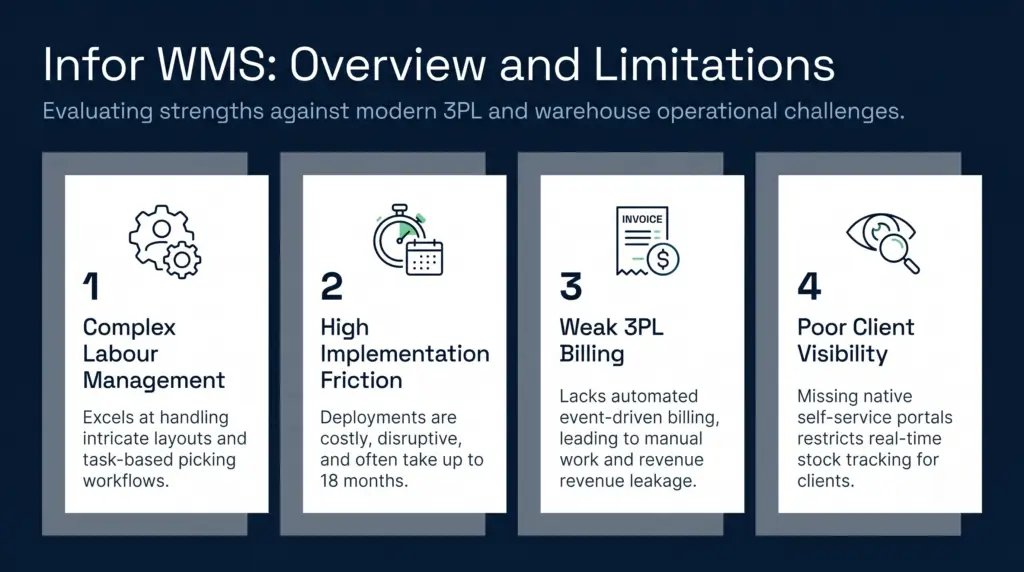
Infor WMS (now marketed as part of Infor CloudSuite) is an enterprise warehouse management platform that combines core WMS functionality with labour management, task management, and 3PL billing on a configurable, scalable database. It earns best-in-class recognition for labour management and excels at handling complex, intricate warehouse layouts and diverse picking workflows. Built originally as an on-premise system, Infor now offers a cloud option (CloudSuite WMS), though the platform’s DNA remains rooted in enterprise complexity.
Key strengths: labour task management, voice and RF (radio frequency) processing, multi-channel order handling (B2B/B2C), and integration with Infor’s broader SCM suite. If your operation is large, labour-heavy, and running complex workflows with dosens of variations, Infor has the tools to model that reality.
Infor WMS: Strengths and Limitations
What Infor WMS does well
- Labour management: Task-based picking, wave management, and labour tracking are deeply embedded. It’s built for operations where labour utilisation and picking efficiency are the primary drivers of cost.
- Warehouse complexity: If your physical warehouse has unusual layouts, multiple zoning strategies, or highly customised pick routines, Infor’s configurability can model it.
- Integration depth: When deployed alongside other Infor applications (ERP, supply chain planning), the system integrates tightly with shared data models.
- Maturity: Decades of development and thousands of live implementations mean the platform is battle-tested at scale.
Where Infor WMS struggles
- Implementation complexity and cost: Infor implementations typically take 9–18 months. Multi-phase rollouts are common; going live is a significant capital event, not an operational decision you can reverse easily.
- 3PL-specific features are weak: Client self-service portals, automated multi-client stock segregation, and event-driven billing (receiving, storage, pick, pack, despatch charges captured in real time) are not Infor’s strength. If you’re a 3PL that needs to show clients their stock levels and charges daily, you’re building custom interfaces or integrations.
- Lock-in and vendor dependency: Once deployed, moving away from Infor is expensive and disruptive. Your warehouse operations become tightly coupled to the system, and staff training is specialised. You can’t easily test alternatives without a parallel implementation.
Why Companies Look for an Infor WMS Alternative
The most common reasons 3PLs and UK distributors explore alternatives fall into three categories:
Billing chaos and revenue leakage
According to 3PL industry benchmarks, average providers lose 3–15% of revenue to billing leakage. Manual reconciliation, missed charges, and dispute resolution consume over 50% of 3PLs’ time on administrative tasks. Infor WMS doesn’t solve this—it requires custom development or a bolt-on billing module to capture real-time billable events. By contrast, purpose-built alternatives like Clarus capture every billable event automatically: receiving, storage, pick, pack, despatch, returns, and value-added services all flow into invoicing without human intervention. St John’s Hall Storage, a 3PL, cut their invoicing from four hours to twenty minutes after switching, and eliminated a two-person manual reconciliation team entirely.
Multi-client complexity slowing growth
Every new client Infor WMS takes on requires configuration work. Separate billing rules, reporting views, stock segregation logic, and client portal customisation all need to be set up individually. This means you can’t easily win new contracts without engineering overhead. Newer 3PL-first platforms support unlimited clients within a single warehouse with stock segregation, billing rules, and portal access configured once and replicated for each new account. You can onboard a client in days, not weeks.
Client visibility demands and manual workload
Modern clients—especially in e-commerce and third-party logistics—expect self-service portals where they can see their stock in real time, track orders, and access shipment data and invoices. Infor WMS doesn’t include this out of the box; you build it yourself or use a separate system. Many 3PLs end up fielding stock-level queries via phone and email all day because they can’t point clients to a portal. Purpose-built alternatives include white-labelable client portals as standard, reducing operational friction and improving customer experience.
Best Infor WMS Alternatives in 2026
1. Clarus WMS — Best for 3PLs and UK Warehouses
Clarus WMS is a cloud-native, server-less warehouse management platform built from the ground up for 3PLs, wholesale distributors, and multi-client operations. Unlike Infor, which retrofits multi-client support onto an enterprise WMS, Clarus has multi-client billing and stock segregation at its core.
What makes Clarus a strong fit
- Bygget spesifikt for 3PL: Multi-client stock segregation, real-time event-driven billing, and client self-service portals are native. Each client’s inventory, reporting, and billing is isolated within one warehouse environment.
- Automated 3PL billing engine: Every billable event—receiving, storage, pick, pack, despatch, returns, value-added services—is captured in real time without manual counting. JODA Freight brought stock accuracy from the low 90s to 99.8% after implementing automated verification. MSD (Mitchell Storage & Distribution) cut admin workload by 60% and unlocked new revenue streams without adding headcount.
- Cloud-native, no server maintenance: Clarus runs on server-less infrastructure. No version upgrades to plan, no server patches to manage, no infrastructure costs. You always run the latest version.
- Fast implementasjon: Most 3PLs go live in 6–12 weeks, not 12–18 months. You can test, adjust, and move to production quickly.
- Multi-warehouse from one system: Manage multiple sites, temperature zones, bonded stock, and hazmat control from a single interface. Automated wave picking, FIFO/FEFO/LIFO rotation, and serial number tracking are all built in.
- Selvbetjeningsportal for kunder: White-labelable portal where clients see real-time stock, order status, shipments, and billing summaries. Reduces support overhead dramatically.
- AI warehouse assistant: Reads operational data to execute tasks and surface bottleneck insights automatically.
- Cost and contract terms: From £1,000/month on monthly rolling contracts—no long-term lock-in. You can adjust user count and features month-to-month.
- Støtte: Sub-2-minute response times with a UK team.
Where Clarus may not fit
- Bespoke labour management workflows: Infor’s labour task management is its strongest differentiator. If you have highly specialised picking strategies (e.g. voice-directed complex kitting workflows), you may need deeper task customisation.
Proof points
Clarus case studies include KATEM Logistics (picking volumes scaled 10x), St John’s Hall Storage (invoicing 4 hours to 20 minutes), and Edge Transport (99% stock accuracy, sub-5-minute recalls for food traceability). More at claruswms.ai/case-studies.
2. Snapfulfil — Best for High-Volume, Complex Picking
Snapfulfil is a cloud-based WMS purpose-built for high-volume e-commerce and omnichannel fulfilment. It excels at optimising the physical warehouse—pick paths, labour routing, and throughput maximisation.
Strengths
- Wave picking and optimised pick-path routing (claimed: 50% travel time reduction).
- Real-time inventory visibility and multi-location management.
- Strong 3PL module with multi-tenant support.
- Integration with major carriers (70+) and ecommerce platforms.
Limitations
- Billing is not fully automated: A billing module exists, but most customers still do manual reconciliation at month-end.
- Implementation cost: Custom quote, typically £50k–£200k+ depending on scope.
- Best for high-volume picking, less suited to complex multi-client contracts: If you’re a small 3PL with varied clients and intricate billing rules, Snapfulfil’s strength (picking optimisation) may overshadow your actual needs.
3. Mintsoft — Best for Integrated OMS + WMS + Shipping
Mintsoft is a UK-based all-in-one platform that combines order management, warehouse management, and shipping coordination in one pane of glass. It’s particularly strong for growing DTC (direct-to-consumer) brands and 3PLs managing omnichannel orders.
Strengths
- Unified OMS + WMS + shipping—no need to sync data between separate systems.
- Strong integration with ecommerce platforms (Shopify, WooCommerce, Amazon, eBay, etc.).
- Good multi-warehouse support.
- UK-based company, local support.
- Flexible pricing, starting around £500/month + usage fees.
Limitations
- Smaller customer base than Infor or Snapfulfil: Less field-proven at very large scale.
- 3PL-specific features are present but not as mature: Automated 3PL billing, client portals, and multi-client billing rules are secondary strengths, not the platform’s primary design.
- Pick optimisation is not its primary focus: If you’re running thousands of picks per day and labour efficiency is your constraint, Snapfulfil’s picking engine is stronger.
4. Deposco — Best for E-commerce Fulfilment at Scale
Deposco is a cloud-based WMS built for e-commerce 3PLs and fulfilment centres managing high volumes of small-parcel orders.
Strengths
- Multi-tenant operations with strong 3PL feature set.
- Activity-based billing built into the core platform.
- Deep integration with ecommerce platforms and carriers.
- Strong for parcel-volume, smaller-box workflows.
Limitations
- US-centric: Founded and headquartered in the US; UK/EU support is remote.
- Pricing is enterprise-level: Typically $5k–$15k/month, making it less accessible for small–mid 3PLs just starting out.
- Not ideal for mixed warehouse types: If you handle palletised goods, temperature-controlled stock, and small parcels, Deposco is optimised for the latter.
5. Manhattan Active WM — Enterprise Alternative
Manhattan Active WM is a tier-one, cloud-native platform built for high-volume retail distribution and large omnichannel fulfillment centres. It’s an enterprise option comparable to Infor in scope and cost.
Strengths
- World-class picking optimisation and labour management for mega-scale operations.
- Integrates with Manhattan’s billing management module for sophisticated invoicing.
- Battle-tested at 100M+ unit/year scale.
Limitations
- Enterprise pricing: Implementation costs often exceed £1M+.
- Not optimal for small–mid 3PLs: The system is over-engineered for operations with fewer than 10M units/year.
- Lock-in: Like Infor, moving away is expensive and disruptive.
How to Choose: A Decision Framework
Ask yourself these questions
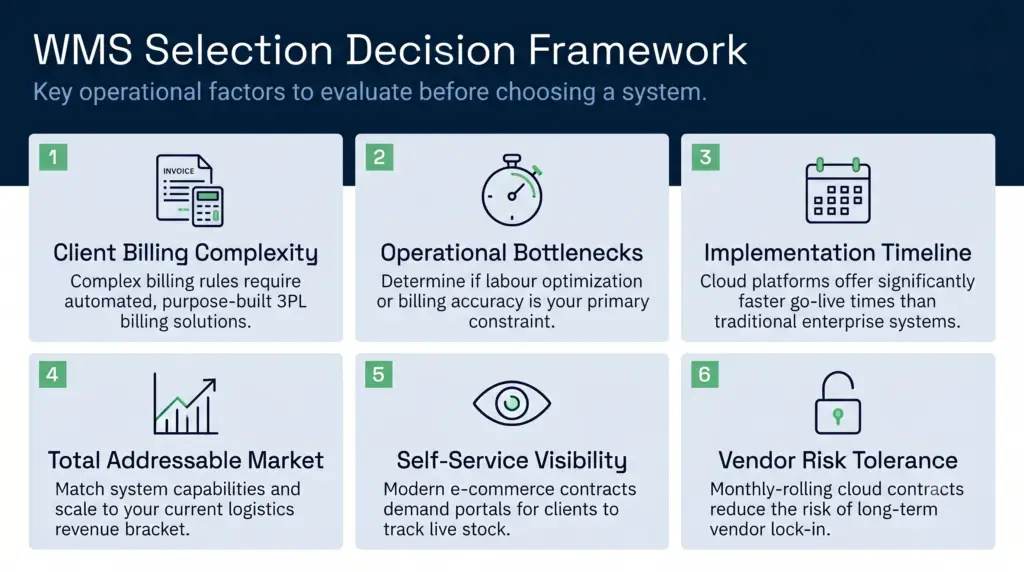
- How many clients do you serve, and do they have different billing rules? If you have 5+ clients with distinct pricing tiers, storage rates, and activity-based charges, you need purpose-built 3PL billing automation. Clarus is built for this; Infor requires custom work.
- Is labour optimisation your biggest constraint, or is billing accuracy? Infor’s strength is labour. If you’re labour-constrained (picking speed, travel time reduction), Infor or Snapfulfil excel. If you’re billing-constrained (revenue leakage, manual reconciliation), Clarus is the better fit.
- How quickly do you need to go live? Clarus: 6–12 weeks. Infor: 9–18 months. Snapfulfil: 3–6 months. If time-to-value is critical, newer cloud platforms beat enterprise systems.
- What’s your total addressable market for clients? If you’re a £5M–£50M revenue 3PL, Clarus is purpose-built for you. If you’re a £500M+ logistics conglomerate, Infor or Manhattan may be more appropriate.
- Do your clients demand self-service visibility? Modern e-commerce and 3PL contracts require clients to see stock, shipments, and invoices in real time. Clarus includes a white-labelable client portal. Infor, Snapfulfil, and others require custom development or third-party integrations.
- What’s your risk tolerance around vendor lock-in? If you want the flexibility to change platforms without a 12-month migration, monthly-rolling cloud contracts (Clarus) are less risky than multi-year enterprise agreements (Infor).
Clarus WMS vs Infor WMS: Head-to-Head
For a 3PL context, the key differences are clear:
- Implementasjonshastighet: Clarus 6–12 weeks vs Infor 9–18 months. Clarus gets you to measurable business value faster.
- Multi-client billing: Clarus automates real-time event capture per client. Infor requires manual reconciliation. The difference is not procedural—it’s about whether your system actively prevents revenue leakage or tolerates it as inevitable.
- Total cost of ownership: Clarus from £1,000/month, no setup fees, no long-term contracts. Infor typically £3k–£20k/month in licensing plus hidden infrastructure and integration costs. Over 5 years, Clarus can cost 60–70% less depending on your size.
- Infrastructure: Clarus is serverless cloud. Infor often requires on-premise or managed hosting, adding operational overhead.
- Exit flexibility: Clarus month-to-month terms mean you can test, adjust, and leave if it’s not working. Infor contracts lock you in for 3–5 years.
- Labour optimisation: Infor’s task management and labour tracking are more mature. If labour is your constraint, Infor is stronger. Clarus includes smart wave picking and scan verification but is not labour-management-obsessed.
Integration and API Support
Both platforms offer integrations, but with different philosophies:
Clarus: API-first architecture. Supports RESTful API, EDI (X12, EDIFACT), XML, and CSV via SFTP. Out-of-the-box integration with 200+ systems including Shopify, WooCommerce, Amazon, eBay, Sage 200, Quickbooks, 70+ shipping carriers, and Qargo TMS. Full audit trail of every action; task-based system means everything is tracked in real time.
Infor: Deep integration with other Infor applications (ERP, supply planning). Custom API development for third-party integrations typical. Less plug-and-play than Clarus.
Infor WMS Pricing and Implementation
Infor WMS pricing is not publicly listed. Publicly reported estimates for similar enterprise WMS platforms suggest:
- Software licensing: £3k–£20k/month depending on user seats and modules.
- Implementation: £500k–£2M+ depending on scope, customisation, and deployment model (on-premise vs cloud).
- Timeline: 9–18 months for a full rollout.
- Contract terms: Typically 3–5 year minimum commitments with annual maintenance fees (15–20% of license cost).
- Infrastructure (if on-premise): Server hardware, database licensing, and ongoing IT support add hidden costs over 5 years.
For a 50-user, single-site implementation, total 5-year cost is often £2M–£5M when all components (hardware, integration, training, support) are included.
By contrast, Clarus from £1,000/month on monthly rolling terms means a comparable 50-user operation costs £60k–£150k over 5 years, depending on user count and feature adoption.
What’s Included in Clarus WMS
- Multi-client stock segregation and isolation.
- Real-time, event-driven 3PL billing (receiving, storage, pick, pack, despatch, returns, value-added services).
- White-labelable client self-service portal.
- Smart wave picking with path optimisation.
- Scan-verified picking (99.9% accuracy claimed).
- FIFO/LIFO/FEFO inventory rotation, serial number and expiry-date control, batch and lot control for recall readiness.
- Multi-warehouse and multi-site from a single environment.
- Dock scheduling, cross-docking, and directed putaway/replenishment.
- Kitting (assembly) workflows.
- Bonded (wet bonded) stock, Hazchem/hazardous goods, temperature-zone management.
- HHD (handheld device) workflow builder—fully customisable scanning workflows on Android devices.
- Automations and triggers for workflow bottlenecks.
- AI warehouse assistant for task execution and operational insights.
- 200+ integrations (Shopify, WooCommerce, Amazon, Sage 200, QuickBooks, 70+ shipping carriers, etc.).
- Full audit trail and task-based tracking.
- UK-based support with sub-2-minute response times.
- No version upgrades, no server maintenance—always on the latest release.
Learn more at claruswms.ai or view Clarus WMS priser directly.
Snakk med en lageransvarlig
If you’re evaluating your options and want to see how a purpose-built WMS works in practice, Clarus is worth a conversation. We work with 3PLs and distributors across the UK to implement warehouse management software that fits the way you operate—not the other way around.
Ta kontakt med teamet vårt å snakke gjennom dine krav.