

If you’re managing a 3PL warehouse or distribution centre and NetSuite WMS feels like it’s fighting you, high setup costs, clunky multi-client billing, long implementation timelines, you’re not alone. NetSuite is an ERP-first platform; warehouse management is an add-on module. For operations managing multiple clients, complex billing rules, and the need to move fast, that architectural mismatch becomes expensive and slow.
This guide compares the best NetSuite WMS alternatives for UK warehouses, focusing on solutions built from the ground up for 3PL operations, multi-client complexity, and real-time billing automation.
Quick Comparison Table
| Solution | Best For | Multi-Client / 3PL | Pricing Model | Implementering | Integration Support |
|---|---|---|---|---|---|
| Clarus WMS | 3PLs, distributors, fast scaling | Native architecture | From £1,000/month, rolling | Weeks | 200+ integrations, API-first |
| NetSuite WMS | SMBs, single-client operations | Retrofitted (weak) | Custom quote, annual | 1–6 months (3+ for 3PL) | Native ERP only |
| Mintsoft | 3PLs, mid-market | Native multi-client | Custom pricing | 4–8 weeks | 100+ integrations |
| Deposco | 3PLs, post-Brexit UK | Native, customs-focused | Custom pricing | 6–10 weeks | Strong carrier / pallet network |
| Körber WCS | Enterprise, automation-heavy | Multi-site capable | Custom pricing | 3–12 months | Deep automation integration |
1. Clarus WMS — Purpose-Built 3PL Solution
Clarus is a cloud-native warehouse system management platform designed specifically for 3PLs and distributors. Unlike NetSuite WMS, which grafts warehouse capabilities onto an ERP platform, Clarus was built from day one for multi-client operations, real-time billing, and zero downtime.
What It Is
A serverless, cloud-native WMS that runs warehouse operations independently of ERP systems. Multi-client stock segregation is native architecture—each client’s inventory, workflows, and billing sit in isolated logical containers within a single database. Your warehouse sees one system; your clients each see their own portal with live stock, orders, and billing summaries.
Where It Shines
- Multi-client fakturering: Real-time capture of every billable event—receiving, storage, picking, packing, despatch, returns, value-added services. St John’s Hall Storage, a UK 3PL, cut invoicing time from 4 hours to 20 minutes and eliminated a two-person manual reconciliation process entirely. No month-end spreadsheet horror.
- Fast implementasjon: Weeks, not months. Cloud-native means no servers to set up, no IT infrastructure projects, no version upgrades causing downtime. You go live, and the system auto-updates every release.
- Integration depth: 200+ out-of-the-box integrasjoner across e-commerce (Shopify, Amazon, eBay, WooCommerce), carriers (70+ including DHL, UPS, DPD, Royal Mail), ERPs (Sage 200, Dynamics, QuickBooks), and pallet networks (Palletways, Pallex, The Pallet Network). Your clients bring their tech stack; Clarus connects it.
- Client visibility: White-labelable self-service portal. Clients see real-time stock, order status, shipment tracking, and billing summaries. Stops the daily “where’s my inventory?” call.
- Stock accuracy: Real-time scan verification. Barcode must match the order or the system stops the packer. JODA Freight, a UK 3PL, moved from low-90s pick accuracy to 99.8%. No surprise discrepancies.
- Transparent pricing: From £1,000/month on month-to-month contracts. No per-user fees, no lock-in, no surprise module add-ons. Competitors quote after a sales cycle; Clarus publishes it upfront.
- Støtte: Sub-2-minute response time. Real warehouse teams, not offshore ticket systems.
Where It’s Not a Fit
- Enterprise automation: If you’re deploying ASRS, automated conveyor, or large robotic systems at scale, enterprise WCS platforms like Körber or Manhattan Associates may have deeper integrations.
- Bespoke financial integrations: If your ERP uses a custom data model that Clarus doesn’t yet integrate natively, you’ll need middleware (n8n, Zapier, API bridge) to sync master data.
Proof Points
Clarus has helped 100+ customers across 300+ sites scale their operations. See Clarus WMS customer stories for detailed cases. Key results include:
- MSD (Mitchell Storage & Distribution): Admin workload down 60%. Invoicing automation unlocked new revenue streams without adding headcount.
- KATEM Logistics: Monthly picking volumes scaled 10x after switching.
- Welch Group (Transport/3PL): 100% time saving from eliminating duplicate data entry between WMS and TMS.
2. NetSuite WMS — What It Is and Why It Struggles
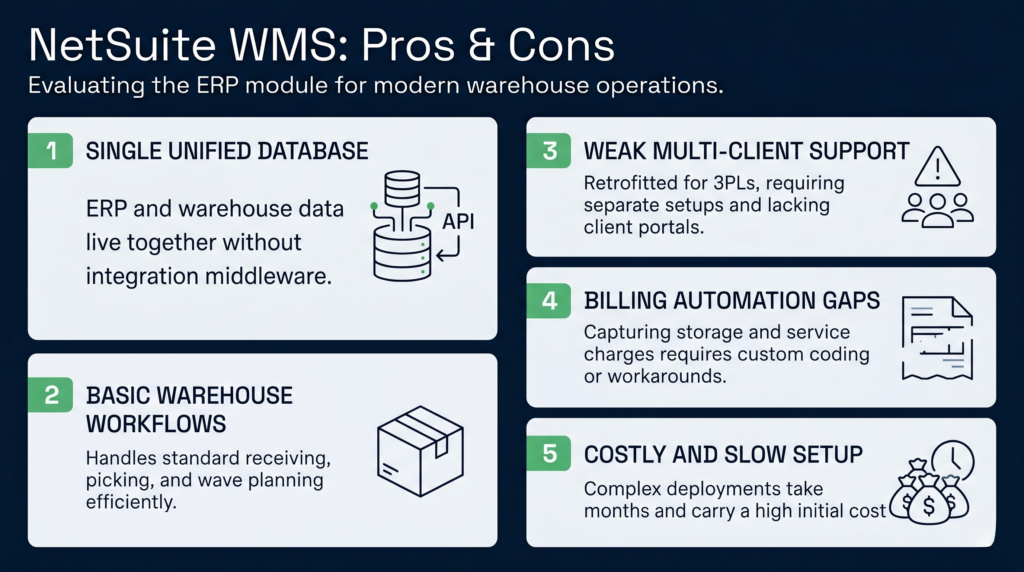
NetSuite WMS is a warehouse management module within Oracle’s cloud ERP platform. It handles receiving, putaway, picking, packing, and multi-location operations. It’s native to NetSuite’s database, which means no integration delays for basic ERP-to-WMS sync.
Strengths
- Single database: ERP and warehouse data live in one place. Financial transactions, inventory, and orders don’t require synchronisation middleware.
- Basic WMS workflows: Wave planning, RF scanning, bin management, and cycle counts work for straightforward single-client operations.
- ERP leverage: If you’re already on NetSuite financials, adding WMS uses the same training, logins, and audit trail.
Limitations
- Multi-client 3PL is weak: WMS was designed for single-client inventory management. Multi-client support exists but is retrofitted; you have to create separate “warehouses” per client and manually manage billing logic. Client portals are limited or non-existent in the core module.
- Billing automation gaps: Invoicing is tied to ERP order-to-cash workflows, not warehouse events. Capturing storage charges, value-added services, or complex billing rules requires custom development or workarounds. 3PLs typically hand-reconcile invoices at month-end.
- Automation integration: Conveyors, ASRS systems, and robotics require significant custom coding. Purpose-built WMS platforms have pre-built connectors.
- Implementation time: 1–6 months for simple operations; 6+ months for multi-client 3PL scenarios. NetSuite implementations are often bottlenecked by ERP configuration, not warehouse-specific complexity.
- Total cost: Base platform licence plus WMS module plus implementation (1–2x annual licence cost) typically totals £80,000–£250,000 in Year 1. Long-term contracts mean you’re locked in.
- Upgrade cycles: NetSuite updates the platform regularly; you’re on a vendor roadmap, not choosing your upgrade timing.
Typical Scenario Where NetSuite Fails 3PLs
A 3PL running £2M ARR across 15 clients decides to upgrade from legacy WMS to NetSuite. They assume ERP + WMS module = complete system. Reality: invoicing requires custom development to separate client billing rules, client portal requires a third-party add-on (additional cost and support burden), and implementation drags to 8+ months as NetSuite’s professional services team balances ERP configuration and warehouse setup. Total project cost: £150k+. By the time it’s live, two new client contracts have been signed but the system can’t yet handle their integrations (their clients use Shopify; NetSuite doesn’t have that out-of-the-box). Workaround: manual order entry for six months until the integrations are coded. Revenue recognition becomes messy. The team questions whether they should have chosen a purpose-built WMS.
That’s not a fictional scenario. It’s a pattern in the data: 3PLs leaving ERP-based warehouse modules for specialists like Clarus, Mintsoft, and Deposco.
3. Mintsoft — Strong Alternative for Mid-Market 3PLs
Mintsoft is a long-standing 3PL specialist in the UK market. It has deep multi-client architecture, client portals, and a strong carrier/integration network.
Strengths
- Purpose-built for 3PL operations
- Native multi-client support with billing separation
- Established in UK market (10+ years)
- 100+ integrations
- Web and mobile RF scanning
Limitations
- Implementation typically 4–8 weeks (longer than Clarus for complex setups)
- Pricing is custom; expect £2k–£5k/month depending on complexity and user count
- User interface and UX feel legacy compared to cloud-native platforms
- Smaller team means slower feature development and occasional support delays
- Less investment in AI-driven insights compared to newer platforms
Best For
Established 3PLs comfortable with long implementation timelines and mid-tier pricing. Good fit for teams that prioritise track record and stability over innovation pace.
4. Deposco — Strong for Post-Brexit Customs & Compliance
Deposco is a WMS built for 3PLs, with particular strength in customs declarations, Brexit compliance, and complex logistics rules.
Strengths
- Native 3PL multi-client architecture
- Strong carrier and pallet network integration (Pallex, Palletways, etc.)
- Advanced SLA tracking and client reporting
- Fast implementation (6–10 weeks typical)
Limitations
- Custom pricing (typically similar to or slightly below Mintsoft)
- Smaller team; slower feature velocity than Clarus
- Support availability less generous than Clarus’s sub-2-minute SLA
Best For
UK 3PLs handling international shipments, customs, or B2B distribution where compliance and pallet network integration are priorities.
5. Körber WCS — Enterprise-Grade Automation Control
Körber is a German automation and WMS giant. Their WCS (Warehouse Control System) integrates with large-scale automation—conveyors, ASRS, sorters, and robotics.
Strengths
- Industry-leading automation integration (conveyors, ASRS, sorters, autonomous vehicles)
- Deep warehouse analytics and optimisation
- Enterprise-grade performance and scalability
- Proven in high-volume distribution centres and e-commerce fulfilment
Limitations
- Enterprise pricing (typically £10,000+/month) makes it cost-prohibitive for mid-market 3PLs
- Implementation timelines: 3–12 months depending on automation complexity
- Steep learning curve; requires dedicated warehouse operations IT team
- Overkill for 3PLs without significant automation investment
- Slower to adapt to new e-commerce integrations compared to cloud-native platforms
Best For
Large automated distribution centres, fulfilment networks, or manufacturing operations where conveyor systems and robotics are core infrastructure. Not a fit for warehouse ops focused on flexibility and speed-to-market.
How to Choose: The Decision Framework
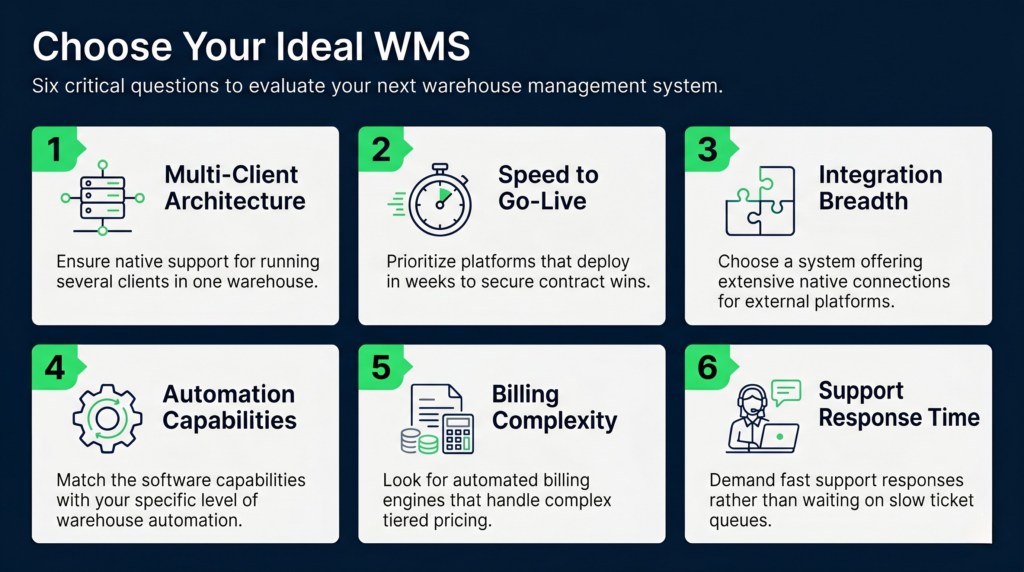
Ask Yourself These Questions
- Do you operate multiple clients from one warehouse? If yes, you need native multi-client architecture. NetSuite doesn’t have it; Clarus, Mintsoft, and Deposco do.
- How fast do you need to go live? Weeks matter when you’re chasing contract wins. Clarus and Deposco move fastest (weeks to 10 weeks). NetSuite, Körber, and complex Mintsoft setups take months.
- What integrations do your clients need? If you’re fielding requests for Shopify, Amazon, TikTok, or custom EDI, choose a platform with breadth. Clarus leads here (200+); NetSuite is limited to ERP ecosystem.
- Do you have significant automation? If you’re deploying conveyors or ASRS, Körber or Manhattan Associates are your lane. If you’re manual picking with RF scanning, Clarus, Mintsoft, or Deposco suffice.
- What’s your billing complexity? Simple per-pallet storage? Clarus, Mintsoft, Deposco handle it. Complex tiered billing per client per activity type? Clarus’s billing engine is built for it; NetSuite requires custom work.
- Do you need sub-2-minute support? Only Clarus commits to that. Most competitors operate on ticket queues (24–48 hour response).
Quick Shortlist
- Fastest to live, best multi-client support, most integrations: Klar
- UK compliance and customs focus: Deposco
- Large-scale automation integration: Körber
- Avoid: NetSuite WMS for 3PL operations (unless you’re already locked into NetSuite ERP and single-client only)
NetSuite WMS: Honest Assessment
NetSuite WMS works for what it was designed for: companies using NetSuite ERP as their primary system who need basic warehouse support. If you’re a single-client distributor or manufacturer using NetSuite for financials, adding the WMS module makes sense—no integration middleware, single database, simplified training.
But if you’re a 3PL managing multiple clients with different billing rules, operating from a single facility, and needing to connect to 50+ customer integrations, NetSuite becomes a constraint, not a solution. The architectural mismatch—ERP-first, warehouse-second—means you’ll spend money and time on customisations and workarounds that a best warehouse management software built for your use case handles natively.
Speak to a Warehouse Expert
If you’re evaluating your options and want to see how a purpose-built WMS works in practice, Clarus is worth a conversation. We work with 3PLs and distributors across the UK to implement warehouse management software that fits the way you operate—not the other way around.
Ta kontakt med teamet vårt å snakke gjennom dine krav.
 English (UK)
  Nederlands (Formeel)
  Nederlands (België)
  Français de Belgique
  Deutsch
  Español
  Español de México
  English
  English (Australia)
  English (Canada)
  English (New Zealand)
  Svenska
  Norsk bokmål