

Warehouse robots are no longer the preserve of Amazon and mega-fulfilment centres. Today, 3PLs and distributors across the UK are discovering that intelligent warehouse automation can cut picking times in half, reduce labour costs, and dramatically improve accuracy. But robots aren’t a standalone solution. They’re part of a wider warehouse logistics strategy that hinges on one critical element: a system that orchestrates every movement, every transaction, and every inventory decision in real time. That’s where a proper Lagersystem becomes essential.
Whether you’re exploring autonomous mobile robots (AMRs), automated guided vehicles (AGVs), or robotic picking arms, the foundation of successful warehouse automation is integration with your WMS. In this guide, we’ll explore what robots can do for your warehouse, the main types you’ll encounter, how they integrate with your operation, and what the real ROI looks like in practice.
What Are Warehouse Robots Used For?
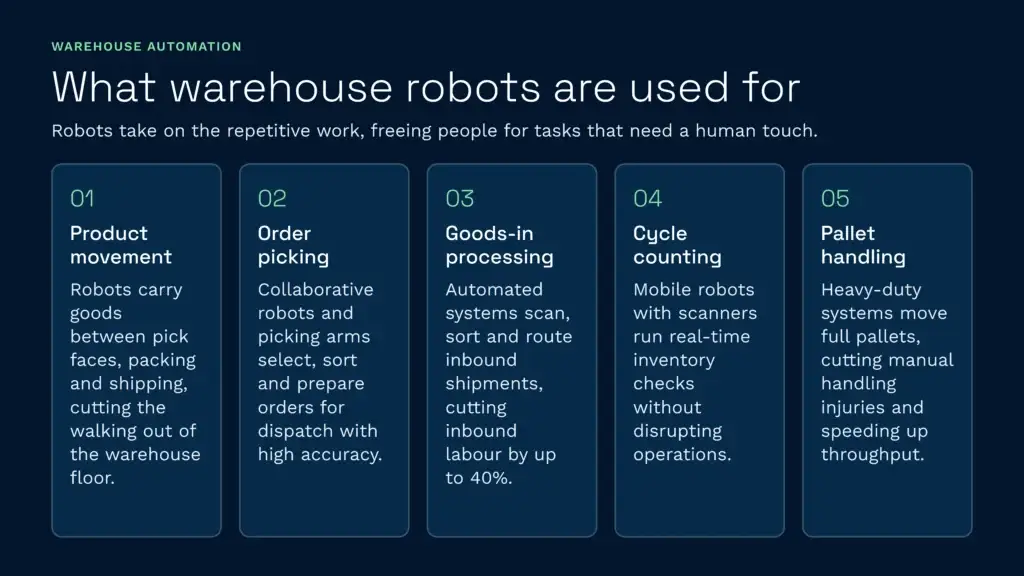
Warehouse robots handle a range of tasks that are repetitive, time-consuming, or physically demanding for human workers. The most common applications are:
- Product movement: Robots transport goods between pick faces, packing stations, and shipping areas, eliminating the time spent walking back and forth across the warehouse floor.
- Order picking: Collaborative robots and picking arms can select items from shelves, sort them by order, and prepare them for dispatch with high accuracy.
- Goods-in processing: Automated systems scan, sort, and route inbound shipments to the correct location, cutting inbound labour by up to 40% in some operations.
- Cycle counting and inventory verification: Mobile robots equipped with scanners conduct real-time inventory checks without disrupting warehouse operations.
- Pallet handling: Heavy-duty automated systems move full pallets, reducing manual handling injuries and speeding up throughput in high-volume environments.
The beauty of warehouse robotics is that they don’t replace people; they redirect them. Workers focus on tasks that require decision-making, customer service, or adaptability, while robots handle the grunt work. A 3PL using warehouse automation often finds that throughput increases by 20–30% while headcount stays flat or grows more slowly than order volume.
Main Types of Warehouse Robots
Not all robots are the same. Let’s walk through the most common types you’ll encounter in UK warehouse logistics:
Autonomous Mobile Robots (AMRs)
Autonomous mobile robots are self-driving units that navigate warehouse floors using sensors and AI. Unlike older AGVs, they don’t need magnetic tape or fixed infrastructure. They map the warehouse, sense obstacles, and adapt their routes in real time. AMRs are ideal for smaller to mid-sized operations where floor layout changes or where you want flexibility without heavy capital investment in floor modifications.
Automated Guided Vehicles (AGVs)
Automated guided vehicles are the older cousins of AMRs. They follow fixed paths, typically marked by magnetic tape or embedded wires. AGVs are more rigid in layout but very reliable and predictable, making them common in large-scale, high-throughput operations where the warehouse footprint is stable. They’re also cheaper per unit than AMRs in high-volume deployments.
Robotic Picking Arms
Collaborative picking robots, often with vacuum grippers or multi-axis arms, can select items from shelves or bins with precision. Some can handle delicate goods without damage. These are popular in e-commerce and high-SKU environments where manual picking becomes the throughput bottleneck. The best systems can switch between different item types and adapt grip pressure on the fly.
Automated Storage and Retrieval Systems (ASRS)
ASRS are large fixed installations where a grid of shelves is served by automated cranes or shuttles. Items are stored in dense, vertical configurations, and the system retrieves exactly what’s needed. ASRS offers the highest density and speed but requires significant upfront capital and a stable warehouse footprint.
The British Automation and Robot Association publishes detailed guidance on these different systems, and their recommendations often come down to your operation’s size, SKU range, and floor space constraints.
The Real Benefits of Warehouse Robotics
Beyond the obvious speed boost, warehouse automation delivers surprising business outcomes:
Accuracy and Consistency
Robots don’t have off-days. A picking robot makes the same movement the same way every time. Human error in picking can run 1–3% depending on fatigue, stress, and workload. A well-configured robotic picking system cuts that to under 0.1%. For a 3PL handling high volumes, that translates to fewer customer complaints, lower return processing costs, and stronger margins.
Labour Retention and Workplace Safety
Warehouse work is physically demanding. Back injuries, repetitive strain, and cumulative fatigue drive turnover in many facilities. Robots handle the most dangerous and repetitive work, which means fewer injuries, better morale, and easier staff retention. Your workers spend more time on problem-solving and customer-facing tasks, which they find more rewarding.
Space Efficiency
Robots can work in tighter spaces and higher-density configurations than humans. Some AMRs fit into standard doorways and aisles. ASRS systems can stack 10+ metres high. Effective warehouse automation often means you can handle 30–50% more volume in the same footprint or consolidate operations into smaller premises.
Speed and Responsiveness
In today’s market, faster order processing is a competitive advantage. Robots cut warehouse picking time significantly. Some operations report cycle times dropping from 45 minutes per order to 15 minutes. For 3PLs operating on tight margins, that speed translates directly to customer satisfaction and repeat business.
Cost Reduction Over Time
The upfront cost is real. A small AMR might cost £40,000–£80,000; a full ASRS installation can run into millions. But over 5–7 years, the labour cost savings typically exceed the hardware investment. As the Material Handling Institute notes, ROI for warehouse automation typically falls between 2–4 years in high-volume operations.
How Warehouse Robots Integrate with Your WMS
Here’s where many companies stumble. You can buy the best robots on the market, but if they’re not integrated with your warehouse management system, you’ll create more problems than you solve.
A modern WMS like Clarus is built with automation in mind. It provides the orchestration layer that tells robots where to go, what to pick, and in what sequence. The WMS talks to your robots via APIs, feeds them real-time inventory data, adjusts routing based on stock levels, and captures every movement for reporting.
Practical integration looks like this:
- Task assignment: An order arrives. Your WMS calculates the optimal picking route and dispatches a robot with the task. The robot completes the picks and returns the batch for packing.
- Inventory sync: As robots move stock, the WMS updates inventory in real time. No more discrepancies between the system and the floor.
- Adaptive routing: If a robot encounters a congestion or a failed pick, the WMS reroutes it dynamically. The system self-optimises throughout the day.
- Berichterstattung und Analytik: You see robot utilisation, downtime, picking accuracy, and throughput trends. You can identify bottlenecks and optimise your operation continuously.
A purpose-built 3PL WMS like Clarus handles multi-client segregation, complex billing scenarios, and integration with automation systems. It’s the glue that turns robots from expensive standalone hardware into a cohesive, profitable operation.
As you’re planning Lagerbestandskartierung and layout optimisation, your WMS must be part of that conversation from day one. Late-stage WMS selection is one of the biggest mistakes companies make with automation projects.
The Workforce Question: Will Robots Replace Your Workers?
This is the question every warehouse manager wants answered. The short version: no, robots are creating net job growth in warehousing, but the roles are changing.
The data is clear. The UK government’s research on automation and the future of work found that despite significant automation investment, employment in logistics and warehousing has grown because automation itself creates demand for new roles: robot technicians, WMS specialists, automation engineers, data analysts, and quality assurance staff.
What’s happening is redistribution, not replacement. Picking roles are down, but maintenance, technical, and coordination roles are up. A 3PL that implements warehouse robotics successfully typically sees:
- A smaller team doing more volume.
- Higher skills requirements and slightly higher wages for technical roles.
- Better working conditions and lower injury rates.
- Easier recruitment once the operation’s reputation for modern working practices spreads.
For your customers, the shift means faster order processing, which means a better service from your 3PL. That’s a genuine competitive advantage.
Implementing Warehouse Automation: What to Expect
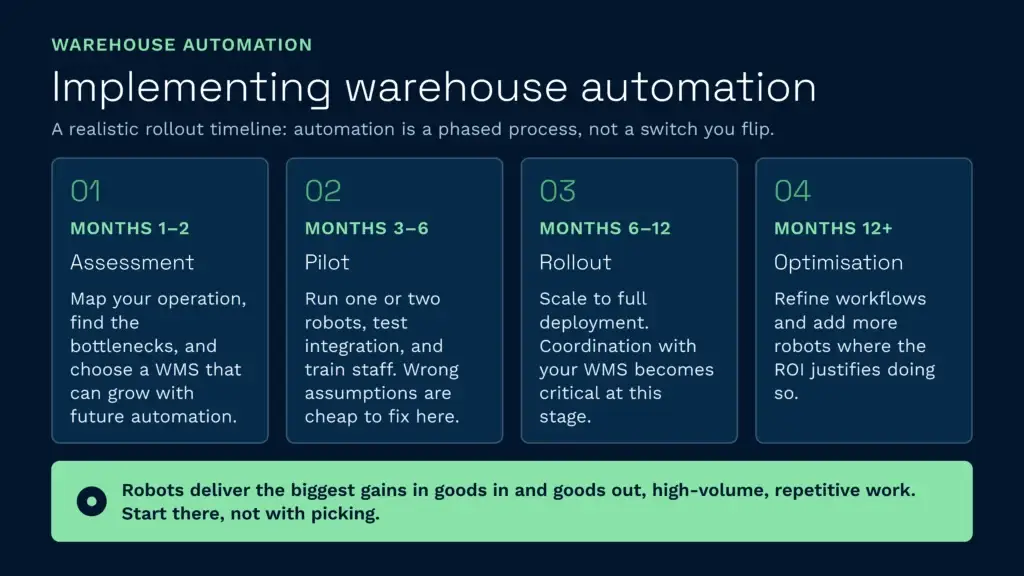
Rolling out warehouse robotics isn’t like flipping a switch. Here’s a realistic timeline and process:
- Phase 1 (Months 1–2): Assessment. You map your current operation, identify bottlenecks, and spec out a solution. This is where WMS selection happens. Choose a system that can grow with you and integrate with future automation.
- Phase 2 (Months 3–6): Pilot. You deploy one or two robots in a controlled area. You test integration points, train staff, and measure performance. This phase often reveals assumptions you got wrong, and that’s good; it’s cheap to fix at this stage.
- Phase 3 (Months 6–12): Rollout. You scale to full deployment. This is where coordination with your WMS is critical. Synchronization breakdowns here cause real problems.
- Phase 4 (Months 12+): Optimisation. You refine workflows, add more robots if ROI justifies it, and push the operation to new efficiency levels.
During goods in and goods out operations, robots often deliver the biggest gains because these are high-volume, repetitive, and physically taxing for staff. Start here, not with picking.
Choosing the Right Automation Partner
Not all robot vendors are created equal. Neither are WMS providers. Look for partners who understand 3PL logistics, not just warehouse automation. You want a vendor who:
- Has experience in your vertical (e-commerce, pharmaceuticals, chilled, fast-moving goods).
- Integrates with mainstream WMS platforms and doesn’t insist on proprietary systems.
- Offers support during the pilot phase and can adjust implementation based on real-world performance.
- Provides transparent ROI modelling and doesn’t oversell the benefits.
- Understands that technology is just part of the solution; change management and staff training matter more.
Your WMS vendor is often your best guide here. A system like Clarus, designed for 3PLs, will have vetted automation partners and can advise on compatibility and integration timelines.
Sprechen Sie mit einem Lagerfachmann
If you’re evaluating warehouse automation and want to understand how it fits into your operation, the right WMS choice is your biggest lever. We work with 3PLs and distributors across the UK to implement warehouse management software that integrates seamlessly with automation systems, giving you real-time visibility and control over your operation.
Kontaktieren Sie unser Team to talk through your automation strategy and see how a purpose-built 3PL WMS can accelerate your robotics deployment.