

ShipHero is a US-built order fulfilment platform that works well for single-site, ecommerce-first operations. But if you’re running a UK 3PL, multi-warehouse distributor, or need billing automation that doesn’t require manual reconciliation each month, ShipHero may have some limitations. The platform lacks true multi-client stock segregation, struggles with complex 3PL billing models, and support for UK customers sits behind a single European account manager.
This guide covers the best ShipHero alternatives for UK warehouses and 3PLs in 2026 — including a detailed comparison table, honest assessments of each platform’s strengths and gaps, and a clear decision framework to help you choose.
Quick Comparison: Best ShipHero Alternatives
| WMS | Best For | Multi-Client 3PL | Automated Billing | UK Support | Cloud-Native |
|---|---|---|---|---|---|
| Clarus WMS | UK 3PLs, multi-warehouse distributors | Purpose-built | Real-time billing engine | Sub-5-minute response | Serverless, always current |
| Deposco | Scalable 3PLs, high-volume ecommerce | Yes, multi-tenant | Activity-based, event-driven | Available | Cloud-based SaaS |
| Körber WMS | Enterprise 3PLs, complex operations | Yes, modular | Advanced modules, complex setup | Available (via partners) | On-premise or cloud |
| Mintsoft | UK mid-market 3PLs, food & beverage | Yes | Built-in, event-based | Excellent, UK-based | Cloud-based SaaS |
| ShipHero | Single-site ecommerce fulfilment, Shopify sellers | Limited (basic client portal) | Automated billing | Limited (one account manager for Europe) | Cloud-based SaaS |
1. Clarus WMS — Best for UK 3PLs and Multi-Warehouse Distributors
Clarus is a cloud-native WMS purpose-built for 3PLs and multi-warehouse operations. It’s born from frustration with legacy systems like Snapfulfil and Indigo — the team spent years in warehouses before building software.
What Clarus does exceptionally well
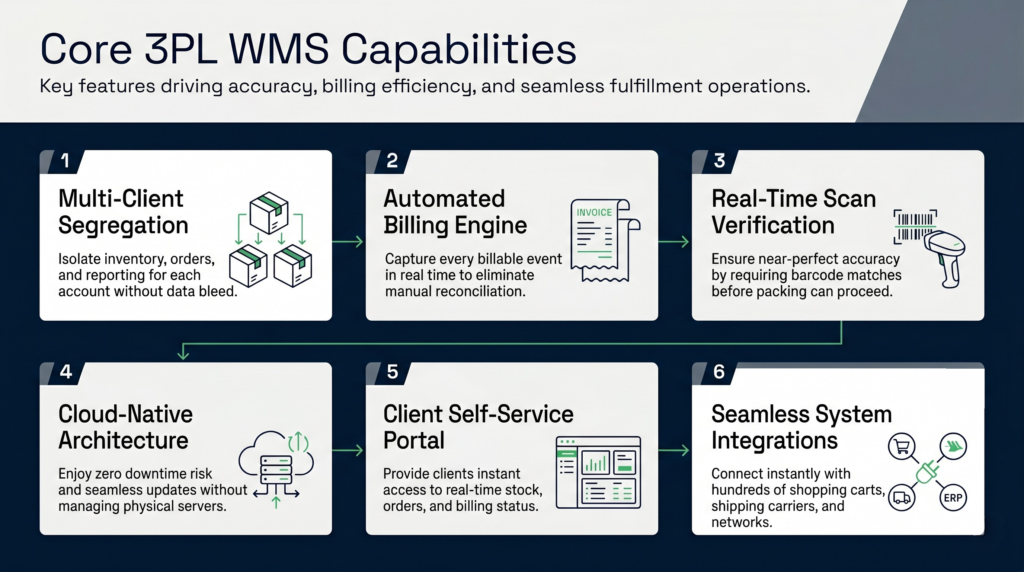
- Multi-client stock segregation: Each client’s inventory, orders, reporting, and billing live in isolated logical spaces within a single warehouse. You can manage 50 clients from one system without data bleeding between accounts.
- Automated 3PL billing engine: Every billable event — receiving, storage, picking, packing, despatch, returns, and value-added services — is captured in real time with a full audit trail. St John’s Hall Storage cut their invoicing from four hours to twenty minutes, and eliminated the two-person manual reconciliation that previously ate a day each month.
- Real-time scan verification: Barcode must match the order at pack, or the system stops the packer. JODA Freight brought accuracy from the low 90s to 99%.
- Server-less cloud-native architecture: No servers to manage, no version upgrades to schedule, no downtime risk. You’re always on the latest release.
- Client self-service portal: Your clients see real-time stock, order status, shipment tracking, and billing summaries in a white-labelable portal — no more fielding “what’s my stock level?” calls.
- Integrations at scale: 200+ out-of-the-box integrations including Shopify, Amazon, WooCommerce, Sage 200, QuickBooks, 70+ shipping carriers, and major pallet networks.
Where Clarus is a poor fit
- Tiny single-client webshops (under £500k/year revenue) may find the £1,000/month base overpriced versus spreadsheet-plus-fulfillment-outsource.
- Pure B2C parcel-only operations (no 3PL, no complex picking) might find Clarus deeper than needed; simpler platforms like ShipHero still work for that use case.
- If you’re locked into an ERP module suite (Sage, Dynamics, NetSuite) and want everything in one vendor, Clarus stays best-of-breed but doesn’t integrate as “one system”.
Proof points and real results
KATEM Logistics scaled picking volumes 10x after switching from manual processes and spreadsheet-based inventory. MSD (Mitchell Storage & Distribution) cut admin workload 60% — the invoicing and reporting burden vanished — and unlocked new revenue streams without adding headcount. Campeys of Selby, a food and beverage distributor, achieved sub-5-minute product recalls and secured BRC Double-A accreditation thanks to full traceability data in the system.
Pricing and contract
From £1,000/month on monthly rolling contracts. Transparent, all-inclusive pricing — no per-seat overages, no surprise integration fees, no tier creep as you grow. What matters is how many sites and users, not how many transactions.
Implementation and support
Sub-2-minute support response time. Go-live typically takes 4–8 weeks depending on your master data quality and carrier setup complexity. Cloud-native deployment means zero infrastructure overhead on your end.
2. Deposco — Best for Scalable Multi-Tenant 3PLs
Deposco is a cloud-based WMS for high-volume, scalable 3PL and ecommerce operations. It’s particularly strong in multi-tenant setups where you’re running dosens or hundreds of client accounts.
Strengths
- Multi-tenant architecture designed from the ground up for 3PLs.
- Event-driven activity-based billing — captures pick, pack, and putaway events automatically.
- Strong integrations with major carriers and ecommerce platforms.
- Mobile workflows and labour analytics built-in.
Limitations and considerations
- Setup and customisation is more technical and time-consuming than Clarus; expect longer implementation timelines.
- UK support is available but not as responsive as UK-based competitors; you may be in a queue behind US operations.
- Pricing is custom
- Not purpose-built for food & beverage traceability or hazardous goods workflows; you’ll need custom modules.
Who should choose Deposco
Fast-growing 3PLs with 10+ active clients and the internal resources to manage technical configuration. Ecommerce fulfilment houses handling Amazon and Shopify at scale. Organisations that can absorb longer implementation cycles in exchange for enterprise-grade flexibility.
3. Körber WMS — Best for Enterprise 3PLs and Complex Operations
Körber is an enterprise-class WMS for large warehouse networks and complex logistics operations. It powers operations at Fortune 500 logistics companies.
Strengths
- Extreme customisation and modular architecture — you build exactly what you need, no bloat.
- Multi-site, multi-warehouse management across global operations.
- Advanced labour, automation, and robotics integration for high-volume automated DCs.
- Decades of industry credibility and battle-hardened software.
Limitations
- Enterprise software complexity. Implementation takes 12–18 months and costs £500k–£2M+.
- Pricing is opaque and enterprise-only; you cannot get a quote without a formal sales engagement.
- Overkill for 3PLs under £50M revenue. You pay for features you’ll never use.
- On-premise deployment option means IT infrastructure, server maintenance, version upgrades — all your problem.
- UK support available through partner ecosystem, not direct from Körber.
Who should choose Körber
Large enterprise 3PLs (£100M+ revenue), multi-national distribution networks, and automated warehouse operations where Körber can integrate with robotics and sortation systems. Not a fit for mid-market or rapidly growing companies.
4. Mintsoft — Best for UK Mid-Market 3PLs and Food & Beverage
Mintsoft is a UK-built cloud WMS with strong roots in food & beverage, 3PL, and UK mid-market distribution.
Strengths
- Designed specifically for UK food and beverage operations — BRCGS compliance, FEFO/FIFO control, temperature zones built-in.
- Multi-client support and event-based billing automation.
- UK-based support and product team; local knowledge and responsiveness.
- Modular, configurable workflows without heavy customisation overhead.
- Mid-market pricing sits between Clarus and enterprise platforms.
Limitations
- Less integrated with non-UK carriers and non-British ecommerce platforms; international expansion is harder.
- Mobile workflows are functional but less polished than Clarus or Deposco.
- User interface feels less modern compared to purpose-built cloud-native competitors.
- Smaller user community means fewer third-party integrations available out-of-the-box.
Who should choose Mintsoft
UK-based 3PLs and distributors, especially in food and beverage. If you’re managing temperature-controlled stock, multiple client accounts, and want to speak to a UK support team in their timezone, Mintsoft is worth evaluating.
5. Other Notable Alternatives — Snapfulfil, Delta WMS, Canary7
Snapfulfil
A long-standing UK WMS for 3PLs and distributors. Strong in pick routing and labour optimisation.
Delta WMS
A modular, cloud-based WMS with strong carrier integration. Popular with ecommerce fulfilment houses. Mid-market pricing; solid but not market-leading in any specific dimension.
Canary7
A cloud WMS developed for fashion, food, and 3PL verticals. Known for flexible workflows and good UI/UX. Smaller installed base means fewer out-of-the-box integrations than Clarus or Deposco.
How to Choose: Decision Framework
Ask yourself these questions
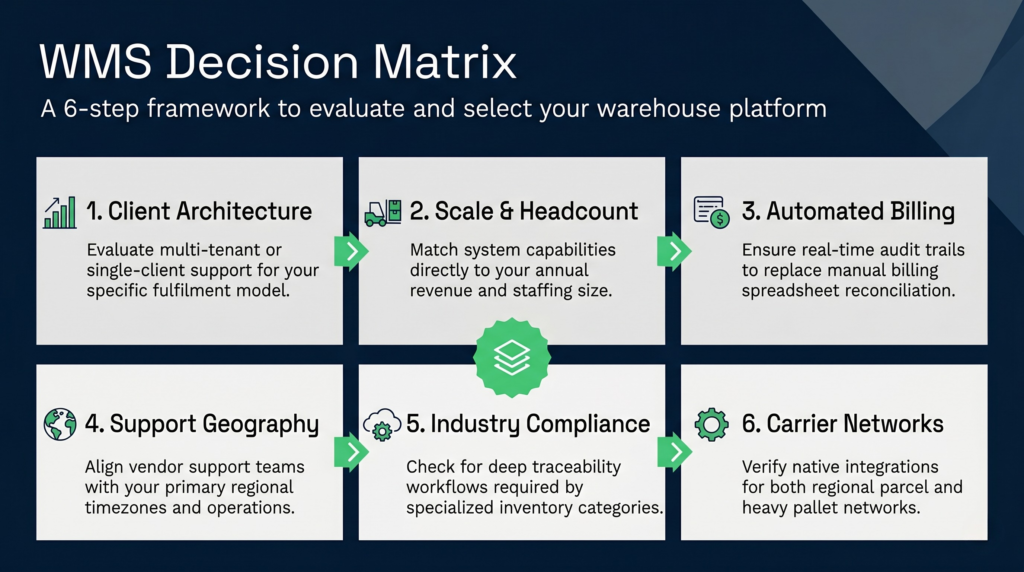
Do you run multiple client accounts (3PL) or single-client warehouse? If multi-client, Clarus, Deposco, Körber, and Mintsoft all support it. ShipHero’s multi-tenant capability is basic and billing is still manual.
What’s your annual revenue and warehouse headcount? Under £10M and 10 staff: Clarus. £10M–£50M and 10–50 staff: Mintsoft or Clarus depending on UK focus. £50M+: Deposco or Körber.
Do you need automated billing with a real-time audit trail? Only Clarus and Deposco truly automate this. Körber and Mintsoft support it but require more configuration. ShipHero requires spreadsheet reconciliation.
How important is UK-based support and timezone alignment? Clarus, Mintsoft, and ShipHero (UK Trustpilot feedback: slow support outside US). Körber and Deposco have global support but not UK-specific.
Do you work in food and beverage, pharma, or hazardous goods? Clarus and Mintsoft have deep compliance and traceability workflows. ShipHero is ecommerce-focused; compliance is manual or via third-party apps.
What’s your carrier mix? Clarus integrates 70+ carriers including all UK pallet networks (Palletways, Pallex, The Pallet Network). ShipHero is strong with parcel carriers (UPS, FedEx, USPS) but weak on UK pallet integrations.
How many sites will you manage from one system? One site: ShipHero works. Two or more sites needing unified visibility and billing: Clarus, Deposco, or Körber. Mintsoft supports multi-site but less elegantly.
Speak to a warehouse expert
If you’re evaluating your options and want to see how a purpose-built WMS works in practice, Clarus is worth a conversation. We work with 3PLs and distributors across the UK to implement warehouse management software that fits the way you operate — not the other way around.
Get in touch with our team to talk through your requirements.
 English (UK)
  Nederlands (Formeel)
  Nederlands (België)
  Français de Belgique
  Deutsch
  Español
  Español de México
  English
  English (Australia)
  English (Canada)
  English (New Zealand)
  Svenska
  Norsk bokmål