

When you’re evaluating warehouse management software, the choice between Clarus WMS and Körber Supply Chain’s Körber WMS (formerly HighJump) comes down to one fundamental question: what does your warehouse actually need to do?
Both are capable cloud-based warehouse management solutions. But they’re built for very different operational contexts. Körber is an enterprise-grade platform designed for large, automated warehouses with significant investment in conveyors, robotics, and labour-intensive operations. Clarus is a purpose-built 3PL WMS designed for multi-client warehousing, rapid deployment, and transparent pricing.
This comparison is for 3PLs, distributors, and mid-market warehouse operators evaluating their options. We’ve covered cost, implementation speed, multi-client capability, and feature depth so you can make the right call for your operation.
Quick comparison: Clarus vs Körber at a glance
| Dimension | Clarus WMS | Körber WMS (Körber One) |
|---|---|---|
| Best for | 3PLs, mid-market distributors, 10–300+ users | Large automated warehouses, enterprise logistics networks |
| Cloud architecture | Serverless, cloud-native; daily updates, no upgrade downtime | Cloud-first (on-premise option available); version-based releases |
| Multi-client capability | Built-in; stock segregation, per-client billing, client portal included | Available; requires additional module/complexity |
| Implementation timeline | Weeks to 2–3 months (4–8 weeks typical) | 4–12 months (12+ for large enterprise rollouts) |
| 3PL billing automation | Real-time, automated; captures every billable event (receive, store, pick, pack, despatch, returns) | Available; often requires custom configuration and professional services |
| Integration library | 200+ out-of-the-box (Shopify, WooCommerce, Sage, Brightpearl, 70+ carriers) | 500+ integrations (SAP, Oracle, Azure, enterprise ERP focus) |
| Automation features | Wave picking, directed putaway, scan verification, AI warehouse assistant | Full WCS (Warehouse Control System) + WMS; robotics, conveyor automation, labour optimisation |
| Support response time | Sub-5-minute average | Tiered SLAs; enterprise contracts standard |
| Customers | 100+ sites globally; primarily UK/Benelux 3PLs and mid-market distributors | 1,600+ global; large DCs, automation-heavy operations, enterprise retail networks |
Verdict in one sentence: Choose Clarus if you need a fast, cost-transparent WMS that’s built for multi-client 3PL operations. Choose Körber if you’re running a large, automation-heavy distribution centre with enterprise budget and a 12-month implementation window.
What is Körber WMS?
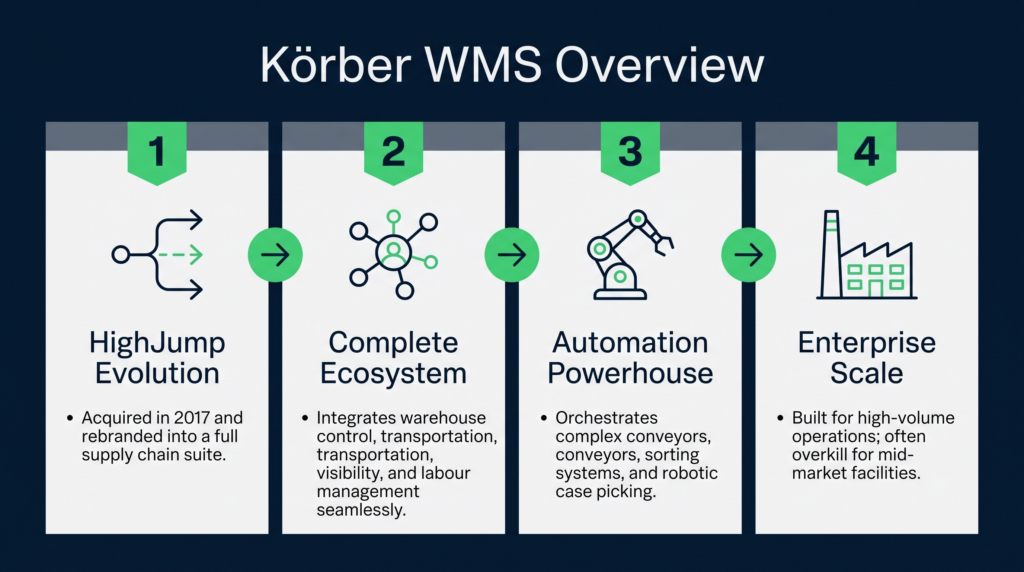
Körber WMS, also known as Körber One, is the warehouse management component of Körber Supply Chain’s logistics software suite. Körber acquired the HighJump WMS platform in 2017 and rebranded it under the Körber name in 2020–2021. It’s a mature, feature-rich platform designed for large distribution centres, 3PLs, and enterprise logistics networks.
Körber WMS works as part of a larger supply chain ecosystem that includes Warehouse Control System (WCS) functionality, transportation management, visibility, and labour management. For large operations running significant automation, conveyors, sorting systems, robotic case picking, Körber can orchestrate both the WMS and the physical equipment in a single environment.
What is Körber WMS good for? Körber is purpose-built for large, labour-intensive warehouses with significant investment in automation infrastructure. It excels at complex, high-volume operations where warehouse control system integration is critical. For a small or mid-market 3PL, Körber’s full feature set is often overkill, and the cost and implementation timeline reflect that enterprise positioning.
Is Körber WMS suitable for small and mid-sized 3PLs?
Technically, yes. Practically, Körber is rarely the first choice for small or mid-sized 3PLs, and here’s why:
Implementation burden. Körber deployments typically take 4–12 months for mid-market operations, and 12+ months for large enterprises. A typical Clarus deployment takes 4–8 weeks. If you’re a 3PL trying to win a new contract and go live before your competitor deploys their legacy spreadsheets, 12-month timelines become prohibitive.
Complexity. Körber’s WCS features, conveyor control, robotics orchestration, advanced labour optimisation, are valuable if you’re operating a highly automated facility. If you’re a 3PL running 5–10 semi-manual warehouses across the UK, you’re paying for capability you don’t use.
Who it works well for in that size range: A mid-market 3PL that’s planning significant automation investment (conveyors, sortation systems, automated storage and retrieval systems) and can absorb a 12-month implementation as a capital project. If that’s you, Körber is worth evaluating alongside automation consultants.
Who it doesn’t work for: A 3PL that needs to deploy quickly, operate at 5–10 regional sites with different client needs, or replace legacy spreadsheets without a year-long project plan. That’s where Clarus fits.
How does Clarus WMS compare to Körber on implementation time?
This is where the rubber meets the road. The differences are stark.
Implementation speed
Clarus goes live in 4–8 weeks. Körber takes 4–12 months (or longer for enterprise rollouts).
Why the gap? Körber’s complexity. A typical Körber deployment involves:
- Discovery and requirements workshops (4–6 weeks)
- Data migration and master data cleanup (8–12 weeks)
- Custom development and integration work (often 8–16 weeks)
- User training and change management (4–8 weeks)
- Testing, UAT, and cutover planning (4–12 weeks)
- Go-live and stabilisation (ongoing)
Clarus, by contrast, is pre-built for 3PL operations. Most of the “customisation” is configuration, picking existing workflows and features that already fit the typical 3PL model. Integration is automated (200+ pre-built connectors). Data migration tooling is self-service. Training is hands-on but compressed into weeks, not months.
For a 3PL operator, this speed difference is transformative. You can sign a customer contract in January and go live by March. With Körber, you’d be signing in January and hoping for a December cutover, by which time your customer has moved to a competitor or back to spreadsheets.
Which is better for UK 3PL warehouses, Clarus or Körber?
For typical UK 3PLs—£5–200M revenue, 10–300+ warehouse staff, operating 3–15 regional sites—Clarus is the better fit. Here’s the decision framework:
Choose Clarus if you:
- Need to go live in weeks, not months. You’re replacing a legacy system or winning a new customer contract and can’t afford a year-long implementation.
- Operate multiple client setups within the same warehouse (true multi-client). Clarus is built for this. Körber requires extra modules and configuration.
- Want transparent, predictable pricing with no lock-in. Clarus is monthly rolling. Körber contracts are multi-year with variable professional services costs.
- Have limited IT resources and want minimal operational overhead. Clarus is cloud-native, serverless; you get daily updates with zero downtime. Körber requires version management and periodic upgrades.
- Want your WMS team to own the system, not depend on agency consultants. Clarus is designed for direct operation and configuration. Körber typically requires ongoing professional services for changes.
- Are growing fast and need flexibility. Scaling from 20 to 200 users on Clarus is straightforward and incremental. On Körber, it often triggers re-architecture conversations with consultants.
- Don’t need advanced WCS (Warehouse Control System) capabilities. You’re not automating conveyors or robotics; you’re running standard putaway, picking, packing workflows at human speed.
Choose Körber if you:
- Are planning significant warehouse automation (conveyor systems, sortation, automated storage and retrieval). Körber’s WCS integration is world-class.
- Are a large enterprise with consolidated IT and budget for a multi-year project. You can absorb a 12-month implementation and have the project management rigour to see it through.
- Need integration with SAP, Oracle, or other large ERP systems as a core requirement. Körber’s enterprise ERP connectors are mature and deep.
- Have 500+ employees in your logistics network and need enterprise-grade visibility, reporting, and compliance across multiple sites and business units.
- Are happy paying a premium for brand recognition and proven scale. Körber is used by Coca-Cola, A-Ware (Netherlands), and other household names.
- Don’t need rapid deployment. Your decision-making window is 12+ months and you’re planning for a multi-year platform relationship.
What is a good alternative to Körber WMS for SMEs?
If you’re a small or mid-market warehouse operator and Körber feels like overkill—which it usually is—here’s the alternative stack:
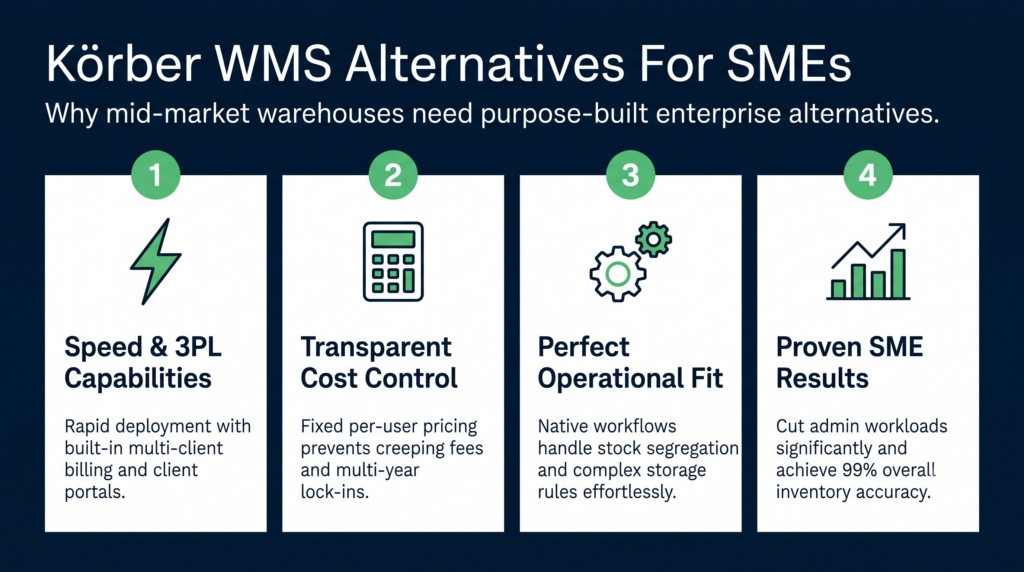
For speed and 3PL multi-client capability: Clarus WMS is purpose-built for exactly this job. It’s the fastest-to-deploy UK WMS for 3PLs, with real-time 3PL billing built in, client portal included, and transparent pricing.
For transparency and cost control: Clarus pricing is fixed and per-user. No creeping professional services, no multi-year lock-in. You see the cost clearly and can forecast it accurately.
For operational fit: Clarus is built by people who’ve run warehouses. The workflows reflect real 3PL operations: multi-client stock segregation, complex billing rules, rapid carrier integration, client-facing visibility. It’s not a retrofitted enterprise platform; it’s a purpose-built 3PL tool.
Real example: JODA Freight, a UK 3PL, brought stock accuracy from the low 90s to 99% by year 2. They didn’t need Körber’s WCS features; they needed accurate inventory tracking and rapid client reporting. Clarus delivered that without the enterprise overhead.
Another example: MSD (Mitchell Storage & Distribution), a 3PL, cut admin workload by 60% and unlocked new revenue streams without adding headcount. They’re now running multiple client billings, complex storage rules, and cross-dock workflows in a single cloud environment—all on Clarus, all at mid-market cost.
Feature and fit-by-business-size comparison
Here’s how Clarus and Körber map to different warehouse sizes and complexity levels:
| Business size / scenario | Clarus fit | Körber fit | Best choice? |
|---|---|---|---|
| Single-site, 10–50 users, simple picking | Excellent. Goes live in 4 weeks. | Overkill. 12-month project. Wasted capability. | Clarus |
| 3PL, 5–10 sites, 50–150 users, multi-client | Ideal. Built for this. Multi-client out of the box. 3PL billing. | Workable but expensive. Requires custom multi-client module. 6–9-month timeline. | Clarus |
| Distributor, 3–5 sites, 100–200 users, complex picking rules | Strong fit. Wave picking, directed putaway, integration to Sage/Brightpearl. 8-week go-live. | Also works. If you have existing SAP/Oracle, Körber integrates well. But slower and more expensive. | Clarus (unless you have enterprise ERP locked in already) |
| Large 3PL or DC, 200+ users, high automation (conveyors, sortation) | Possible, but Körber’s WCS integration is a better match if you’re investing in conveyors. | Perfect fit. This is Körber’s home territory. | Körber |
| Enterprise logistics network, 500+ users across 20+ sites, multi-country | Clarus scales but is primarily UK/Benelux. For truly global, Körber has more region-specific support. | Excellent fit. Proven at scale across multiple countries and business units. | Körber |
| Legacy system replacement, under 6-month timeline | Strong. Clarus is built for rapid legacy replacement. | Risky. 12-month timelines are typical; compressed schedules become chaotic. | Clarus |
| Warehouse automation investment (robotics, automated storage and retrieval) | Can support, but WCS integration is not a core strength. | Ideal. Full WCS + WMS orchestration is Körber’s speciality. | Körber |
Clarus WMS as the agile, UK-focused 3PL alternative
If you’re evaluating alternatives to Körber and want to understand why Clarus is gaining traction in the UK and Benelux 3PL market, it’s worth zooming out and looking at what’s changed in warehouse software over the past five years.
Legacy WMS platforms, on-premise or even early cloud platforms, were built in an era when warehousing was centralised, labour-heavy, and slow-moving. Upgrades happened yearly. Implementation took a year. Customisation required code changes and downtime. That model worked for mega-enterprises where a year-long cutover was just a cost of doing business.
But modern 3PLs operate differently. You win a customer contract in Q1 and need to go live by Q2. Your customers are moving between e-commerce platforms (Shopify to WooCommerce to Amazon), and your WMS has to flex with them. You’re handling multiple billing rules per client, complex carrier integrations, and real-time client visibility demands. Legacy platforms feel heavy and slow.
Clarus was born from exactly this frustration. Warehouse management systems should be fast to deploy, easy to change, and transparent to operate. No agency dependency. No multi-year contracts. No surprise bills.
Real-world performance: Warehouse picking efficiency has improved across Clarus customers—wave picking and directed putaway routines reduce travel time by 40–50%, and real-time scan verification pushes accuracy to 99%. Clarus WMS integrations span 200+ services including all major carriers, e-commerce platforms, and ERP systems. That breadth of integration means you can connect your entire supply chain without custom code.
For a UK 3PL, that’s a fundamentally different proposition than Körber. You’re not evaluating enterprise scale or global presence; you’re asking: can I deploy this in weeks, manage it myself, integrate with my customer’s systems, and control my costs? On all four counts, Clarus is built for yes.
Speak to a warehouse expert
If you’re evaluating your options and want to see how a purpose-built WMS works in practice, Clarus is worth a conversation. We work with 3PLs and distributors across the UK to implement warehouse management software that fits the way you operate—not the other way around.
Get in touch with our team to talk through your requirements.