

The food and beverage industry faces a unique set of warehouse challenges that generic warehouse management systems simply cannot address. Temperature control, expiry date tracking, lot and batch traceability, food safety compliance, and rapid recall capability aren’t nice-to-haves, they’re regulatory requirements and operational imperatives. The best warehouse management system for food and beverage is one purpose-built to handle these demands without retrofitting your operations around an off-the-shelf platform designed for other industries.
This guide explores what makes a WMS genuinely fit for food and beverage warehousing, the key features that matter most, and why a purpose-built solution outperforms generic alternatives.
What Makes Food and Beverage Warehousing Different
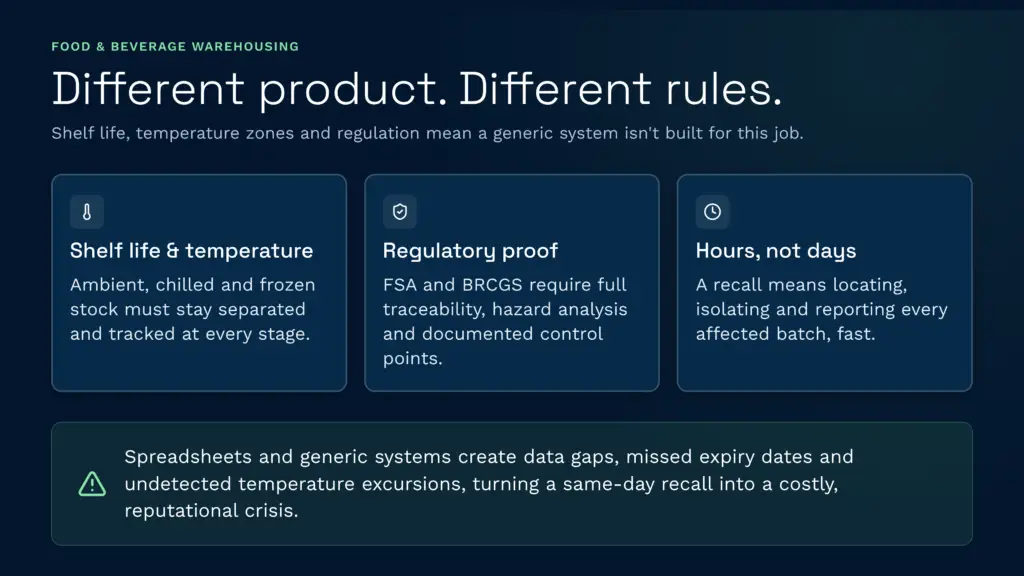
Food and beverage warehousing operates under constraints that don’t apply to general merchandise distribution. Every product has a shelf life. Temperature zones separate ambient, chilled, and frozen stock. Regulatory bodies, from the Food Standards Agency (FSA) to BRCGS, mandate traceability records, hazard analysis, and documented control points. Retailers demand proof of compliance. And when a product fails safety testing or is recalled, your team has hours, not days, to locate every affected batch, isolate it, and report to regulators.
A spreadsheet-based system or a generic WMS will collapse under this weight. Manual lot tracking creates data gaps. Expiry dates get missed. Temperature excursions go undetected. Recalls take days instead of hours. The cost isn’t just operational, it’s reputational and legal.
Core Requirements for a Food and Beverage WMS
Before evaluating specific systems, understand what a purpose-built food and beverage WMS must deliver:
- FEFO rotation logic: The system must enforce First Expired, First Out (FEFO) rules, ensuring products with the nearest expiry dates move out first. Unlike FIFO (First In, First Out), FEFO prevents waste and regulatory non-compliance by prioritising expiration rather than receipt order.
- Lot and batch tracking: Every incoming batch must be tracked from receiving through picking, packing, and despatch. When a recall occurs, the system must answer in seconds: how many units of lot #X are in the facility, where exactly are they, and which shipments have already left?
- Expiry, best-before, and sell-by date control: The WMS must enforce date rules at putaway, prevent picking of expired stock, and alert warehouse staff when products approach their end-of-life.
- Temperature zone management: Ambient, chilled, and frozen zones require separate putaway logic, route optimisation, and continuous monitoring to prevent cross-contamination and quality loss.
- Recall readiness: The system must support rapid isolation and quarantine of affected lots, generate traceback and traceforward reports, and maintain a complete audit trail of every movement.
- Food safety compliance: Built-in support for BRCGS standards, FSA compliance, and HACCP documentation is essential. The WMS should capture evidence of control points automatically.
- Allergen and product separation: The system must prevent cross-contamination by enforcing physical or logical separation rules between allergen-containing products and allergen-free batches.
- Integration with order and carrier systems: Real-time connectivity to e-commerce platforms, ERP systems, and shipping providers ensures accurate, up-to-date tracking from warehouse to customer.
A system lacking any of these capabilities will force your team to work around the software—introducing delays, errors, and compliance gaps that negate the investment.
Why FEFO and Lot Tracking Are Non-Negotiable
The foundation of food and beverage warehouse operations is accurate rotation and traceability. FEFO ensures that products with the shortest shelf life are sold first, reducing waste and the risk of expired goods reaching customers. But FEFO only works if the WMS enforces it at every step: at putaway (storing newer stock behind older), at replenishment (pulling from the oldest first), and at picking (blocking any attempt to select an expired or near-expiration product).
Lot traceability goes deeper. Lot-level traceability tracks products at a batch level both forward and backward along the supply chain, facilitating quick withdrawal procedures and root cause analysis. When a supplier alerts you that batch #2024-06-15-001 contains a contaminant, your WMS must instantly tell you how many units you received, where they’re stored, which orders they were picked into, and whether they’ve already shipped. Manual systems can’t answer that question in minutes; a purpose-built WMS can answer it in seconds.
Clarus WMS enforces FEFO rules at the point of picking and supports full lot and batch capture from receiving onward. Edge Transport, a UK food 3PL, achieved 99% stock accuracy and gained full BRCGS traceability visibility in minutes after switching to an automated lot-tracking system.
Food Safety, Compliance, and Recall Management
Food safety compliance is not optional. The Food Safety Act 1990 and subsequent FSA regulations require documented hazard analysis, control of critical control points, and traceability records. BRCGS Storage and Distribution standards audit how warehouses manage product safety, integrity, and legality. Retailers—especially large supermarket chains—will not stock your products without proof of compliance.
A recall can strike without warning. The FDA’s requirement is that a responsible party must report a recall within 24 hours of discovery. In practice, your team has hours to find every affected unit, quarantine it, generate documentation, and prevent further distribution. A manual process will fail. A slow WMS will fail. Only a system with real-time lot tracking, automated quarantine logic, and instant reporting can execute a recall in the window available.
Campeys of Selby, a food and beverage specialist, reduced product recall response time to under five minutes and secured BRC Double-A accreditation by automating lot visibility and quarantine procedures.
The system must also maintain an unbroken audit trail, who accessed which lot, when, for what purpose. This isn’t just good practice; it’s required by regulators and will be the first thing investigators ask to see if something goes wrong.
Temperature Control and Cold-Chain Management
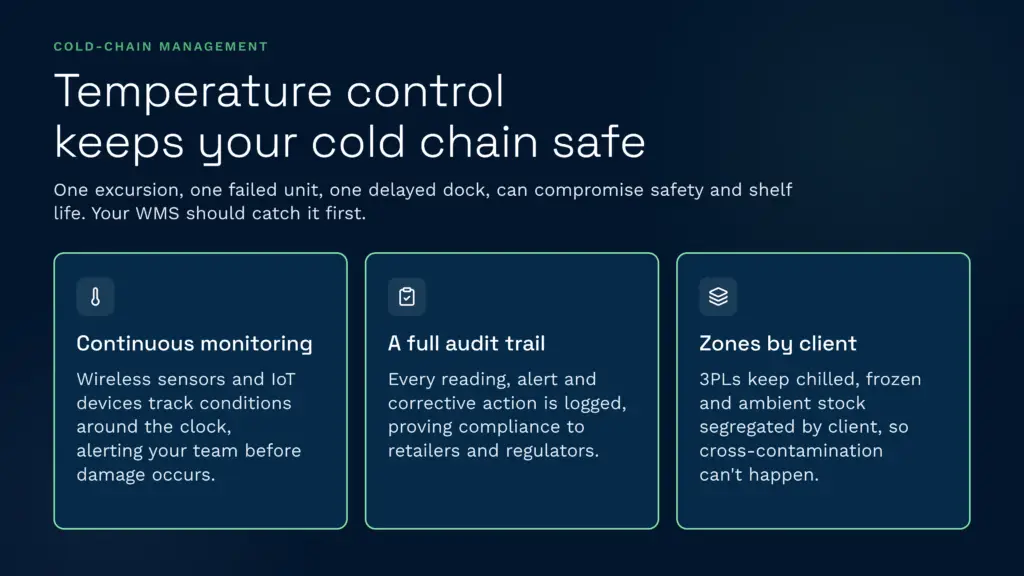
Cold-chain integrity is fundamental to food safety. A single temperature excursion, whether a failed refrigeration unit, a loading-dock delay, or a carrier breakdown, can compromise product quality, safety, or shelf life. Your WMS must not just store products in temperature-controlled zones; it must continuously monitor conditions and alert your team to deviations before damage occurs.
Advanced WMS platforms continuously track temperature conditions using wireless sensors and IoT devices, automatically alerting operators when deviations occur. The WMS should log every temperature reading, every alert, and every corrective action, creating an audit trail that proves compliance to both retailers and regulators.
For 3PLs and distributors managing multiple clients’ chilled or frozen stock, the WMS must also segregate temperature zones by client and product type, ensuring that cross-contamination or mislabelling doesn’t occur. A 3PL managing ambient stock for one retailer and chilled stock for another cannot afford mixing.
How to Choose the Best WMS for Food and Beverage
Evaluate any potential WMS on these non-negotiable criteria:
- Purpose-built or retrofitted? A system designed from the ground up for food and beverage will have FEFO, lot tracking, and compliance features as core primitives. A system retrofitted from a general-purpose WMS, or worse, an ERP add-on, will force workarounds and create hidden costs.
- Cloud-native or server-based? Cloud-native systems eliminate the need to maintain servers, apply patches, and manage upgrades. You’re always on the latest release with the latest features. Server-based systems transfer operational burden and capital expense to you.
- Multi-client capability: If you’re a 3PL or distributor with multiple clients, the WMS must isolate each client’s inventory, billing, reporting, and workflows within a single environment. Clients have different SLAs, labelling rules, carrier integrations, and pricing structures, the system must handle that complexity without creating separate silos.
- Real-time visibility and client portal: Your clients expect to see real-time stock levels, order status, and shipment tracking. A client self-service portal reduces calls and disputes. A portal that doesn’t exist forces your team to field every query manually.
- Integration breadth: The WMS must integrate with your current e-commerce platform (Shopify, WooCommerce, Amazon, etc.), ERP (Sage, Dynamics, SAP), carrier systems (DHL, UPS, Royal Mail, Parcelforce, etc.), and any vertical-specific tools you use. Lock-in to a system with narrow integrations will constrain your growth.
- Implementation speed and support: Food and beverage businesses can’t afford a six-month go-live. Look for a system that deploys in weeks, not months, with documentation that’s clear and support that responds quickly. A sub-two-minute support response time is the industry standard.
Clarus WMS: A Purpose-Built Solution for Food and Beverage
Clarus WMS is a cloud-native, serverless warehouse management platform designed for 3PLs and distributors. It was born from frustration with legacy WMS vendors, slow implementations, high costs, inflexible multi-client logic, and the burden of maintaining on-premise infrastructure.
Key capabilities for food and beverage warehousing:
- Enforced FEFO / FIFO / LIFO rotation logic: Configurable per client or per product. The system prevents picking of expired or near-expiration stock automatically.
- Lot and batch control: Full traceability from receiving through despatch. Serial numbers, expiry dates, and best-before dates are captured and enforced.
- Temperature zone management: Separate warehouses or zones for ambient, chilled, and frozen stock. Real-time monitoring and alert capability.
- Automated 3PL billing: Captures every billable event (receiving, storage, pick, pack, despatch, value-added services) in real time. No manual reconciliation.
- Client self-service portal: Real-time stock visibility, order tracking, shipment status, and billing summaries. White-labelable with your branding.
- Integration-first architecture: 200+ out-of-the-box integrations, e-commerce platforms, ERP systems, 70+ shipping providers, pallet networks, and more. API-first; supports EDI, XML, CSV via SFTP.
- Cloud-native, always-current: No servers to maintain, no version upgrades to manage. Always on the latest release with the latest features and security patches.
- From £1,000/month on monthly rolling contracts: No long-term lock-in, no enterprise sales complexity.
A WMS is more than software—it’s the operational backbone of your warehouse. When evaluating the best warehouse management systems for 2026, purpose-built solutions for your industry will outperform generic platforms every time.
Essential WMS Features for Food & Drink 3PLs and Distributors
If you operate a food and beverage 3PL or distribution centre, your WMS must also address:
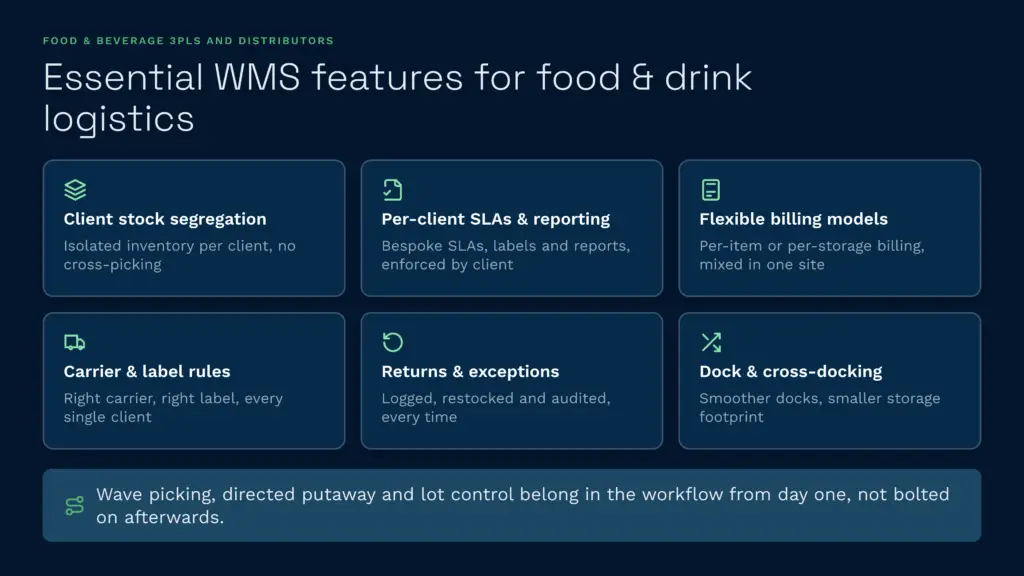
- Multi-client stock segregation: Each client’s inventory must be physically or logically isolated. Picking for Client A must never pull from Client B’s stock.
- Per-client SLA and reporting: Clients have different delivery SLAs, labelling formats, and reporting requirements. The WMS must enforce SLAs per client and generate bespoke reports.
- Activity-based and storage-based billing: Some clients pay per item stored, others per item handled. The system must support mixed billing models within a single facility.
- Carrier and label customisation: Client A ships via DPD with a specific label format; Client B ships via Royal Mail with a different format. The WMS must route to the correct carrier and generate the correct label per client.
- Returns and exception handling: When a shipment is rejected or returned, the system must log it, notify the client, and re-integrate the stock into available inventory with full audit trail.
- Dock scheduling and cross-docking: Inbound and outbound dock management prevents bottlenecks. Cross-docking capability—unloading inbound shipments and immediately reloading them for outbound—reduces storage footprint and improves velocity.
Wave picking and directed putaway logic also matter: the system should batch orders intelligently and optimise walking routes to reduce labour time. Lot and batch controls must be built into putaway, replenishment, and picking workflows, not bolted on afterward.
Avoiding the Retrofit Trap
Many businesses start with a general-purpose WMS or ERP platform (Sage, Microsoft Dynamics, etc.) and later discover they need food-specific features. Retrofitting those features is expensive and brittle. You’ll find yourself working around the system, creating parallel spreadsheets, and living with half-automated workflows.
The hidden cost of retrofitting is operational burden: staff who know how to work around the system’s limitations leave, and you lose institutional knowledge. Data integrity suffers. Compliance gaps emerge. Recalls take longer because the system wasn’t designed to execute them quickly.
A purpose-built WMS, one where FEFO, lot tracking, traceability, and compliance are core, will save you months of implementation time and years of operational friction.
Speak to a warehouse expert
If you’re evaluating your options and want to see how a purpose-built WMS works in practice, Clarus is worth a conversation. We work with 3PLs and distributors across the UK to implement warehouse management software that fits the way you operate, not the other way around.
Get in touch with our team to talk through your requirements.