

Magazijnbeheer is fundamentally about controlling three things: inventory, people, and space. Get these wrong and your operation becomes a tangle of inefficiency, inventory shrinkage, and frustrated staff. Get them right and you run a profitable, scalable facility that adapts to demand without friction.
This guide walks you through the core disciplines of warehouse management, the ones that separate organised, high-performing warehouses from chaotic, cost-bleeding ones. Whether you’re running a 3PL warehouse, a distribution centre, or in-house stock management, these principles apply. We’ll cover the operational realities, the specific failure modes to avoid, and how modern warehouse management systems fit in.
The Five Core Areas of Warehouse Management
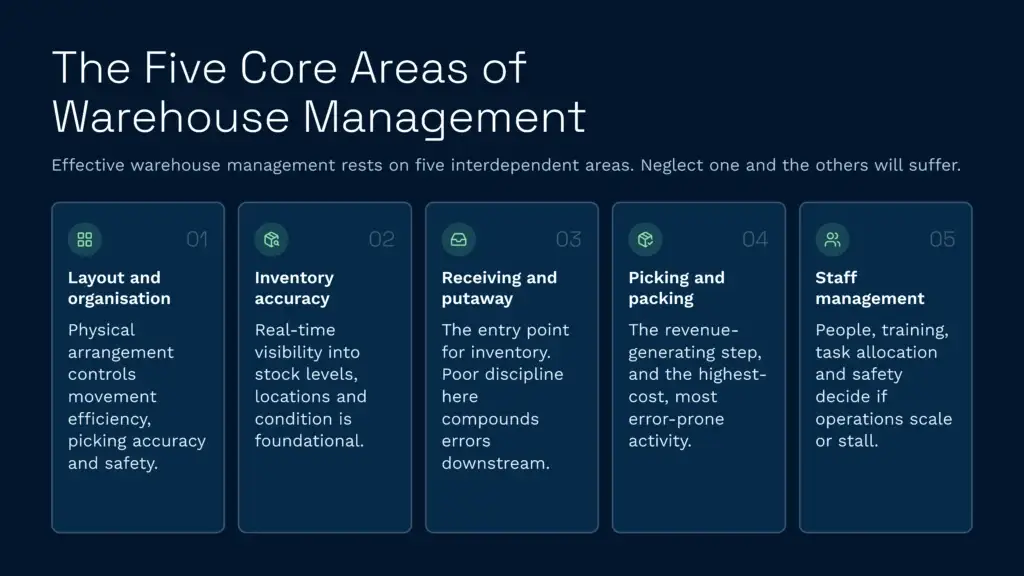
Effective warehouse management rests on five interdependent areas. Neglect one and the others will suffer.
- Warehouse layout and organisation: The physical arrangement of your warehouse directly controls movement efficiency, picking accuracy, and safety.
- Inventory accuracy and stock control: You can’t manage what you don’t see. Real-time visibility into stock levels, locations, and condition is foundational.
- Receiving and putaway: The entry point for inventory. Poor discipline here compounds errors downstream.
- Picking and packing: The revenue-generating operation. Picking is typically the highest-cost, error-prone activity in a warehouse.
- Staff management and operational efficiency: Warehouses are labour-intensive. People, training, task allocation, and workplace safety determine whether your operation scales or stalls.
1. Warehouse Layout and Organisation
Your warehouse layout either enables efficient movement or forces people to waste time. The best layout depends on your product mix and order types, but the principles are universal.
Zone-based organisation
Divide your warehouse into functional zones: receiving, put-away, picking, packing, and despatch. Keep these physically separate. A common failure is cramming all operations into one chaotic space — pickers trip over receiving staff, scanners interfere with each other, and the noise and congestion create a pressure cooker for errors.
Within the picking zone, organise SKUs by velocity. Fastest-moving items belong in the middle of the zone, chest to waist height, close to the packing area. Slow movers live on higher and lower shelves. This simple rule cuts walking distance dramatically.
Logical location coding
Design a location naming convention that your team can understand instantly. A good system includes zone, aisle, shelf level, and position. For example, “A-03-02-01” means “Aisle A, bay 3, shelf 2, position 1”. Pickers learn it quickly, barcode errors drop, and new staff get up to speed faster.
Document the layout on a visible plan. When stock has a permanent home and everyone knows it, you eliminate the “where is it?” conversations that eat into your day.
Accessibility and safety
Ensure aisles are wide enough for your equipment. Tight spaces force pickers to move slowly and create accident risk. Shelving should have adequate load limits marked clearly — overloaded shelves collapse. Height limits for stacked pallets must be enforced; a pallet falling from height is a serious injury or fatality.
Keep floors clear of spills and clutter. The fastest way to a serious accident is a wet floor or a pallet jack hidden by boxes.
2. Inventory Accuracy and Stock Control
Manual inventory management is slow, error-prone, and fragile. The moment one person holding critical stock information leaves, the system degrades or collapses.
Realtime inzicht
Implement a system that tracks every stock move in real time. When a product is received, picked, or returned, the system records it immediately. The alternative, manual counts at month-end, is archaic and guarantees errors. Physical inventory usually doesn’t match paper counts, triggering a costly and time-consuming recount.
Real-time visibility also lets you manage stock rotation properly. For perishable goods, you must enforce FIFO (first in, first out) of FEFO (first expiry, first out) rotation. Spreadsheets fail at this. A system enforces it automatically.
Cycle counting vs. annual stocktakes
Annual stocktakes are disruptive. You must close the warehouse for a day or more, count everything, and then spend days investigating discrepancies. Cycle counting is better: count a small section of your warehouse daily or weekly, adjust for errors on the spot, and never face a big surprise at year-end.
Investigate every variance immediately. If a SKU shows a variance larger than your tolerance (typically 2–3% by value), find out why: was the previous count wrong, was there a data entry error, or did stock go missing? Address the root cause, not just the symptom.
Managing slow-moving and obsolete stock
Stock sitting on your shelves is cost. Storage space, heating, insurance — it all adds up. Track how long stock has been in the warehouse. Products with no movement in 12 months are dead weight. Run clearance sales, bundle them with faster movers, or liquidate. The space cost of keeping dead stock almost always exceeds the sale value you’ll get.
How to maintain optimal stock levels covers reorder points, safety stock, and demand forecasting in detail. Get stock levels right and you free up cash, reduce storage cost, and improve your inventory turns.
3. Receiving and Put-Away Discipline
Receiving is where inventory enters your warehouse. Mistakes here multiply downstream. A wrongly counted pallet, an undetected damaged item, or a misplaced SKU creates confusion and lost revenue.
Goods-in process
Establish a formal receiving dock operation. Suppliers deliver to a scheduled receiving window. On arrival, the receiving staff verify:
- Quantity: Count or weigh the delivery. Don’t trust the supplier’s label — verify it.
- Condition: Inspect for physical damage, wet boxes, crushed corners. Damage visible on receipt is the supplier’s liability; hidden damage discovered later is yours.
- Specification: Check that what arrived matches the order. Wrong SKU, wrong quantity, wrong specification — catch it now, not when you try to pick it.
- Documentation: Match the delivery note to the purchase order. Discrepancies go in writing.
Barcode the received items immediately and scan them into your system. This is your system of record — if it’s not scanned, it doesn’t exist as far as the warehouse is concerned.
Put-away strategy
Once received, stock must go to its designated location quickly. Slow put-away creates a pile-up in the receiving zone, which blocks new deliveries and slows your whole operation.
Use directed put-away logic. The system tells each person exactly where to put each pallet — no guessing, no “I’ll put it here for now”. This ensures stock ends up in the right place consistently and prevents staff from creating their own ad-hoc storage, which destroys the organisation you’ve built.
For bulk items with multiple SKUs on one pallet, break the pallet and put items to their correct locations. Yes, this costs time upfront. But it eliminates the problem of a pallet spanning two different SKUs and two different locations — a source of picking confusion and variance.
Cross-docking
Some orders don’t need to be stored — they arrive in the morning and leave by afternoon, going directly from receiving to despatch. Maximising warehouse receiving processes covers docking operations in depth. Setting up a cross-dock area lets you handle these high-velocity orders without adding them to stock.
4. Picking and Packing Accuracy
Picking is the highest-cost operation in most warehouses, and it’s where picking errors happen. Get the wrong item into a box, seal it, and you’ve created a customer complaint, a return, and a logistics cost to fix it.
How picking errors happen
Manual pick lists (printed or on paper) create a specific failure pattern. Pickers interpret handwriting differently. Under time pressure, they create shortcuts: scanning only the first item in a multi-item order, or skipping low-stock items to “come back later”. Peak periods amplify cognitive load — errors cluster when demand peaks.
The system of record becomes unreliable. A picker works from an inaccurate list, picks incorrectly, and if they don’t scan, the system doesn’t know what went wrong.
Scan verification
Implement scan-verify discipline. The barcode on the bin or shelf must match the barcode on the order. If they don’t match, the system stops the picker. No guessing, no overrides. This single rule eliminates a huge class of picking errors.
The cost per pick rises slightly — the picker has to scan more. But the cost of picking the wrong item (customer complaint, return shipping, re-work) is far higher. You break even on the first prevented error.
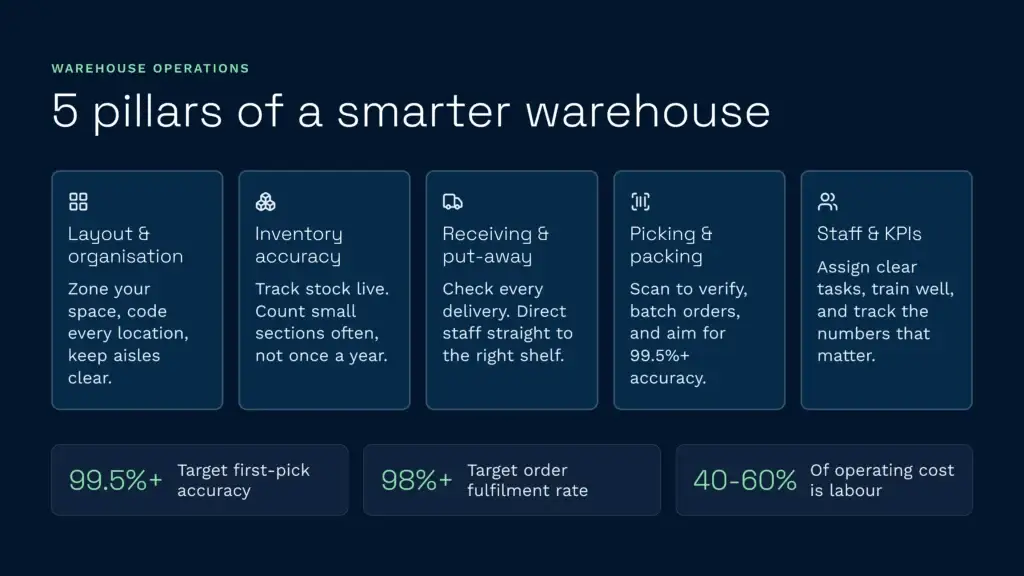
For accuracy targets, aim for 99.5%+ on first-pick accuracy. Anything below 99% is a sign that your process is broken or your staff are under unsustainable pressure.
Wave picking and batch picking
Picking random orders one-by-one is inefficient. Group orders into waves — all orders due to despatch in a time window — and then batch them. Batch picking means one picker collects all units of a SKU for multiple orders at once, reducing redundant travel.
Warehouse order picking guide covers picking strategies in detail. The right picking method depends on your order size and frequency, but batching is almost always more efficient than random picking.
Packing and despatch quality checks
Before a box leaves the warehouse, someone must verify the order contents against the pick list. Weight checks work well: if the box weighs within a tolerance of the expected weight, it’s likely correct. Dimensional checks prevent oversized items being forced into boxes.
Despatch labels must be legible and match the box contents. A label that falls off or is unreadable creates shipping chaos downstream.
5. Staff Management, Productivity, and KPIs
Warehouses are labour-intensive. People represent 40–60% of operating cost. How you manage them determines whether your warehouse is efficient, safe, and scalable.
Task-based management and workload balance
Assign work in discrete tasks rather than open-ended shifts. Instead of “pick today”, it’s “pick orders 1001 to 1050”. Task management creates clear accountability, lets you measure performance, and helps you spot bottlenecks.
Distribute workload evenly across your team. Peak-period bottlenecks are a sign that you’ve under-staffed or that certain individuals are carrying too much. Redistribute work or add temporary staff to smooth the load.
Measure productivity per person: picks per hour, lines picked per shift, cases packed per day. Trends tell you a lot. Declining productivity often signals low morale, inadequate training, or process issues. Investigate.
Training and competency
New warehouse staff need structured training, not a sink-or-swim introduction. Cover:
- System navigation: How to use the WMS, how to log in, how to read a pick list.
- Safety: How to use equipment safely, load weight limits, emergency procedures.
- Process: How goods arrive, how they move through the warehouse, where they go.
- Quality: What accuracy looks like, how to scan verify, what to do if something doesn’t match.
Pair new staff with experienced ones for the first week. Have them shadow first, then work alongside, then work independently while observed.
Health, safety, and wellbeing
Warehouse work is physical. Common injuries include back strain, repetitive strain injuries, and falls. Create a safety culture:
- Enforce proper lifting technique. Don’t lift loads heavier than your guidelines (typically 20 kg for women, 25 kg for men without assistance).
- Use mechanical aids: pallet jacks, trolleys, lifting assists. If it’s heavy, don’t carry it.
- Keep floors clear and dry. Wet floors are accident waiting to happen.
- Provide adequate lighting, ventilation, and temperature control. A hot, dark, cramped warehouse is demoralising and error-prone.
- Conduct monthly safety briefings. Discuss near-misses and incidents; use them to improve process.
Invest in wellbeing. Warehouse work is intense and repetitive. Breaks, stretching programmes, and access to water reduce burnout and turnover.
Key performance indicators (KPIs) and metrics
Track what matters. Key warehouse KPIs include:
- Inventory accuracy: System count vs. physical count. Target 99%+.
- Pick accuracy: First-pick accuracy before quality check. Target 99.5%+.
- Order fulfilment rate: Orders shipped on time, in full. Target 98%+.
- Picking productivity: Lines picked per person per day. Benchmark against your own history and industry standards.
- Labour cost per order: Total labour cost / number of orders picked. Trends show whether you’re getting more efficient.
- Safety incident rate: Injuries per 200,000 hours worked (OSHA standard). Target zero.
- Staff turnover: Annual % of people leaving. High turnover signals low morale or poor training.
Report these weekly or daily (depending on scale). If a metric is trending wrong, investigate the root cause and act. Don’t just report — respond.
How a Warehouse Management System Fits In
A manual warehouse — one relying on paper, spreadsheets, and memory — hits a ceiling quickly. As volume grows, errors multiply and staff frustration rises. What is a warehouse management system explains the fundamentals. Here’s how a modern WMS changes the game.
Real-time data and visibility
A WMS records every action instantly. Stock movements, picks, packs, quality checks — all logged. You get real-time visibility into what’s in your warehouse and where. No more surprises at month-end.
For 3PL warehouses managing multiple clients, this visibility is essential. Each client’s stock must be segregated, tracked separately, and billed accurately. A spreadsheet-based system requires manual reconciliation every month — error-prone and time-consuming. St John’s Hall Storage, a UK 3PL, cut their invoicing from four hours to twenty minutes after switching to a system with automated billing. The invoicing admin person went from spending days a month on reconciliation to barely a day — unlocking that person’s time for higher-value work.
Automation and workflow logic
A WMS can automate low-value, repetitive work. Directed put-away tells each person exactly where stock should go. Wave picking groups orders intelligently, reducing walking distance. Automated billing captures every billable event — receiving, storage, picking, packing, despatch, returns — without manual counting.
These automations don’t replace people; they free them up from tedious work and let them focus on quality, problem-solving, and customer service.
Decision support and alerting
A WMS can surface bottlenecks and issues before they become problems. Low stock alerts, slow-moving inventory alerts, quality exception alerts — all sent automatically. You can act proactively rather than reactively.
For food and beverage operations, a WMS with expiry date tracking can alert you when stock is approaching best-before date, letting you manage FEFO rotation accurately. Best warehouse management system software for 2026 covers the features that matter across different industries.
Scaling without proportional cost increase
A manual warehouse has to add staff with every volume increase. One person per 500 picks per day is a rough rule of thumb. A WMS, by cutting non-value work and automating routine tasks, lets you handle higher volumes with the same headcount. KATEM Logistics, a UK 3PL, scaled their monthly picking volumes 10x after switching from a legacy system. Headcount didn’t 10x — the WMS made them far more efficient.
Continuous Improvement and Adaptation
A warehouse is never “done”. Markets shift, customer demands change, technology evolves. The best-run warehouses treat this as an opportunity.
Regular review and iteration
Monthly, review your KPIs. If a metric is trending wrong, dig into why. Involve your warehouse team — they see the problems first. Work with them to test improvements on a small scale before rolling them out.
A single process change might save ten minutes per day per person. Across a ten-person team, that’s 1,700 minutes (28 hours) saved per month. Compound ten such improvements and you’ve transformed your operation.
Technology and tooling
Evaluate new technology with real use in mind. Barcode scanning, mobile-first interfaces, handheld devices, route optimisation — the right tools reduce friction. But tools chosen for the sake of tools add cost without benefit.
API integrations between your WMS, your ERP, and your e-commerce platform eliminate data re-entry. When your order management system talks directly to your warehouse system, orders arrive in the warehouse ready to pick — no manual data entry, no delays.
Benchmarking and learning from others
Your warehouse doesn’t exist in isolation. Talk to peers in your industry. What metrics do they track? What tools do they use? What mistakes have they made? Industry organisations like the UKWA (UK Warehousing Association) and Cold Chain Federation (for food) are good sources of benchmarking and best practice.
Neem contact op met een magazijnexpert
Als u uw opties aan het afwegen bent en wilt zien hoe een speciaal ontwikkelde WMS in de praktijk werkt, is Clarus zeker het overwegen waard. Wij werken samen met 3PL-bedrijven en distributeurs in heel het Verenigd Koninkrijk om magazijnbeheersoftware te implementeren die is afgestemd op uw bedrijfsvoering — en niet andersom.
Neem contact op met ons team om uw wensen te bespreken.