

Oracle WMS Cloud is a powerful enterprise warehouse management system, but it comes with a hefty price tag, long implementation timelines, and limited flexibility for 3PL operations. If you’re evaluating Oracle or looking to switch, this guide compares the leading alternatives and shows why a purpose-built, cloud-native WMS might be a better fit — especially if you run a 3PL, wholesale distributor, or smaller multi-site operation.
We’ve researched the market, reviewed G2 and Capterra ratings, and compared real pricing, implementation speed, and features. Here’s what you need to know.
Quick comparison: Oracle WMS vs the best alternatives
| System | Best for | 3PL multi-client billing | Implementation time | Pricing model | Cloud-native |
|---|---|---|---|---|---|
| Clarus WMS | 3PLs, UK distributors, purpose-built | Native — automated per-client billing | 6–8 weeks | From £1,000/month, monthly rolling | Yes — server-less |
| Oracle WMS Cloud | Large enterprise warehouses | Limited, requires customisation | 6–18 months | Custom, typically £3,000–£30,000+/month | Yes (SaaS) |
| Blue Yonder WMS | High-automation facilities, large enterprises | Capable but complex setup | 6–12 months | Custom, enterprise tier | Yes (cloud) |
| Infor WMS | Large distribution centres, Infor ecosystem shops | Configurable but manual-heavy | 8–16 months | Custom, enterprise pricing | On-premise or cloud |
| Manhattan Associates | Large enterprises, automation-heavy | Advanced, but implementation-heavy | 8–18 months | Custom, top-tier pricing | Yes (cloud-native, microservices) |
| Snapfulfil | Mid-market 3PLs, UK focus | Strong multi-client support | 8–12 weeks | Custom, mid-market | Hybrid (cloud + on-premise) |
Clarus WMS — purpose-built for 3PLs and UK distributors
Who it’s best for: 3PLs with 2–100+ sites, wholesale distributors, food & beverage, e-commerce fulfilment, manufacturing. If you operate a multi-client warehouse or have fast-changing client contracts, Clarus is built for that.
What makes it different
Clarus is a cloud-native, server-less WMS born from frustration with legacy on-premise systems. Unlike enterprise platforms that retrofit multi-client billing after the fact, Clarus was built from the ground up for 3PL operations — each client’s inventory, billing, and reporting are isolated within a single database, yet managed from one interface.
Key strengths:
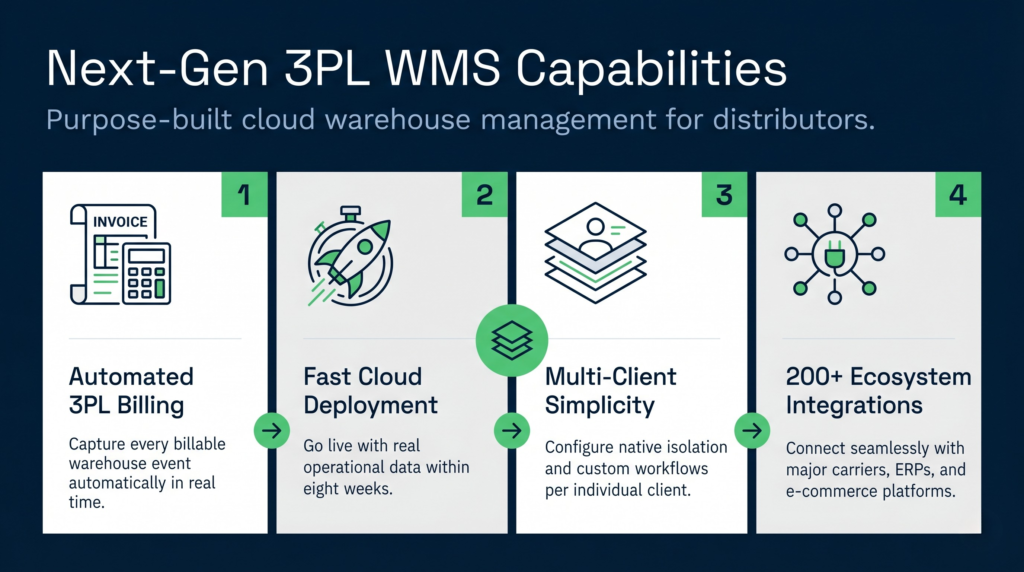
- Automated 3PL billing: Every billable event (receiving, storage, pick, pack, despatch, returns, value-added services) is captured in real time. St John’s Hall Storage, a UK 3PL, cut their invoicing from four hours to twenty minutes and eliminated manual reconciliation entirely. No more spreadsheet disputes at month-end.
- Fast deployment: Live in 6–8 weeks, not 6–18 months. You go live with real data in under two months because the system doesn’t require weeks of data migration or complex enterprise configuration.
- Multi-client simplicity: Wave picking, put-away logic, FIFO/LIFO/FEFO rotation, and billing rules are configured per client in minutes. You’re not retrofitting client isolation into a single-client design; it’s native.
- Cloud-native architecture: No servers to patch, no version upgrades, no infrastructure overhead. Always running the latest release. Always available — designed for 99.9% uptime.
- Client portal: Clients see real-time stock levels, order status, shipment tracking, and billing summaries — white-labelable with your branding. Ends the daily stock-level phone calls.
- 200+ integrations: Clarus integrates with 70+ shipping providers, major ERPs (Sage, Dynamics, SAP), e-commerce platforms (Shopify, WooCommerce, Amazon, eBay), and 200+ systems across the ecosystem. If it’s a carrier, ERP, or e-commerce platform, Clarus likely connects.
- AI-powered warehouse assistant: Reads operational data to execute tasks and surface insights, no more manual reporting or buried data.
Limitations
Clarus may not be a fit if you’re running a single, massive automated distribution centre with 500+ users and complex SAP integration at enterprise scale. It’s optimised for 3PLs and distributors, not Fortune 500 mega-facilities. It’s also not the choice if you need on-premise infrastructure for regulatory reasons (though nearly all UK warehouses now operate in cloud-native setups).
Customer proof points
JODA Freight, a UK 3PL, brought stock accuracy from the low 90s to 99.8% and slashed their weekly stocktake from weeks to days. MSD (Mitchell Storage & Distribution) cut admin workload by 60% and now unlock new revenue streams without hiring more staff. KATEM Logistics scaled monthly picking volumes 10 times after switching, they couldn’t have done that with legacy systems.
These are real 3PLs solving real problems, not Fortune 500 facilities, but the backbone of UK warehouse operations.
Oracle WMS Cloud — enterprise power, enterprise cost
Who it’s best for: Very large enterprises (1000+ users across multiple continents) with deep Oracle investments and budgets that can absorb long implementation timelines and six-figure annual costs.
What it is
Oracle WMS Cloud is a cloud-hosted version of the on-premise Oracle WMS system, originally built as part of Oracle SCM (Supply Chain Management). It offers advanced features like wave planning, directed putaway, labour tracking, and deep supply chain integration, if you have the time and money to unlock them.
Genuine strengths
- Deep ERP integration: If your business runs on Oracle ERP, you get native integration at the database level. Inventory moves in WMS instantly reflect in the general ledger.
- Advanced automation support: Designed to work with automated picking systems, conveyor belts, and robotic systems. Enterprise-scale sort and pack automation.
- Mature wave planning: Highly configurable wave templates for complex picking scenarios. If your facility runs hundreds of waves a day, Oracle can handle the volume.
- Labour tracking and optimisation: Detailed task-based labour costing and productivity analytics, useful in very large facilities where labour spend is massive.
- Gartner credibility: Listed as a leader in the Gartner Magic Quadrant for WMS. That matters if your procurement process demands it.
Real limitations for 3PLs
According to Oracle’s own documentation, 3PLs face critical constraints with Oracle WMS:
- Complex locator-level tracking: Oracle tracks bin/LPN levels, but syncing this with ERP ledgers isn’t plug-and-play. You need costly consultants for data mapping, losing the instant visibility smaller operations need.
- Limited multi-client configuration visibility: Wave templates and configurations made at the 3PL parent level are not visible to individual client portals. You end up duplicating configurations at every client level, multiplying your operational overhead.
- Inflexible billing for contract variations: G2 reviewers report that after Oracle’s acquisition of LogFire, custom billing models, value-added services (VAS), and contract-specific workflows became difficult to implement. You often have to accept standard outputs or spend months in consulting services to customise billing logic.
- Extensive customisation required: Out-of-the-box picking reports, replenishment rules, and client-specific workflows usually don’t match your operation. You hire Oracle consultants to modify them. That’s cost and delay on top of licensing.
Implementation reality
Oracle’s own estimates show:
- Simple, single-site implementations: 3–4 months (rare)
- Standard, single-site implementations: 6–9 months (typical)
- Complex, multi-site or highly customised: 12–18 months
- Post-go-live stabilisation and optimisation: another 6–12 months
That’s a year to two years before you’re getting value. In that window, your team is in implementation mode — they’re not optimising operations, they’re answering Oracle’s questions about your business processes and approving customisations.
Where Oracle wins
If you’re a large enterprise with existing Oracle infrastructure, existing COBOL-based systems to replace, automated high-speed warehouses, and a team of 20+ people who can absorb a year-long implementation, Oracle WMS offers the deepest integration and most advanced automation support in the market. For that segment, it’s the right tool.
For everyone else — 3PLs, distributors, food & beverage, UK operations — the cost, complexity, and timeline are overbuilt.
Blue Yonder WMS — AI-powered automation at scale
Who it’s best for: High-automation facilities (conveyor-heavy, robotics-driven), global enterprises, demand forecasting-intensive operations.
Overview
Blue Yonder (formerly JDA Software) is a leader in AI-powered warehouse automation and demand planning. Rated 4.6/5 stars on G2 with 216 reviews. It excels at integrating with robotic systems, automated conveyors, and machine-learning-driven wave optimisation.
Key strengths
- Advanced AI for demand forecasting and labour optimisation — predicts staffing needs based on order patterns
- Deep integration with robotic picking and sorting systems
- Intuitive, modern UI compared to legacy WMS platforms
- Global support and multi-language out of the box
Known limitations
- Price: Enterprise-tier only. Not realistic pricing for small-to-mid 3PLs.
- Implementation: 6–12 months. Still long, still consultant-heavy.
- 3PL complexity: Multi-client billing exists but requires significant configuration. Not native like Clarus.
- Overkill for many: If you’re not running robots and automated sorting, you’re paying for features you don’t use.
Who should consider it
If you operate a high-automation facility (Amazon-style fulfilment centre, large pallet network distribution centre) and you have the budget and implementation bandwidth, Blue Yonder is among the best in the world for AI-driven optimisation.
Infor WMS — mature, complex, Infor-centric
Who it’s best for: Large enterprises running Infor ERP, facilities with highly standardised processes, long-term implementation budgets.
Overview
Infor WMS is a 2026 Gartner Magic Quadrant Leader (8 consecutive years). It’s mature, widely used, and deeply integrated with Infor’s ecosystem of supply chain tools.
Key strengths
- Proven at scale — thousands of installations globally
- Advanced directed putaway and wave-planning logic
- Deep Infor ecosystem integration (supply chain planning, manufacturing)
- Flexible deployment (on-premise, cloud, or hybrid)
Known limitations
- UI complexity: Many clicks required for routine tasks. G2 reviewers frequently cite the need for many data-entry steps per operation.
- Customisation burden: Standard reports and workflows require Infor consultant involvement to modify. You’re locked into Infor’s professional services ecosystem.
- Implementation time: Typically 8–16 months. Long and expensive.
- 3PL fit: Configurable multi-client support, but manual-heavy. Not built natively for it like Clarus.
Who should consider it
If you’re already deep in the Infor ecosystem and have a large, standardised operation with a long implementation runway, Infor WMS is a proven choice. For smaller 3PLs or those not committed to Infor, it’s overengineered and slow to deploy.
Manhattan Associates WMS — cloud-native, microservices-based
Who it’s best for: Large global enterprises, automation-first operations, organisations with significant IT investment.
Overview
Manhattan Associates is a 2026 Gartner Magic Quadrant Leader, known for cloud-native microservices architecture. It powers some of the world’s largest retailers and parcel operators.
Key strengths
- True cloud-native, microservices-based design — scalable and modular
- Strong automation integration (robotics, conveyor systems)
- Advanced labour and productivity analytics
- Global scale — handles high-volume operations across multiple regions
Known limitations
- Price: Top-tier, enterprise-only. Six figures per year typical.
- Implementation: 8–18 months. You need a dedicated implementation team.
- Complexity: Advanced features require technical expertise to configure and maintain.
- 3PL setup: Multi-client billing is advanced, but implementation-heavy. Better than Oracle’s, but not as native as Clarus.
Who should consider it
If you’re a large parcel or logistics provider with significant IT resources and a multi-year roadmap, Manhattan Associates offers world-class automation and analytics. For UK 3PLs and distributors, it’s overscaled and overpriced.
Snapfulfil — UK-focused 3PL alternative
Who it’s best for: 3PLs, mid-market distributors, UK-centric operations looking for a quick alternative to Oracle.
Overview
Snapfulfil is a UK-born WMS with strong 3PL focus. Deploying cloud and on-premise options, and favoured by many mid-market UK 3PLs.
Key strengths
- Strong multi-client billing support — built for 3PL from the start
- Fast implementation — typically 8–12 weeks
- UK support and UK-centric development
- Flexible pricing model that scales with your operation
Known limitations
- Smaller ecosystem: Fewer integrations than Clarus or enterprise platforms. Limited to major carriers and ERPs.
- Scaling complexity: Some UK 3PLs report challenges when scaling to very high volumes (100,000+ picks per day).
- Innovation pace: Slower release cycle compared to pure cloud-native competitors like Clarus.
Who should consider it
Snapfulfil is a solid alternative if you want a UK-friendly 3PL platform without Oracle’s overhead or Clarus’s positioning. It’s a middle ground — not as feature-rich as Oracle, not as cloud-native as Clarus, but faster to deploy and lower cost.
Comparison table: key decision factors
| Factor | Clarus | Oracle | Blue Yonder | Infor | Manhattan | Snapfulfil |
|---|---|---|---|---|---|---|
| Implementation time | 6–8 weeks | 6–18 months | 6–12 months | 8–16 months | 8–18 months | 8–12 weeks |
| 3PL billing (native) | Yes — automated | Limited, requires customisation | Yes, but complex | Yes, but manual-heavy | Yes, advanced | Yes — strong |
| Base pricing (monthly) | From £1,000 | £3,000–£30,000+ | £5,000–£50,000+ | Custom, enterprise tier | Custom, top tier | Custom, mid-market |
| Cloud-native | Yes — server-less | Yes (SaaS) | Yes (cloud) | Hybrid | Yes, micros-services | Hybrid |
| Integrations | 200+ | Deep Oracle ecosystem | 100+ | Infor ecosystem | 50+ | 30–50 |
| Best for | 3PLs, distributors | Large enterprises | High automation | Infor shops | Global scale | UK 3PLs |
| Support response time | Sub-2 minutes | Tiered, typically hours | Tiered, typically hours | Tiered, typically 4–24 hours | Tiered, typically 4–24 hours | Tiered, typically 2–4 hours |
How to choose the right WMS for your business
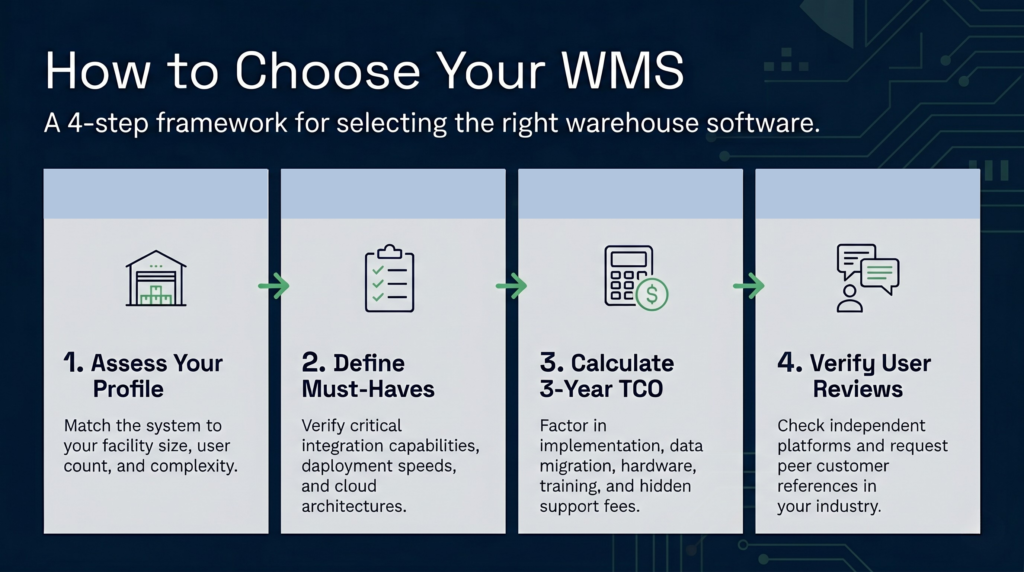
Choosing a WMS is one of the biggest operational investments you’ll make. Here’s a framework:
1. Start with your operation’s size and profile
- Single-site, 50–200 users: Clarus or Snapfulfil are excellent fits. Fast deployment, low cost, high ROI.
- Multi-site 3PL with 5–50 sites: Clarus is purpose-built for this. Snapfulfil is also strong.
- Automated distribution centre, 200+ users: Blue Yonder, Manhattan, or Infor. You need advanced automation integration and labour optimisation that smaller platforms don’t offer.
- Global enterprise, 500+ users, deep Oracle ecosystem: Oracle WMS makes sense if you have the budget and timeline. Otherwise, Manhattan or Infor.
2. Assess your must-haves
3PL multi-client billing: Clarus (native), Snapfulfil (native), Manhattan (advanced), Infor (configurable), Oracle (limited). If this is critical, Clarus or Snapfulfil are the fastest to value.
Fast deployment: Clarus (6–8 weeks), Snapfulfil (8–12 weeks). Enterprise platforms are 6–18 months.
Specific integrations: Check that your ERP, shipping carrier, and e-commerce platform are supported. Clarus has 200+; enterprise platforms have 50–100+.
Cloud-native, no infrastructure: Clarus (serverless), Manhattan (microservices), Blue Yonder (cloud), Oracle (SaaS). Infor is hybrid. If you want zero infrastructure headaches, Clarus is the choice.
3. Calculate total cost of ownership over 3 years
Don’t just compare monthly fees. Include:
- Implementation consulting and go-live support
- Data migration and cleanup
- Training and change management
- Custom development and integration work
- Annual maintenance and support upgrades
- Infrastructure and hosting (if not cloud-native)
- Staff time during implementation (your salary cost)
4. Talk to current users
Check G2 reviews and Capterra reviews for your shortlist. Pay attention to implementation time, support quality, and whether they mention your specific pain points (e.g. 3PL billing, food traceability, e-commerce volume).
Better yet, ask the vendor for three customer references in your industry and call them directly.
Oracle WMS vs Clarus: a direct comparison
If you’re specifically comparing Oracle to Clarus, here’s the honest breakdown:
| Dimension | Oracle WMS Cloud | Clarus WMS |
|---|---|---|
| Built for 3PLs? | Retrofitted. Multi-client support exists but requires heavy customisation and consultant support. Billing logic is manual-intensive. | Native. Each client’s inventory, billing, and reporting are isolated by design. Automated billing engine captures every billable event in real time. |
| Implementation time | 6–18 months typical. Complex data migration, extensive customisation, requires full project team. | 6–8 weeks. Minimal data mapping, pre-built multi-client workflows, no infrastructure setup. |
| Monthly cost (base) | £3,000–£30,000+. Plus implementation (£50,000–£300,000+), consulting, customisation, training. | £1,000–£3,000+/month depending on users and sites. Transparent pricing, no hidden modules or upgrade costs. |
| 3-year TCO | £300,000+. Implementation and consulting often exceed licensing cost. | £30,000+. All-inclusive: software, go-live support, training, integration. |
| Locator-level tracking | Yes, but complex. Syncing bin/LPN data with ERP ledgers requires expensive consultant setup. | Yes. Every product tracked to bin level, enabling real-time locator reporting and cycle counting. |
| Client portal | Requires separate customisation. Limited visibility by default. | Native, white-labelable, real-time stock levels, order tracking, billing summaries. |
| AI and automation | Machine-learning features exist in Blue Yonder, not in core WMS. | AI warehouse assistant reads operational data to execute tasks and surface insights. Smart Wave Picking optimises walking paths (claimed: 50% reduction). |
| Support SLA | Tiered. Enterprise support typically 4-hour response. Standard support 24–48 hours. | Sub-2-minute response time, 24/7, no tiering based on contract level. |
| Integrations | Deep into Oracle ecosystem (ERP, supply chain planning). Limited to ~50 third-party integrations. | 200+ integrations: 70+ shipping providers, major ERPs, e-commerce platforms, pallet networks, TMS systems. |
| Contract lock-in | Enterprise sales cycles, typically 3–5 year terms. Expensive to exit. | Month-to-month rolling. You can leave anytime. Reduces risk. |
If you’re a 3PL, the choice is clear: Clarus solves the problem Oracle was not designed for. If you’re a Fortune 500 enterprise with Oracle infrastructure, Oracle WMS makes sense.
The downsides of Oracle WMS for 3PLs — an honest assessment
We’ve mentioned this, but it’s worth spelling out for 3PL readers specifically:
- Billing complexity: Oracle’s billing logic is not designed for multi-client, per-activity billing. You end up relying on spreadsheets or external billing systems to reconcile what the WMS captured.
- Long time-to-value: A 12-18 month implementation means 18 months of consultants in your office, constant meetings, custom development, and no time for your team to optimise operations. After go-live, you still need 6–12 months to stabilise.
- Locator blindness: You can’t see where products physically sit in the warehouse at a bin level. That’s a critical gap for 3PLs managing thousands of SKUs across narrow aisles.
- Customisation burden: After LogFire’s acquisition, Oracle became less willing to build custom functionality. You’re often stuck with the standard offering or facing long consulting queues.
- Client onboarding friction: Each new client requires custom wave templates, billing rules, and portal configurations. That’s weeks of work per client, eating into your ability to grow.
For UK 3PLs and distributors, these downsides often outweigh the benefits of Oracle’s scale and deep ERP integration.
Is Oracle WMS Cloud worth it?
Oracle WMS Cloud is worth it if:
- You’re a very large enterprise (1000+ users) with existing Oracle investments
- You have a 12–18 month implementation runway and a £500,000+ budget
- You operate automated, high-speed distribution centres with complex labour tracking needs
- Your team has deep enterprise software experience and can manage long implementations
Oracle WMS Cloud is not worth it if:
- You’re a 3PL or multi-client distributor, Clarus or Snapfulfil will serve you better and faster
- You need to go live quickly (in weeks, not months)
- You want transparent, predictable pricing without consulting surprises
- You need strong multi-client billing automation built-in
- Your budget is under £300,000 for total cost of ownership
- You operate in the UK and want local, responsive support
Speak to a warehouse expert
If you’re evaluating your options and want to see how a purpose-built WMS works in practice, Clarus is worth a conversation. We work with 3PLs and distributors across the UK to implement warehouse management software that fits the way you operate — not the other way around.
Get in touch with our team to talk through your requirements.
 English (UK)
  Nederlands (Formeel)
  Nederlands (België)
  Français de Belgique
  Deutsch
  Español
  Español de México
  English
  English (Australia)
  English (Canada)
  English (New Zealand)
  Svenska
  Norsk bokmål