

If you’re evaluating Astro WMS from Consafe Logistics, you’ve probably heard it’s a solid option for warehouse operations. But before you commit, you should know what else is out there. This guide covers the real alternatives to Astro WMS — systems that compete head-to-head on 3PL capabilities, implementation speed, and total cost of ownership — so you can make an informed choice.
We’ll look at eight systems that actually serve the same market, compare them side by side, and explain where each one shines and where it struggles. By the end, you’ll know which alternative fits your operation best.
Quick comparison: Astro WMS alternatives at a glance
This table gives you the headline differences. Below it, we dive into detail on each system.
| WMS | Best for | 3PL / multi-client | Billing automation | Cloud-native | Implementation | Pricing model |
|---|---|---|---|---|---|---|
| Clarus WMS | 3PLs & distributors seeking cloud-native efficiency | Full multi-client isolation, per-client billing rules | Real-time event capture, zero manual counting | Yes, serverless | 4-8 weeks | From £1,000/month, monthly rolling |
| Astro WMS | Distributed operations, standard workflows | Basic multi-location support | End-of-period batch invoicing | Partial (hybrid model) | 12-16 weeks | Tiered modules, annual licences |
| Snapfulfil | High-volume e-commerce and retail fulfillment | Limited native multi-client; retrofitted | Manual reconciliation required | Partial cloud, some on-premise dependencies | 14-18 weeks | Per-transaction fees + licence |
| Mintsoft | SME e-commerce warehouses, low complexity | Single-client focus; weak for 3PLs | Automated client billing | Yes, SaaS | 6-10 weeks | From £375/month, pay-as-you-grow |
| Körber WMS | Enterprise automation, complex DC operations | Excellent multi-site, complex contracts | Advanced billing engine available as module | No; on-premise, significant infrastructure | 20-30+ weeks, massive project | Custom-tailored to each enterprise |
| Deposco | US-focused e-commerce, 3PLs, SaaS simplicity | Native multi-tenant, per-client ledgers | Event-driven, real-time | Yes, fully cloud | 8-12 weeks | Usage-based (per order, storage, labour) |
| Delta WMS | Food & beverage, temperature zones, compliance | Multi-site, per-location billing | Batch invoicing with FEFO/LIFO | Partial cloud, hybrid architecture | 10-14 weeks | Licence + modules, annual contracts |
| Infor WMS | ERP-integrated environments (Infor ecosystem) | Strong multi-company support | Integrated with ERP billing module | On-premise or cloud, complex licensing | 16-24+ weeks | ERP bundle pricing, six-figure deployments |
1. Clarus WMS — Cloud-native 3PL alternative
Best if: You’re a 3PL, distributor, or food & beverage operation running multiple clients from the same warehouse and you want billing automation, real-time visibility, and no enterprise software headaches.
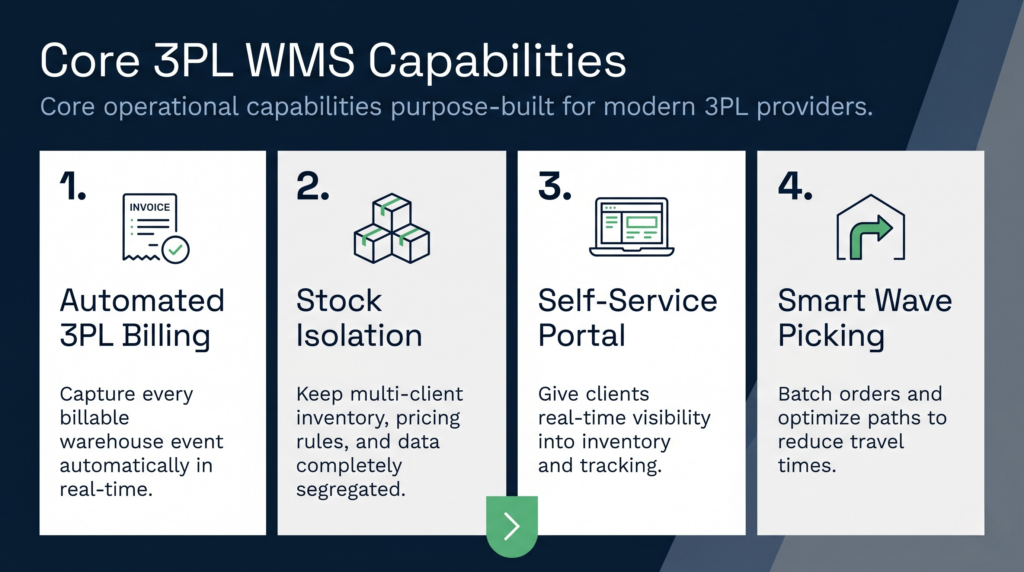
Clarus is a cloud-native, server-less WMS purpose-built for multi-client operations. Unlike legacy systems retrofit for 3PL billing, Clarus was designed from the ground up to segregate client stock, automate billable events, and give each client a self-service portal.
Strengths:
- Automated 3PL billing: Every billable event, receiving, storage, pick, pack, despatch, returns, value-added services. is captured in real-time without manual counting. St John’s Hall Storage cut invoicing from four hours to twenty minutes.
- True multi-client stock isolation: Each client’s inventory, pricing rules, and reporting are completely separate within a single warehouse environment. No client can see another’s stock or billing data.
- Client self-service portal: Clients see real-time stock levels, order status, shipment tracking, and billing summaries without raising a support ticket. White-labelable with your branding.
- Smart wave plukken: Orders are automatically batched and walking paths optimised to reduce travel time by up to 50%. Real-time scan verification targets 99.9% pick accuracy.
- Cloud-native architecture: No servers to maintain, no version upgrades to plan, no infrastructure costs. Always on the latest release, ISO 27001 certified.
- Fast implementation: Typically live in 4-8 weeks, not 12-16+ months. Monthly rolling contracts mean no long-term lock-in.
- Integrations: 70+ carrier integrations, ERP connections (Sage, Dynamics, SAP, QuickBooks), 200+ out-of-the-box integrations including Shopify, WooCommerce, Amazon, and major TMS platforms.
- Sub-2-minute support: Response time promise means issues get escalated quickly, not left in a queue.
Weaknesses:
- Smaller vendor than Körber or Infor
- Not designed for pure B2C parcel-volume operations (100,000+ picks per day per user). Best fit for mid-market 3PLs, 10+ users, £5M–£500M revenue.
- No on-premise option, if you need the software running on your own infrastructure, this isn’t for you.
Who chooses Clarus: JODA Freight scaled picking volumes 10x after switching; MSD Logistics reduced admin workload by 60%; KATEM Logistics unlocked new revenue without adding headcount.
2. Astro WMS by Consafe Logistics
Best if: You’re running a distributed operation with standard warehouse workflows and you’re comfortable with annual licence models and longer implementation timescales.
Astro WMS is Consafe’s flagship system, built to handle multiple sites, basic multi-client operations, and typical DC functions like putaway, picking, and despatch.
Strengths:
- Established product with a long market history and proven stability in mid-market deployments.
- Multi-location support, managing inventory across different sites from one system.
- Reasonable feature set for standard warehouse operations: directed put-away, wave picking, inventory control, receiving workflows.
- Vendor support available for custom integrations if needed.
- G2 and Capterra reviews show steady customer satisfaction in the 4.0-4.2 range.
Weaknesses:
- Billing leakage on 3PL operations: Multi-client billing is not native; invoicing typically happens end-of-period via batch export. Manual reconciliation required to capture events like additional handling, surcharges, and returns.
- Longer implementation: 12-16 weeks typical. System requires significant data migration and configuration; go-live often slips into year two.
- Hybrid architecture: Not fully cloud-native. Some on-premise components may still require infrastructure management or dependencies on legacy systems.
- Client visibility gaps: No built-in self-service portal means you handle all stock-level queries manually.
- Annual contracts: Multi-year licence terms typical. Switching costs are higher if you need to move on.
- Integration complexity: Integrations often require custom development. EDI and API connections can take weeks to set up.
- Pricing model: Tiered modules mean you end up paying for add-ons (advanced billing, reporting, carrier integrations) that would be standard in a modern cloud system.
Where it shines: If your operation is a single large warehouse with standard workflows, no complex multi-client billing, and you value a vendor with long implementation resources on hand, Astro WMS is a reasonable choice. However, 3PLs and food & beverage operators usually outgrow it.
3. Snapfulfil
Best if: You’re a high-volume e-commerce and retail fulfilment house running single-client, high-SKU operations with complex wave picking.
Snapfulfil excels at e-commerce fulfilment — it’s built to shift volume, optimise pick paths, and integrate with major marketplaces (Shopify, Amazon, eBay).
Strengths:
- Market-leading in e-commerce fulfilment; proven with Shopify Plus and high-volume operations.
- Excellent wave picking and path optimisation; some claim 40-50% travel time reduction.
- Strong Shopify and marketplace integrations built in.
- Partial cloud architecture reduces infrastructure burden vs. full on-premise competitors.
- Established vendor with strong UK presence.
Weaknesses:
- Weak 3PL support: Multi-client functionality is retrofitted on top of a single-client architecture. Billing for separate clients is a nightmare; manual workarounds are common.
- Expensive to extend: Custom integrations, carrier connections, and EDI links often require professional services; costs can balloon.
- Long implementation: 14-18 weeks typical, with go-live often delayed by data migration and third-party integrations.
- Per-transaction fees: Beyond the licence cost, you pay per pick, pack, or parcel shipped. Volume growth can drive per-unit costs up.
- Not food-safe: No native support for FEFO, temperature zones, or recall workflows; unsuitable for food & beverage.
Where it shines: Pure e-commerce single-client operations, high order volume, where wave picking and labour optimisation are the priority. Not a 3PL choice.
4. Mintsoft
Best if: You’re a small e-commerce warehouse (under 10,000 picks per month) and you want to start small with a pay-as-you-grow pricing model.
Mintsoft is a lightweight, affordable cloud WMS aimed at SME e-commerce sellers and small warehouse operations.
Strengths:
- Extremely affordable entry point: from £375/month, with pay-as-you-grow pricing.
- Quick implementation: 6-10 weeks typical.
- Modern SaaS interface; no infrastructure needed.
- Good Shopify and WooCommerce integration for e-commerce sellers.
- Suitable for bootstrapped e-commerce businesses scaling from 10 to 100 orders per day.
Weaknesses:
- Limited features: No wave picking, no sophisticated routing, no advanced inventory control, no client portal.
- Supplier lock-in: At very low price points, vendor margins are thin; support quality and roadmap innovation often lag.
- Scaling ceiling: Once you exceed a few hundred daily orders, you’ll feel the system’s limitations.
- No advanced integrations: EDI, complex ERP links, and bespoke carrier integrations are not available.
Where it shines: Solo e-commerce operators, small fulfilment houses, and test-and-learn projects where you want minimal upfront commitment.
5. Körber WMS (formerly Dematic)
Best if: You’re planning a massive automation project — a multi-story automated storage and retrieval system (ASRS), conveyor systems, or a large new DC build — and you have a nine-figure budget.
Körber is the enterprise-grade system. It’s built for complex, large-scale, automated warehouses where the software orchestrates robotics, conveyors, and labour simultaneously.
Strengths:
- Market leader in large automated DC operations. Proven with global retailers, automotive, and pharma.
- Exceptional multi-site and multi-company support; handles complex contractual arrangements.
- Integrates tightly with conveyor, ASRS, and robotic systems for end-to-end automation orchestration.
- Highly configurable; custom workflows can be built to match almost any DC design.
- World-class implementation and support for mega-projects.
Weaknesses:
- On-premise only: You build and maintain the infrastructure. No cloud option means IT headaches, upgrade planning, and security patches are your responsibility.
- Astronomical implementation time and cost: 20-30+ weeks for a go-live; total project cost could exceed £500,000–£2,000,000+ depending on automation scope.
- Vendor lock-in: Once you’ve invested this much, you’re locked in; switching is not a realistic option.
- Overkill for mid-market: If you don’t need conveyor or robotic orchestration, 90% of Körber’s features are wasted money.
- Steep learning curve: Complex to operate; your team will need extensive training.
- Not suitable for 3PL. Billing engines are available as modules but are expensive to implement and often still require manual tuning.
Where it shines: Global enterprises with automated warehouses, pharma and healthcare with extreme traceability needs, and automotive OEMs with complex multi-line operations.
6. Deposco
Best if: You’re a 3PL, distributor, or e-commerce operation in the US or Canada seeking a modern, fully cloud-native system with usage-based pricing and no upfront licence fees.
Deposco is a cloud-native WMS born in the US. It’s native-multi-tenant by design, meaning each client’s data is genuinely isolated.
Strengths:
- Fully cloud-native: Built for scale; no servers, no on-premise dependencies.
- Native 3PL billing: Each client’s invoicing rules and per-client billing rates are built in. Real-time event capture.
- Usage-based pricing: Pay for orders picked, storage days, and labour. No surprise licence fees.
- Fast implementation: 8-12 weeks typical.
- Strong in North America: Wide adoption in US 3PLs and Canadian distributors.
- Client self-service portal with live stock visibility and billing summaries.
Weaknesses:
- Limited UK footprint: Most UK reference customers are in e-commerce or smaller 3PLs. Less proven in large UK 3PL operations.
- Pricing unpredictability: Usage-based pricing means your bill can spike in high-volume months. Difficult to forecast costs year-on-year.
- Integration complexity: While Deposco connects to major carriers and ERPs, some bespoke integrations require professional services.
- Support: US-based support means UK issues may experience time-zone delays during peak hours.
- Scaling costs: As volume grows, usage costs can exceed fixed-fee alternatives for high-throughput operations.
Where it shines: 3PLs and distributors in North America; any operation where you want to avoid long-term licensing. In the UK, it’s less proven than Clarus in comparable scenarios.
7. Delta WMS
Best if: You’re a food & beverage warehouse, cold-storage operator, or pharmaceutical distributor needing FEFO/LIFO controls, temperature zone management, and compliance-focused features.
Delta is a specialist WMS for temperature-controlled and compliance-heavy operations. It’s built to handle expiry dates, lot numbers, and regulatory audit trails.
Strengths:
- Industry-leading in food & beverage. Deep expertise in FEFO, LIFO, best-before date management, and recall workflows.
- Multi-site support with per-location billing and per-site stock ledgers.
- Compliance-focused: generates audit trails required by BRC, HACCP, and FSA.
- Temperature zone management built in: ambient, chilled, frozen all managed from one system.
- Batch and lot control for complete traceability.
- Implementation in 10-14 weeks typical; faster than enterprise systems.
Weaknesses:
- Not truly cloud-native: Hybrid architecture means some on-premise components or dependencies. Updates and upgrades still require planning.
- Limited multi-client billing: Not built for 3PLs with complex per-client pricing. Adding client billing often requires bespoke configuration.
- Narrower integrations: Strong with ERP (Sage, Dynamics) but limited with marketplaces and modern APIs.
- Smaller vendor: Less brand recognition and fewer reference cases than Körber or Clarus.
- Annual contracts: Typical licensing model means longer commitment than monthly rolling.
Where it shines: Food & beverage distribution, cold storage, pharmaceutical warehouses, and any operation where compliance and expiry management are regulatory requirements. Not a choice for standard 3PL or e-commerce.
8. Infor WMS
Best if: You already run Infor ERP (Infor 10 Suites, Infor CloudSuite) and you want your WMS tightly integrated with your financials, procurement, and supply chain planning.
Infor WMS is an ERP-embedded system; it’s not a standalone WMS. If you use Infor ERP, this becomes a natural extension.
Strengths:
- True ERP integration: no API, no EDI, no manual reconciliation. Stock movements update your GL in real-time.
- Strong multi-company support; designed for enterprises with complex inter-company billing.
- Excellent for supply chain planning; pulls demand signals directly from orders, sales forecasts, and procurement plans.
- World-class vendor with global support resources.
- Highly configurable; enterprise customers can build very custom workflows.
Weaknesses:
- ERP lock-in: You’re locked into the entire Infor ecosystem; walking away from WMS means walking away from your ERP.
- Massive implementation: 16-24+ weeks typical. Not a fast deployment. Often bundled with ERP upgrades, making total project timelines 12+ months.
- Licensing cost: WMS is typically priced as an ERP module, not standalone. Your bill is bundled with your overall Infor spend. Hard to isolate WMS-only costs.
- On-premise or complex cloud: Cloud options exist but often come with licensing complexity and high minimums.
- Not true 3PL billing: Multi-client invoicing is possible but often requires custom coding and ongoing maintenance.
- Support: If issues involve both WMS and ERP, troubleshooting can get complicated across vendor boundaries.
Where it shines: Enterprises already on Infor ERP (manufacturing, large distributors, global retail) where you want warehouse visibility fed back into your financials and supply chain plans automatically.
How to choose the right Astro WMS alternative
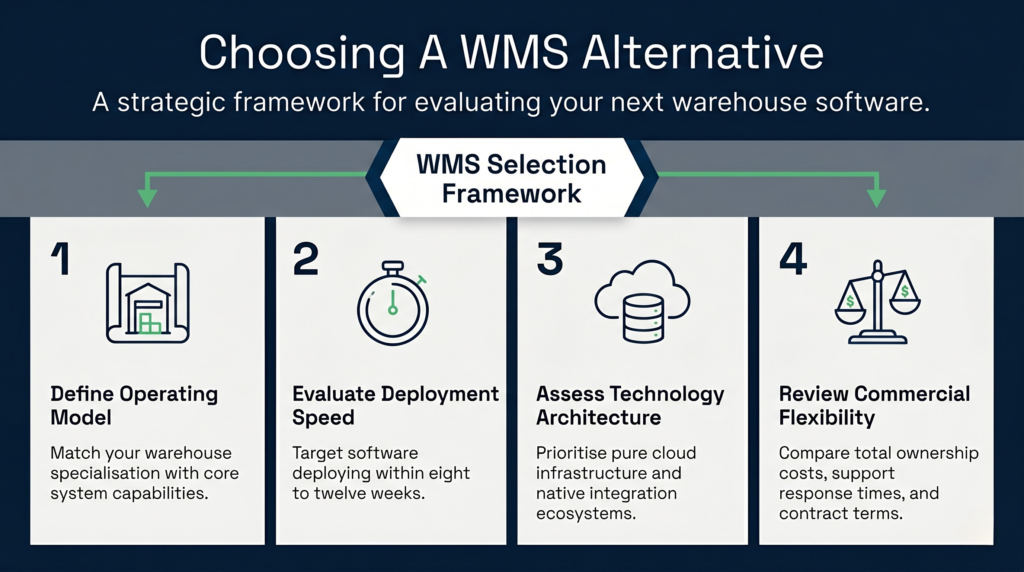
Start with your operating model:
- Single-client, high-volume e-commerce: Snapfulfil or Mintsoft (depending on scale).
- 3PL with multi-client billing needs: Clarus or Deposco.
- Food & beverage, temperature-controlled: Delta WMS.
- Massive automated DC with conveyors/robotics: Körber.
- Already on Infor ERP: Infor WMS (if you value tight ERP integration over standalone WMS capabilities).
Then evaluate on these dimensions:
- Implementatiesnelheid: If you need live in under 12 weeks, eliminate Körber and Infor. Clarus, Mintsoft, and Deposco all go live in 8-12 weeks.
- Total cost of ownership (TCO): Calculate licence + implementation + year-one support. Don’t assume the lowest monthly fee is the cheapest.
- 3PL billing automation: If this is critical, only Clarus and Deposco offer real-time event capture without manual reconciliation. Astro, Snapfulfil, and others force manual invoicing.
- Cloud vs. on-premise: If you want zero infrastructure headaches, eliminate Körber, Infor (unless cloud tier), and partial-cloud solutions like Astro and Delta. Go pure cloud: Clarus, Mintsoft, Deposco.
- Integration ecosystem: If you rely on Shopify, Amazon, EDI, and multiple carriers, check the product’s integration library. Clarus and Snapfulfil excel here; Körber requires custom development.
- Support model: Körber and Infor offer on-site support; Clarus offers sub-2-minute response times. Mintsoft offers self-service or ticketed support. Which fits your team’s needs?
- Contract flexibility: If you want to trial the system or exit within 12 months, monthly rolling (Clarus, Mintsoft, Deposco) beats annual contracts (Astro, Delta, Körber, Infor).
Speak to a warehouse expert
If you’re evaluating your options and want to see how a purpose-built WMS works in practice, Clarus is worth a conversation. We work with 3PLs and distributors across the UK to implement warehouse management software that fits the way you operate — not the other way around. We’ve helped 3PLs eliminate billing leakage, food operators achieve sub-5-minute recalls, and distributors cut admin time by 60%. See how we compare on the dimensions that matter most to you.
Get in touch with our team to talk through your requirements.
 English (UK)
  Nederlands (Formeel)
  Nederlands (België)
  Français de Belgique
  Deutsch
  Español
  Español de México
  English
  English (Australia)
  English (Canada)
  English (New Zealand)
  Svenska
  Norsk bokmål