

Managing orders across multiple channels, websites, marketplaces, phone calls, wholesale distributors, is genuinely complex. Every order that arrives needs to be captured, checked against inventory, allocated to the right warehouse, and shipped on time. Get one step wrong and you’re looking at delayed shipments, stock-outs, and frustrated customers.
This is where order management system software comes in. An order management system (OMS) is a dedicated platform designed to handle the complete order lifecycle: from capture through fulfilment to post-sale. Unlike generic accounting software, an OMS is built specifically to streamline order workflows, sync inventory across channels, and automate decisioning.
In this guide, we’ll walk you through what order management system software does, how it differs from other systems you might be using, and what to look for when evaluating solutions for your business.
What is Order Management Software?
Order management software is a specialised platform that automates the flow of customer orders from point of entry to final delivery. It captures orders from all your sales channels, centralises them in one place, and orchestrates the warehouse, logistics, and customer communication processes needed to fulfil them.
A good OMS software solution does several key things:
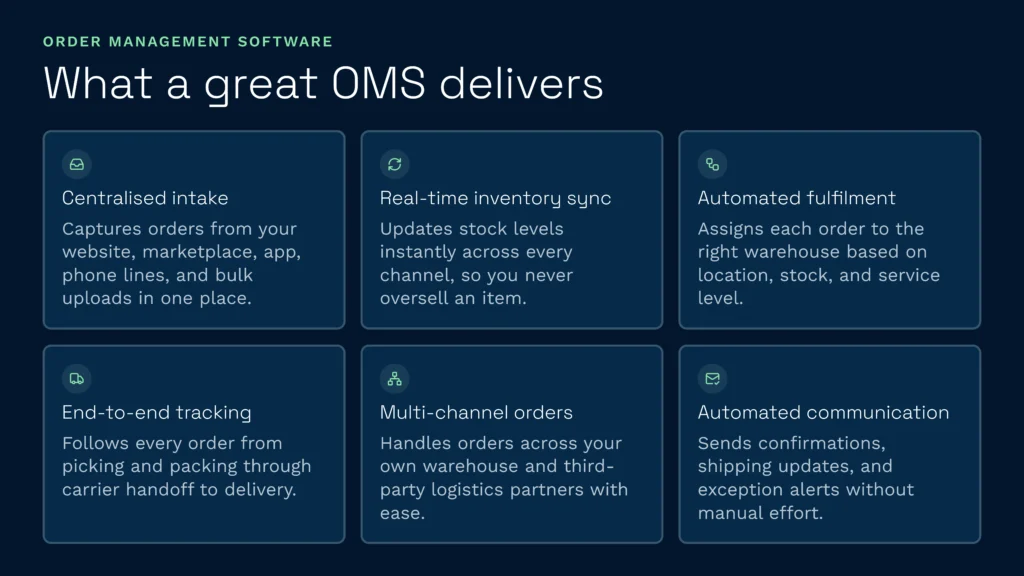
- Centralises order intake: Captures orders from your website, marketplace listings, mobile app, phone lines, and even bulk uploads from wholesale partners, all in one system.
- Syncs inventory in real-time: Prevents overselling by updating stock levels instantly across all channels whenever a unit moves.
- Automates fulfilment logic: Decides which warehouse ships which order based on location, inventory, and service level, without manual intervention.
- Tracks shipments end-to-end: Monitors orders from picking and packing through carrier handoff and delivery, so you always know where everything is.
- Manages multi-channel orders: Handles the complexity of orders that span different fulfilment paths—some from your own warehouse, some from logística de terceros (3PL) partners.
- Automates customer communication: Sends order confirmations, shipping notifications, and exception alerts without manual effort.
Think of order management system software as the nerve centre of your fulfilment operation. Everything flows through it, and it orchestrates the actions of everyone else, warehouse staff, carriers, 3PL partners, and your customers.
Order Management Software vs Other Systems: What’s the Difference?
You might already be using accounting software, a warehouse management system, or an ERP platform. So where does an OMS fit in, and is it actually different than an ERP?
Is an OMS Different Than an ERP?
Yes, fundamentally. An ERP (Enterprise Resource Planning system) is a broad, company-wide platform that handles accounting, finance, HR, procurement, and inventory management all in one database. It’s designed to manage data across the entire business.
An order management system is purpose-built for one thing: managing orders efficiently. It’s narrower in scope but deeper in functionality for order-specific workflows. An ERP might give you a basic order module, but it’s not optimised for the complexity of modern multi-channel fulfilment.
Think of it this way: an ERP is a Swiss Army knife for business operations. An OMS is a specialist knife designed just for cutting through order chaos.
Many successful businesses use both, an ERP for financial reporting and general ledger, and an OMS (or a tightly integrated warehouse management platform) for order execution and inventory orchestration. A warehouse management system focused on order operations often handles what a lightweight OMS would do, especially for 3PLs and logistics businesses.
OMS vs WMS: Are They the Same?
No. A Warehouse Management System (WMS) is a warehouse-specific tool that optimises internal operations: picking sequences, packing, labour, and storage density. It answers “How do I move goods most efficiently inside my warehouse?”
An OMS is order-specific and asks “How do I fulfil this order across potentially multiple warehouses or fulfilment partners?” An OMS typically talks to a WMS (or multiple WMS instances) to orchestrate work. Some platforms combine both functions, especially 3PL-focused solutions like Clarus.
If you’re outsourcing fulfilment to a 3PL partner, their system probably combines WMS and OMS capabilities. Learn more about 3PL management systems to see how modern platforms handle both warehouse execution and order orchestration.
The Key Features of Modern Order Management System Software
Not all order management system software is built the same way. Here’s what to expect from a modern, purpose-built solution:
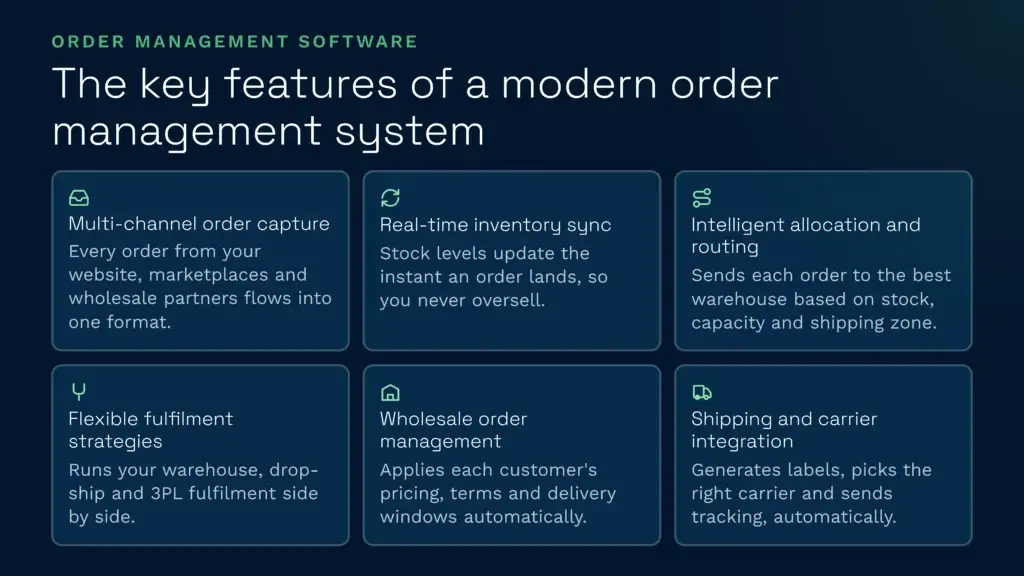
Multi-Channel Order Capture
Your customers buy from you in different ways. Some use your website, some buy through Amazon o eBay, some are wholesale partners who send bulk orders via email or EDI files. A proper OMS captures orders from all these sources and normalises them into a single format for processing.
This matters because without it, you’re manually moving orders between systems, which is slow and error-prone. The best order management software solutions handle direct API connections to major marketplaces, plus custom integrations for wholesale partners and EDI feeds.
Real-Time Inventory Synchronisation
You can’t sell what you don’t have. The moment a customer orders online, your stock level in that channel needs to drop. If a warehouse records a new receipt, your website needs to know about it.
Real-time synchronisation prevents the nightmare scenario where you sell the same item twice. It also means you’re not holding unnecessary safety stock to cover synchronisation delays. For businesses with ecommerce order management software integrated with their warehouse operations, this is table stakes.
Intelligent Allocation and Routing
When an order arrives, the system needs to decide: which warehouse fulfils this? A rule-based engine looks at inventory levels, warehouse capacity, shipping zones, and service-level commitments, then automatically assigns the order to the best location. No manual work needed.
Good order management software learns over time too. It tracks which allocation decisions led to fast shipments and happy customers, and optimises future decisions accordingly.
Flexible Fulfilment Strategies
Your business probably doesn’t fulfil every order the same way. Maybe some orders ship from your own warehouse, some drop-ship from suppliers, and some are fulfilled by a 3PL partner. An OMS needs to handle all these paths in parallel without getting confused.
The system should also let you split orders, a customer orders five items, but only two are in stock at your main warehouse. The OMS automatically ships the available items immediately and backlogs the rest for later, all without user intervention.
Wholesale Distribution and Order Management
If you sell to wholesale distributors or operate as a distributor yourself, you need an OMS that understands bulk orders, standing orders, and trading terms. Understanding warehouse costs becomes especially important when you’re handling both retail and wholesale channels with different margin profiles.
A good order management system software lets you define customer-specific pricing, terms, delivery windows, and reporting requirements, then automatically applies them without manual setup each time an order arrives.
Shipping and Logistics Integration
Your OMS should connect directly to your carriers, Correos (Servicio de Paquetería y Mensajería), DHL, UPS, Royal Mail, whoever you use. When an order is ready to ship, the system auto-generates the label, routes to the right carrier based on package size and destination, and sends the tracking number to the customer automatically.
This is where you save hours every day. You’re not logging into three different carrier portals. The system handles it.
What is the Best Order Management System?
There’s no single “best” order management system software, it depends on your business model, channel complexity, and growth plans. But here’s how to evaluate:
For pure ecommerce businesses, look for platforms like SoftwareAdvice’s recommended order management software solutions. These specialise in marketplace integration and high-volume, straightforward fulfilment.
For wholesale distribution and complex multi-channel operations, you need something more robust. Sage Order Management Software is a mature platform with enterprise features, though it can be complex to implement. Microsoft Dynamics 365 Order Management offers cloud-native architecture and tight integration with Microsoft’s ecosystem.
For e-commerce platforms using Salesforce, Salesforce Order Management System is a natural fit, with built-in integration to Salesforce Commerce Cloud and Einstein AI for predictive routing.
For 3PLs and logistics providers, you need a system purpose-built for warehouse operations with integrated OMS capabilities. That’s where something like Orderwise Order Management System shines—it’s built for high-volume, multi-warehouse, multi-customer scenarios.
When you’re evaluating, look for:
- Channel coverage: Does it integrate with the specific marketplaces and partners you use?
- Scalability: Can it handle your expected order volume without slowdowns?
- Ease of configuration: How long does implementation take? Can you customise workflows without coding?
- Warehouse integration: Does it talk to your WMS, or do you need separate systems?
- Reporting: Can you track the metrics that matter to your business?
- Soporte: What’s the vendor’s track record for support and updates?
Order Management System Software for Your Business Model
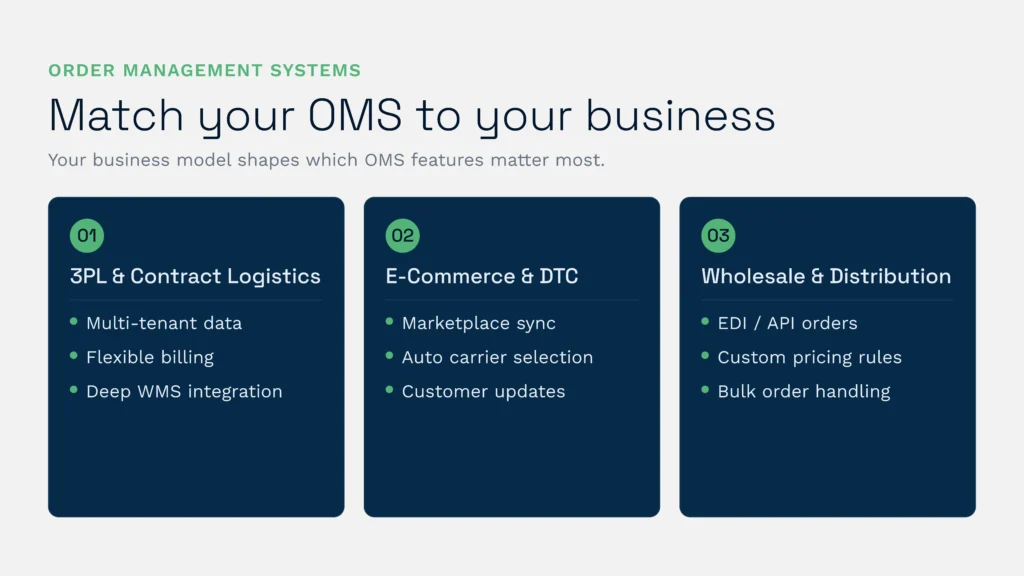
Your business model shapes what OMS features matter most.
3PL and Contract Logistics
If you’re running a 3PL operation or contract warehouse, your OMS is almost your entire business. You need to manage orders for multiple customers, each with their own expectations and workflows. Learn how to choose a warehouse management system that also handles order orchestration—ideally one built specifically for 3PL operations rather than adapted from a generic platform.
Key features: multi-tenancy (isolating each customer’s data), flexible billing models, and deep warehouse integration.
E-Commerce Direct-to-Consumer
You’re selling direct to consumers, possibly across multiple sales channels. Your OMS needs to be fast, lightweight, and tightly integrated with your shopping carts and marketplace integrations. Speed matters because you’re handling high volumes of smaller orders.
Key features: real-time marketplace sync, automated carrier selection, and customer communication.
Wholesale and Distribution
You’re selling in bulk to resellers, distributors, or retailers. Orders are fewer but larger, and customers expect features like EDI integration, custom pricing by customer, and detailed reporting. Understanding goods-in processes is critical because inbound stock management directly impacts your ability to fulfil wholesale orders on time.
Key features: EDI/API order acceptance, customer-specific rules, bulk order handling, and wholesale pricing tiers.
Making the Business Case for Order Management System Software
You’re considering investing in an OMS. Here’s what you typically see:
- Faster order processing: Manual steps take minutes or hours. Automated routing and picking takes seconds.
- Fewer fulfilment errors: When the system assigns orders automatically based on inventory and location, you pick the right item the first time.
- Lower inventory costs: Real-time sync means you need less safety stock. You’re not holding buffers to cover synchronisation lags.
- Improved customer satisfaction: Customers get their orders faster and receive proactive tracking updates.
- Operational visibility: You can see exactly where every order is in the fulfilment process, spot bottlenecks, and fix them.
- Reduced manual overhead: Your team spends less time moving data between systems and more time on exceptions and customer issues.
The ROI timeline depends on your scale. A small business handling 50 orders a day might see ROI in 12 months. A mid-market business handling 500+ orders a day across multiple channels could see ROI in 6 months. At that scale, the labour savings alone pay for the software.