

If you’re comparing warehouse management systems, you’ve likely encountered both Clarus WMS and Linnworks. But they’re fundamentally different tools solving different problems. Linnworks is an inventory and order management platform built for ecommerce sellers who trade across multiple channels. Clarus WMS is a purpose-built warehouse management system designed for 3PL operations, distributors, and businesses that need true bin-level control, multi-client billing, and advanced fulfilment workflows.
This comparison cuts through the noise. We’ll walk through the architecture, capabilities, and real-world fit of each, so you can decide which actually works for your operation.
Quick Verdict
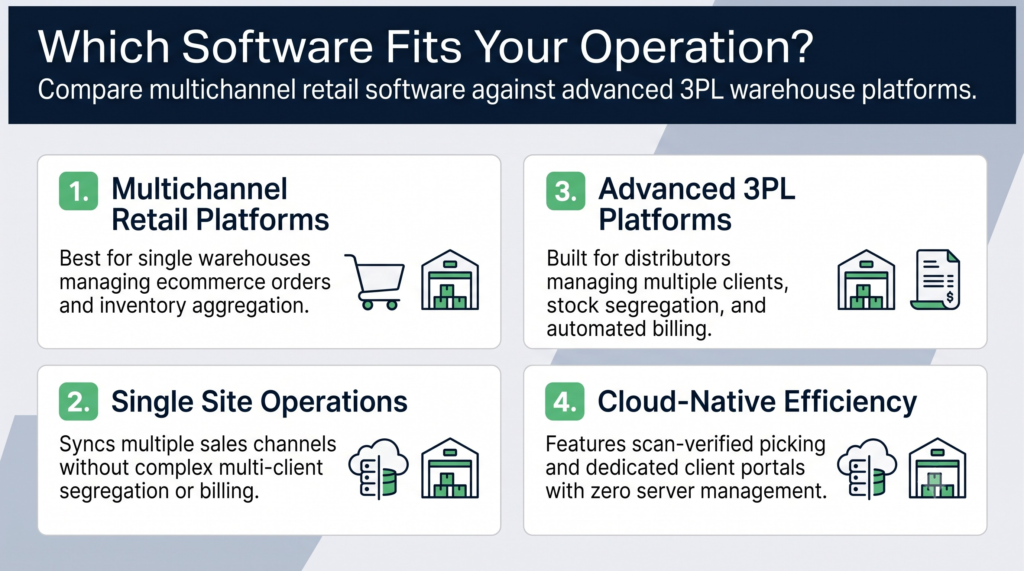
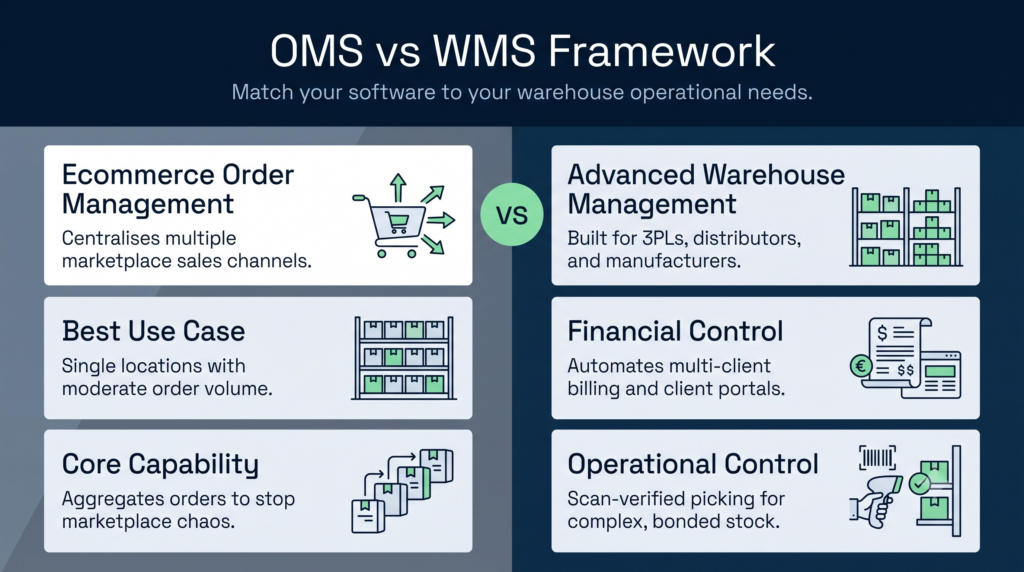
Choose Linnworks if: You’re an ecommerce seller managing inventory across multiple sales channels (Amazon, Shopify, eBay, etc.) and need order aggregation, batch processing, and multichannel visibility. You operate a single warehouse or site and don’t need multi-client segregation or detailed 3PL billing.
Choose Clarus WMS if: You’re a 3PL, distributor, or wholesale operation managing inventory for multiple clients. You need real-time billing automation, per-client stock segregation, scan-verified picking, client portals, and the ability to differentiate clients in your billing model. You’re moving away from spreadsheets or legacy on-premise systems and want a cloud-native platform with zero server management.
Head-to-Head Comparison Table
| Feature | Clarus WMS | Linnworks |
|---|---|---|
| Primary Use Case | 3PL, multi-client, distributors, manufacturing | Ecommerce sellers, multi-channel inventory |
| Multi-Client / Multi-Tenant | Native multi-client billing per client; complete stock segregation | Client Identifiers for basic separation; not designed for per-client billing |
| Bin / Location Management | Yes, full directed putaway, FIFO/FEFO/LIFO, intelligent replenishment | Basic warehouse locations; not designed for fine-grained physical control |
| Scan Verification | Yes, real-time barcode matching at pick/pack; 99.9% accuracy claimed | Quality control and scanning available; primarily order-focused |
| Automated 3PL Billing | Yes, real-time capture of receiving, storage, pick, pack, despatch, returns, value-added services; invoice generation automated | Possible with add-ons; requires manual configuration and reconciliation |
| Client Portal | Yes, white-labelable, real-time stock visibility, order tracking, billing summaries | Business Hub portal for basic visibility; limited customisation |
| Integraciones | 200+ (ERPs, ecommerce, TMS, carriers); API-first; EDI, SFTP, XML | Focus on ecommerce channels (Shopify, Amazon, eBay, WooCommerce); 70+ integrations claimed |
| Despliegue | Cloud-native, serverless; no servers; always latest release | Cloud-hosted; may require onboarding/data migration overhead |
| Pricing Model | From £1,000/month; monthly rolling; no long-term contracts | Order-volume tiered; custom quotes; add-ons for WMS, forecasting, analytics |
| Setup Time | Typically 4–8 weeks (cloud-native, configurable) | Weeks to months (depends on data migration complexity, add-on activation) |
What is Linnworks?
Linnworks is an inventory and order management system (OMS) for ecommerce and multi-channel retailers. It aggregates orders from dosens of sales channels—Amazon, Shopify, eBay, Etsy, TikTok Shop, BigCommerce, Wix, and others—into a single interface. The platform then routes those orders to a warehouse system (which could be Linnworks’ own SkuVault warehouse module, or an integrated third-party WMS) for fulfilment.
Think of Linnworks as a commerce operations hub. It sits in the middle of your sales ecosystem, pulling real-time inventory, syncing stock across all channels so you don’t oversell, and managing the order workflow from purchase through despatch.
Linnworks Core Strengths
- Multichannel order aggregation: One place to see and manage orders from every channel; reduces manual re-keying and order duplication.
- Real-time inventory sync: Stock updates flow to all channels instantly; mitigates oversell and channel conflicts.
- Ecommerce focus: Deep integrations with Shopify, Amazon, eBay, and 70+ other sellers’ platforms; purpose-built for that workflow.
- Batch order processing: Automation rules let you sort, prioritise, and route orders without manual intervention.
- Forecasting (add-on): Analyses sales trends to predict future inventory needs.
Linnworks Limitations for True Warehouse Operations
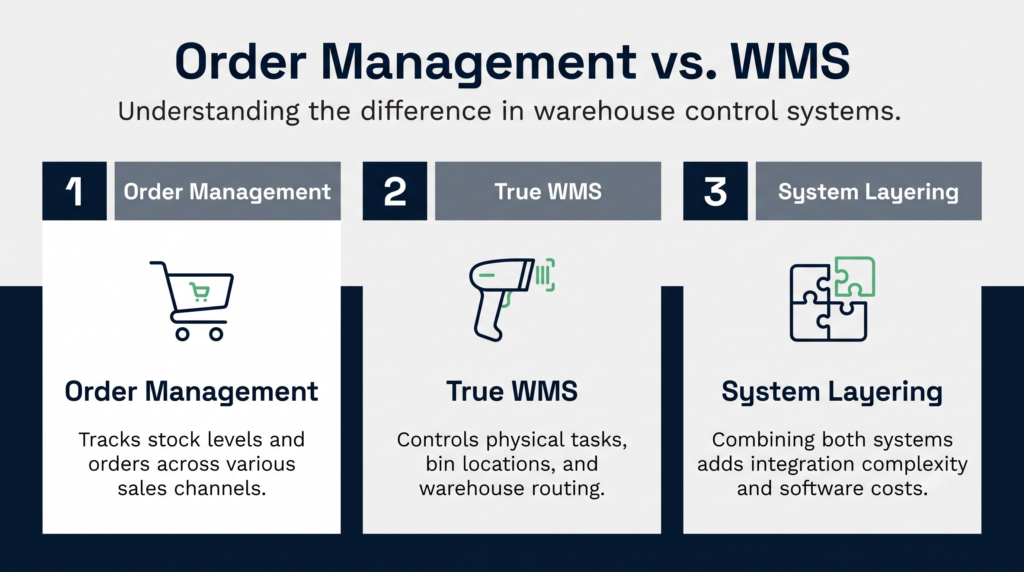
Linnworks is not a warehouse management system in the traditional sense. It doesn’t control the physical warehouse. Here’s where it falls short for 3PL and multi-client operations:
- No bin-level control: Warehouse locations exist but are basic; Linnworks doesn’t direct putaway, manage FIFO/FEFO rotation at the bin level, or optimise picking paths.
- Not designed for multi-client billing: Client Identifiers allow basic product separation, but per-client invoicing for 3PL work—capturing storage, handling, value-added services—requires manual processes. No automated billing engine.
- Limited stock segregation: You can tag items to clients, but the system doesn’t enforce operational boundaries (e.g., separate billing zones, client-specific SLAs, or per-client quality control).
- Not for distributors or manufacturers: If you’re managing raw materials, work-in-progress, or B2B orders with complex fulfilment rules, Linnworks’ ecommerce assumptions create friction.
- Onboarding overhead: Implementation typically takes weeks to months, with manual data migration and add-on activation delays.
What is Clarus WMS?
Clarus WMS is a cloud-native warehouse management system built from the ground up for 3PLs, distributors, food & beverage wholesalers, and manufacturers. It handles the physical warehouse: receiving, putaway, replenishment, picking, packing, despatch, and returns. Every movement is tracked in real time, scannable, and billable.
Unlike legacy on-premise WMS systems (such as Indigo or Snapfulfil), Clarus runs entirely on cloud servers with no installation overhead. It’s built for multi-client operations, each client’s inventory, workflows, and billing live in isolated containers within the same system, so you manage multiple businesses from one dashboard.
Clarus WMS Core Strengths
- True multi-client billing: Every billable event—receiving, storage per day, picks, packs, despatches, returns—is captured in real time and automatically assembled into per-client invoices. St John’s Hall Storage, a UK 3PL, cut their invoicing time from 4 hours to 20 minutes by eliminating manual reconciliation.
- Bin-level inventory control: Directed putaway logic, FIFO/FEFO/LIFO rotation, serial number tracking, expiry date management, batch control. You know exactly where every item is and when it expires.
- Real-time scan verification: Pickers scan barcodes at pick and pack stages. If the barcode doesn’t match the order, the system stops the process. This approach delivers 99.9% accuracy—far above the 97–98% typical of manual pick lists.
- Client portal: Each client logs in to see real-time stock levels, order status, shipment tracking, and billing summaries. White-labelable with your branding. Clients stop emailing you for stock questions.
- Cloud-native architecture: No servers to manage, no version upgrades to schedule. You’re always on the latest release. Clarus operates serverless, so every user sits on one code base with new features releasing monthly.
- 200+ integrations: ERPs (Sage 200, Microsoft Dynamics, SAP), ecommerce (Shopify, WooCommerce, Amazon, Etsy), carriers (70+ including DHL, UPS, Royal Mail, Evri), and TMS platforms. API-first, so custom integrations are straightforward.
Clarus Real-World Proof Points
JODA Freight, a UK 3PL, brought stock accuracy from the low 90s to 99.% after implementing Clarus and switching to scan-verified picking. KATEM Logística scaled their monthly picking volumes 10 times over without adding proportional headcount, thanks to wave-picking automation and smart routing. These aren’t edge cases—they’re the outcomes customers consistently report.
When Clarus May Not Be the Right Fit
- Pure ecommerce single-warehouse: If you run a tiny webshop (sub-£100k revenue) with one location and no multi-client complexity, Linnworks is likely cheaper.
- Enterprise automation at scale: If you operate 100,000+ lines per day with fully automated conveyor systems and sortation, you may need a specialist deep-automation WMS like Körber or Blue Yonder.
- Legacy system lock-in: If your ERP is deeply integrated with an incumbent WMS (e.g., Infor married to your Microsoft Dynamics instance), ripping it out carries political and technical risk.
Is Linnworks a Warehouse Management System?
No, not in the strict sense. Linnworks is an order and inventory management platform. It manages orders and stock levels across channels, but it doesn’t manage the physical warehouse. It doesn’t tell pickers where to walk, rotate stock by expiry, or enforce bin locations. If you need true warehouse management (the physical control, scanning, and location logic), you must pair Linnworks with a separate WMS, either Linnworks’ own SkuVault warehouse module or a third-party system like Mintsoft, Snapfulfil, or Clarus WMS.
This layering adds complexity and cost. You’re managing two systems, two vendor relationships, and two sets of integrations.
Linnworks Pricing Model
Linnworks pricing is tiered by order volume, not revenue. There’s no percentage of sales fee. Plans start with a base monthly fee and scale with your order throughput. Custom quotes are required; pricing isn’t published publicly.
Add-on modules cost extra:
- Listing management (for multichannel listings)
- Warehouse Management System (WMS module, if you want warehouse control)
- Forecasting
- Advanced analytics
Onboarding is a one-off fee based on the complexity of your setup and your internal resource availability. Implementation typically takes weeks to months, depending on data migration volume and add-on activation.
According to G2 reviews, customers report Linnworks pricing can rise significantly as order volume scales, and some feel the per-module add-ons add up quickly.
Clarus WMS Pricing Model
Clarus WMS starts from £1,000/month on a monthly rolling contract—no long-term lock-in. The price scales with the number of warehouse users and warehouse locations (per-site charging model). All features are included: scan verification, multi-client billing, client portals, 200+ Integraciones, and the AI warehouse assistant.
There are no add-on fees for warehouse capabilities. You don’t pay extra to unlock billing automation or multi-client features; they’re built in from day one.
Most implementations go live in 10–20 days because Clarus is cloud-native and configuration-driven, not code-heavy. There’s no server setup, no version management, and minimal data migration friction.
Feature-by-Feature Deep Dive
Architecture and Cloud Model
Clarus WMS: Serverless, cloud-native. Every user on the same code base. Monthly product releases. You manage zero infrastructure. Always on the latest version.
Linnworks: Cloud-hosted. Data migrates to Linnworks’ servers during onboarding. You control your environment through a web interface, but underlying infrastructure is Linnworks’ responsibility. Updates are managed by Linnworks but may require you to test integrations before rollout.
Winner for 3PLs: Clarus. Serverless means faster release cycles, so new features benefit you immediately. No infrastructure management = less operational risk.
3PL and Multi-Client Capability
Clarus WMS: Purpose-built for multi-client. Each client gets:
- Isolated inventory (real stock segregation, no cross-contamination)
- Per-client billing rules (different pricing models per client, activity-based or storage-based)
- White-labelable client portal with their branding
- Audit trail per client
Linnworks: Client Identifiers allow you to tag products to sellers/clients. However, there’s no operational isolation—no per-client SLAs, no per-client billing zones, no client-specific quality control workflows. Multi-client invoicing requires manual reconciliation outside the platform.
Winner for 3PLs: Clarus by a wide margin. If multi-client billing is your core business, Linnworks will cost you hours of admin work every month.
Bin / Location and Inventory Accuracy
Clarus WMS: Full bin-level management:
- Directed putaway (system tells receiver which bin to use)
- FIFO, FEFO, LIFO rotation per client or per SKU
- Serial number and expiry date tracking
- Batch control for recall readiness
- Intelligent replenishment (auto-generate pick-from-bulk tasks to replenish forward picking zones)
Linnworks: Warehouse locations can be tracked, but there’s no directed putaway or rotation logic. You’d manually assign bins or rely on an integrated third-party WMS to do this work. Clarus’ scan verification + FEFO logic is particularly valuable for food & beverage—expiry-driven recalls can be resolved in minutes, not hours.
Winner for accuracy and compliance: Clarus. If you handle temperature-controlled stock, expiry-controlled goods, or need sub-5-minute recall times, this is critical.
Order Picking and Wave Picking
Clarus WMS: Smart wave picking batches orders automatically and optimises walking paths. Claimed: 50% travel time reduction vs. traditional pick-list methods. Pickers use handheld devices (Zebra, Honeywell) with fully customisable scanning workflows. Scan-verification at pick stage means errors are caught before packing.
Linnworks: Supports lote order processing and digital pick lists. If paired with a warehouse module (like SkuVault), you get better picking workflows. Standalone, Linnworks aggregates orders but doesn’t optimise the pick path or enforce scanning.
Winner for fulfilment efficiency: Clarus. The combination of wave picking, scanning verification, and path optimisation translates to faster throughput and fewer errors.
Client Visibility and Portals
Clarus WMS: Dedicated client portal. Clients log in to see:
- Real-time stock levels by SKU
- Order status and tracking
- Confirmaciones de envío
- Billing summaries and invoices
White-labelable—clients see your branding, not Clarus’. Reduces support tickets because clients answer their own questions about stock and order status.
Linnworks: Business Hub provides basic visibility into orders and inventory. Less rich than Clarus’ portal; customisation is limited. Primarily shows order status, not detailed stock or billing.
Winner for client relationships: Clarus. Transparency builds trust and reduces your operational overhead.
Integrations and API Approach
Clarus WMS: 200+ out-of-the-box integrations. API-first architecture. Connects to ERPs (Sage 200, Microsoft Dynamics, SAP, QuickBooks), ecommerce platforms (Shopify, WooCommerce, Amazon, Etsy, eBay), 70+ carriers (DHL, UPS, FedEx, Royal Mail, Parcelforce, Evri, TNT), TMS platforms (Qargo, Maxoptra), and pallet networks. Supports EDI, XML, CSV over SFTP. MCP server available so AI tools can query live warehouse data.
Linnworks: Strong ecommerce integrations (Shopify, Amazon, eBay, Etsy, WooCommerce, BigCommerce, Wix, OnBuy, Magento, Squarespace, TikTok Shop, others). ~70 integrations claimed. Weaker on ERP and TMS connections—you may need custom development or middleware.
Winner for breadth: Clarus. If you need to integrate with a Sage 200 ERP or a bespoke TMS, Clarus has you covered. Linnworks excels at ecommerce but lags elsewhere.
Setup and Implementation Speed
Clarus WMS: Typically 4-8 weeks. Cloud-native means:
- No server provisioning
- Configuration-driven (not code-heavy)
- Data import is straightforward
- Training happens in parallel
Linnworks: Weeks to months. Onboarding depends on:
- Data migration complexity (channel feeds, SKU counts, historical orders)
- Add-on activation (if you choose WMS, forecasting, analytics, you enable each separately)
- Integration testing (especially if you use a third-party WMS alongside Linnworks)
Winner for speed: Clarus. Fast deployment means you’re capturing multi-client billing and efficiency gains sooner.
Pricing Transparency and Flexibility
Clarus WMS: Transparent pricing: £1,000/month starting point. Monthly rolling contract—no lock-in. You can pause or cancel with 30 days’ notice. All features included from day one.
Linnworks: Custom quotes required. Pricing opaque until you speak to sales. Add-ons multiply the total cost. Long-term contracts are common.
Winner for predictability: Clarus. If you want to budget and forecast costs, Clarus’ model is clearer.
Which Should You Choose? A Decision Framework
Choose Linnworks If:
- You’re an ecommerce seller (B2C, consumer goods, retail) with inventory on multiple channels.
- Your core pain is order chaos across Amazon, Shopify, eBay, and other marketplaces.
- You operate a single warehouse location or a small number of sites.
- You don’t need automated 3PL billing or per-client invoicing.
- Your order volume is moderate (under 10,000 orders/month) and you want order aggregation, not warehouse control.
Choose Clarus WMS If:
- You’re a 3PL, distributor, wholesaler, or manufacturer managing multiple clients or product lines.
- You need real-time, automated multi-client billing (capturing storage, handling, value-added services).
- You handle temperature-controlled, expiry-critical, hazardous, or bonded stock.
- You want scan-verified picking and bin-level inventory control.
- You need a client portal so your customers can see their stock in real time.
- You’re moving away from spreadsheets, paper, or a legacy on-premise WMS and want a modern cloud-native system.
- You want predictable, transparent pricing and no long-term contracts.
Integrating Clarus and Linnworks
While Linnworks and Clarus solve fundamentally different problems, they are highly complementary when used together. For businesses that need Linnworks’ powerful multi-channel order aggregation alongside Clarus’s advanced physical warehouse controls, the two platforms integrate seamlessly to create a complete, end-to-end operational stack.
When connected, Linnworks acts as the digital nervous system for your sales channels, while Clarus acts as the engine driving your physical warehouse execution. Here is how the integrated workflow operates:
- Seamless Order Flow: As Linnworks aggregates orders from across your sales channels (Amazon, Shopify, eBay, etc.), they flow automatically into Clarus WMS, complete with all necessary customer, delivery, and line-item details.
- Precision Execution: Your warehouse team allocates stock by quantity, and performs scan-verified picking, packing, and labeling entirely within Clarus’s optimised workflows.
- Real-Time Writebacks: Once an order is physically packed and despatched in Clarus, the system instantly pushes shipment confirmations and carrier tracking data back into Linnworks.
- Universal Stock Sync: As stock is moved, picked, or replenished within the warehouse, Clarus continuously updates inventory availability in Linnworks, which then broadcasts accurate stock levels across all your connected ecommerce channels to prevent overselling.
This integration allows complex 3PLs and growing distributors to leverage Linnworks’ vast ecosystem of marketplace connectors without sacrificing the bin-level control, multi-client segregation, and automated billing engines required on the warehouse floor.
Speak to a warehouse expert
If you’re evaluating your options and want to see how a purpose-built WMS works in practice, Clarus is worth a conversation. We work with 3PLs and distributors across the UK to implement warehouse management software that fits the way you operate—not the other way around.
Get in touch with our team to talk through your requirements.