

If you’re a UK 3PL evaluating Boltrics, you’re likely weighing a proven but enterprise-heavy Dynamics 365 platform against the growing pool of purpose-built, cloud-native warehouse management systems. Boltrics is built on Microsoft Dynamics 365 Business Central and offers solid WMS, TMS, and freight-forwarding capabilities—but it comes with the implementation complexity, cost, and pace of an ERP platform. For many UK operators, the faster, simpler, and more specialised alternatives are worth a serious look.
This guide walks through the five best Boltrics alternatives for 3PLs in 2026, with an honest comparison table, a deep-dive into why teams switch, and practical guidance on how to choose.
Quick comparison: Boltrics alternatives at a glance
| Solution | Cloud-native | Multi-client / 3PL billing | Typical go-live | Meilleur pour |
|---|---|---|---|---|
| Clarus WMS | Yes (serverless) | Native — automated billing engine | 2-8 weeks | UK 3PLs, multi-client operations, fast deployment |
| Boltrics | No — Dynamics 365 BC | Native (3PL Dynamics) | 6-12 weeks (claimed: 3 months) | Logistics groups wanting integrated ERP + WMS + TMS |
| Deposco | Yes | Native multi-tenant | 6-12 weeks | High-growth 3PLs needing scale and speed |
| Mintsoft | Yes | Native — per-client tenancy | 4-8 weeks | Multi-site 3PLs, UK and Europe |
| Snapfulfil | Yes | Native (Multi-owner) | 6-10 weeks | High-volume fulfilment, e-commerce heavy |
| Delta WMS | Yes | Native multi-client | 4-6 weeks | Speed-focused, UK food and beverage, wholesale |
Why teams leave Boltrics for cloud-native alternatives
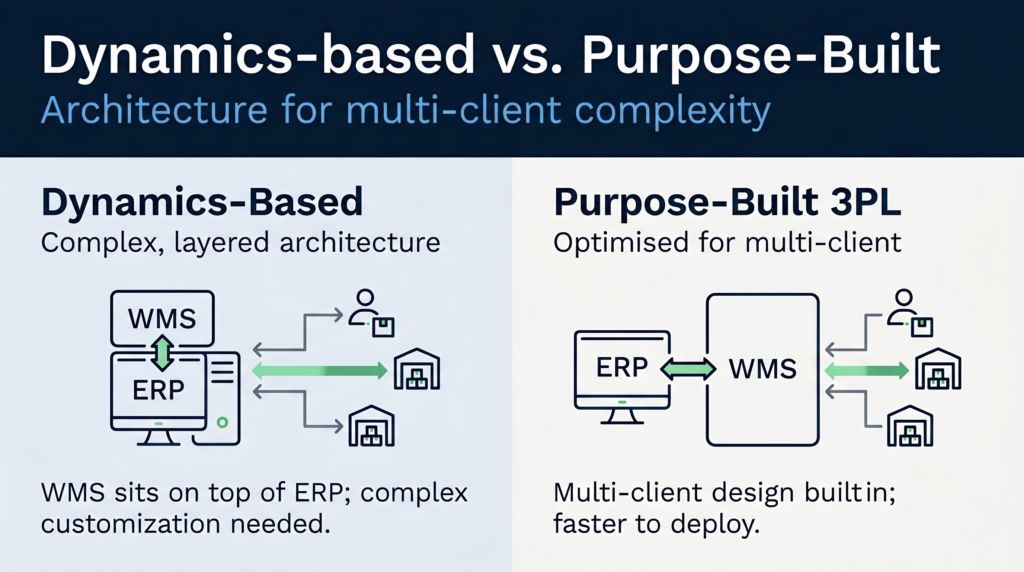
Boltrics is built on the Dynamics 365 Business Central platform, which brings both strengths and fundamental constraints:
Implementation speed and cost
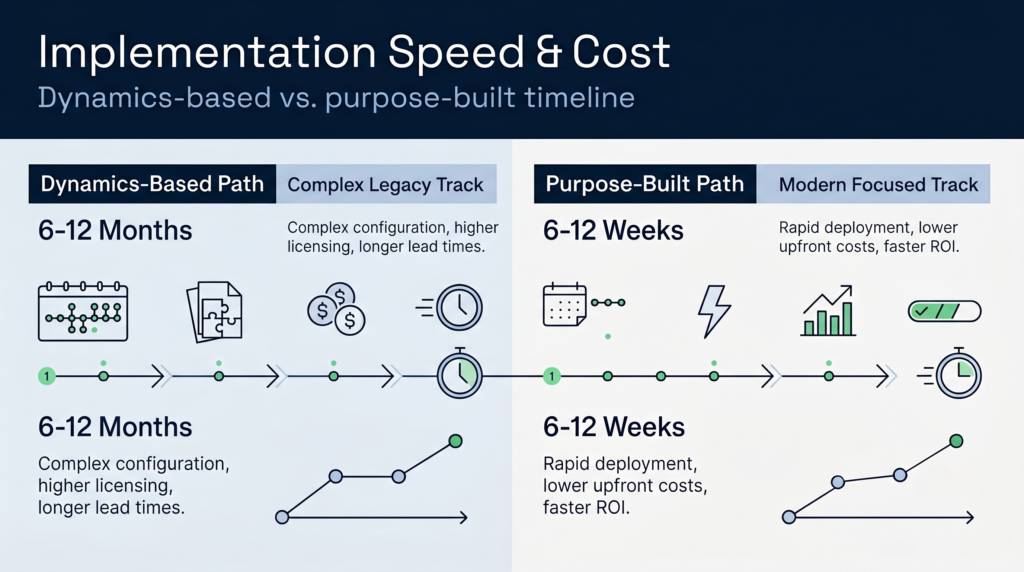
Boltrics offers a Quick Start package (£19,999 upfront) designed for a 30-business-day (6-week) go-live. However, integrating a system tethered to a broader ERP architecture still requires meticulous master-data alignment and change management across your tech stack.
Multi-client billing and separation
While Boltrics handles multi-client logistics natively through its 3PL Dynamics offering, some warehouse teams find the broader Dynamics 365 interface heavy. Purpose-built 3PL systems like Clarus focus entirely on the warehouse floor user experience. Purpose-built 3PL systems like Clarus have this baked in: each client’s inventory, orders, and events are natively segregated within a single warehouse. Stock belongs to Client A or Client B, never gets mixed, and every billable event—receiving, storage, pick, pack, despatch—is captured in real time without manual reconciliation.
Pace of innovation
While Boltrics operates as a continuously updated SaaS solution, you are still ultimately operating within the broader Microsoft ecosystem’s roadmap. Specialist cloud-native WMS vendors deploy updates fortnightly or monthly, moving faster to address your operational pain points.
Client visibility and self-service
Boltrics includes a standard web-based Customer Portal, but some 3PLs prefer the highly customisable, purpose-built portals offered by purely cloud-native WMS vendors. Clarus, Deposco, and Mintsoft all include white-label client portals as standard, reducing your support workload and making you look more professional to your customers.
Clarus WMS: The fastest, most purpose-built alternative
Clarus is a server-less, cloud-native WMS designed from the ground up for UK 3PLs. It’s the solution built by a team frustrated with the pace and complexity of legacy systems; every feature has been carved out of real warehouse frustration.
What makes Clarus different
- True multi-client isolation: Each client’s stock, billing, and reporting lives in a separate logical bucket within one shared system. No data leakage; no manual segregation workarounds. St John’s Hall Storage, a 3PL, cut their monthly invoicing from four hours to twenty minutes by using Clarus’s automated billing engine, which captures every event—receiving, storage, picking, packing, despatch, returns—without a single manual count.
- Automated 3PL billing: Real-time event capture means you invoice the second a client’s goods are picked or stored. No end-of-month reconciliation, no disputes about what was actually done. Clarus WMS pricing is transparent and monthly rolling—from £1,000/month—with no enterprise lock-in.
- Fast deployment: Clarus goes live in 2–8 weeks because there’s no ERP architecture to untangle. You’re not migrating 10 years of master data; you’re onboarding your operations into a system built for the work you do.
- Client self-service portal: Clients log in to see real-time stock, order status, shipment tracking, and billing summaries. White-labelable with your branding. One less phone call about “where is my stock?”
- Wave picking and scan verification: Smart Wave Picking groups orders and optimises warehouse walks; scan verification stops a packer from putting the wrong item in the wrong box. Result: 99.9% pick accuracy. JODA Freight, another 3PL, raised stock accuracy from the low 90s to 99.8% after switching from spreadsheets and manual processes.
- Native integrations: 200+ out-of-the-box connectors to Clarus WMS integrations including Shopify, Amazon, 70+ carriers (DHL, UPS, Royal Mail, Evri), and ERPs like Sage 200 and Dynamics. No bespoke integration fees.
- No servers, always current: Clarus is serverless—no version upgrades, no patching, no infrastructure to maintain. You get the latest release automatically.
Where Clarus is a poor fit
Clarus is not right for pure B2C parcel fulfilment at massive single-client volume (millions of picks monthly to one customer), nor for legacy businesses needing deep ERP integration with full accounting modules. If you need warehouse management plus integrated accounting, GL, and AP/AR in one system, Dynamics or an enterprise ERP might actually be the right call. But for the vast majority of UK 3PLs—multi-client, mid-scale, needing speed and billing automation—Clarus is the obvious choice.
Proof point: MSD / Mitchell Storage & Distribution
MSD switched from a legacy on-premise WMS to Clarus and cut admin workload by 60%. They used the freed-up time to build new service lines—cold storage, kitting, returns processing—without adding headcount. Admin went from two FTEs to one.
Other strong alternatives to Boltrics
Deposco
Deposco is a cloud-native, multi-tenant WMS built for 3PLs from scratch. It competes hard on integration speed—150+ pre-built connectors to carriers, shopping carts, and ERPs cut implementation from months to weeks. Strong for high-growth 3PLs that need fast scaling and rapid carrier integrations. Pricing is custom and SaaS-based; typical go-live is 6–12 weeks.
Weaknesses vs Clarus: Deposco is strong on integration breadth but doesn’t offer the same level of tailored, specialist support that UK-based Clarus does. Also doesn’t include a white-label client portal in the base product.
Mintsoft
Mintsoft is a mature UK WMS vendor with strong multi-site and multi-client capabilities. Each client can be a separate logical tenant, with independent billing and workflows. Good for large European 3PLs managing dozens of clients. Typical go-live is 4–8 weeks.
Weaknesses vs Clarus: Mintsoft’s licensing structure (per-client overheads) and implementation pace match Clarus, but Clarus’s billing automation is more elegant—every event is a billable hook, whereas Mintsoft relies more on activity logs and manual billing logic. Also, Clarus pricing is simpler for small-to-mid 3PLs.
Snapfulfil
Snapfulfil is a specialist fulfilment WMS, especially strong in e-commerce and high-volume parcel picking. Excellent for single-site, single-client operations. It handles multi-client operations natively via its ‘Multi-owner’ architecture. Deployments typically take 6–10 weeks.
Weaknesses vs Clarus: Built for e-commerce fulfilment, not logistics. Limited 3PL billing; struggles with complex multi-activity pricing (storage + picking + packing + returns); no native client portal. Better for order-driven parcel shops than complex logistics operators.
Delta WMS
Delta is a UK favourite for speed. Built on modern cloud tech, deployments often close in 4–6 weeks. Native multi-client billing and strong food & beverage credentials (BRC compliance, FEFO/FIFO, lot/batch control).
Weaknesses vs Clarus: Delta is lean and fast but has a smaller feature set around analytics and reporting. Client portal is functional but less polished. Support is good but not as embedded in the UK 3PL community as Clarus. Good for speed, less good for long-term, nuanced customisation.
Comparison: Boltrics vs the alternatives
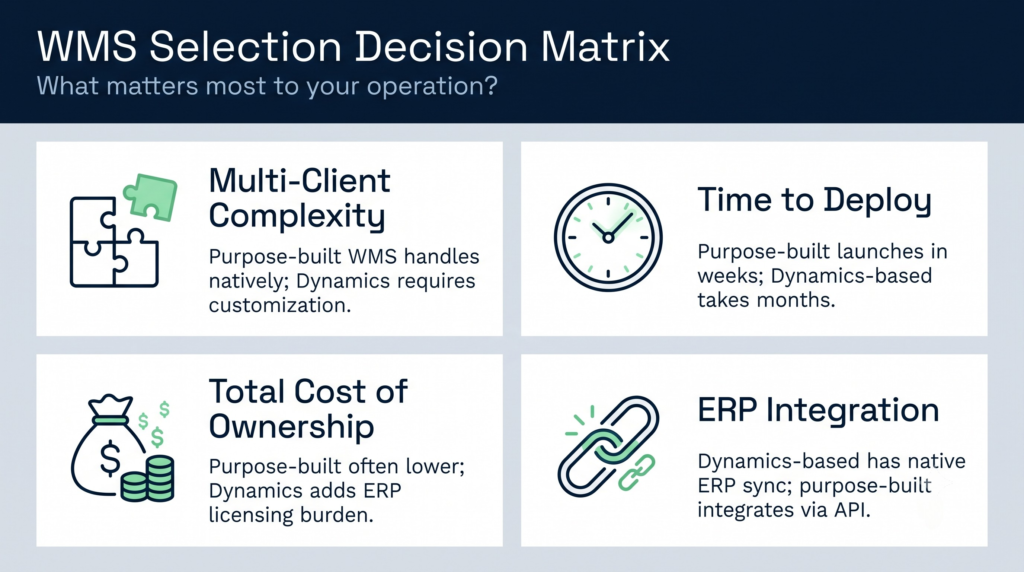
Architecture and deployment
Boltrics: Runs on Dynamics 365 Business Central (server/cloud hybrid, depending on your setup). Deployment is methodical but slow—ERP implementations always are, even when vendors claim “three months.” Plan for 8–12 weeks in reality, plus post-go-live tuning.
Clarus, Deposco, Mintsoft, Snapfulfil, Delta: All cloud-native, purpose-built. Deployments in 2–10 weeks because there’s no ERP architecture to retrofit. Faster time-to-value.
Multi-client billing
Boltrics: Possible but requires careful module setup and custom coding. Every client essentially shares the same GL structure; billing is manual or semi-automated.
Clarus: Every billable event—receiving, storage, picking, packing, despatch, returns, value-added services—triggers a charge in real time. Client A’s activity never crosses into Client B’s ledger. Invoices are pre-calculated; no reconciliation disputes.
Deposco, Mintsoft, Delta: All offer native multi-client isolation and automated billing. Deposco and Mintsoft are equivalent to Clarus in richness; Delta is simpler but effective.
Client visibility and portal
Boltrics: Limited portal or requires custom development. Not a standard feature.
Clarus, Deposco, Mintsoft: White-label, self-service client portals included. Real-time stock, shipments, invoices.
Snapfulfil, Delta: Portal available but less polished than Clarus or Mintsoft.
Integration breadth
Boltrics: Strong if your tech stack is already Dynamics (erp, CRM). Limited pre-built connectors to e-commerce platforms and smaller carriers. Heavy reliance on bespoke EDI or custom code.
Clarus: 200+ out-of-the-box integrations. Shopify, WooCommerce, Amazon, eBay, 70+ carriers, Sage, QuickBooks, Dynamics. If the vendor isn’t listed, API is open.
Deposco: 150+ connectors. Exceptionally strong on carrier and marketplace integrations.
Mintsoft, Snapfulfil, Delta: 50–100 pre-built connectors each. Good for common platforms, may need custom code for niche systems.
How to choose: Boltrics vs the alternatives
Ask yourself these questions:
1. Do you need integrated ERP or just WMS?
If you absolutely need accounts, GL, AP/AR, and multi-currency handling in one system, and you’re already on Dynamics, Boltrics keeps you in the Microsoft ecosystem. If you just need WMS + integrations to your existing accounting software, every alternative is simpler and faster.
2. How fast do you need to go live?
If you have 8+ weeks and are comfortable with ERP-style implementation, Boltrics is manageable. If you need live in 4–6 weeks, Clarus, Delta, or Mintsoft are the answer.
3. How many clients do you service, and how complex is their billing?
Single client? Snapfulfil. 5–20 clients with mixed SLAs and billing rules? Clarus, Mintsoft, or Delta. 50+ clients? Deposco or Mintsoft at scale.
4. How important is client self-service visibility?
If your clients expect a portal to check stock and shipments (modern, professional expectation), Clarus, Deposco, or Mintsoft are standard. Boltrics you’d need to build or pay extra for.
5. What’s your budget?
If you’re constrained to under £2,000/month, Clarus (from £1,000/month) or Delta are your best bets. Boltrics’s all-in cost is usually 2–4x higher because of Dynamics licencing.
6. Do you want to be tied to an ERP platform, or do you want optionality?
Boltrics locks you into Dynamics 365. Switching later means rewriting integrations and migrating data. Clarus, Deposco, Mintsoft are more portable; if you later decide to change, your WMS moves independently of your accounting software. Lower strategic risk.
Migration path from Boltrics to a cloud-native alternative
If you’re running Boltrics now and evaluating a move, here’s what to expect:
Data preparation
You’ll export client master data, product catalogues, SKU attributes, and any active stock movements from Boltrics. Most alternatives have data-import templates. Expect 2–4 weeks to clean and map the data.
Integration re-mapping
Your EDI, carrier feeds, and e-commerce connections will need to be re-pointed to the new system’s API/integration endpoints. If you’re using pre-built connectors in the new platform, this is a day or two. If you’ve built bespoke Dynamics integrations, allow 1–2 weeks to rewrite them or find a comparable pre-built option.
Testing and parallel run
Most teams run both systems in parallel for 1–2 weeks—new orders flow into the new WMS, but old orders still work in Boltrics until you’re confident. Plan 2–3 weeks for this phase.
Cutover
On the chosen date, you switch clients over, run a data sync, and go live. Typical cutover is a Friday to Monday, with support standing by. Most alternative vendors offer cutover support as standard.
Total migration timeline: 4–6 weeks from decision to live-in-production. Far faster than an ERP-to-ERP swap, and you gain speed and cost savings immediately.
Speak to a warehouse expert
If you’re evaluating your options and want to see how a purpose-built WMS works in practice, Clarus is worth a conversation. We work with 3PLs and distributors across the UK to implement warehouse management software that fits the way you operate—not the other way around.
Get in touch with our team to talk through your requirements.
 English (UK)
  Nederlands (Formeel)
  Nederlands (België)
  Français de Belgique
  Deutsch
  Español
  Español de México
  English
  English (Australia)
  English (Canada)
  English (New Zealand)
  Svenska
  Norsk bokmål