

Picking errors cost warehouses more than you might think. A single mispicked order triggers a cascade of expense: customer dissatisfaction, return shipping, rehandling, administrative investigation, and lost revenue. Industry benchmarks show that manual picking, without technology support, carries error rates of 1–3% per order. At 500 orders per day, that’s 5 to 15 wrong shipments daily. Each one costs £50–75 to fix in rework and reshipping alone. Yet most warehouses accept this as normal.
The good news: picking errors are preventable. The problem isn’t usually the pickers themselves. It’s the system. When pickers work from printed pick lists, interpret handwriting, take shortcuts around a disorganised layout, and lack real-time verification, errors cluster predictably around peak periods and product similarity. Purpose-built warehouse systems eliminate these failure modes at the source.
This guide walks through the root causes of picking errors, the methods that actually reduce them, and how technology, particularly het scannen van streepjescodes and warehouse management systems, can drive accuracy from the industry average toward 99%+ with real-time verification at every touchpoint.
What Causes Picking Errors in Warehouses?
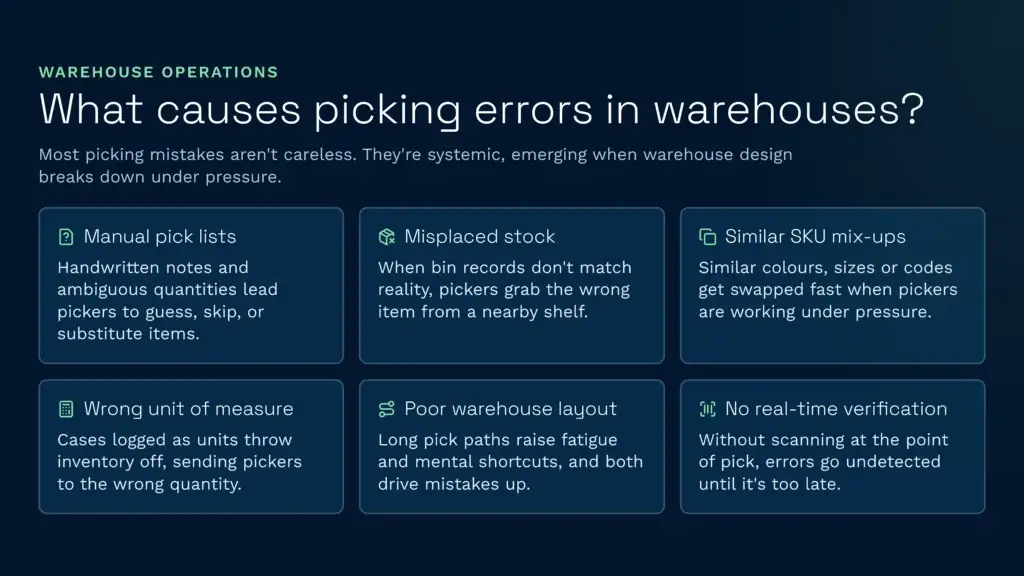
Before you can reduce picking errors, you need to understand why they happen. Most picking mistakes aren’t careless: they’re systemic. They emerge from the gap between how a warehouse is designed to work and how it actually operates under pressure.
Manual Pick Lists and Misinterpretation
Printed pick lists are the starting point of error for many warehouses. Handwritten notes are ambiguous. “Qty 5” can be read as “Qty 8”. Product codes get abbreviated or spelled phonetically. When the picker has discretion to interpret the list, they create shortcuts, skipping items they think are duplicates, combining similar SKUs, moving items between zones without updating the system. By the time they reach the packing station, what was picked may not match what was intended.
Mixed Bins and Misplaced Stock
If stock location records don’t match physical reality, items shelved in the wrong bin, products moved without scanning, or partial cases left on the floor, pickers pick from the wrong location. The system says “SKU ABC in location A5” but the picker finds nothing there, grabs what looks similar from the adjacent bin, and moves on. The order ships with the wrong item.
Similar SKU Confusion
Warehouses carrying hundreds of SKUs inevitably stock similar items, different colours of the same garment, varying pack sizes, or products with sequential product codes. Under time pressure, especially in peak periods, pickers grab the wrong variant. Without scan verification, the error travels all the way to the customer.
Receiving Errors in the Wrong Unit of Measure
Stock arrives in cases, but the WMS records it in units. If goods-in staff post receipt in the wrong unit of measure, recording 10 cases as 10 units, the system inventory is off by a factor of 12 (if cases contain 12 units each). Pickers work from inaccurate system counts and pick the wrong quantity or from locations that appear empty when they’re actually full.
Poor Warehouse Layout and Long Pick Paths
Warehouses with inefficient layouts force pickers to traverse the entire building for a single order. The longer the walk, the higher the cognitive load. Pickers take mental shortcuts, misread signage, and fatigue degrades attention. A well-organised layout with logical flow, enabled by magazijnindeling tools, reduces travel by 40–60% and dramatically improves accuracy by lowering the number of opportunities for error.
Lack of Real-Time Verification
The biggest failure mode is the absence of verification at the point of pick. Without barcode scanning, pickers have no real-time confirmation that they’ve selected the right item. They rely on visual matching, label reading, mental checklist, all prone to error, especially under fatigue or time pressure. By the time the error is discovered at the packing station or in the returns department, it’s already cost you.
What Is a Good Picking Accuracy Rate?
Industry benchmarks put manual picking accuracy at around 97–98%, though this varies by product mix, team training, and warehouse layout. A 99% accuracy rate sounds impressive until you do the maths. If your warehouse ships 500 orders per day, 1% error rate means 5 wrong orders every day, or 1,250 errors per year. At £50–75 per error to rework and reshipping, that’s £62,500–£93,750 in annual cost from picking alone.
Warehouses using technology, particularly real-time barcode verification, consistently achieve 99.5%–99.9% accuracy. Some reach 99.95%. At this level, with 500 daily orders, you’d see fewer than one error per day. The difference between 99% and 99.9% is the difference between 1,250 errors per year and 125 errors per year. That’s an 90% reduction in rework cost.
For 3PLs and high-volume distributors, this distinction is material: picking accuracy directly affects client satisfaction, chargeback rates, and retention. For food and beverage operations, inaccuracy creates traceability and compliance risk. For e-commerce fulfilment, every wrong shipment is a return, a refund, and a potential negative review.
How Barcode Scanning Reduces Picking Errors
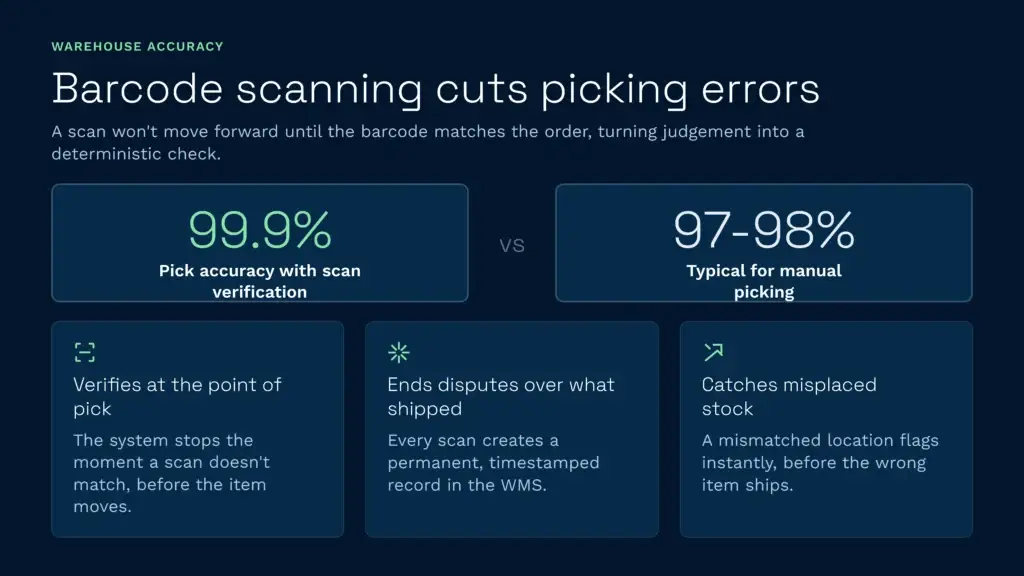
Barcode scanning is the single most effective tool for reducing picking errors because it moves verification from the picker’s judgment to a deterministic check. The system won’t move forward until the barcode matches the order.
Real-Time Verification at the Point of Pick
When a picker scans a product before placing it into the order container, the WMS confirms instantly: is this the right item for this order? If the scan doesn’t match, the system stops. The picker must investigate. This single gate eliminates the most common failure mode, picking the item the picker thinks is correct when it actually isn’t.
Scan verification targets 99.9% pick accuracy compared to 97–98% typical for manual order picking processes. The technology itself is nearly infallible; the gains come from forcing a moment of verification before the item moves.
Eliminating Data Entry Errors
Barcode scanning replaces manual interpretation. There’s no ambiguity about what was picked. The scan creates a permanent, timestamped record in the WMS. No one can dispute what was selected or when. This eliminates the classic error pattern: “the picker swears they picked item X, but the system shows item Y was shipped.”
Catching Mixed Bin Problems
If stock is in the wrong physical location, scanning forces the discovery immediately. The picker scans the location the system directed them to, finds a different product, scans it, and the system alerts them: “This item doesn’t match the expected pick.” They then correct the system record or locate the correct item before picking proceeds. The error is caught before it ships.
Speed Without Sacrifice
Contrary to intuition, adding scan verification doesn’t slow picking. Modern barcode scanners are fast. Once the system is familiar, pickers work at the same speed or faster because they’re no longer second-guessing themselves or dealing with downstream rework. Handheld devices also guide pickers to the next location, eliminating navigation time.
Picking Methods That Reduce Errors
Beyond barcode scanning, the method by which you organise and execute picks has a measurable impact on accuracy.
Wave Picking for Streamlined Flow
Wave picking batches orders into waves released at specific times, then progresses them through picking, packing, and despatch as a coordinated group. Because all picks in a wave move together, the packing station receives them all at once, making it easier to verify before shipment. Errors that slip through picking are caught by the packing team before the order ships. Wave picking also allows the warehouse to optimise pick sequences within each wave, reducing travel time by 30–45% and giving pickers a smaller, more focused set of items to juggle mentally.
Batch Picking for Multi-Order Efficiency
Batch picking combines multiple orders into a single picking trip, then sorts the picked items at a consolidation station. A picker might retrieve items for five orders in one walk, then sort them into five separate containers. This reduces the picker’s cognitive load compared to single-order picking (where they’re always tracking one order at a time) and cuts travel distance by 40–60%. Fewer touches and a shorter attention span per order both reduce errors. Many modern warehouse management software platforms automate batch consolidation to further improve throughput and accuracy.
Zone Picking for Specialisation
Zone picking divides the warehouse into sections; each picker becomes expert in their zone and picks items for all orders that include items from that zone. The picker knows their zone intimately, reducing the chance of selecting from the wrong location. However, zone picking requires coordination between zones and careful handoff at consolidation points. It works best in large warehouses with distinct product families.
Directed Picking and Route Optimisation
A purpose-built WMS doesn’t just tell the picker what to pick; it tells them the optimal sequence and location. The system knows the warehouse layout, current stock positions, and which items are quickest to reach together. It directs the picker through an optimised route that minimises backtracking. This reduces fatigue, keeps the picker’s attention focused, and dramatically cuts the number of picking errors caused by navigation confusion or missed locations.
Slotting and Warehouse Layout
Picking errors cluster where the layout forces high cognitive demand. Warehouses with disorganised layouts, where fast-movers sit at the back, slow-movers at the front, and no logical grouping, force pickers to traverse the full building for almost every order. Slotting is the practice of locating items based on picking frequency and complementary demand. Effective slotting often requires integration with WMS benefits like real-time analytics and inventory tracking to identify which items move fastest and where they should be positioned for minimum picking time.
Fast-Movers in Easy Reach
Items picked in every third order should be in the prime picking zone, waist height, closest to the despatch area. Slow-movers go overhead or in distant sections. This simple rule cuts picking distance by 30–40% for typical product mixes, and lower travel distances mean fewer opportunities for error.
Logical Product Grouping
Organising by product family or complementary demand reduces picker confusion. If T-shirts, jeans, and jumpers are clustered together instead of scattered across zones, a picker picking fashion items stays mentally focused on that product type and is less likely to confuse sizes or colours. Some systems use suggested putaway logic to automatically recommend optimal locations for new stock based on demand patterns, further reducing picking errors by keeping related items close together.
Clear Labelling and Signage
Location labels must be large, clear, and standardised. Faded or ambiguous labels force pickers to second-guess whether they’re in the right location. A modest investment in durable, high-contrast location signage pays dividends in accuracy.
How a Warehouse Management System Reduces Manual Picking Errors
A warehouse management system (WMS) is the connective tissue that ties all of the above together. It’s not just software; it’s the system of record for what’s where, and it enforces the workflows that prevent errors.
Real-Time Inventory Accuracy
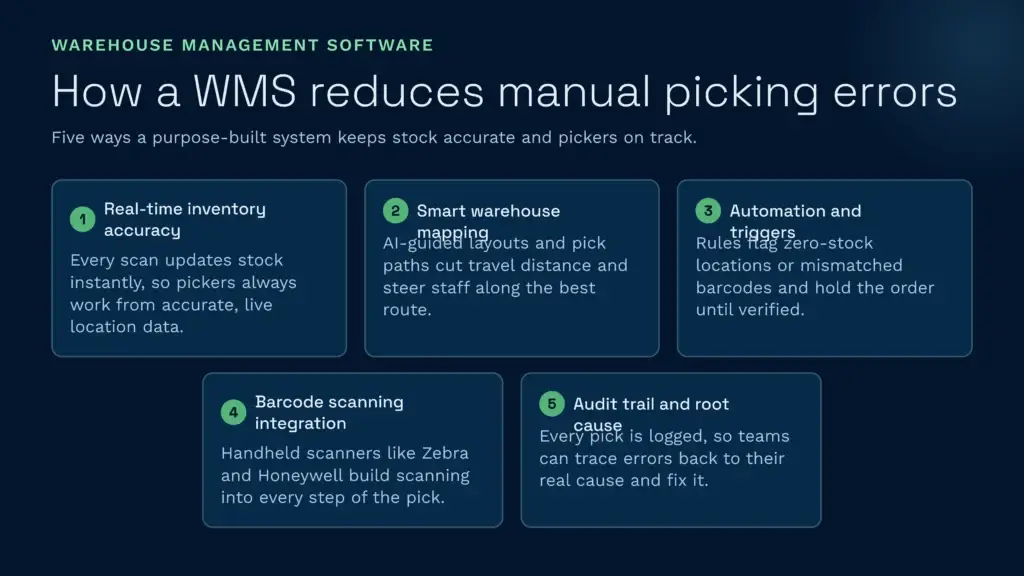
A purpose-built WMS tracks every stock movement in real time. When goods arrive, they’re scanned into location. When items are picked, they’re scanned out. When stock is moved, it’s tracked. The WMS maintains an up-to-date inventory record. Pickers work from accurate information. If the system says “SKU ABC is in location A5 with qty 12,” that’s what the picker will find. This eliminates the most common source of inaccuracy: working from stale or incorrect system data.
Warehouse Mapping and Smart Slotting
Advanced WMS platforms include 2D and 3D magazijnindeling. The system understands your physical layout, where each item is stored, and how to optimise pick paths. Some systems use AI to automatically slot items based on picking frequency, seasonality, and order patterns, adjusting layout recommendations in real time as your business changes. A warehouse mapping feature in your WMS can cut travel distance and dramatically improve accuracy by guiding pickers along the most logical route.
Automation and Triggers
A WMS can be configured with rules and triggers to automate tasks and flag anomalies. For instance, “if a pick is attempted for a location that shows zero stock, flag and notify the supervisor before the pick proceeds.” Or “if a barcode doesn’t match the expected pick, send an alert and hold the order until manually verified.” These automated guardrails catch errors before they ship.
Integration with Barcode Scanning Devices
A cloud-native WMS integrates seamlessly with barcode scanning hardware, such as Zebra or Honeywell handheld devices, and allows you to design custom picking workflows. You can specify exactly when and where scanning must occur, what data is captured, and how errors are escalated. This tight integration ensures barcode scanning is not an afterthought but a core part of the picking process.
Audit Trail and Root Cause Analysis
Every action in the WMS is recorded: who picked what, when, from where, and with what result. If an error occurs, say, the wrong item was picked, you have a complete record. You can trace whether the error was due to a system record problem (inventory wrong in the first place), a picking error (wrong item scanned), or a labelling problem (barcode illegible). Understanding root cause means you can fix the actual problem, not just catch the error downstream.
Neem contact op met een magazijnexpert
If you’re evaluating your options and want to see how a purpose-built WMS works in practice, Clarus is worth a conversation. We work with 3PLs and distributors across the UK to implement warehouse management software that fits the way you operate, not the other way around.
Neem contact op met ons team om uw wensen te bespreken.