

If you run a warehouse in 2026, cloud warehouse management software has stopped being the “modern” option and started being the default. Operators who once worried about uptime, security and data control now ask different questions: how fast can we go live, how much does it cost per month, and will it actually fit a 3PL that runs ten clients on one floor? This guide answers those questions in plain language, with a focus on what matters when you actually have to pick the system.
We’ll cover what a cloud WMS really is, how it differs from on-premise software, how secure it is in practice, what it costs, and how long it takes to roll out. Along the way we’ll show how Clarus WMS Cloud software features are built for 3PL operators rather than retrofitted from a retail or manufacturing tool.
What is cloud warehouse management software?
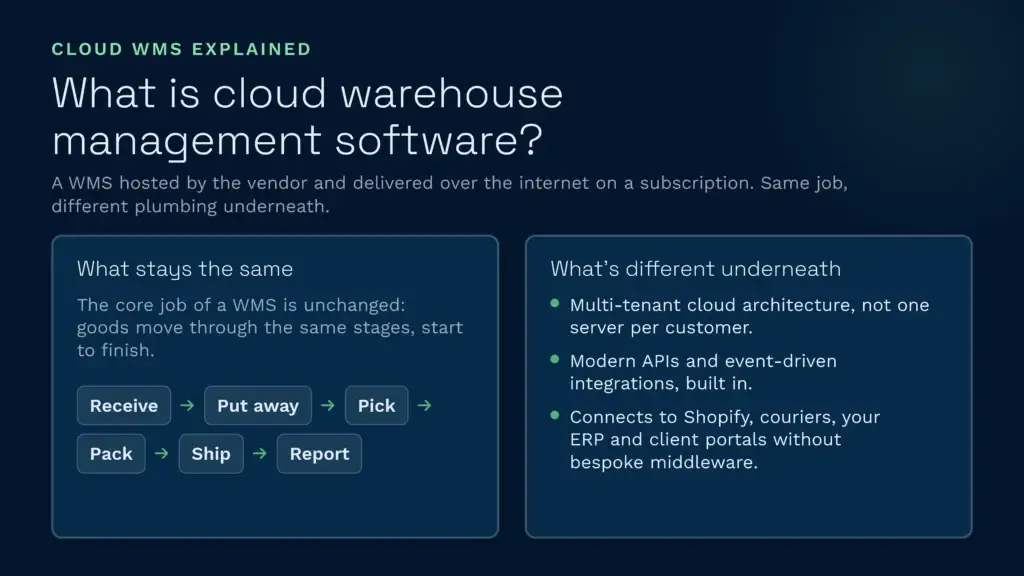
Cloud warehouse management software is a WMS hosted by the vendor and delivered to you over the internet, usually on a monthly subscription. You log in through a browser or a handheld app, your data sits in the vendor’s data centre, and updates are pushed automatically. The core function of a WMS stays the same: receive stock, put it away, pick orders, pack, ship, and report. What changes is the plumbing underneath.
The shift is more than where the server lives. A well-built cloud WMS uses multi-tenant architecture, modern APIs, and event-driven integrations. That means it talks to Shopify, your couriers, your ERP and your client portals without bespoke middleware. For a deeper look at the fundamentals, see our overview of what a warehouse management system actually does.
How a cloud based WMS system differs from a hosted server
Be careful with vendor language. A “hosted” WMS often means an on-premise product running on a VM somewhere, with one customer per server, slow upgrades, and limited elasticity. A true cloud based WMS system is built to scale, share infrastructure safely between tenants, and release new features every few weeks. If the vendor talks about “their server” rather than “the platform”, that’s a signal.
Cloud vs on-premise WMS: an honest comparison
On-premise WMS deployments still exist, especially in older manufacturing plants and a handful of large retailers. According to Gartner’s supply chain research, the share of new WMS deployments choosing cloud has climbed past 80% as buyers value speed, predictability and lower up-front cost.
| Factor | Cloud-WMS | WMS op locatie |
|---|---|---|
| Up-front cost | Low, mostly setup fees | High licence and hardware spend |
| Time to go live | Weeks | Months to a year |
| Updates | Automatic, frequent | Manual, project-based |
| Schaalbaarheid | Add users and sites in days | Hardware purchase cycle |
| IT burden | Vendor handles infrastructure | Internal team owns servers |
| Customisation depth | Configurable, less custom code | Heavily customisable but rigid after |
The trade-off used to be customisation versus convenience. That’s narrowed. Modern cloud platforms expose configuration options that cover 90% of what a 3PL needs out of the box, and the remaining 10% is usually handled through workflow rules or APIs.
How secure is cloud WMS?
Security is the question that stops most boards from approving a cloud move. It’s a fair concern, but the answer surprises people: a serious cloud WMS is almost always more secure than the on-premise alternative.
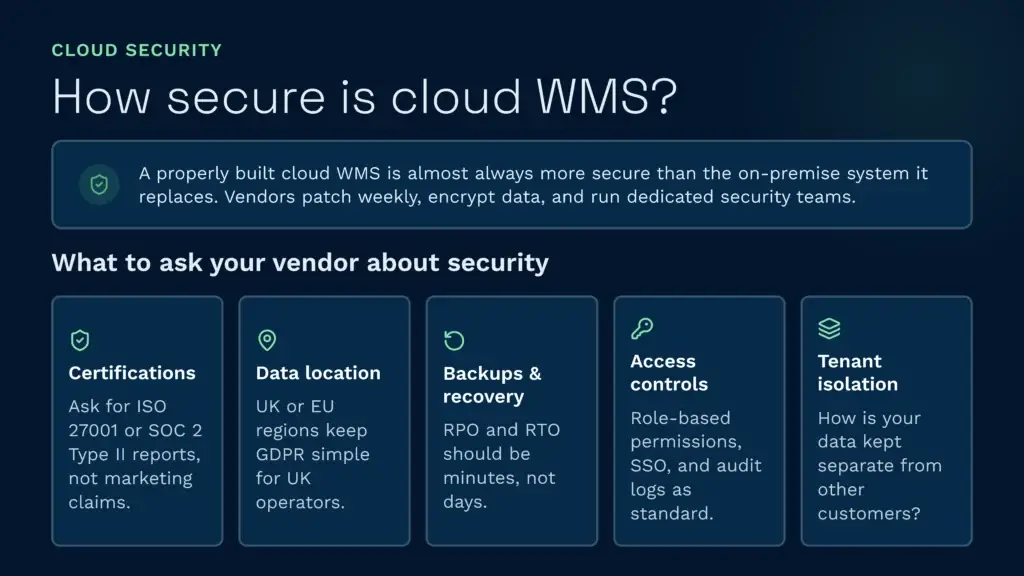
Cloud vendors run in data centres certified to ISO 27001, SOC 2 and similar standards. They patch operating systems weekly, encrypt data in transit and at rest, and have dedicated security teams. Most warehouses, by contrast, run servers in a back office, with backups on a USB drive and the last Windows update from 2022. MHI’s fundamentals guide notes that the operational risk of an unpatched on-premise system now exceeds the perceived risk of cloud hosting in most assessments.
What to ask your vendor about security
- Certifications: Ask for ISO 27001 or SOC 2 Type II reports, not marketing claims.
- Data location: For UK operators, confirm data sits in UK or EU regions to keep GDPR simple.
- Backups and recovery: What’s the RPO and RTO if a region goes down? A good answer is minutes, not days.
- Access controls: Role-based permissions, SSO, and audit logs as standard.
- Tenant isolation: In multi-tenant cloud, how is your data separated from other customers’?
How much does cloud WMS cost?
Pricing for cloud warehouse management software falls into three loose tiers. Entry-level tools start around £100 to £300 per user per month. Mid-market platforms aimed at 3PLs and growing operators sit between £500 and £3,000 per month for the base subscription, scaling with users, sites or orders. Enterprise platforms like Manhattan, Blue Yonder or SAP EWM run into six figures a year before implementation.
The headline figure isn’t the full picture. Watch for:
- Implementation fees: Usually 1x to 3x the annual subscription for the first year.
- Per-transaction charges: Some vendors charge per order, per line, or per shipping label.
- Integration costs: Pre-built connectors are free; custom connectors are not.
- Hardware: Scanners, label printers and Wi-Fi infrastructure are usually outside the WMS budget.
- Training and change management: Often under-budgeted; allow 5–10% of the project cost.
For a transparent breakdown of what Clarus charges, see our pricing page. We publish band ranges rather than hiding behind “contact sales”, because 3PLs need to model unit economics before they pick a platform. Logistics Bureau recommends building a five-year total cost of ownership model before signing; cloud usually wins, but the gap is closest in year one.
Implementation timeline for a cloud WMS
An old enterprise WMS rollout took 12 to 18 months. A modern cloud based warehouse management software project takes weeks to a few months, depending on complexity. Here’s a realistic timeline for a single-site 3PL operator going live with Clarus or a comparable platform:
- Discovery (week 1): Map your existing process. What clients, SKUs, carriers and integrations are in scope?
- Configuration (weeks 2–4): Set up locations, users, clients, billing rules, integrations, and label templates.
- Data migration (weeks 3–5): Import master data, opening stock, and historical orders if needed.
- User acceptance testing (weeks 4–6): Pickers, packers and admins run through real scenarios.
- Training (week 5–6): Floor training, admin training, and client onboarding.
- Go-live (week 6–8): Cut over, with vendor support on site or on call.
- Hypercare (weeks 9–12): Daily check-ins, quick fixes, refinement.
For 3PLs running multiple clients on one floor, see our guide to a 3PL-ready warehouse management solution and how multi-client billing, separate client logins, and per-client SLAs work in practice.
Why 3PLs benefit most from cloud WMS
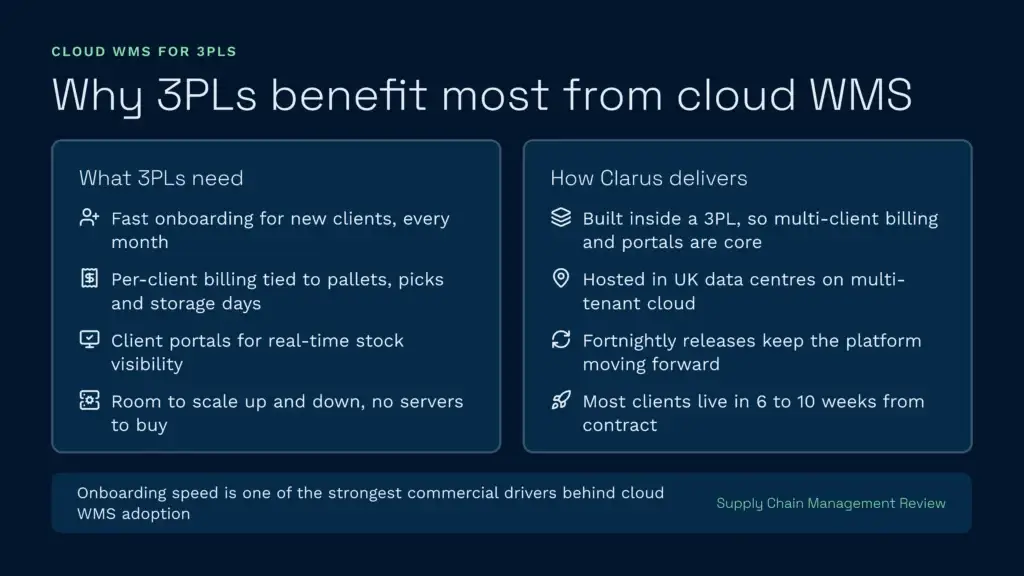
3PL operators have specific needs that legacy on-premise WMS systems struggle with. They onboard new clients every month. They need per-client billing that ties to received pallets, picks, and storage days. They need client portals so brand owners can see their stock in real time. They need to scale up and down without buying servers.
Cloud is structurally better suited to all of this. Supply Chain Management Review highlights 3PL onboarding speed as one of the strongest commercial drivers behind cloud WMS adoption. A platform that takes weeks instead of months to absorb a new client is a competitive advantage you can quote in your sales process.
Where Clarus is built differently
Clarus WMS started life inside a 3PL, not a retail chain or a factory. Multi-client billing, per-client reporting, and client portals are core, not bolted on. We host in UK data centres, run on a multi-tenant cloud architecture, and release updates fortnightly. Most clients go from contract to live in 6 to 10 weeks. For more context on the UK market specifically, see our UK WMS guide.
Also talk about: cloud wms, integrations, and reporting
A modern cloud WMS is judged on three things beyond the core warehouse workflow: integration depth, reporting, and the quality of the mobile app on the warehouse floor. A cloud based warehouse management software platform with weak integraties leaves you typing tracking numbers by hand. Weak reporting leaves you exporting CSVs to Excel every Monday. A clunky scanner app slows every pick.
When you evaluate a cloud based wms system, do three tests:
- Plug your top carrier in: If it’s not a standard connector, ask how long custom integration takes.
- Pull a real report: Ask the vendor to show client-level profitability for a week of demo data.
- Walk a pick on the device: Use the actual scanner, not a tablet demo. Latency and screen design matter.
Common pitfalls when picking cloud WMS
The mistakes we see most often:
- Buying on features, not fit: A 500-feature platform you’ll use 30 of is worse than a focused tool that fits your workflow.
- Ignoring the floor team: If pickers hate the scanner app, the project fails regardless of how clever the back office is.
- Skipping reference calls: Talk to two or three live customers. Ask about support response times.
- Underestimating integration work: “Pre-built” doesn’t always mean zero configuration.
- Choosing the cheapest option: Switching cost is high; a 20% cheaper platform that fails you in 18 months costs more than the right one.
See How Clarus Fits Your Warehouse
Evaluating WMS software on paper is only half the job. The real test is whether a platform handles your specific floor layout, carrier integrations, and 3PL billing quirks.
If you are planning a system move, skip the generic slide decks and high-pressure sales pitches. When you get in touch with our team, we will review your current operations, talk through your exact requirements, and run a live walkthrough using real-world scenarios from your actual warehouse floor.
Get in touch with the Clarus team today for a practical, no-nonsense conversation about getting your warehouse live on a true 3PL cloud platform in weeks, not months.