

If your 3PL is evaluating warehouse management systems, you’ve likely encountered NetSuite WMS. It’s tempting, NetSuite is an established platform, and if your finance team already uses it, adding the WMS module seems like a natural fit. But NetSuite WMS and Clarus WMS serve fundamentally different needs. NetSuite WMS is a module of an ERP suite, designed for product businesses that need basic warehouse workflows. Clarus WMS is purpose-built for 3PLs managing multiple clients from a single warehouse. Before you commit to either platform, understand the structural differences that will shape your operation for years to come.
Quick Verdict
Choose NetSuite WMS if you are a single-client manufacturer or distributor already invested in NetSuite’s ERP, with straightforward warehousing needs (basic putaway, picking, cycle counting) and no requirement for multi-client billing or dedicated customer portals. It avoids vendor sprawl and keeps everything in one platform.
Choose Clarus WMS if you’re a 3PL managing inventory for multiple clients, need automated billing that captures every billable event, require client-branded portals, or want fast cloud implementation without the cost and complexity of an ERP adoption. Clarus is built for the multi-client model from the ground up.
Side-by-Side Comparison
| Mogelijkheid | Clarus WMS | NetSuite WMS |
|---|---|---|
| Architecture | Purpose-built 3PL WMS, cloud-native, serverless | ERP module, cloud-hosted, requires full NetSuite ecosystem |
| Multi-client support | Native, purpose-built; full inventory segregation, per-client billing, client portals | Possible with customisation; requires custom SuiteScript development; no native multi-client architecture |
| Automated billing | Yes — captures every billable event (receive, storage, pick, pack, despatch, returns, value-adds) in real time; automated invoice generation | Possible via SuiteBilling module (additional cost); manual configuration and custom logic required for activity-based billing |
| Client portals | White-labelable, real-time stock visibility, order tracking, shipment status, billing summaries; included | Not native; requires custom portal development or third-party add-on |
| Mobile RF scanning | Yes, fully customisable HHD workflow builder for Android (Zebra, Honeywell); included | Yes, supported, but may require third-party app (RF-SMART, Descartes) for advanced workflows |
| Wave/zone picking | Yes, Smart Wave Picking with automatic order batching and path optimisation; claimed 50% travel time reduction | Yes, supported; less sophisticated than dedicated WMS |
| Bin management & FEFO/LIFO | Yes, directed putaway, FIFO/LIFO/FEFO rotation logic, configurable per client or product | Yes, supported; requires configuration |
| Voorraadnauwkeurigheid | Real-time scan verification (99.9% accuracy claimed); barcode must match or system stops packer | Real-time scan verification supported; less automated |
| Integraties | 200+ including Shopify, WooCommerce, Sage 200, QuickBooks, 70+ carriers, API-first architecture | Extensive NetSuite ecosystem; requires custom development for non-native systems; middleware partners available |
| Implementation speed | Weeks (typically 4-12 weeks for full 3PL setup) | Months (6-18 months for complete ERP adoption; WMS alone 2-6 months if ERP already in place) |
| Deployment model | Cloud only (SaaS); no servers to manage; always on latest release | Cloud (NetSuite managed); integrated with full ERP |
| Support response time | Sub-2-minute response time for critical issues | Varies by support tier; commercial support widely available |
| Vendor lock-in | Low, monthly rolling contracts, no penalties for exit, API-first design allows easy data export | High, core ERP dependency; switching costs are significant if you’re using other NetSuite modules |
What NetSuite WMS Is and How It Works
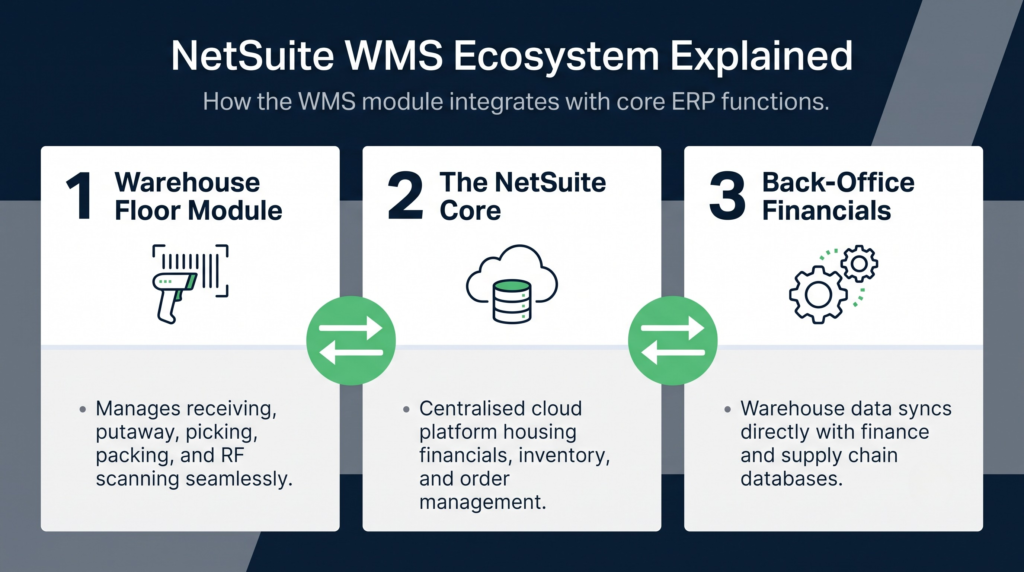
NetSuite WMS is a module of Oracle NetSuite, the dominant cloud ERP platform. It sits inside the NetSuite ecosystem alongside financials, inventory, order management, and other business modules. The WMS module handles the warehouse floor: receiving, putaway, picking, packing, cycle counting, and RF scanning. All warehouse data flows directly into NetSuite’s centralised inventory database, which also serves finance, supply chain planning, and accounting.
This architecture works well for manufacturers and distributors who use NetSuite as their central business platform and want to avoid deploying a separate warehouse system. If your finance team is already reconciling inventory against NetSuite’s general ledger, adding the WMS module keeps that integration tight.
NetSuite WMS Features: What’s Included
NetSuite WMS provides the standard warehouse toolkit:
- Mobile RF scanning: Warehouse staff use handheld barcode scanners (requires third-party apps like RF-SMART or Descartes for advanced workflows) to receive goods, confirm picks, and record pack/despatch events
- Bin management: Directed putaway rules tell staff where to place incoming stock; supports putaway strategies based on SKU, location, or bin type
- Wave and zone picking: Group orders into waves for batch picking and route optimisation; supports zone picking where each picker owns a warehouse section
- Cycle counting: Real-time or scheduled counting workflows to validate inventory accuracy without a full stocktake
- FIFO/LIFO rotation: Configurable rotation logic, though best-before date management can be manual or require additional setup
- Integrations: Native connectors to major carriers (UPS, DHL, Koninklijke Post); integrations to external order management systems via middleware
For a single-client warehouse operation already using NetSuite, these features are adequate. The system will capture warehouse transactions and feed them back into inventory and accounting on the same platform.
NetSuite WMS Limitations for 3PLs
This is where the cracks appear. NetSuite WMS was not architected for multi-client, multi-service 3PL operations. The limitations are structural, not accidental:
No Native Multi-Client Architecture
A 3PL managing inventory for five different clients needs five separate stock ledgers, five billing streams, five reporting interfaces, and five client-branded portals, all isolated from each other. NetSuite WMS lacks this built in. You can segment clients in NetSuite using entities or other constructs, but the WMS module itself isn’t designed with this separation as a first principle. Implementing genuine multi-client isolation typically requires custom SuiteScript development, adding weeks to implementation and ongoing complexity to maintenance.
Batch Data Synchronisation Creates Lag
NetSuite WMS relies on batch synchronisation, inventory updates may only refresh every 15 minutes to an hour. For a fast-moving 3PL processing hundreds of orders a day, this lag creates blindness. Your team may pick an order, but the client doesn’t see the shipment status updated for another 15 minutes. In high-touch client operations, this creates friction.
Billing Is Not Automated
A 3PL invoice is complex. You bill for storage (per pallet per day), handling (per item received, picked, packed), value-added services (labelling, kitting, returns processing), and sometimes carrier costs. NetSuite’s SuiteBilling module can help, but it’s not designed to capture the granular warehouse events that drive 3PL invoicing. Most 3PLs using NetSuite WMS end up reconciling warehouse events manually each month, then building invoices in Excel or billing software. This is where operational cost balloons: invoicing admin that could take 20 minutes becomes a four-hour monthly reconciliation task.
Implementation Is Slow and Expensive
If your 3PL isn’t already using NetSuite for finance and operations, adopting it for WMS means adopting the entire platform. Implementation timelines routinely stretch to 6–18 months. If you already use NetSuite, the WMS module still takes 2–6 months to implement and test, especially if you need custom workflows or integration with external client ERPs.
Who NetSuite WMS Is Best For
NetSuite WMS works well in a narrow set of scenarios:
- Single-client manufacturers or distributors already committed to NetSuite who need basic warehouse floor management (receiving, putaway, picking, packing) and can tolerate tighter integration with finance and planning
- Large enterprises with IT resources to customise and maintain SuiteScript workflows
- Organisations already standardised on NetSuite for finance, supply chain, and order management who view WMS as an operational extension of the ERP
NetSuite WMS is not a good fit for growing 3PLs, multi-client fulfilment, or businesses that need fast deployment and low implementation cost.
What Clarus WMS Is and How It Works
Clarus WMS is a purpose-built, cloud-native warehouse management system designed from the ground up for 3PLs and multi-client operations. It’s not an ERP module or a generic WMS forced into a 3PL shape, it’s architected specifically for the operational model of third-party logistics.
At its core, Clarus manages warehouse operations: receiving, putaway, picking, packing, despatch, returns. But it does so with native multi-client architecture. Each client’s inventory, billing, reporting, and portal are isolated within the same warehouse. The system automatically captures every billable event — a pick, a despatch, a return — and streams those events to an automated billing engine that generates invoices without manual reconciliation. Warehouse staff use mobile devices (Zebra, Honeywell) to scan barcodes; the system validates each scan in real time and routes work automatically.
Clarus runs on cloud servers that you don’t manage. You don’t install software, manage versions, or patch systems, Clarus handles all of that. Your team logs in via the web, your clients log into their white-labelled portal, and everything updates in real time.
Clarus WMS Features: What’s Included
Clarus is built for 3PL depth:
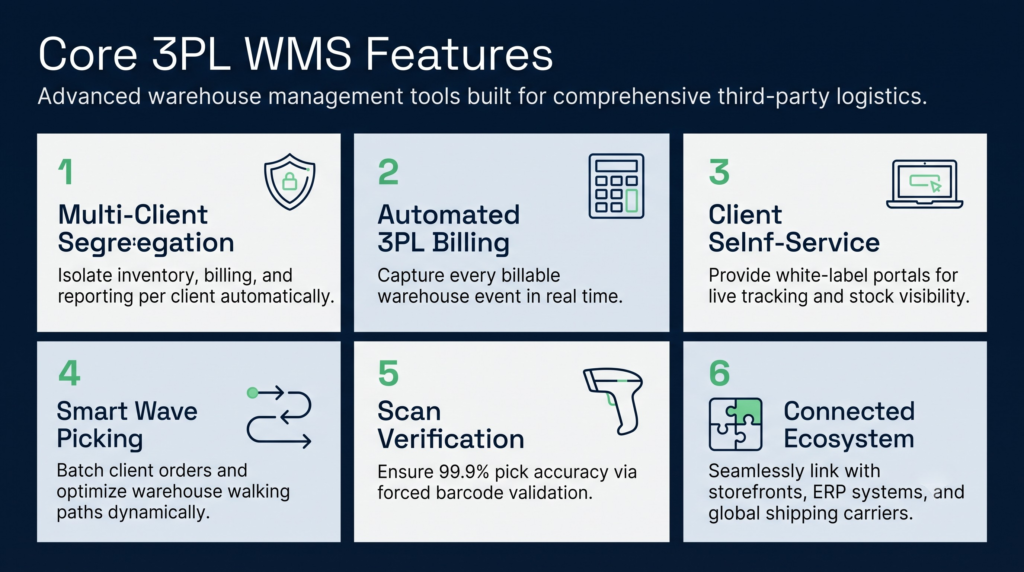
- Multi-client stock segregation: Each client’s inventory is completely isolated; billing, reporting, and visibility are per-client. No custom development needed
- Automated 3PL billing engine: Captures every billable event in real time, receiving, storage, picking, packing, despatch, returns, value-added services. Generates invoices automatically without manual counting or spreadsheet reconciliation
- Client self-service portal: White-labelable portal where clients see real-time stock levels, order status, shipment tracking, and billing summaries
- Smart Wave Picking: Automatically batches orders and optimises walking paths; claimed 50% reduction in travel time versus manual picking
- Real-time scan verification: Barcode must match the order or the system stops the packer; achieves 99.9% pick accuracy
- FIFO, LIFO, FEFO rotation: Configurable per client or product; includes best-before date and expiry management
- HHD workflow builder: Fully customisable scanning workflows on Android devices (Zebra, Honeywell). No coding required, design workflows through the UI
- 200+ integrations: Shopify, WooCommerce, Amazon, eBay, Sage 200, QuickBooks, 70+ carriers, and more. API-first architecture means you can build custom integrations easily
- Audit trail: Every stock movement, every user action, every billing event is logged with full traceability for compliance and dispute resolution
Clarus pricing is straightforward: from £1,000/month on monthly rolling contracts. All features are included. No per-user costs, no add-on modules, no hidden implementation fees.
Where Clarus Wins
Multi-client architecture: Clarus is purpose-built for 3PLs. You don’t need custom development to segment clients, isolate billing, or deploy per-client portals. This is native functionality.
Automated billing: Clarus’s automated billing engine captures every billable event and generates invoices in minutes, not days. St John’s Hall Storage reduced their invoicing time from four hours to twenty minutes after switching from manual processes. Mitchell Storage and Distribution (MSD) eliminated a two-person manual reconciliation entirely.
Fast implementation: Clarus goes live in weeks, not months. Your team starts using it within 4–12 weeks of contract signature. NetSuite WMS, if it’s not already in place, takes 6–18 months as part of an ERP adoption.
Lower total cost of ownership: Clarus starts at £1,000/month with all features. NetSuite WMS, with implementation, user seats, and SuiteBilling, typically costs £80,000–£200,000 in year one.
Real-time visibility: Clarus updates inventory and billing events in real time. NetSuite WMS batches updates, creating lag in client visibility and billing accuracy.
Where NetSuite WMS Wins
ERP integration: If your business already runs on NetSuite for finance, supply chain, and operations, the WMS module is native to the same platform. You don’t need to integrate two systems or manage data sync between a WMS and an ERP. That tightness has value if you’re already committed to NetSuite.
Established vendor: NetSuite is Oracle-backed, with a massive customer base and ecosystem. If your organisation values vendor size and longevity, NetSuite’s scale may feel safer than a 35-person specialist vendor.
Single-client simplicity: If you’re a manufacturer or distributor managing your own warehouse (not a multi-client 3PL), NetSuite WMS provides adequate warehouse functionality without the complexity of dedicated 3PL features you don’t need.
Who Should Choose Which
Choose Clarus if you are:
- A 3PL or contract logistics provider managing inventory for multiple clients
- A fulfilment centre, co-packing operation, or warehouse serving multiple brands or SKU families
- Growing and need to scale without proportional increases in administrative overhead (invoicing, reporting, client management)
- Looking for fast deployment and predictable monthly cost
- Not already heavily invested in NetSuite
- Want automated billing that captures revenue without manual reconciliation
Choose NetSuite WMS if you are:
- A single-client manufacturer or distributor managing your own warehouse
- Already using NetSuite for finance, operations, and supply chain
- Comfortable with longer implementation timelines and higher upfront cost
- Your warehouse operation is straightforward (basic receiving, putaway, picking, packing) with no complex multi-client billing requirements
- Value vendor size, stability, and an all-in-one ERP platform
NetSuite WMS Integration and Implementation Effort
If you don’t already use NetSuite, implementing NetSuite WMS means adopting the entire platform. This is a major commitment:
- Timeline: 6–18 months from contract signature to go-live, depending on your existing systems, data migration complexity, and customisation needs
- Integration with external systems: If your clients use different ERPs, you’ll need custom SuiteScript development or middleware (e.g., Pipe17, Houseblend) to connect their systems to NetSuite.
- Internal resource commitment: Your team will need dedicated staff to manage the project, participate in training, and oversee testing. This is a business-wide initiative, not just a warehouse project
If you already use NetSuite, the WMS module implementation is faster but still non-trivial:
- Timeline: 2–6 months if your ERP is already in place and you have moderate warehouse complexity
- Custom workflows: If you need advanced billing logic or multi-client handling, expect custom SuiteScript development
By contrast, Clarus implementation is weeks. Most 3PLs go live in 4–12 weeks, with no major infrastructure changes or organisation-wide migrations.
Speak to a warehouse expert
If you’re evaluating your options and want to see how a purpose-built WMS works in practice, Clarus is worth a conversation. We work with 3PLs and distributors across the UK to implement warehouse management software that fits the way you operate, not the other way around.
Get in touch with our team to talk through your requirements.