

If you’re running a 3PL operation or managing ecommerce inventory, you already know that manual warehouse processes are costing you time, money, and customer satisfaction. A warehouse management system solution automates the core tasks that eat up your team’s day: picking, packing, shipping, stock counts, and goods receiving. But with dosens of options on the market, finding the right warehouse management system solution for your specific needs feels overwhelming.
In this guide, we’ll walk you through what a warehouse management system solution actually does, what features you need to look for, and how to choose the best one for your business. We’ll also show you how Clarus WMS has helped lots of 3PL and ecommerce businesses streamline operations and cut costs.
What is a warehouse management system solution?
A warehouse management system solution is software that controls and optimises warehouse operations from productos en to final dispatch. It tracks inventory in real-time, automates picking and packing workflows, manages labour allocation, and generates reports on warehouse performance.
Think of it as the nervous system of your warehouse. Every movement, every stock adjustment, every shipment passes through the system. Without it, you’re relying on spreadsheets, manual scans, and guesswork. With it, you have complete visibility into what’s in stock, where it is, and when it needs to move next.
The best warehouse management system solutions sit somewhere between complexity and ease of use. They’re powerful enough to handle thousands of SKUs and complex fulfilment workflows, but intuitive enough that your team doesn’t need weeks of training to operate them.
Key features to look for in a warehouse management system solution
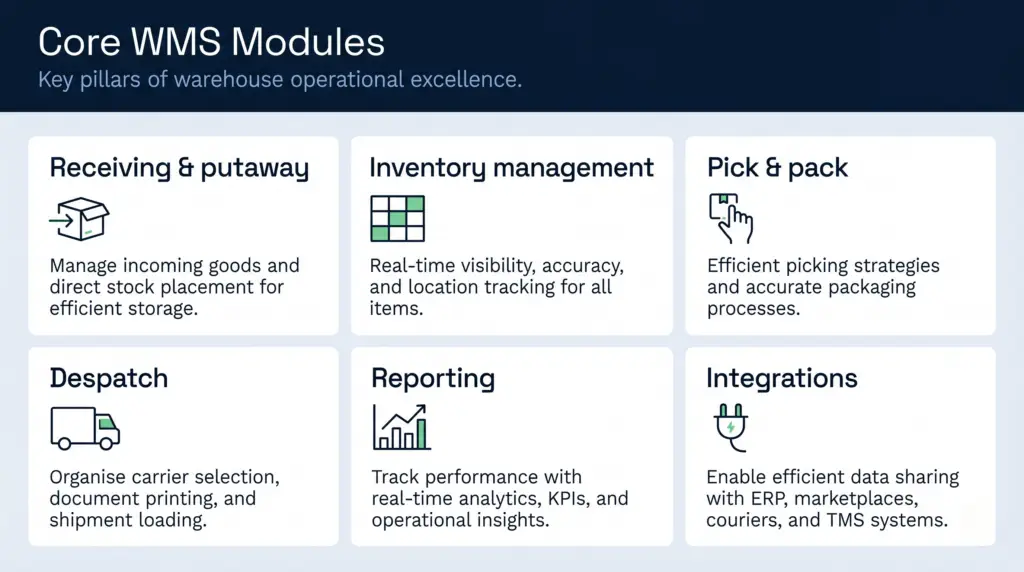
Not all warehouse management system solutions are created equal. Some are designed for large enterprises with massive budgets. Others are built specifically for 3PLs and ecommerce businesses that need speed and flexibility. Here’s what your warehouse management system solution must include:
Seguimiento de inventario en tiempo real
Your system needs to track stock levels as they change. When a picking operation completes, inventory updates instantly. When goods arrive at the dock, they’re logged into the system before they even reach the shelf. This eliminates phantom stock, overselling, and the chaos of discovering missing items weeks after they vanish.
Picking and packing automation
A good warehouse management system solution tells your pickers exactly what to grab and in what sequence. It can use wave picking (grouping orders by zone), zone picking (each worker owns a section), or even single-order picks depending on your operation. The system routes pickers efficiently and confirms each item before it goes into a box.
Multi-location and multi-warehouse support
If you operate across multiple locations, your warehouse management system solution must split orders intelligently across facilities. It should route stock to the nearest warehouse, balance inventory levels, and consolidate shipments where it makes sense.
Integration with sales channels and carriers
Your warehouse management system solution should connect directly to your sales channels, Shopify, Amazon, WooCommerce, and others. It should also integrate with major carriers to pull tracking numbers and update customers automatically. This removes manual entry and human error.
Reporting and analytics
You need clear visibility into warehouse performance. Metrics like pick accuracy, cycle time, labour cost per order, and inventory turnover should be available in real-time dashboards and scheduled reports.
Goods receiving and put-away automation
When new stock arrives, a warehouse management system solution should automate the receiving process. It validates shipments against purchase orders, checks for damage, and directs items to the right shelf location—all without manual intervention. This is especially critical if you’re dealing with goods in processes that impact warehouse efficiency.
How to choose the right warehouse management system solution for your business
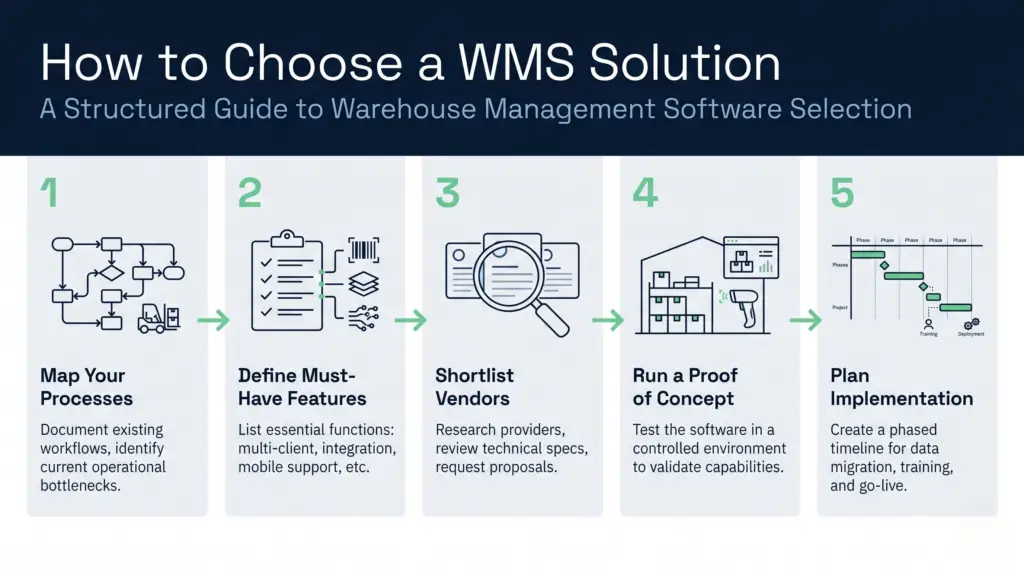
Choosing a warehouse management system solution is one of the most important decisions you’ll make. Get it wrong, and you’re locked into a platform that doesn’t fit your workflows. Get it right, and you’ll cut operating costs by 20-40% and improve customer satisfaction dramatically.
Start with your current pain points
Don’t choose a system based on what’s popular. Choose based on what hurts most right now. Are you losing money to picking errors? Is goods in process taking forever? Are you unable to scale because you’re bound by manual labour? A warehouse management system solution should solve these specific problems, not add new ones.
Look for 3PL-native architecture
If you’re a 3PL, your warehouse management system solution must be designed for multi-client operations. This means you need segregated billing, separate inventory spaces per client, and the ability to set different warehouse processes for different customers. Most enterprise systems force you to work around their limitations. The best warehouse management system solutions are built for your business model from the ground up.
Evaluate the cost structure
There are three typical pricing models for a warehouse management system solution:
- Per-user licensing: You pay per employee who touches the system. This penalises you for having a larger team.
- Per-order licensing: You pay based on orders processed each month. This scales naturally with your business.
- Fixed monthly fee: You pay a flat rate for the system regardless of volume. Good if you have stable, predictable throughput.
Test the user experience
Your warehouse staff will spend 8 hours a day inside this system. If it’s clunky, poorly designed, or unintuitive, adoption will fail and you’ll waste the entire investment. Request a demo and put your actual team through realistic workflows. Watch how they interact with the interface. Can they find what they need? Do they understand what’s being asked of them?
Check for integration capabilities
A warehouse management system solution is only as good as the systems it connects to. Make sure it integrates natively with your current sales channels, ERP, accounting software, and carriers. Poor integrations mean manual workarounds and data entry errors.
Warehouse management system solution vs. ERP: what’s the difference?
Many businesses confuse a warehouse management system solution with an ERP system. They’re related, but they solve different problems.
An ERP (Enterprise Resource Planning) system manages your entire business: finance, HR, procurement, manufacturing, and warehousing. It’s the backbone of enterprise operations. But ERPs are expensive, take months to implement, and often treat warehouse management as a secondary function. When you buy an ERP, you get a decent WMS module, not a purpose-built warehouse solution.
A warehouse management system solution, by contrast, is laser-focused on warehouse operations. It’s optimised for picking, packing, shipping, and inventory control. It integrates with your ERP (or accounting system) to share data, but it doesn’t try to do everything. This specialisation means it’s faster to implement, easier to use, and typically much cheaper.
For most 3PLs and ecommerce businesses, a dedicated warehouse management system solution paired with accounting software beats an ERP every time. You get warehouse expertise without the bloat.
The business impact of a warehouse management system solution
Here’s what a well-implemented warehouse management system solution actually delivers:
Lower operational costs
Picking errors, rework, and inefficient labour routing add up fast. A warehouse management system solution typically reduces labour costs by 15-25% by eliminating wasted motion and directing work more intelligently. You also reduce misshipments, which costs money to rectify and damages customer trust.
Faster order fulfilment
Your warehouse management system solution should cut your average pick-to-ship time. This means more orders shipped same-day, happier customers, and the ability to compete with larger rivals on delivery speed.
Better inventory accuracy
Real-time inventory tracking prevents overselling, stock-outs, and the chaos of physical counts. You know exactly what you have and where it is at any moment.
Scalability without proportional cost increases
As your business grows, a warehouse management system solution scales with you. You handle 50% more orders without hiring 50% more staff. The system works smarter, not just harder.
Improved customer satisfaction
Faster shipping, accurate orders, and real-time tracking updates all feed into customer satisfaction. Fewer complaints, fewer returns, more repeat orders.
For a detailed breakdown of what warehouse management system benefits look like in practice, read our full overview of the value a good system creates.
Real-world warehouse management system solution examples
The market has dozens of warehouse management system solutions to choose from. Here are some major players:
- Enterprise systems: These are built for large operations with complex needs. They’re powerful but expensive and slow to implement. Examples include SAP, Oracle NetSuite, and Infor.
- Mid-market systems: Purpose-built for growing businesses. Faster to implement than enterprise systems but with less customisation. Examples include Plex, Fishbowl, and others reviewed on platforms like Capterra’s WMS directory.
- 3PL-native systems: Designed specifically for third-party logistics providers and ecommerce fulfilment. Clarus WMS falls into this category—built from the ground up for the workflows, billing models, and multi-client needs of 3PLs.
To see how your shortlist compares, check independent reviews on G2, Gartner, y Supply Chain Digital.
How much does a warehouse management system solution cost?
There’s no single answer, cost depends on your operation size, complexity, and the pricing model the vendor uses.
A basic cloud-based system for a small operation might cost £500-£1,500 per month. A mid-market system could run £2,000-£5,000 per month depending on order volume. Enterprise systems often start at £10,000+ per month and scale from there.
But don’t just look at the software cost. Factor in implementation time, training, integration work, and the cost of the labour your system will eliminate. Most businesses see ROI within 6-18 months.
If you operate a 3PL and need 3pl systems that handle billing, multi-client inventory, and automated invoicing, expect to pay more than a simple ecommerce WMS—but you’ll also save far more on manual billing and reconciliation work.
{“@context”: “https://schema.org”, “@type”: “FAQPage”, “mainEntity”: [{“@type”: “Question”, “name”: “What is a warehouse management system solution?”, “acceptedAnswer”: {“@type”: “Answer”, “text”: “A warehouse management system solution is software that controls and optimises warehouse operations from goods in to final dispatch. It tracks inventory in real-time, automates picking and packing workflows, manages labour allocation, and generates reports on warehouse performance.”}}, {“@type”: “Question”, “name”: “Warehouse management system solution vs. ERP: what’s the difference?”, “acceptedAnswer”: {“@type”: “Answer”, “text”: “Many businesses confuse a warehouse management system solution with an ERP system. They’re related, but they solve different problems.”}}, {“@type”: “Question”, “name”: “How much does a warehouse management system solution cost?”, “acceptedAnswer”: {“@type”: “Answer”, “text”: “There’s no single answer, cost depends on your operation size, complexity, and the pricing model the vendor uses.”}}]}