

Choosing between an Inventory Management System (IMS) and a Warehouse Management System (WMS) is critical for ensuring stock visibility, accuracy, and efficient order-picking. Warehouse and 3PL professionals often face challenges like limited integration with ERP, poor layout optimisation, and inefficiencies in product-movement tracking, leading to stock discrepancies and delayed fulfilment. At Clarus WMS, we deliver solutions that integrate barcode and, where appropriate, RFID tracking to provide quick wins in automation and scalability for seamless inventory management.
Traditionally, managing inventory with basic IMS or manual processes required extensive labour for stock reconciliation and layout adjustments, sometimes taking months to achieve reliable accuracy. With a structured WMS approach, organisations can move to real-time visibility with ERP integration on a realistic timeline, provided data readiness and change management are in place.
The result of traditional methods:
- Delays in fulfilment due to poor stock visibility and manual tracking
- Inefficiencies in order-picking caused by suboptimal warehouse layout and lack of automation
- Lost revenue from inaccurate inventory reconciliation and non-scalable IMS limitations
This article breaks down the shortcomings of traditional IMS methods and explores how a modern WMS rethinks the process with feature-rich capabilities for better optimisation and accuracy. We answer common questions and weave in field insights from a warehousing professional to make the guidance practical.
What is the Difference Between IMS and WMS?
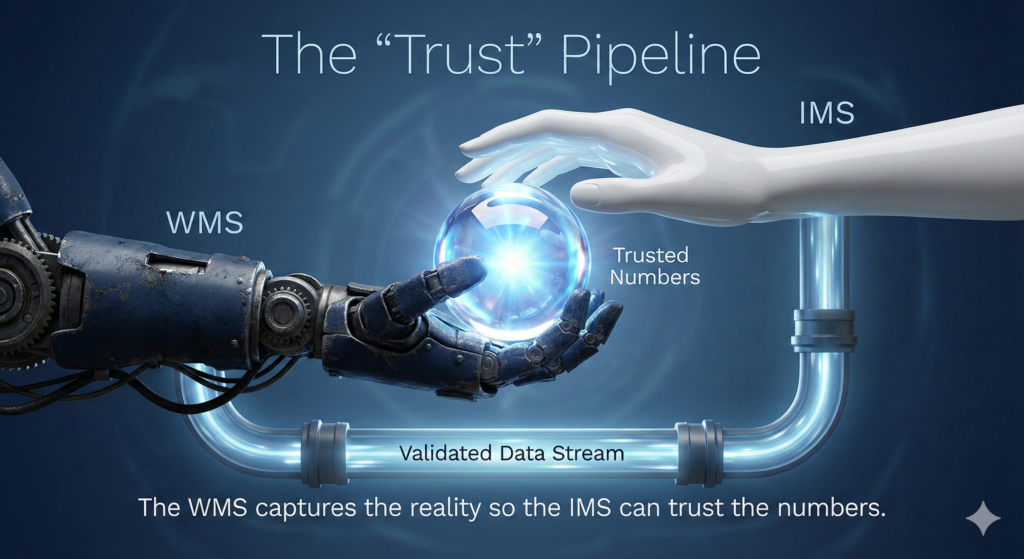
An IMS focuses on stock control across the business, tracking quantities, locations, and valuation. A WMS controls day-to-day warehouse execution, including directed putaway, picking, packing, shipping, and the capture of batch, lot, serial and date attributes that drive compliant flows. NetSuite summarises it well: IMS provides a high-level view across all locations, while a WMS manages movements and locations within the warehouse, guiding users through efficient pick and pack rules (NetSuite guide).
Expert insight: “An inventory management system is a top-level view of what stock you have and its value. A WMS controls the movement of an item through its warehouse life cycle, and captures what needs to be recorded so the IMS can trust the numbers.”
— Mathew Buttar, Head of Solutions.
Do I Need a WMS if I Already Have an IMS?
Yes, once operations scale beyond basic stock control or SKU complexity increases, a WMS becomes essential. It brings directed workflows, scan-to-verify steps, and real-time updates that reduce manual reconciliation and improve fulfilment reliability. Industry guidance shows that digital design and WMS-led improvements to layout and flow can raise warehouse efficiency by 20 to 25 percent when executed with proper process change and data discipline (McKinsey, improving warehouse operations digitally).
How Does WMS Improve Order-Picking Efficiency?
A WMS improves picking through slotting rules, optimised pick paths, mobile scanning, and validation at pick and pack. Research consistently shows that travel is the dominant time component in manual picking operations, often about 50 percent of total picking time, which is why slotting and routing offer outsized gains (for example, Tompkins et al., summarised in academic proceedings: POMS paper, INFORMS WSC study).
Order picking is also the largest cost centre for many warehouses. Recent academic work summarises prior studies indicating picking can account for 50 to 75 percent of total warehouse operating costs, which explains why WMS-driven slotting, batching, and routing are high-leverage (MDPI review).
What Role Does Integration Play in Inventory Accuracy?
Tight integration between WMS and ERP is a foundation for accurate inventory and timely billing. NetSuite documentation highlights real-time bin guidance and mobile barcode capture that immediately updates on-hand and fulfilment records, minimising manual entry and reconciliation (NetSuite WMS overview, Oracle Help: Picking Orders).
When integration extends to analytics and AI, measurable service improvements follow. McKinsey reports a distributor improving fill rates by 5 to 8 percent with an AI-enabled control tower, and finding 7 to 15 percent additional capacity via AI-driven warehouse insights (McKinsey, AI in distribution operations).
Traditional Methods vs. Clarus WMS for Inventory Management
Manual IMS or spreadsheets lack execution control, which leads to delayed picks, reactive layouts, and heavy reconciliation effort. In contrast, a WMS guides users through validated, scan-based flows, reduces travel time with better slotting and routing, and provides upstream and downstream system updates in near real time. Independent sources show that redesigning layouts and flows with digital tools can deliver double-digit efficiency gains, long before any automation is purchased (McKinsey, digital improvements; POMS paper).
Why Teams Struggle with Inventory Management
- Limited ERP integration, causing gaps in real-time visibility and reconciliation
- Manual tracking, increasing errors in order-picking and layout mapping
- Poor automation in IMS, limiting fulfilment scalability
- Inadequate barcode and labelling discipline, slowing product-movement accuracy
Most warehouses still rely primarily on barcodes, which are cheap, flexible and universally supported. GS1 reports more than 10 billion barcode scans per day globally, underscoring why barcodes remain the default for identification and capture (GS1 2022/23 Year in Review, GS1 US “Scanniversary” press).
How Does Clarus WMS Handle Inventory Management?
Clarus WMS combines mobile barcode capture with ERP integration to increase first-time accuracy and speed while keeping a full transaction history. In our JODA customer story, the published result is 97 percent inventory accuracy in year one and 99 percent by year two, alongside dramatically faster stocktakes (Clarus WMS x JODA case study).
Real-Time Monitoring
Real-time monitoring is not just dashboards. With a WMS, each scan updates the system of record immediately, which means variances surface faster, cycle counting can be risk-based, and replenishment can be triggered at the right time. NetSuite’s WMS documentation illustrates how mobile picking, GS1 barcode support and packing processes update stock levels and fulfilment records as work is completed (NetSuite WMS overview, Oracle Help: Picking Orders, Oracle Help: Packing Orders).

Scalable Adaptation
For 3PLs, sudden volume spikes are routine.
Expert insight: “If you rent overflow space, you can create a new warehouse and locations, import the data, and start receiving there in literally minutes, as long as connectivity and labels are ready.”
— Mathew Buttar, Head of Solutions.
Full Visibility
Full visibility means that every movement is auditable, which is essential for regulated product categories and good governance. Data-integrity guidance used by many regulators expects time-stamped, user-attributed audit trails for data changes, something a WMS captures natively in its transaction logs (PIC/S data integrity guidance).
Ready to See It in Action?
Implementing advanced inventory management with a WMS can transform operations by improving layout, reducing travel, and driving scan-based accuracy. Imagine directed picking with mobile verification, exceptions flagged immediately, and ERP updated without manual rekeying. Contact Clarus WMS for a demo to explore which workflows and integrations would deliver the fastest, lowest-risk impact for your sites.
References
- “Inventory Management vs. Warehouse Management: What’s the Difference?,” NetSuite
- “Warehouse Management System (WMS),” NetSuite
- “Picking Orders,” Oracle Help Center (NetSuite Applications Suite)
- “Packing Orders,” Oracle Help Center (NetSuite Applications Suite)
- “Improving warehouse operations, digitally,” McKinsey
- “Picking productivity estimation in Distribution Warehouses,” POMS
- “The Impact of Item Weight on Travel Times in Picker-to-parts Order Picking,” INFORMS WSC
- “Enhancing Warehouse Picking Efficiency Through Integrated Allocation…,” MDPI
- GS1, “2022/23 Year in Review”
- GS1 US, “50-Year Barcode Scanniversary”
- PIC/S, “Good Practices for Data Management and Integrity …”
- Deloitte, “Ramp-up planning for an enterprise WMS implementation”
- Clarus WMS, “Helping JODA Achieve 99% Stock Accuracy”