

Der britische Lagersektor steht unter enormem Druck. Verringerte Margen, steigende Arbeitskosten, die Nichteinhaltung von Post-Brexit-Vorschriften und explodierende E-Commerce-Volumen bedeuten, dass die Wahl des richtigen Lagerverwaltungssystem Großbritannien Betriebsleiter verlassen sich tatsächlich nicht auf etwas Schönes, sondern auf einen Wettbewerbsvorteil. Diese Anleitung behandelt alles, was Sie wissen müssen: welche WMS-Systeme britische Unternehmen tatsächlich nutzen, wie viel sie kosten, welche spezifisch britischen Funktionen wichtig sind und wie der Markt wächst. Egal, ob Sie einen Betrieb an einem Standort oder ein Multi-Site-Lagerverwaltungssystem an mehreren Standorten betreiben, das Folgende wird Ihnen helfen, eine fundiertere Entscheidung zu treffen.
Wie groß ist der britische Lagersektor?
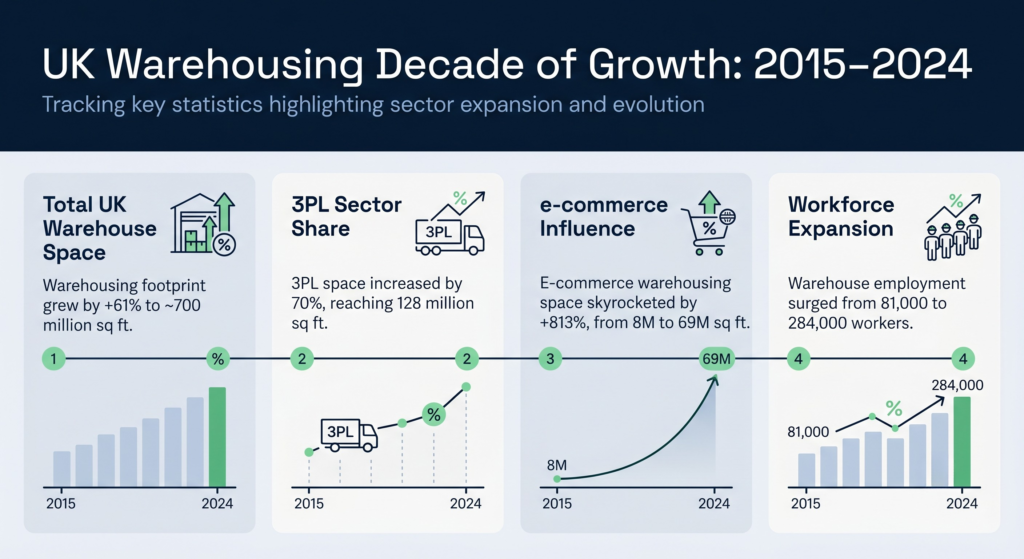
Die Zahlen sind beeindruckend. Der britische Lagerhaltungssektor ist seit 2015 um 61% gewachsen und erreicht nun laut der UKWA und Savills 2024 Lagerbericht. Der 3PL-Sektor führt bei der Auslastung an und macht mit 128 Millionen Quadratfuß des Bestands den größten Anteil aus, wobei sein Anteil im gleichen Zeitraum um 70% gestiegen ist.
Der Online-Handel war dabei der Motor des Wachstums. Die Nutzer im E-Commerce-Bereich haben ihre Lagerfläche von gerade einmal 8 Millionen Quadratfuß im Jahr 2015 auf 69 Millionen Quadratfuß bis 2024 ausgebaut – ein Anstieg um 813%. Ein solches Wachstum stellt den Lagerbetrieb vor erhebliche Herausforderungen, insbesondere für 3PL-Anbieter, die mehrere Kunden unter einem Dach betreuen.
Arbeitsdruck verschärft die Herausforderung. ONS-Daten zeigen, dass die Beschäftigung in Lagerhäusern von 81.000 Mitarbeitern im Jahr 2010 auf 284.000 im Jahr 2023 gestiegen ist, aber ein Logistik UK Umfrage Die Untersuchung ergab, dass 76% der Betreiber im Jahr 2024 mit kritischen Personalengpässen zu kämpfen hatten, obwohl der Median des Stundenlohns im Vergleich zum Vorjahr um 9% gestiegen war. Eine solche Lücke lässt sich einfach nicht durch mehr Personal überbrücken. Die Argumente für die Automatisierung und das dahinterstehende WMS sind in Großbritannien so überzeugend wie nie zuvor.
Was ist ein Lagerverwaltungssystem und warum ist es in Großbritannien wichtig?
Wenn Sie neu in diesem Bereich sind, beginnen Sie mit den Grundlagen. A Lagersystem ist das operative Gehirn Ihres Lagers: Es steuert Warenbewegungen, weist Picker- und Packaufgaben zu, verwaltet Arbeitskräfte, bearbeitet Wareneingang und -versand und erstellt die Audit-Protokolle, die Ihre Kunden und Regulierungsbehörden erwarten. Stellen Sie es sich als Unterschied vor, ob Sie Ihren Betrieb nach Instinkt oder nach Daten steuern.
Für britische Betreiber leistet ein WMS mehr als nur die Organisation von Paletten. Es hilft Ihnen bei der Einhaltung der HMRC-Vorschriften für Zolllager, der Aufrechterhaltung der Rückverfolgbarkeit für Lebensmittelsicherheitsvorschriften gemäß dem Food Safety Act 1990 und den geltenden Food Hygiene Regulations sowie bei der Erstellung von Lagerbestandsaufzeichnungen, die die HMRC für die Zolllagergenehmigung verlangt. Ohne ein System, das diese Verpflichtungen nativ versteht, bauen Sie die Einhaltung von Vorschriften im Wesentlichen manuell auf Software auf, die dafür nie konzipiert wurde.
Der britische WMS-Markt spiegelt diese Nachfrage wider. Der Markt wurde im Jahr 2024 auf 179,9 Millionen US-Dollar geschätzt und soll laut einer Prognose bis 2030 mit einer durchschnittlichen jährlichen Wachstumsrate (CAGR) von 16,41 % wachsen. Grand View Research. Diese Wachstumsrate ist kein Zufall; sie korreliert direkt mit dem Automatisierungsschub im britischen Vertrieb und in der Fulfillment-Branche.
Welche UK-spezifischen Funktionen sollte ein WMS haben?
Nicht jedes WMS ist für britische Lager konzipiert. Dies unterscheidet eine wirklich UK-fähige Plattform von einem generischen System, das hier nur verkauft wird.
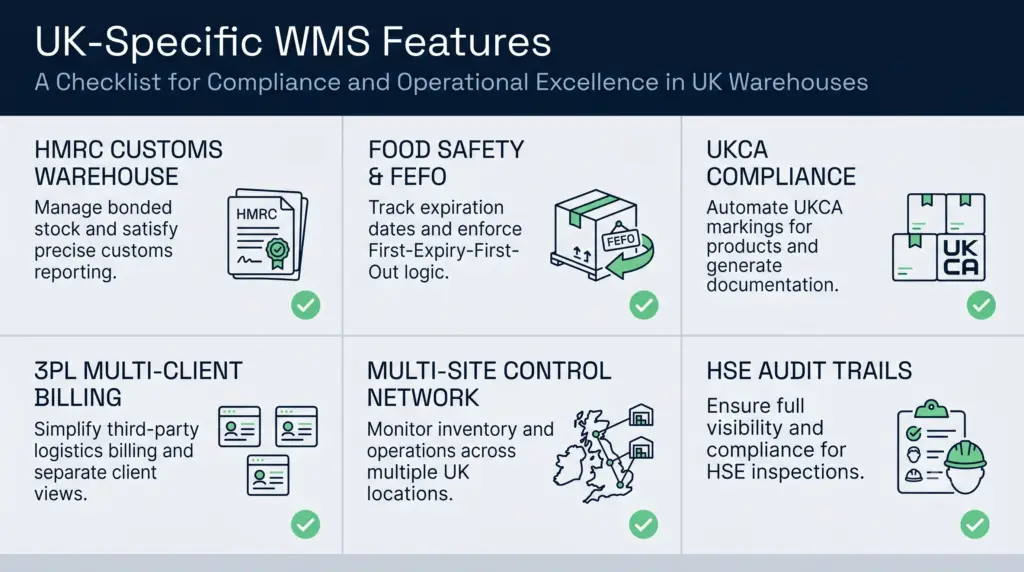
HMRC Zoll- und Zolllager-Support
Wenn Sie ein Unternehmen betreiben oder den Betrieb eines Unternehmens in Erwägung ziehen Von HMRC zugelassenes Zollager, Ihr WMS muss aktuelle Zolltarifnummern, Bewegungsaufzeichnungen und Prüfprotokolle pflegen, die einer Prüfung durch die Finanzbehörde standhalten. Nach dem Brexit ist dies unumgänglich. Der Customs Declaration Service (CDS) erfordert eine Echtzeit-Transparenz über zollbegünstigte Bestände, und Ihr System muss die dazugehörige Dokumentation ohne manuelles Eingreifen erstellen können.
Lebensmittelsicherheit und Rückverfolgbarkeit der Kühlkette
Lebensmittel und Getränke sind eines der größten Geschäftsfelder in der britischen Lagerhaltung. Ein WMS, das in der Lebensmittelverteilung eingesetzt wird, muss Batch- und Chargenverfolgung, Verwaltung von Verfallsdaten und FEFO (first expired, first out) Picking-Regeln. Die Rückverfolgbarkeitsanforderungen der FSA bedeuten, dass Sie eine vollständige Nachweiskette vom Wareneingang bis zum Versand benötigen, und diese Kette muss innerhalb von Minuten, nicht Tagen durchsuchbar sein.
UKCA-Konformitätsdokumentation
Die britische UKCA-Kennzeichnung hat nach dem Brexit die CE-Kennzeichnung für in Großbritannien verkaufte Waren abgelöst. Für Lagerhäuser, die regulierte Produkte handhaben, sollte Ihr WMS bei der Verwaltung von Konformitätserklärungsdokumenten helfen und sicherstellen, dass nicht konforme Lagerbestände Ihr Lager nicht ohne die richtigen Papiere verlassen. HMRC kann diese Dokumente bei der Einfuhr und bei Stichprobenkontrollen anfordern.
Mandantenfähige Abrechnung für 3PLs
Der dominierende Nutzungsart-Typ in britischen Lagerhäusern ist der 3PL, und 3PLs stehen oder fallen mit ihrer Abrechnungsgenauigkeit. Ein fähiger 3PL-Management-System Rechnungen basierend auf tatsächlicher Aktivität automatisch generieren: Palettenlagerung, Kommissioniergebühren, Handlingskosten, Mehrwertdienste. Dies manuell am Monatsende in Tabellenkalkulationen zu tun, ist der Weg, wie Sie gleichzeitig Kunden und Marge verlieren.
Multi-Standort-Lagerverwaltung
Da britische Betreiber expandieren, wird die Verwaltung von Lagerbeständen in mehreren Depots ohne die richtigen Werkzeuge zu einer echten Herausforderung. Echtes Multi-Site-Warehouse-Management bedeutet eine einheitliche Plattformansicht für alle Standorte mit standortübergreifenden Transfers, konsolidierten Berichten und standortspezifischer Konfiguration. Es ist nicht nur eine Bequemlichkeit; es ist das, was Ihnen ermöglicht zu skalieren.
Wie viel kostet ein WMS im Vereinigten Königreich?
Die Preise variieren erheblich je nach Bereitstellungsmodell, Betriebsgröße und dem Umfang der benötigten Funktionalität. Hier ist eine realistische Aufschlüsselung.
| WMS-Typ | Typischer Kostenbereich (UK) | Am besten für |
|---|---|---|
| Cloud-SaaS (für KMU) | 500–2.000 £ / Monat | Wachsende 3PLs, Ein-Standort-Betreiber |
| Cloud SaaS (Mittelstand) | 2.000–5.000 £/Monat | Multi-Client 3PLs, Großhandelsvertrieb |
| Enterprise (On-Premise oder Hybrid) | 50.000 £–250.000 £+ Anzahlung | Large DCs, high-volume retail |
| Implementation fees | £5,000–£50,000 | All tiers (one-off) |
Cloud-based WMS has become the default for most UK operators under the enterprise tier. Lower upfront cost, faster implementation, and automatic updates make it the practical choice. The CPC figure for this keyword (£19) reflects real commercial intent from buyers with budget; these aren’t casual browsers.
One thing to watch: some WMS vendors quote low monthly fees but charge separately for integrations, additional users, and support. Always ask for a total cost of ownership figure over three years, not just the headline subscription rate.
What are the top WMS providers in the UK?
The UK WMS market has a mix of global platforms, regional specialists, and purpose-built 3PL tools. Here’s an honest overview.
Clarus WMS
Clarus WMS is built in the UK, for UK operators. The platform is cloud-native and designed specifically for 3PL and multi-client warehousing. Key strengths include automated client Abrechnung, real-time multi-site visibility, RF and mobile scanning, and a fast implementation track record that gets you live in weeks rather than months. Farrall’s Group, a third-generation logistics business with nearly 70 years in the industry, chose Clarus for its ability to manage mixed pallets, pallet consolidation, and pallet splitting, capabilities that transformed how they serve clients. Matthews Haulage, founded in 1975 and now one of the most respected names in UK haulage, selected Clarus for its automation capabilities and workflow customisation.
Mintsoft
Mintsoft is a UK-based fulfilment-focused platform with a broad integration library and transparent tiered pricing. It starts from around £1,600 per month and suits e-commerce fulfilment operations well. Where it can struggle is with complex 3PL billing structures and advanced warehouse logic, areas where a purpose-built 3PL WMS has a clear edge.
Peoplevox
Peoplevox focuses on retail brands rather than 3PLs. Its inventory accuracy controls are strong, but it relies on third-party connectors for courier and channel integrations, which adds cost and complexity that some operators underestimate at the buying stage.
Global enterprise platforms
SAP Extended Warehouse Management and Manhattan Associates WMS are the heavyweights at the top of the market. They’re powerful but expensive, slow to implement, and typically designed for enterprise distribution centres rather than agile UK 3PLs. Implementation timelines of 12 to 24 months are common, which matters if your operation is growing now.
How is the UK WMS market growing?
The trajectory is clear. The UK WMS market is projected to reach USD 375.2 million by 2030, growing at a CAGR of 14.1% from 2025, according to Grand View Research. That growth is driven by three converging forces.
First, e-commerce growth continues to push fulfilment volumes upward. The UK remains one of Europe’s most developed e-commerce markets, and the warehouses serving it are under constant pressure to process more orders with the same or fewer people.
Second, automation adoption is accelerating. The UKWA projects that more than 85% of UK warehouses will deploy some form of automation by 2030. A WMS is the control layer that makes automation actually work; robots and conveyors are only as useful as the software directing them.
Third, the UK 3PL market is expanding. The sector is forecast to grow from USD 29.1 billion in 2025 to USD 36.26 billion by 2031 at a 3.73% CAGR, per Mordor Intelligence. As more businesses outsource their warehousing to third parties, those 3PLs need systems that can handle multiple clients, complex billing, and granular client reporting without custom development.
Wholesale distribution is also a significant driver. UK distributors handling thousands of SKUs across multiple customers find that spreadsheet-based stock management simply can’t keep pace with demand. The move to dedicated warehouse management systems uk distributors can rely on is well underway.
What are the UK warehousing regulations a WMS should support?
Compliance isn’t optional in UK warehousing, and the regulatory landscape is distinctly shaped by post-Brexit changes. Here’s what your WMS needs to handle.
Health and Safety Executive (HSE) requirements
The HSE’s warehousing guidance (HSG76) requires documented risk assessments, equipment safety checks, and operational controls. A WMS supports this by logging who operated what equipment, when, and under what conditions, creating the paper trail your health and safety officer needs.
HMRC customs warehouse obligations
For operators holding an HMRC customs warehouse authorisation, you must maintain stock control records that include commodity codes, quantities, movements, and the customs procedure codes used. These records must be available for HMRC inspection at any point. A WMS that generates this data automatically as part of normal operations saves significant compliance overhead.
Food Safety Act and FSA traceability
Food warehouses must demonstrate complete product traceability, from supplier to end destination. Batch tracking, temperature logging, and FEFO picking rules need to be embedded in daily operations, not bolted on as an afterthought. The Food Standards Agency expects these controls to be systematic, not manual.
UKCA marking and product compliance
Warehouses distributing regulated products, from electrical goods to personal protective equipment, need to manage UKCA marking documentation. Your WMS should flag non-compliant stock and prevent it from being despatched without the required documentation. This is especially relevant for 3PLs handling multiple clients with varied product categories.
WMS implementation: what to expect in a UK context
The implementation experience varies enormously between vendors. Enterprise platforms from global providers typically take 12 to 24 months and require significant IT resource. Cloud-native platforms built for the UK market can get you live in four to twelve weeks, depending on integration complexity.
The key variables that affect your timeline are the number of integrations you need (ERP, carrier, e-commerce channels), the complexity of your billing rules if you’re a 3PL, and how much data migration is involved from your current system or spreadsheets.
For a practical walkthrough of the full process, the WMS Implementation Guide on the Clarus site covers the stages in detail, from requirements gathering through go-live and post-launch optimisation. It’s worth reading before you sign any contract.
Mitchell Storage and Distribution, a growing UK 3PL, implemented Clarus WMS to expand their warehousing capabilities and give clients the real-time visibility they demanded. The result was a step-change in operational efficiency and a platform they could grow on, rather than one they’d quickly outgrow.
Getting stock control right: the foundation of everything
Before you can do anything else well, you need accurate inventory. Picking packing errors, despatch mistakes, and client disputes almost always trace back to inaccurate stock data. A WMS replaces the guesswork of manual counts and spreadsheet updates with real-time, barcode-confirmed movements at every stage.
For UK operators managing both owned stock and client stock under the same roof, the discipline of inventory and warehouse management requires absolute separation of client stock, location-level accuracy, and the ability to run cycle counts without shutting down operations. That’s table stakes for any serious warehouse management software.
The business case is straightforward. Reducing picking errors by even 2% across a high-volume operation translates directly into fewer returns, lower reprocessing costs, and stronger client retention. Operators who’ve moved from manual or legacy systems consistently report that inventory accuracy is the first and most tangible improvement they see.
Why Clarus WMS is the Right Choice for UK Operators
Navigating the UK’s compounding warehousing pressures—from skyrocketing e-commerce demands to strict post-Brexit HMRC compliance—requires a system built for British soil, not a generic global platform forced to fit. Clarus WMS delivers exactly that. By offering a cloud-native, agile solution designed specifically for the nuances of UK 3PLs and distributors, Clarus transforms operational friction into a distinct competitive advantage. Whether you need to automate complex multi-client Abrechnung, secure flawless food traceability, or seamlessly scale across multiple sites, Clarus gets your operation live in weeks rather than years. Don’t let rigid spreadsheets or bloated enterprise software bottleneck your growth; equip your business with the precision, automation, and compliance trusted by the UK’s leading logistics operators.