Less Paperwork, Full VIN History: WMB’s Warehouse Transformation
Live VIN traceability.
RF scanning for picks.
Fewer “can’t find” bikes.
WMB’s Quality-led Logistics
WMB built its reputation on a simple promise that carries real weight in high-value transport, quality and service.
That promise is not marketing polish, it is engineered into how WMB handles motorcycles day to day. The business is uniquely differentiated by its proprietary motorcycle cradling system, developed and refined over years to move bikes safely and keep damage to a minimum.
For customers, that means confidence that a motorcycle will arrive as it left, protected, handled correctly, and fully accounted for at every stage. For WMB, it means running an operation where traceability is not a “nice to have”, it is the backbone of service delivery.
But as volumes increased and operational complexity grew, WMB’s internal systems began to lag behind the standards the business set for itself. The organisation found itself relying on a bespoke Microsoft Access database that had been continuously tailored by a single internal IT specialist.
Over time, that “made for us” system became both a crutch and a risk. It supported core processes, but it also carried the hidden cost of fragility, limited scalability, and an ever-narrowing circle of people who truly understood how it worked.
When that IT specialist retired, WMB was left exposed. Bringing someone else in to maintain or extend the system proved difficult because the tooling was heavily customised to one person’s knowledge, and to the business’s workarounds.
That vulnerability created a clear inflection point in WMB’s journey. The mission was unchanged, protect bikes, deliver quality, provide service. The method had to change.
WMB had outgrown the “farm boy toolkit”. To reach the next stage, the business needed a system designed for modern warehouse operations, live scanning, enforced process, and forensic traceability across every motorcycle movement.
Warehouse Traceability Challenges
A legacy system ceiling
WMB’s biggest challenge was not effort or intent, it was the ceiling imposed by its technology stack. Microsoft Access is not built to serve as a long-term operational platform for a growing warehouse, especially when the workflow must support real-time location truth, high-value goods handling, and rapid dispatch decisions.
WMB’s team experienced the consequences in the most operationally painful way, the system was not live. The warehouse team would complete work through a mobile app, then return at the end of the day to upload activity to a desktop environment.
That delay created a gap between what the system said and what was physically true in the building. In motorcycle logistics, where bikes move frequently and location accuracy is non-negotiable, even small timing gaps become expensive.
“Can’t find bike” incidents
The most visible symptom was the “can’t find bike” scenario. A bike could be scanned, along with many others, but by the time picks were created or loading was underway, some of those bikes had moved.
In practical terms, WMB described scanning a batch of bikes, then attempting to pick them later only to find that one or two were missing from the expected location. The system said they were there, the floor said they were not.
Inside a large warehouse, searching for a single motorcycle is not a quick task. A bike could be at the top, at the bottom, or anywhere in between. That manual hunt delays loading, disrupts schedules, and increases handling touches, which can also raise damage risk.
This is where operational friction becomes reputational risk. WMB’s brand is built on quality and service. Lost time, uncertain locations, and reactive searching are the opposite of that experience.
A traceability mandate
WMB also highlighted the high stakes of their inventory. They are dealing with motorcycles worth thousands of pounds. In that context, traceability is not only about efficiency, it is about accountability.
When location errors occurred, WMB lacked an easy, indisputable way to see the full history of an item and who executed each scan or movement. That created friction internally, too.
If a bike was put away incorrectly, the conversation could spiral into guesswork, “Who scanned it?”, “Was it you?”, “Was it me?”, without an authoritative audit trail.
Operational risk after retirement
The retirement of the internal IT specialist amplified the urgency. The system was not only outside its technical limits, it was also difficult for new support resources to maintain. WMB described the situation as a “nightmare” when someone else tried to step in, precisely because the database and workflows had been tailored over time to match a specific person’s approach.
This created a vulnerability that went beyond day-to-day inefficiency. It threatened continuity, governance, and the ability to scale with confidence.
At this stage of the story, the conflict is clear. WMB had a premium service promise, high-value stock, and a unique physical handling system. Yet the digital backbone was not providing live truth, enforced process discipline, or sustainable supportability.
Guiding WMB Toward WMS Modernisation
Meeting the mentor
WMB began looking for a new solution to take the business forward, specifically a Warehouse Management System (WMS) capable of supporting modern operational requirements.
This is where Clarus WMS enters the story as the guide. The role of the guide is not to replace the hero, but to equip them with the tools, structure, and confidence to overcome what they cannot solve alone.
Clarus WMS aligned with what WMB needed most: live operational control, RF-driven execution, and traceability designed for real warehouse conditions rather than end-of-day reconciliation.
From nervousness to confidence
Change in a warehouse is rarely neutral. WMB described the team’s initial mindset as positive, but nervous. That is typical when staff have built muscle memory around an existing system, even a flawed one, because familiarity can feel safer than transformation.
The shift happened when the team started to see tangible benefits in daily work. As processes became clearer and labour was removed from repetitive admin tasks, confidence rose.
WMB’s team highlighted how the old system involved a multi-step process to get a bike “in”. Under the new approach, the process felt almost surprisingly simple, “Is that it?”, “That’s completed?”
Simplicity here is not about cutting corners, it is about removing avoidable complexity and ensuring the process is executed the same way, every time, by every user.
RF scanning for high-value goods
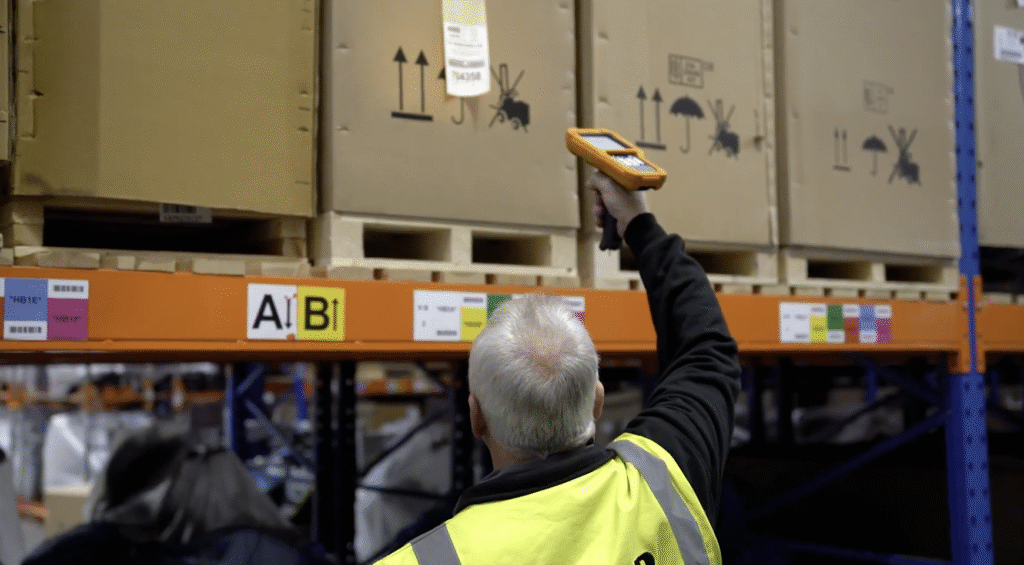
One of the most practical shifts WMB called out was enabling more work on RF devices, rather than accumulating paperwork and office-based admin.
RF execution moves decision-making and confirmation to the point of activity. It reduces transcription errors, eliminates end-of-day uploads, and supports the live “single source of truth” that high-value inventory operations require.
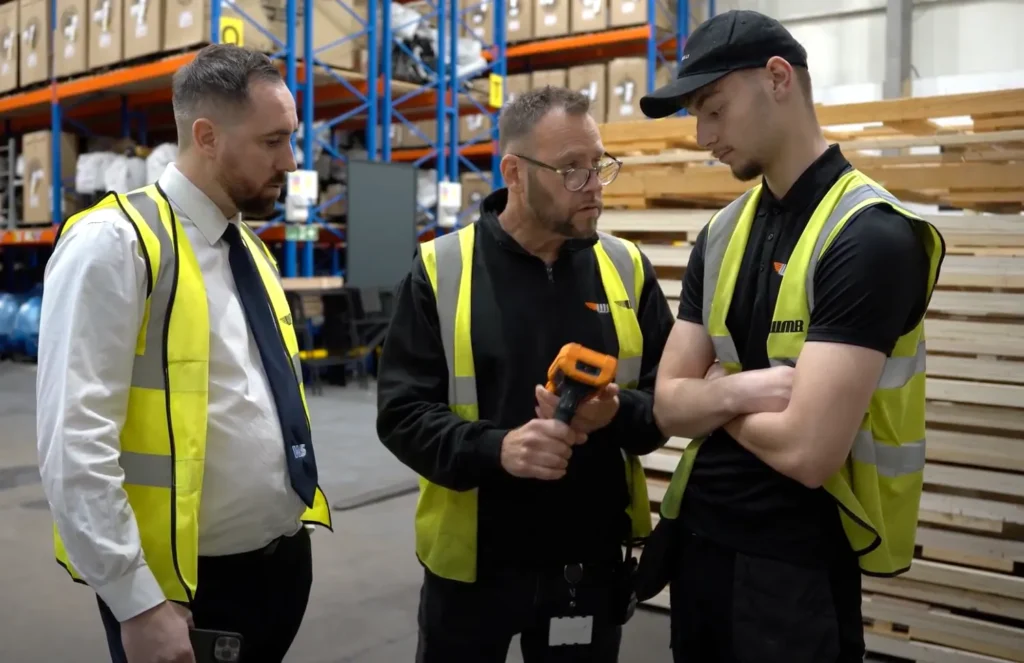
WMB also described how the new approach transfers picking responsibility from the office to the floor. Previously, picking activity was being set up and controlled by office staff (including the supervisor). With RF, the warehouse team can execute picks directly, staying aligned to what is physically being handled.
This is a significant operational rebalancing. It reduces office workload, improves flow, and keeps warehouse labour focused where it belongs, in the warehouse, not at a desktop.
“If you don’t follow the process, it will stop you farther down the line. That’s the bit I really like.”
Mike, Systems Specialist
That single observation captures a crucial WMS value in operational terms. A good system does not just record what happened, it prevents predictable failure modes by enforcing correct sequence and validation at the moment of action.
Implementing RF Scanning Execution
Process discipline by design
WMB’s experience highlights a common trap in legacy systems, workarounds become normal. Over time, teams learn how to “get it done” even when they are not following the designed process. That can feel efficient locally, but it creates bigger issues later, missing items, uncertain locations, incomplete audit trails, and rework that hits service levels.
WMB noted that, in the old Access-driven environment, it was possible to work around steps. Under Clarus WMS, the system enforces the process. If a step is not completed correctly, it blocks progress rather than allowing the error to travel downstream.
That matters deeply in RF scanning for high-value goods. When the cost of error is measured in delays, customer impact, and potential damage exposure, prevention is more valuable than detection.
Live visibility replaces uploads
A core improvement implied in WMB’s description is the move away from end-of-day uploads into live operational updates. The team described how non-live scanning created the conditions for bikes to “disappear” between scan and pick.
With live scanning and system-confirmed moves, WMB can reduce the mismatch between recorded location and physical location. This is the heart of warehouse traceability, the system reflects reality, not yesterday’s data.
Faster training and adoption
WMB also touched on training impact. The new workflow cuts down the amount of work people need to do and is easier to train. That is especially valuable in warehouse environments where onboarding speed and consistency directly influence quality and throughput.
When processes are simpler, validated by the system, and executed on RF devices, the training burden shifts from memorising exceptions to following clear prompts and confirmations. That makes performance more repeatable across the team, and reduces reliance on “tribal knowledge”.
VIN-level history
One of the strongest traceability outcomes WMB called out is the ability to look up a single VIN (or a storage unit number) and see the total history.
This capability changes how the operation manages accountability and continuous improvement. When you can see exactly who executed an action, and when, the focus shifts away from debate and toward root cause. It also supports quality governance, especially where customer expectations are high and the value of stock is significant.
“I can look at one VIN, I can see the total history.”
– Andy, Warehouse Manager
That is warehouse traceability expressed in the clearest possible operational language.
Results Achieved With Clarus WMS
What is confirmed now
From the transcript alone, these results can be stated without inventing figures:
Reduced reliance on paper and office-based admin, with more work executed on RF devices.
Improved operational traceability, including item-level history by VIN and visibility of who completed each scan or movement.
Reduced opportunity for process workarounds, with the system enforcing required steps and preventing downstream errors.
Shift of picking execution from the office to the warehouse floor, reducing office workload and keeping warehouse teams aligned to the picks they execute.
Greater confidence in daily operations as processes become simpler, clearer, and easier for staff to adopt.
“It will reduce my workload in the office and give it to these guys, which is what they should be doing.”
Andy, Warehouse Manager
That is not only an efficiency gain. It is a structural shift in how the warehouse operates, pushing execution to the floor and freeing leaders to focus on improvement rather than manual coordination.
Client Reflections And Lessons Learned
Traceability is operational trust
WMB’s experience reinforces a key principle in RF scanning for high-value goods, traceability builds trust internally and externally. When the system can show the total history of a VIN and who completed each step, the operation becomes calmer. Conversations become factual. Exception handling becomes faster. Continuous improvement becomes possible because causes can be identified, not guessed.
Enforced process protects service
WMB also highlighted the value of enforced process. In real warehouses, people sometimes take the path of least resistance to hit the immediate target. The problem is that shortcuts often create larger issues later, and those issues are paid for by someone else, often in dispatch or customer service.
A WMS that blocks incomplete or incorrect process steps prevents that downstream cost and protects the customer experience. In WMB’s case, that customer experience is anchored in quality and service, so process discipline is aligned to brand promise.
Simplicity accelerates adoption
Finally, WMB’s reaction to the simplified “bike in” process shows how important user experience is in warehouse technology. When the workflow feels intuitive, adoption accelerates. When staff can see work being removed, confidence grows and the change becomes self-reinforcing.
Your Path To Warehouse Traceability
WMB’s journey is a familiar one for growing logistics operations, a legacy system that once worked becomes a limiting factor, then a risk. Add non-live workflows and high-value inventory, and the gap between system data and warehouse reality becomes impossible to ignore.
By moving toward Clarus WMS, WMB is building the foundations for modern motorcycle logistics, live traceability, RF-led execution, and operational accountability at VIN level. The transformation is not just about speed. It is about making quality measurable, repeatable, and scalable.
If your warehouse is still relying on end-of-day uploads, paperwork-heavy processes, or bespoke systems that only one person truly understands, the opportunity is the same: replace uncertainty with live truth, and replace workarounds with enforced process.
Discover how Clarus WMS can help your operation achieve stronger warehouse traceability, faster execution, and higher confidence in every movement of high-value goods.
To finalise this case study with verified data, send me any numbers you have for the seven measures you listed, even rough ranges, plus your go-live dates.
To provide the best experiences, we use technologies like cookies to store and/or access device information. Consenting to these technologies will allow us to process data such as browsing behaviour or unique IDs on this site. Not consenting or withdrawing consent, may adversely affect certain features and functions.
Functional
Always active
The technical storage or access is strictly necessary for the legitimate purpose of enabling the use of a specific service explicitly requested by the subscriber or user, or for the sole purpose of carrying out the transmission of a communication over an electronic communications network.
Preferences
The technical storage or access is necessary for the legitimate purpose of storing preferences that are not requested by the subscriber or user.
Statistics
The technical storage or access that is used exclusively for statistical purposes.The technical storage or access that is used exclusively for anonymous statistical purposes. Without a subpoena, voluntary compliance on the part of your Internet Service Provider, or additional records from a third party, information stored or retrieved for this purpose alone cannot usually be used to identify you.
Marketing
The technical storage or access is required to create user profiles to send advertising, or to track the user on a website or across several websites for similar marketing purposes.