

“Agility” shows up as very real daily questions: can we cope with tomorrow’s inbound containers, do we have enough people on shift, will we still hit carrier cut-offs if something breaks? When demand spikes, promotions land, or a key supplier slips, the difference between a resilient, agile supply chain and a brittle one is often the quality of your data and how well you and your 3PL partners act on it.
Analysts are clear that this is now a board-level priority. Deloitte argues that agility is what separates operations that “thrive” from those that “merely survive” in a disrupted world.(Deloitte Brazil) At the same time, a 2025 Gartner survey found that only 29% of supply chain organisations have built at least three of the core capabilities required for future readiness, including agility, resilience and integrated ecosystems.(Gartner) The gap between aspiration and reality is still large.
For warehouse and 3PL professionals, agile supply chain management is no longer just about squeezing a bit more efficiency from pick paths. It’s about building an integrated, cloud-based logistics platform that gives you real-time inventory visibility, supports flexible fulfilment models and lets you collaborate with 3PL partners as if they were an extension of your own operation.
We see this every day in our work at Clarus WMS. Our cloud-based warehouse management system for 3PLs is designed to make data shareable, actionable and trustworthy across multiple sites, partners and clients, so teams can adjust labour, routing and inventory positioning in hours rather than weeks. Insights from our implementation teams line up with what you’ll see in industry research: real-time information, integrated planning and automation are now the foundations of an agile, resilient supply chain.
In this article, we’ll tackle the practical questions warehouse leaders ask most about supply chain agility, 3PL partnerships and cloud WMS — and show how to turn visibility and collaboration into something measurable: faster response times, lower labour costs and more resilient fulfilment.
1. What does supply chain agility really mean for 3PL-led networks?
Agility as speed of decision as well as speed of movement
In an agile supply chain, the critical metric isn’t just how quickly you can move stock, but how quickly you can see what’s changing and decide what to do about it. Deloitte describes agility as the capability that turns disruption into competitive advantage, highlighting that in the long run it is agility that “can make the difference between operations that thrive and those that merely survive.”(Deloitte Brazil)
In a 3PL-led network, this means:
- Real-time demand sensing – capturing order, forecast and POS data early enough to adjust labour and capacity plans.
- Dynamic inventory positioning – moving stock closer to the point of demand and re-slotting quickly as profiles change.
- Short decision cycles – compressing planning horizons from weekly to daily (or even intra-day) cycles.
From a warehouse and 3PL operations point of view, agility shows up in very concrete questions: do you have enough people for tomorrow’s inbound, will stock physically fit, and what happens if a client drops five containers on you with two days’ notice?
Why resilience and agility now go together
Recent years have pushed resilience to the top of the agenda. Deloitte reports that 86.2% of manufacturers have taken steps to de-risk their supply chains in the last two years, and 97% of companies surveyed globally are reconfiguring their supply chains in some way.(Deloitte Brazil) At the same time, average lead times for production materials remain well above pre-2019 levels.(Deloitte Brazil)
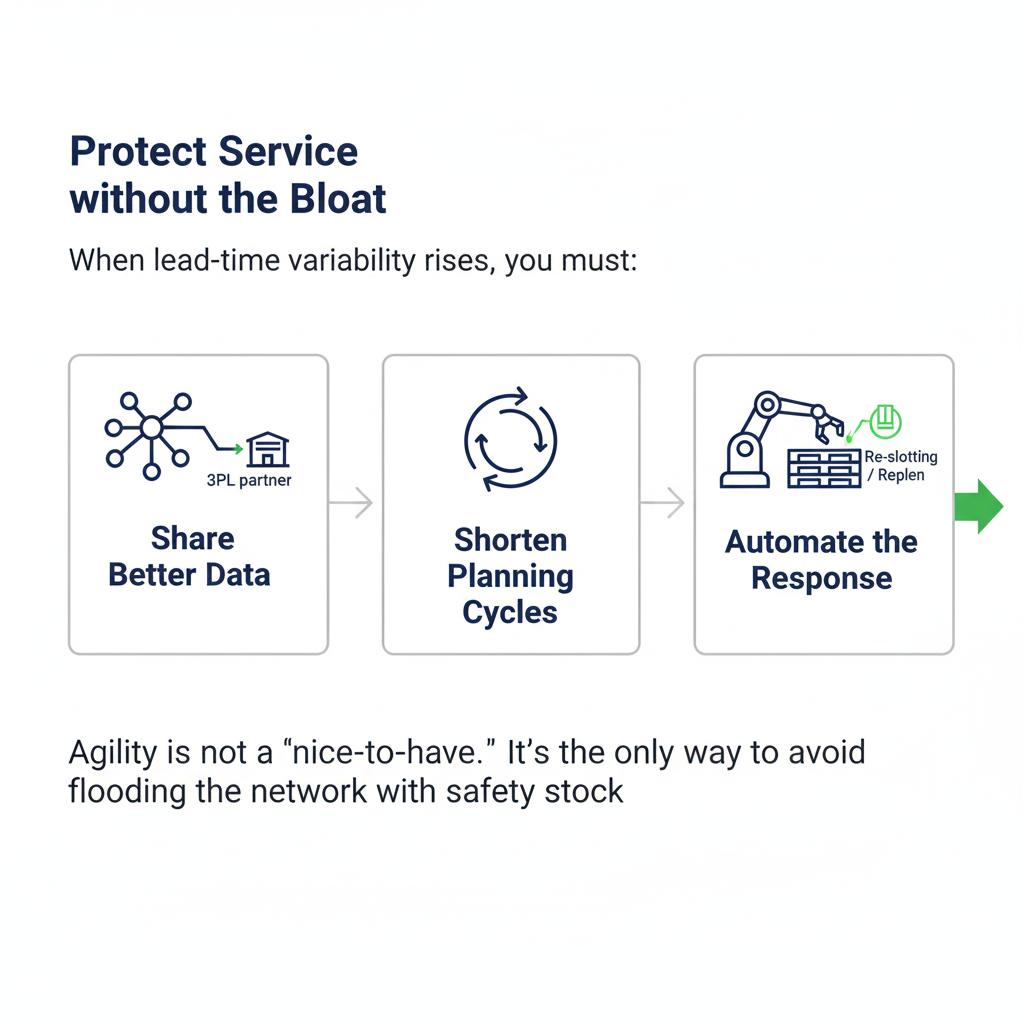
That matters if you’re running outsourced warehousing and distribution. When upstream lead-time variability rises, the only way to protect service levels without flooding the network with safety stock is to:
- Share better data with your 3PL partners
- Shorten planning cycles
- Automate more of the response (e.g. re-slotting, replenishment, carrier allocation)
Agility here is not a “nice-to-have”. It’s how you maintain supply chain resilience without blowing up working capital or labour costs.
Core building blocks for agile supply chain management
If you strip the jargon away, most agile supply chains share four building blocks (which map closely to Deloitte’s agility dimensions(Deloitte Brazil)):
- Demand sensing – using real-time data (orders, returns, POS, B2B forecasts) to update demand views frequently.
- Collaborative relationships – closer information sharing with 3PLs and customers (e.g. CPFR, shared dashboards).
- Process integration – aligning planning and execution so that allocation, replenishment and pick priorities update quickly.
- Information integration – a cloud-based WMS or logistics platform that synchronises master data, transactions and events across parties.
You don’t need to implement everything at once, but every step you take on these dimensions makes your network more flexible under stress.
2. How do 3PL partnerships and WMS work together to improve agility?
Why 3PL partnerships are central to supply chain flexibility
For many organisations, agile supply chains are impossible without scalable 3PL logistics. Outsourced warehousing and distribution allows you to flex capacity, open new geographies, and experiment with new service levels without waiting for long capital projects.
However, the partnership only boosts supply chain agility if:
- Your warehouse management system software is designed for multi-client, multi-site 3PL operations
- There is tight 3PL integration – shared SLAs, APIs, and agreed data standards (GS1, ASNs, serialisation)
- Both sides commit to collaborative planning, forecasting and replenishment (CPFR), not just tactical fire-fighting
In practice, that means WMS for 3PLs must support flexible billing, account-specific rules, and mixed operational models (B2B/B2C, full-pallet vs. each-pick) without forcing one-size-fits-all workflows.
A mini case: Tap’in 3PL’s agile fulfilment journey
Tap’in 3PL, a UK drinks logistics specialist, is a useful example. Public case studies describe how they moved from manual, paper-based processes to a technology-led model, using Clarus WMS to underpin their cloud-based logistics platform.(Clarus WMS)
Key outcomes include:
- Real-time client visibility into current stock and orders via Clarus WMS
- The ability to support flexible fulfilment for on-trade drinks brands — from next-day delivery to seasonal peaks
- A step change in admin: in one Clarus WMS customer video, Tap’in report reducing client billing queries from 10–50 per month to just one or two.(YouTube)
This kind of 3PL-WMS combination doesn’t just deliver efficiency; it gives brands the confidence to push promotions, launch new SKUs or add channels knowing the logistics network can flex.
Practical checklist: making 3PL integration work
To turn a 3PL relationship into true supply chain agility, we typically see teams focus on:
- Upfront data mapping – defining what each field means (SKU, batch, sell-by date, LPN, storage unit reference), where it originates, and who owns data quality.
- GS1-compliant labelling and ASNs – so that inbound pallets can be received with minimal “button presses” and maximum accuracy.
- Shared, real-time views of orders and exceptions – via dashboards, APIs or embedded BI, so both parties can see bottlenecks and decide on labour moves together.
- Clear rules for exceptions and SLAs – defining who acts when something is late, short or damaged, and how the WMS flags that in real time.
When these are in place, 3PL partnerships become a powerful lever for flexible fulfilment and supply chain resilience.
3. How does a cloud-based WMS improve supply chain visibility?
Cloud WMS as the backbone of supply chain visibility
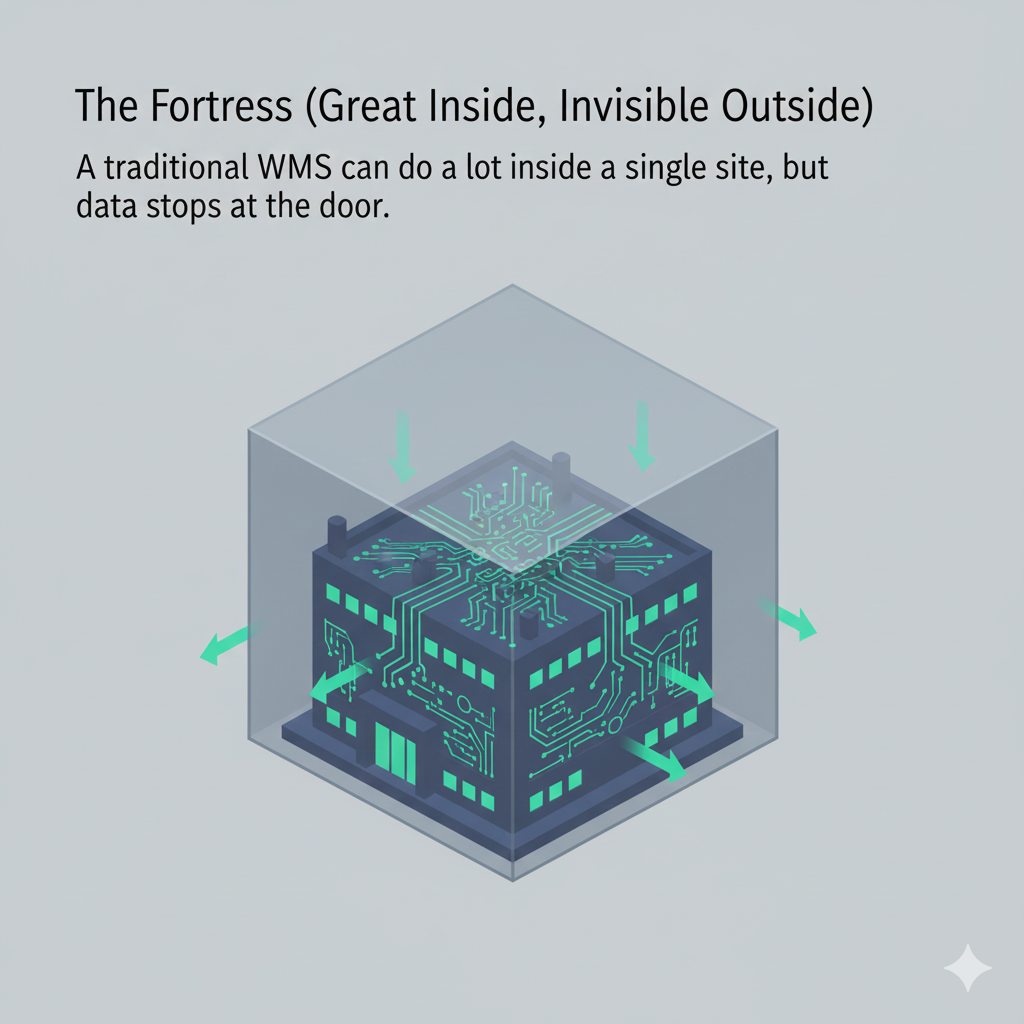
Agile supply chains rely on supply chain visibility that is timely, accurate and shareable. A traditional on-premise WMS can do a lot inside a single site, but it often struggles with:
- Multi-site, multi-country roll-outs
- Real-time data sharing with clients and 3PLs
- Rapid configuration changes for new customers or channels
Cloud-based WMS platforms remove much of this friction. Across the EU, the share of enterprises using cloud computing reached 45% in 2023 (up from 41% in 2021), with adoption even higher among large enterprises.(Stackscale) This general shift makes it easier to standardise on cloud-based logistics platforms.
In our experience, the practical benefits for warehouse and 3PL operations include:
- Single version of the truth for inventory and orders, across all warehouses and clients
- Easier integration with carrier systems, ERP and e-commerce via APIs
- Faster deployment of new features such as mobile apps, dashboards and automation hooks
Real-time inventory visibility in day-to-day decisions
In the interview material we work with internally, our implementation team keeps coming back to one theme: real-time data is what lets operations leaders answer “have I got enough people, trucks and time to do everything that still needs to be done — and what’s coming tomorrow?”.
A cloud WMS for 3PL warehouses typically supports that by:
- Streaming updates as goods-in, moves and picks happen (rather than in overnight batches)
- Providing filterable grids and dashboards by client, account, day, carrier or zone
- Allowing 3PLs and brands to pull data via APIs into their own BI tools or integrated supply chain platforms
When you combine this with good location management and digital warehouse mapping, you get practical day-to-day benefits: if a pallet is supposed to be in a given bay, the map and the handheld agree, and you can see at a glance whether a location will physically cope with extra part-pallets.
Visibility as a driver of resilience
Visibility isn’t just about nice dashboards. Celerity, writing in Supply Chain Tribe, note that real-time visibility across every node has become a defining factor in business resilience and responsiveness.(supplychaintribe.com) And Gartner’s work on future-ready supply chains suggests that leaders plan to invest further in technologies such as real-time visibility and digital twins over the next three to five years.(Gartner)
For warehouse and 3PL teams, the resilient outcomes look like:
- Faster detection of disruption – you see inbound delays or stock discrepancies early, not at pick time.
- Better use of alternatives – you can switch sites, carriers or stock-holding locations based on actual availability.
- Improved client communication – real-time order status reduces inbound queries and supports proactive issue management.
4. Where do automation and AI fit in agile supply chain management?
The time cost of manual forecasting and planning
One of the clearest points our implementation consultants make is that manual forecasting and planning are fundamentally constrained by time: someone has to extract, manipulate and interpret the data, and that time is a direct cost to the business. In high-variability 3PL environments, this quickly becomes unsustainable.
Automating data collection and analysis through a cloud WMS and connected planning tools changes the equation:
- Automated demand sensing can detect spikes or dips in near real time.
- Dynamic inventory positioning and replenishment rules can update slots and pick faces without manual intervention.
- AI-powered supply chain optimisation can recommend labour moves, carrier choices or safety-stock adjustments.
What the research says about technology and agility
Deloitte’s research on the new supply chain equilibrium emphasises that digital capabilities and faster, richer data are key to building agility alongside resilience and efficiency.(Deloitte Brazil) At the same time, a separate Deloitte report on supply chain resilience highlights that shipping disruptions and longer average lead times are motivating ongoing investment in technologies that support faster decisions and smarter routing.(Deloitte Brazil)
From an operations perspective, that translates into:
- Warehouse automation (scan-driven processes, mobile devices, goods receipt labelling, and in some cases robotics)
- AI-augmented planning (forecasting, slotting, labour planning), fed by WMS and 3PL data
- Integrated supply chain platforms that pull together WMS, TMS, OMS and planning into a common view
5. How should you measure supply chain resilience and agility with your 3PL and WMS?
From vague “visibility” to specific resilience KPIs
Supply chain resilience is often discussed in abstract terms, but in agile fulfilment networks it can be tracked through very tangible KPIs, for example:
- Lead time performance – average and variability from order to despatch, and inbound lead times for critical SKUs
- Recovery time – time to clear backlogs after a disruption
- Inventory coverage and accuracy – especially for fast movers and promotion-sensitive lines
- 3PL SLA adherence – receiving, picking, despatch and carrier handover
Gartner’s 2025 survey highlights that only a minority of organisations have built the integrated capabilities (agility, resilience, regionalisation, integrated ecosystems and strategy) required for future readiness.(Gartner) So for many teams, simply defining and tracking these KPIs consistently across sites and 3PL partners is a big step forward.
Using WMS dashboards to track agility
A well-implemented 3PL warehouse management system should make it straightforward to build supply chain resilience KPIs into dashboards and reports. In our own roadmap conversations, we focus on giving users:
- Dynamic, filterable grids for outstanding receipts, open orders and work-in-progress by day, client and carrier.
- Customisable dashboards that surface the metrics that actually drive decisions in that site or account.
- API access so operations and supply chain teams can embed WMS data into their own integrated supply chain platforms and BI tools.
From there, organisations can develop more advanced views: for example, dashboards that show correlations between lead-time variability, labour utilisation and on-time delivery – or that highlight when a client’s promotional calendar will push the network beyond its normal operating envelope.
Agreeing a shared view of “good” with your 3PLs
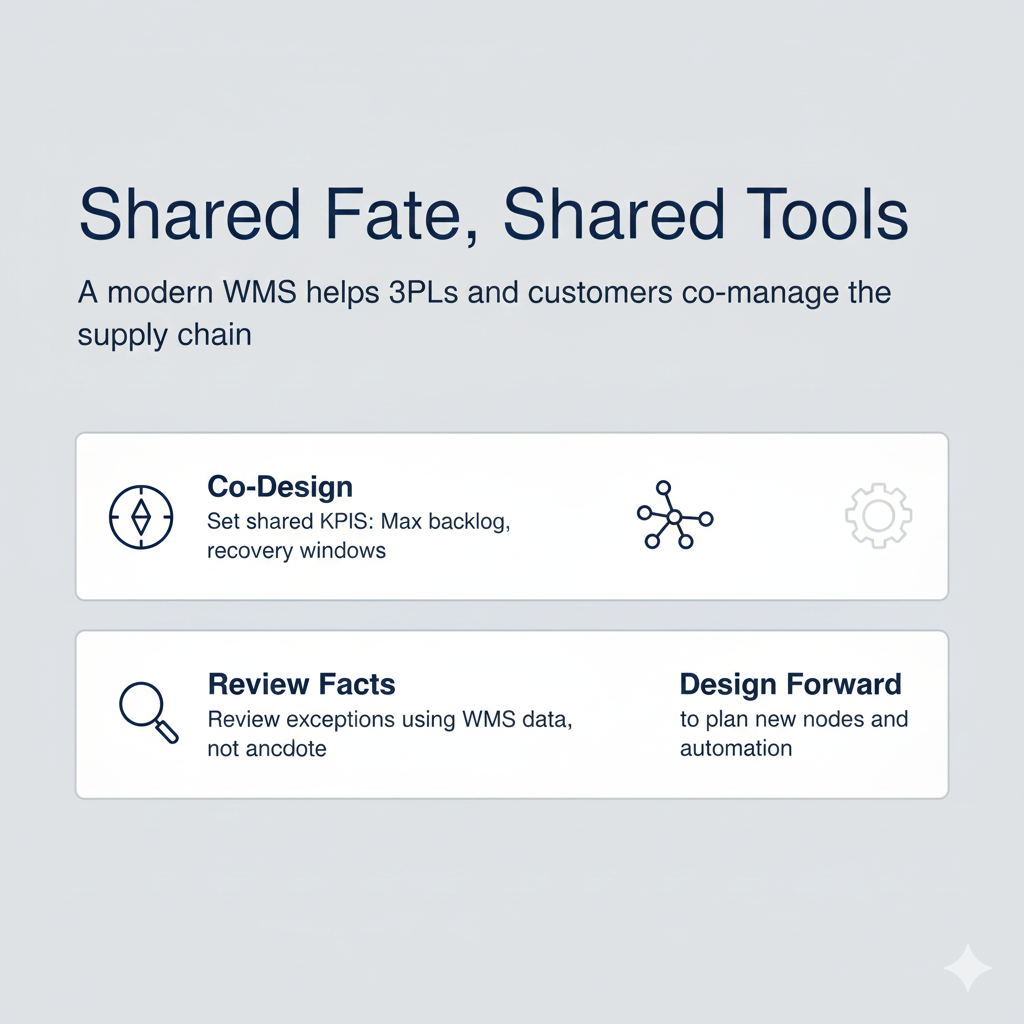
Finally, agility and resilience only work if you and your 3PL partners share the same definitions of success. That usually means:
- Co-designing a set of shared KPIs and thresholds (e.g. maximum acceptable backlog, recovery windows).
- Regularly reviewing exceptions and near misses together, using WMS-derived data rather than anecdote.
- Using joint data to inform future network design decisions (new nodes, capacity, automation investments).
When the WMS provides reliable, real-time data, these conversations move away from blame and towards joint problem-solving.
Why traditional approaches struggle (and how we handle them)
Many teams are trying to build supply chain agility and visibility using a patchwork of spreadsheets, emails and on-premise systems never designed for 3PL collaboration. In practice, we see four recurring problems:
- Limited integration – data silos between WMS, ERP, carriers and 3PLs cause delays and manual rekeying.
- Manual processes – inventory positioning, exception handling and forecasting are driven by individuals, not rules.
- Poor scalability – onboarding new 3PLs or clients requires custom scripts and months of testing.
- Slow feedback loops – by the time issues reach management, it’s often too late to respond without overtime or degraded service.
Clarus WMS is designed specifically as a cloud-based WMS for 3PLs and complex warehouses. We focus on:
- Cloud-based integration – APIs and standardised interfaces that make it easier to share data with 3PL partners, carriers and clients.(Clarus WMS)
- Scan-driven, GS1-compliant processes – to reduce button presses at goods-in and improve traceability across the supply chain.
- Configurable workflows per client – so each account can have its own rules for dates, batches, billing and reporting without new code.(Clarus WMS)
- Pragmatic use of automation and AI – using real-time WMS data to support labour planning, slotting and CPFR, rather than black-box optimisation.
In the Tap’in 3PL story, that combination of cloud WMS, integration and process design has helped them transform from manual, paper-heavy operations to a digitally enabled, scalable 3PL logistics platform that supports rapid growth in a demanding drinks sector.(Clarus WMS)
Next steps: testing agile supply chain ideas safely
If you’re responsible for warehouse and 3PL operations, you don’t need to “boil the ocean” to start improving supply chain agility and visibility. A more realistic approach is to:
- Pick one flow – for example, seasonal drinks promotions with a key 3PL.
- Define the data you need – orders, ASNs, stock, capacity, labour – and where it lives today.
- Use your WMS to expose that data in real time – via dashboards, exports or APIs.
- Agree a small set of shared KPIs with your 3PL and run a time-boxed experiment (e.g. for one peak).
- Review together – what worked, what didn’t, and where automation or better integration would have made the biggest difference.
Clarus WMS helps teams do this safely by making it easier to connect cloud WMS data with 3PL partners, planning tools and BI, without ripping out existing systems. Our implementations are built around workshops that ask a simple question: what information do you have, what can you get earlier, and how can we automate the flow so your people spend less time hunting for data and more time making good decisions?
If you’d like to explore how a cloud WMS for 3PLs could support your own supply chain agility roadmap, we’re always happy to walk through options — whether that’s a full transformation or a targeted pilot.