

A Legacy Logistics Leader Evolves
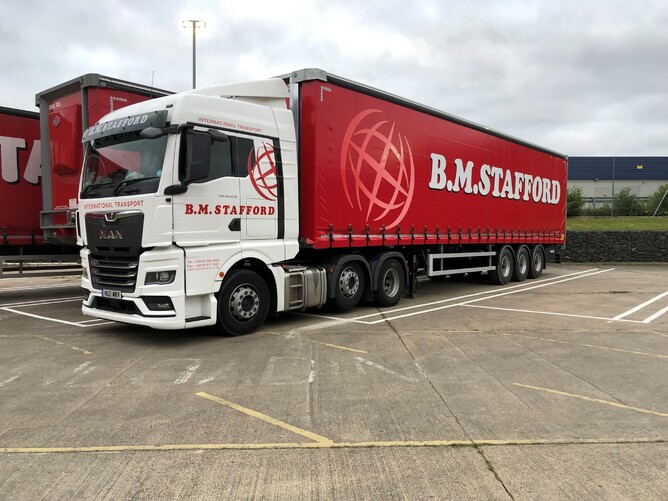
B.M. Stafford is a long-established transport and logistics provider with more than 85 years of experience and a reputation built on reliability, flexibility, and customer service. For decades, the business was recognised primarily for transport excellence: a modern fleet, strong route planning capability, and digital communications that support precision in delivery execution.
As customer expectations shifted, B.M. Stafford expanded beyond transport into broader logistics services, with warehousing becoming a bigger part of its offer. The operation grew to support inventory storage and management for a wider range of goods, including perishable items requiring strict tracking. It also strengthened distribution and freight services across the UK and internationally, supported by a global network of strategic logistics partners.
This expansion created a familiar turning point. The service promise on the transport side was strong and refined. To deliver an equally strong warehousing experience, B.M. Stafford needed warehouse operations that moved with the same speed, accuracy, and control. The business recognised that its existing warehouse system was no longer fit for purpose.
Overcoming WMS Challenges Holding The Business Back
A system that could not scale
B.M. Stafford’s previous on-premises WMS created operational bottlenecks and limited their ability to scale warehousing services efficiently. As volume and complexity increased, the system imposed friction in areas that should be streamlined: inbound putaway, picking, stock movement, reporting, and customer visibility.
The issues were not abstract. They showed up in slower warehouse workflows, less reliable inventory visibility, and time spent on manual administration when the business wanted to focus on performance improvement and customer service.
Manual processes slowed execution
Manual order processing, and the lack of automated picking and putaway, reduced throughput and introduced avoidable delays. In warehousing, manual steps do not only add time. They also increase the chance of inconsistency and create more exceptions that must be resolved later.
Over time, this kind of inefficiency is felt by customers as slower turnaround, less predictable fulfilment, and a greater likelihood of stock questions that take too long to answer.
Transport and warehouse misalignment
B.M. Stafford also faced integration limitations with Qargo TMS. When a WMS cannot sync with the transport management system, coordination breaks down and teams are forced to bridge gaps manually.
That creates inefficiency and increases the risk of mismatched information between warehouse and transport operations, exactly the opposite of what modern end-to-end logistics customers expect.
Inventory visibility and compliance pressure
Outdated stock tracking made it difficult to manage batch tracking, expiry dates, and stock rotation, capabilities that are especially important when handling perishable goods and time-sensitive inventory. Limited visibility also reduces confidence in decisions, because teams must validate information before acting.
Reporting and compliance management, including COMAH compliance documentation, was described as time-consuming and inefficient. When compliance reporting is slow, it becomes a drain on operational capacity and can feel like a disruption rather than a routine control function.
A clear need for change
B.M. Stafford’s leadership framed the transition as necessary because the previous system was holding the business back. The goal was to streamline operations, automate key processes, and integrate warehousing with transport systems to support growth and meet customer expectations.
“As our business has evolved, warehousing has become a much bigger part of our offering. Our previous system was limiting our ability to scale efficiently and provide the level of service our customers expect. We needed a solution that would streamline operations, automate key processes, and integrate seamlessly with our transport systems. This transition has given us exactly that.”
– Nicola Stafford, Commercial Director
This is the conflict and the motivation in one statement. The business had a strong logistics reputation, but its warehousing backbone needed modernisation to keep pace with customer demand and operational complexity.
Guiding B.M. Stafford Toward Cloud WMS Transformation
Why Clarus WMS
B.M. Stafford needed a cloud-based WMS that could automate key workflows, improve operational visibility, integrate with Qargo TMS, and support future growth. Clarus WMS was positioned to meet those requirements through a true cloud platform designed for modern warehousing operations.
The selection rationale is clear from the stated priorities: better compliance reporting, seamless integration, real-time insight, and operational flexibility. Rather than a like-for-like system replacement, the goal was to shift the warehouse operating model to one grounded in automation and shared data.
“B.M. Stafford required more than just a WMS, they needed a system that could automate compliance reporting, integrate seamlessly with Qargo TMS, and provide real-time insights. Our true cloud WMS delivers exactly that, giving them the flexibility and efficiency to take their warehousing operations to the next level.”
– Tim Payne, CEO, Clarus WMS
This quote signals the guide’s role in the story: enabling a higher standard of warehouse control and linking warehouse execution with transport planning through integration.
Implementing The Solution: From Planning To Execution
A unified warehouse and transport flow
The implementation outcome described is a fully integrated WMS with seamless integration to Qargo TMS. This synchronises warehousing and transport operations, supporting real-time data flow and reducing the need for manual coordination between teams.
When systems are aligned, operational decisions become faster because both warehouse and transport teams can act from consistent information. That reduces friction in dispatch planning, improves exception handling, and supports a more reliable customer experience.
Automating inventory control
B.M. Stafford’s new WMS capability includes automated inventory management functions that support batch tracking, sell-by date monitoring, and stock rotation. These capabilities are particularly relevant for customers handling perishable or regulated inventory where compliance and accuracy must be demonstrated, not assumed.
Automation here supports two outcomes at once: better control and less manual effort. Stock can be managed with stronger discipline, while reducing the admin overhead of tracking and reconciling data across separate tools.
Optimised order processing
The system also supports optimised order processing through automation of picking, putaway, and stock movement. This is where warehouse efficiency gains typically show up first: fewer manual steps, clearer task execution, and reduced time lost to rework.
In practical terms, this kind of workflow automation helps warehouses scale without forcing headcount increases at the same rate as volume growth. It also supports more consistent performance across shifts, because process becomes system-led rather than dependent on individual experience.
Client portal visibility
A real-time client portal provides customers with visibility of stock levels, order status, and reporting. This changes customer experience. Instead of relying entirely on updates from the warehouse team, customers can self-serve key information, which reduces query volume and increases confidence.
Future-proofing and scalability
B.M. Stafford described scalability and future-proofing as key requirements, moving away from a rigid on-prem model to a true cloud WMS that can evolve with the business as warehousing demand grows.
This supports long-term value by reducing the likelihood of repeating the same system replacement cycle in a few years, and by enabling process improvements through ongoing platform capability as requirements evolve.
Results Achieved: WMS Success In Action
Greater efficiency, accuracy, control
From the provided source material, B.M. Stafford’s results are described as improved efficiency, visibility, accuracy, and control through automation and cloud-based operations. The system resolved the limitations of the previous WMS by enabling automated workflows, stronger inventory discipline, and integrated transport alignment through Qargo TMS.
Reduced manual tasks and costs
The implementation benefits include cost and resource savings through reduced manual tasks, improved accuracy, and lower operational costs. These gains are described at a benefit level rather than with specific quantified metrics.
Transformation endorsed by leadership
B.M. Stafford’s internal view of impact is reinforced by Clarus leadership, focusing on automation, visibility, and improved operational control.
“B.M. Stafford’s move to a cloud-based WMS has completely transformed their warehousing operations. By automating processes and improving visibility, they are now operating with greater efficiency, accuracy, and control.”
– Glen Wilkinson, Head of Sales, Clarus WMS
This quote is best positioned as a summary of outcomes, with the measurable detail strengthened later if B.M. Stafford provides before-and-after operational metrics.
Client Reflections And Lessons Learned
Warehousing must match transport standards
B.M. Stafford’s story shows a common evolution in transport-first businesses. As warehousing becomes a bigger part of the offer, customers expect the same precision and reliability they already associate with transport performance. That forces a system upgrade from “good enough” tools to modern platforms that support scalable execution.
Integration becomes a competitive edge
The integration of WMS and TMS is not only an IT improvement. It directly impacts service performance. When warehouse and transport teams work from aligned data, the business can coordinate faster, reduce handoff errors, and deliver a more predictable customer experience.
Compliance needs automation
Time-consuming compliance reporting is a drain on operations. Automating compliance reporting and making the data accessible reduces disruption and supports stronger governance, particularly when managing hazardous goods and perishable inventory where traceability and evidence matter.
Your Path To WMS Success
B.M. Stafford’s transition from an on-premises WMS to Clarus WMS reflects a strategic shift: treating warehousing as a growth engine rather than a supporting function. By automating picking and putaway, improving batch and expiry control, integrating with Qargo TMS, and giving customers real-time portal visibility, B.M. Stafford built a warehouse operating model that can scale and deliver the level of service customers expect.
If your logistics business is expanding warehousing services, struggling with manual processes, limited visibility, or disconnected warehouse and transport systems, the lesson is clear. A true cloud WMS can unify execution, strengthen compliance control, and create the transparency that modern customers require.
Discover how Clarus WMS can help your operation streamline workflows, integrate warehousing and transport, and build a scalable foundation for long-term growth.