
Hazardous & Chemical Logistics leaves no room for error. Every pallet needs the right data, every limit must be monitored, and every move has to be traceable. You need a system that actually understands UN numbers, COMAH categories, thresholds, consents, and reporting. Clarus brings it all into one platform so you stay compliant, in control, and running smoothly.
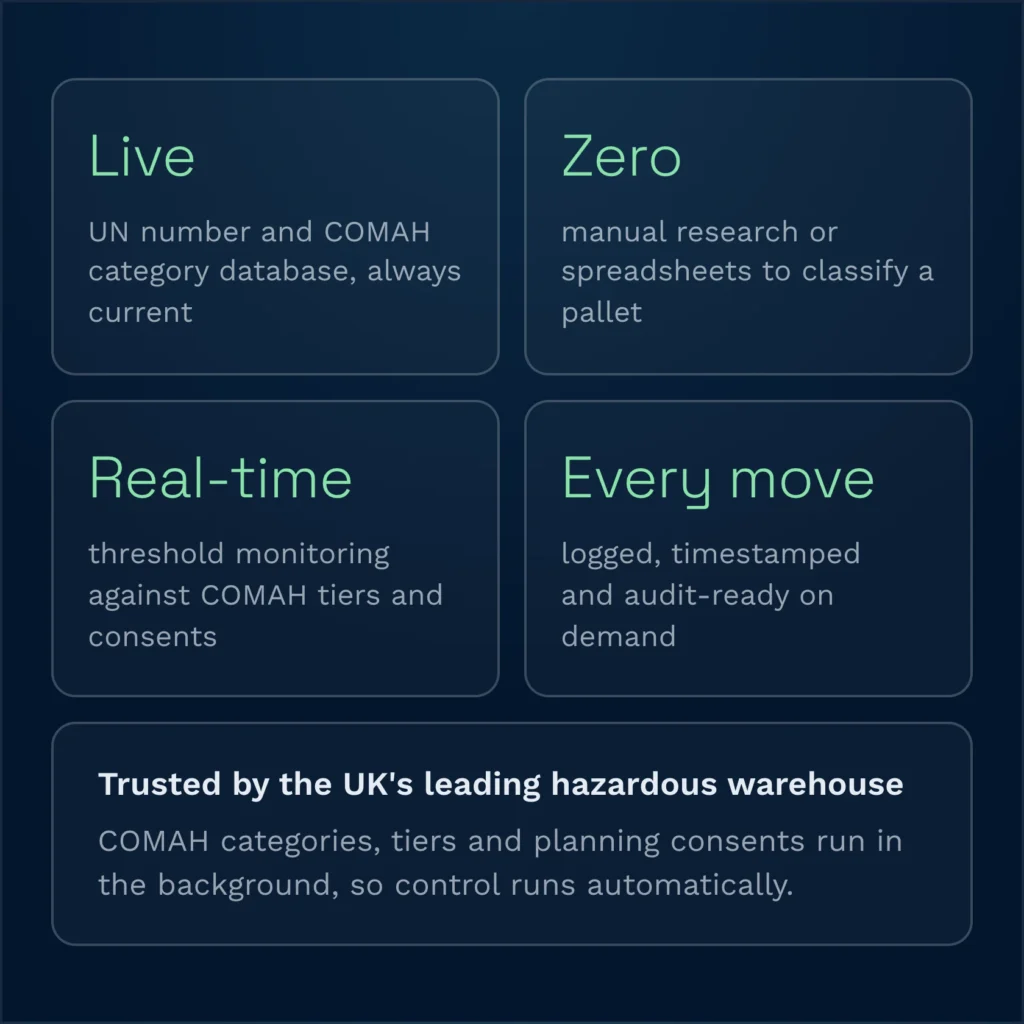
You need control. You need to know every UN number on site, every COMAH category, and exactly when your totals start pushing you into new requirements. Clarus keeps that data live and uses it to enforce safe storage and movement automatically.
When regulators want answers, you can’t be scrambling. Manual records won’t cut it. Clarus centralises every hazardous detail, ties it to stock, and keeps every move traceable. It’s compliance without the chaos and the heavy lifting happens quietly in the background.
Each card links to the full feature, with the proof and configuration detail an operations lead needs before shortlisting.
Clarus maintains a current database of UN numbers, hazard classes, tunnel codes, packing groups, shipping names, and all associated hazardous attributes. This ensures every product can be assigned its correct classification without manual research. When regulations change, the data updates centrally, keeping your entire site aligned.
You get a live, central database of UN numbers, hazard classes, tunnel codes, packing groups, shipping names, and every critical attribute. No manual research, no outdated binders. When regulations shift, the data updates across your site automatically.
Assign every hazardous detail straight from the product panel. Add custom fields for anything site-specific. Every pallet then carries the right data from receipt to despatch, without anyone second-guessing it.
Once hazardous data is in place, the system handles everything through normal operational processes. Every movement is logged, traceable, and audit-ready.
The Clarus AI Assistant works inside your operation: it finds missed charges, quarantines stock, batches orders and speeds up invoicing. And with the built-in MCP server, your own AI tools connect straight to the warehouse.
Recover charges
Protect stock
Automate admin
We support the UK’s leading hazardous warehousing operation, and our functionality was built around the real pressures they face. They needed a WMS that keeps hazardous data accurate, enforces COMAH rules, and produces compliant reports instantly not a system that relies on spreadsheets or manual checks. With thousands of pallets and tight storage thresholds, there was zero room for error.
Clarus gave them complete control. Our live UN number database keeps every classification correct. COMAH categories, tiers, and planning consents are built into the system, so thresholds are monitored in real time and reports are ready on demand. Product-level hazardous attributes keep every pallet accurate, and full movement logs ensure total traceability.
The result: a cleaner, safer, fully compliant operation… where hazardous control runs automatically in the background.
A hazardous-aware WMS stores UN numbers, hazard classes, packing groups, and COMAH categories directly against each product. This ensures every pallet is classified correctly from the start. The system then enforces storage rules, monitors thresholds, and logs all movements. When audits come around, reports can be generated instantly. While regulations vary between sites, a compliant WMS removes the daily burden by keeping hazardous data accurate and accessible.
Yes. Clarus allows operators to set establishment tier (lower, upper, or none), add planning consents, and define category-specific thresholds. The system then monitors stock in real time, highlighting when totals approach limits. COMAH stock reports can be produced on demand. These features support compliance, but the final responsibility always relies on the operator validating measurements and classifications against their regulatory obligations.
Absolutely. In addition to central UN data, Clarus supports custom product attributes such as technical names, environmental hazard flags, marine pollutant indicators, limited quantity status, and temperature restrictions. This means the system can adapt to specialist goods and site-specific requirements. These attributes then flow into reporting and despatch documentation automatically.
Hazardous data ties directly into the location hierarchy. Products can only be stored in compliant locations, and picking logic avoids unsafe combinations. Operators don’t need to memorise rules — the WMS controls what’s permitted. This reduces risk and keeps the site aligned with safety standards. These rules are configurable but should always be checked against your site’s specific compliance framework.
Every receipt, move, adjustment, and despatch is logged in the system with timestamps and operator IDs. For hazardous operations, this level of traceability is essential. If regulators request evidence, you can pull transaction logs, location histories, and documentation such as PODs or goods-in notes within seconds. This improves audit readiness and reduces disruption to operations.
Yes, most hazardous operations link their WMS to a TMS or ERP to keep data consistent. Clarus supports API and file-based integration. Specific connections depend on your environment and must be validated during scoping. For emergency response workflows, the system provides accurate hazardous data that can be passed to other platforms where required. Integrations vary, so these capabilities are always configured with clear assumptions and site-specific checks.