How to Maintain Optimal Stock Levels in Your Warehouse
Optimise warehouse stock with real-time visibility, smarter safety stock and automated replenishment to cut shrinkage, stockouts and carrying costs.
Contents
By Clarus Content Team · Last updated 3 July 2026
Achieving optimal stock levels is crucial for balancing inventory visibility and accuracy while minimising carrying cost and shrinkage risks. Warehouse and 3PL professionals often face challenges such as stockouts from lead?time variance, overstock due to poor forecasting, and inefficiencies in replenishment that lead to excess buffer stock and obsolescence. At Clarus WMS, teams use automation tools that integrate MRP and demand?driven methods, delivering quick wins in safety?stock optimisation and demand?driven replenishment.
Traditionally, optimising stock involved manual EOQ calculations and periodic?review policies, which often lagged behind changing demand patterns. With a modern WMS approach, teams gain real?time inventory visibility and automated threshold alerts in days, streamlining replenishment and reducing the labour needed for reconciliation and shrinkage control.
The result of traditional methods:
Delays in replenishment due to inaccurate forecasting and lead?time variability
Inefficiencies in safety?stock management causing overstock and carrying?cost escalations
Lost revenue from stockouts, shrinkage, and non?optimised inventory thresholds
This article breaks down the gaps in outdated stock optimisation and explores how Clarus WMS rethinks the process with automated solutions for better visibility and audit trails. We address common questions to provide actionable insights for warehouse professionals.
What is Stock Optimisation and How Do I Achieve It?
Stock optimisation balances inventory to meet demand while avoiding stockouts and excess. Core techniques include EOQ for order sizing and safety stock to buffer variability, supported by accurate lead?time data and disciplined replenishment rules. In variable?demand settings, automation that monitors thresholds and updates forecasts is essential.
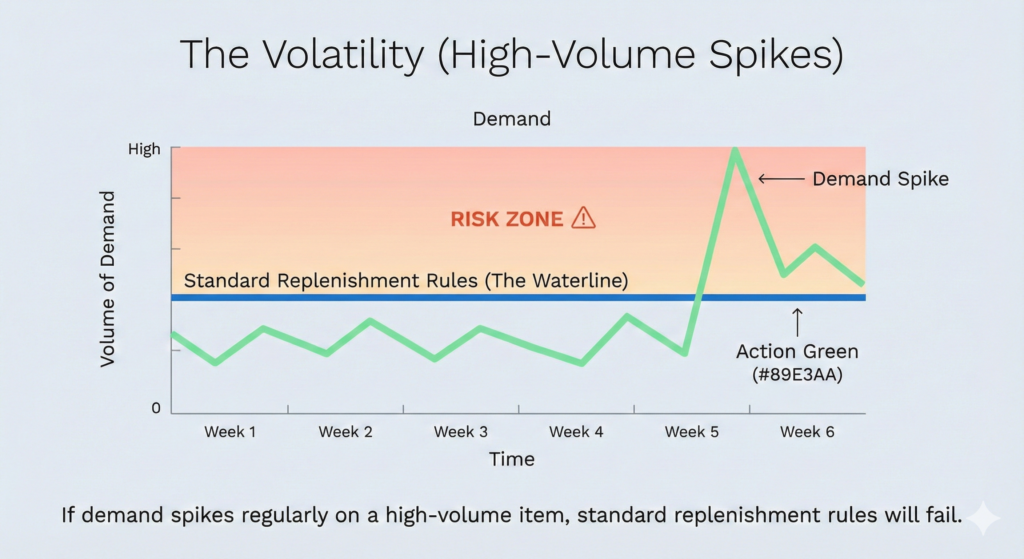
Expert insight, Mathew Buttar, warehousing professional at Clarus WMS: “Safety stock is about ensuring you can cover orders for a given time period. If demand spikes regularly on a high?volume item, you may need an additional percentage held at all times.”
ERP can be effective where demand variability is high and customer tolerance time is shorter than cumulative lead time, because it uses dynamically sized buffers to improve responsiveness. For smaller or stable operations, EOQ and conventional reorder?point policies may suffice, especially when supported by real?time visibility. SeeMicrosoft Dynamics 365: DDMRP overview and industry commentary such asSikich: A smarter approach to inventory management. For case collections, seeDemand Driven Institute: Case studies.
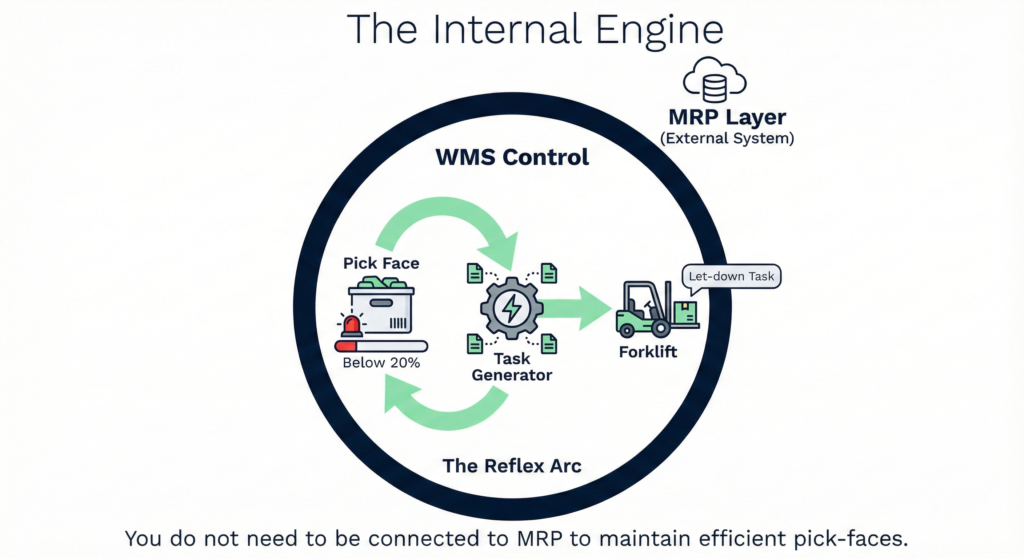
Expert insight: “Replenishment in the WMS is a standalone function. You do not need to be connected to ERP to maintain efficient pick?faces and replenishment, particularly for case?picking operations.”
How Does Visibility Impact Replenishment Accuracy?
Visibility enables precise safety?stock adjustments and timely replenishment by surfacing lead?time shifts, demand variance and shrinkage patterns as they happen. In practice, better visibility has been associated with material inventory reductions in certain sectors without harming service, for example up to 30 percent in medtech, seeHow medtech companies can create value via inventory optimisation (McKinsey).
Expert insight, Mathew Buttar: build workflows that capture product integrity on arrival, tag high?risk SKUs for regular checks, and group fragile or damage?prone items closer to goods?in and dispatch to reduce handling risk.
What Role Does Safety Stock Play in Demand Variance?
Safety stock buffers forecast and supply variability, helping maintain service levels without oversizing inventory. Service?level based approaches, as documented by major ERP systems, explicitly drive safety stock from desired service level, demand variability and replenishment lead time, for exampleSAP Help andOracle Cloud SCM.
Field reminder: stack stability and racking practice matter. Poorly stacked pallets and unstable loads increase damage and shrinkage risk, so prevention controls are part of “effective safety stock” in the real world. See HSE: Pallet safety (PM15) and HSE: Warehousing and storage (HSG76).
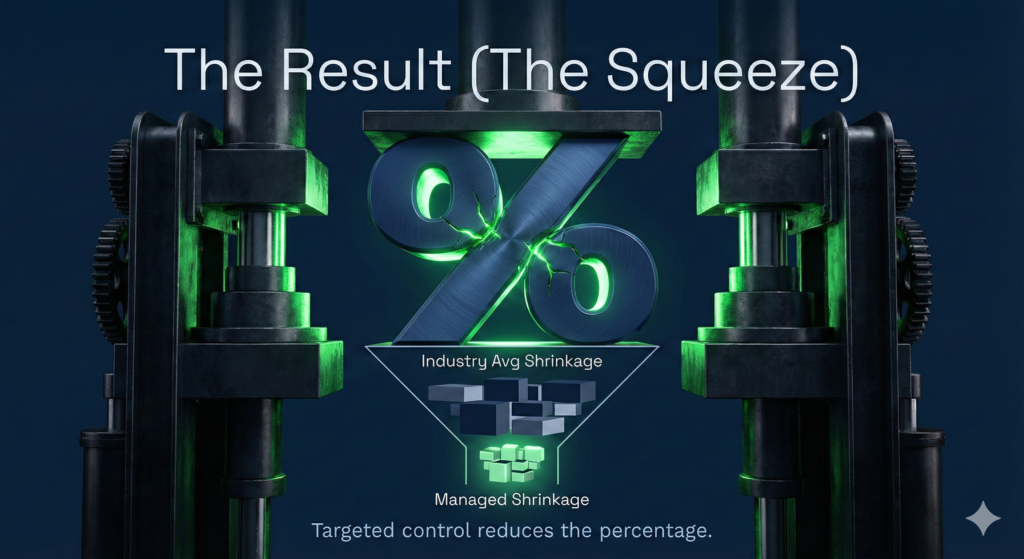
Expert insight: “Shrinkage is unavoidable, the goal is to reduce the percentage. Record issues at receipt, then monitor the known ‘problem products’ more frequently.”
Traditional Methods vs. Clarus WMS for Stock Optimisation
Traditional, static EOQ setups struggle when lead times or order profiles shift, and periodic reviews often miss early warning signals of shrinkage or obsolescence. In contrast, a cloud WMS can automate buffer checks, prioritise replenishment tasks, and present exception?driven dashboards so teams act before service suffers. For context on potential impact when AI?enabled planning is embedded, see McKinsey: Harnessing the power of AI in distribution operations and McKinsey: AI?driven operations forecasting.
Why Teams Struggle with Stock Optimisation
Limited integration, creating gaps between forecasting and replenishment automation
Manual safety?stock processes that introduce errors into reorder?point calculations
Weak exception dashboards for variance, hiding shrinkage root causes
Insufficient support for pick?face replenishment design, slowing high?volume case picking
How Does WMS Handle Stock Optimisation?
Clarus WMS focuses on real?time visibility and automated replenishment, integrating forecasting with practical buffer policies. This prioritises accuracy, speed and auditability across inbound, storage and outbound. In one customer story, JODA reports approximately 99 percent stock accuracy and a reduction of stocktake time from weeks to days after implementing Clarus WMS, see Clarus WMS: JODA case study.
Real?Time Monitoring
Exception?led dashboards surface lead?time changes, stock imbalances and suspected shrinkage, allowing teams to triage issues quickly. Industry bodies emphasise using KPIs and targeted cycle counts so fast movers are checked more often than slow movers, see ASCM: 8 KPIs for an efficient warehouse.
Expert insight, Mathew Buttar: peak examples, such as refrigerated pumpkin moves around Halloween, require pre?booking trailers, agency drivers and training weeks in advance so the warehouse can safely receive far more loads than usual.
Full Visibility
Audit trails for each stock movement, user and timestamp support compliance and customer assurance. Traceability frameworks like GS1’s Global Traceability Standard define critical tracking events and key data elements that a WMS should capture to support investigations and regulatory or customer audits, see GS1: Global Traceability, reference site and GS1: Traceability, overview.
Ready to See It in Action?
Implementing advanced stock optimisation with Clarus WMS can reduce risks and enhance efficiency. Imagine achieving compliant records and real?time visibility without the traditional headaches. Contact Clarus WMS for a demo to see the workflows, KPIs and controls in context.
What is the quickest way to decide between EOQ and DDMRP?
For stable, predictable items, EOQ is a simple baseline for order sizing. For volatile demand and long cumulative lead times, DDMRP’s dynamic buffers can improve responsiveness. See Microsoft’s DDMRP overview and an EOQ primer.
How should I calculate safety stock for variable demand?
Use a service?level method that multiplies the service factor (Z) by the demand standard deviation and the square root of replenishment lead time. For practical configuration details, see SAP Help and Oracle Cloud SCM.
Which KPIs confirm that my safety?stock optimisation is working?
Track fill rate, order cycle time, inventory turns, stockout rate and count accuracy. Guidance from ASCM highlights focusing cycle counts on fast movers to maintain accuracy, see ASCM: 8 KPIs for an efficient warehouse.
Do real?time dashboards and cycle counting really reduce shrinkage?
Yes. By surfacing exceptions early and focusing checks where errors are likeliest, you correct issues before they proliferate. UK HSE guidance also stresses safe stacking and racking to prevent damage, see HSE PM15: Pallet safety.
What audit?trail or compliance features should a 3PL look for in a WMS?
Look for immutable logs of user, timestamp, action and location, plus lot, batch or serial traceability aligned to industry standards. GS1’s Global Traceability Standard outlines the critical tracking events and key data elements a system should capture, see GS1: Global Traceability Standard.
To provide the best experiences, we use technologies like cookies to store and/or access device information. Consenting to these technologies will allow us to process data such as browsing behaviour or unique IDs on this site. Not consenting or withdrawing consent, may adversely affect certain features and functions.
Functional Always active
The technical storage or access is strictly necessary for the legitimate purpose of enabling the use of a specific service explicitly requested by the subscriber or user, or for the sole purpose of carrying out the transmission of a communication over an electronic communications network.
Preferences
The technical storage or access is necessary for the legitimate purpose of storing preferences that are not requested by the subscriber or user.
Statistics
The technical storage or access that is used exclusively for statistical purposes.The technical storage or access that is used exclusively for anonymous statistical purposes. Without a subpoena, voluntary compliance on the part of your Internet Service Provider, or additional records from a third party, information stored or retrieved for this purpose alone cannot usually be used to identify you.
Marketing
The technical storage or access is required to create user profiles to send advertising, or to track the user on a website or across several websites for similar marketing purposes.